One of the most important features of American history is thatprotests, novels, songs, and cartoons are all connected by ideas. The United States did not simply move from Reconstruction to the present through a chain of events; it moved through arguments over what freedom meant, who counted as fully American, how much power government should have, and whether the nation should look inward or outward. To understand modern America, students have to examine not only what happened, but also what people believed and created.
Historians often organize the past using patterns such as continuity and change, cause and effect, complexity, and unity and diversity. These patterns help explain why some beliefs lasted for generations while others changed sharply. For example, faith in individual opportunity remained important over time, but ideas about race, labor, gender, the environment, and federal power changed dramatically. At the same time, some ideas produced unity while others deepened conflict.
Ideas shape laws, institutions, and culture. A belief like capitalism influences how people think about work, wealth, competition, and success. A belief like nationalism affects how citizens view the nation's place in the world. A belief like racism can justify exclusion and violence, while a movement such as environmentalism can lead to new protections for land, air, and water.
These ideas rarely exist alone. They overlap, compete, and evolve. A person might support capitalism but also favor progressive reforms to limit corporate abuse. A leader might call for patriotism in wartime but use that language to silence dissent. That is why historians evaluate ideas not just by definition, but by context, consequences, and the people they affected.
Continuity and change asks what stayed the same and what changed over time. Cause and effect examines why events happened and what resulted from them. Unity and diversity explores how shared national identity coexisted with different regional, racial, ethnic, religious, and political experiences. Complexity reminds us that historical developments usually have multiple causes and mixed effects.
Since Reconstruction, the United States has seen explosive economic growth, expanded democracy for many groups, recurring periods of backlash, and major cultural innovation. The same nation that celebrated freedom also enforced segregation. The same country that praised democracy abroad sometimes denied it at home. Those tensions are central to U.S. history.
Populism began as a movement claiming to defend ordinary people, especially farmers and workers, against powerful economic elites. In the late nineteenth century, the People's Party attacked railroad monopolies, unfair banking practices, and political corruption. Populism could expand democratic participation, but later versions of populism in American politics sometimes took very different forms, from inclusive appeals to working people to more exclusionary attacks on outsiders or political institutions.
Progressivism grew in the early twentieth century as reformers tried to fix the social problems created by industrialization. Progressives supported measures such as food safety laws, labor protections, city reform, women's suffrage, and regulation of big business. Yet progressivism had limits. Some progressives ignored racial injustice, and some even supported eugenics and restrictions on immigration. This is a good example of historical complexity: reform can produce progress in one area and injustice in another.
Isolationism refers to efforts to avoid foreign entanglements, especially wars and alliances. Many Americans after World War I wanted distance from European conflicts. By contrast, imperialism meant extending power over other lands or peoples. In the 1890s and early 1900s, the United States acquired influence or control in places such as Puerto Rico, Guam, the Philippines, and Cuba. These two ideas seem opposite, but both appeared in U.S. history because Americans disagreed over the nation's role in the world.
Capitalism emphasizes private ownership, investment, markets, and profit. It helped fuel industrial growth and innovation, but it also contributed to inequality, labor exploitation, and cycles of boom and bust. Liberalism in the twentieth-century U.S. sense often favored a larger government role in protecting rights and promoting economic fairness, especially during the New Deal and Great Society. Conservatism generally stressed limited government, traditional values, free enterprise, and social order, though conservative thought has included many internal differences.
Nationalism emphasizes loyalty to the nation, while patriotism expresses love and devotion to one's country. They can overlap, but they are not identical. Patriotism may inspire service, civic responsibility, or reform. Nationalism can unify people, but in extreme form it can become aggressive or intolerant. In U.S. history, patriotic language has been used by soldiers, civil rights activists, labor leaders, and presidents. The same language of national loyalty has also been used to pressure dissenters during wartime.
Racism is the belief that races are unequal and that such inequality justifies discrimination or domination. Its effects have been immense, from segregation and disenfranchisement after Reconstruction to redlining, unequal schooling, and violence. Fundamentalism is a religious movement stressing strict adherence to core beliefs, often in response to modern social change. In the 1920s it became especially visible in debates over evolution and public education, including the Scopes Trial. Anti-communism became a major force after World War II, shaping foreign policy, culture, and domestic politics during the Cold War.
Extremism involves political or social views far outside accepted democratic norms, often rejecting compromise or using intimidation and violence. U.S. history includes extremist groups on different parts of the political spectrum, from the Ku Klux Klan to violent revolutionary and white supremacist movements. Environmentalism, by contrast, developed as a broad movement to conserve resources and reduce environmental harm, though it too has taken different forms, from wilderness preservation to climate activism.
Political labels change over time. A "liberal" in one era, or a "conservative" in another, may support policies that would not fit the same label in a different decade. Historians therefore pay close attention to context rather than assuming a term means exactly the same thing in every period.
These ideas are essential because they help explain why Americans repeatedly argued over labor rights, race relations, immigration, foreign policy, religion, and culture. They also show that U.S. history is not a straight line. It is a debate carried across generations.
[Figure 1] After the Civil War, the nation struggled to define freedom and citizenship. Reconstruction promised expanded rights for formerly enslaved people through the Thirteenth, Fourteenth, and Fifteenth Amendments, but white resistance, terror, and political retreat undermined those gains. This period reveals both change and continuity: the legal end of slavery was a major change, but racial inequality remained powerful.
Industrialization created vast fortunes for men such as Andrew Carnegie and John D. Rockefeller, but it also produced dangerous working conditions, low wages, child labor, and urban poverty. Supporters of capitalism often argued that competition and private enterprise created national prosperity. Critics pointed out that unregulated markets could concentrate wealth and weaken democracy. Labor unions such as the Knights of Labor and the American Federation of Labor emerged because workers wanted more control over wages and conditions.
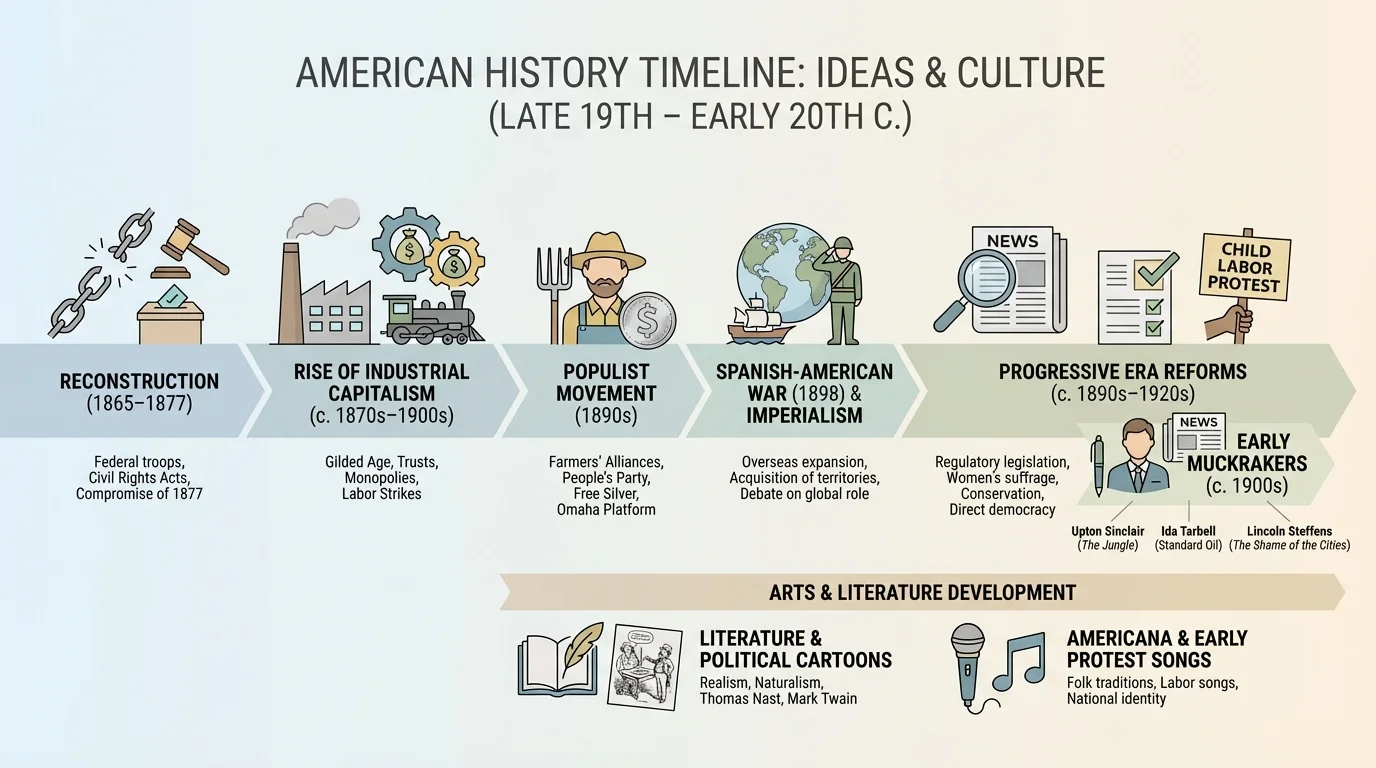
The Farmers' Alliances and then the Populist movement grew because many rural Americans believed railroads, banks, and political parties served the wealthy rather than the public. William Jennings Bryan's famous "Cross of Gold" speech in 1896 captured anger at the economic system and demanded monetary policies that would help debt-ridden farmers. Populism did not take over national politics, but many of its ideas later influenced reformers.
Progressive reformers such as Jane Addams, Theodore Roosevelt, Robert La Follette, and Woodrow Wilson sought to reduce corruption and regulate economic power. Their era saw antitrust action, food and drug laws, and expanding democracy through direct election reforms and women's suffrage. Yet the Progressive Era also coexisted with segregation, anti-immigrant attitudes, and scientific racism. The same period that fought some forms of injustice tolerated others.
American imperialism expanded after the Spanish-American War of 1898. Some Americans argued that imperialism would spread democracy and increase markets. Others, including Mark Twain and members of the Anti-Imperialist League, argued that ruling other peoples betrayed American ideals. This debate shows how nationalism and patriotism could point in different directions. One side claimed empire proved national greatness; the other said true patriotism required respect for self-government.
Muckrakers were journalists and writers who exposed corruption, poverty, and abuse. Ida Tarbell investigated Standard Oil, Upton Sinclair revealed shocking conditions in meatpacking in The Jungle, and Lincoln Steffens criticized urban political machines. Their work mattered because it transformed information into reform pressure. Writing was not separate from politics; it helped change politics.
Case study: How writing changed policy
Upton Sinclair did not merely describe one factory. He helped create public outrage that pushed the federal government toward action.
Step 1: Sinclair published The Jungle in 1906.
The novel described unsanitary and exploitative conditions in Chicago's meatpacking industry.
Step 2: Readers reacted strongly.
Many were horrified by the food contamination more than by the labor abuse Sinclair hoped to spotlight.
Step 3: The government responded.
Congress passed the Meat Inspection Act and the Pure Food and Drug Act in 1906.
This is a clear example of cause and effect: literature and journalism influenced public opinion, and public opinion influenced law.
Political cartoons also became powerful tools during this era. Artists such as Thomas Nast used exaggeration, symbolism, and satire to expose corruption and shape public opinion. A single cartoon could communicate quickly to readers who might never read a long editorial. In an age before television and social media, visual satire was one of the fastest ways to influence national debate.
[Figure 2] The decades after World War I were filled with creativity and contradiction. The nation experienced booming consumer culture, sharp cultural conflict, economic collapse, and global war. The energy of the 1920s appears vividly in the arts, especially in Black cultural life centered in Harlem. At the same time, the era saw nativism, religious controversy, and political division.
The Harlem Renaissance was a major flowering of African American art, literature, and music during the 1920s and early 1930s. Writers such as Langston Hughes, Zora Neale Hurston, and Claude McKay explored race, identity, migration, and pride. Artists such as Aaron Douglas and performers such as Duke Ellington helped redefine American culture. The Harlem Renaissance was important not just as "Black culture," but as American culture. It challenged racist stereotypes and insisted that African American voices were central to the national story.
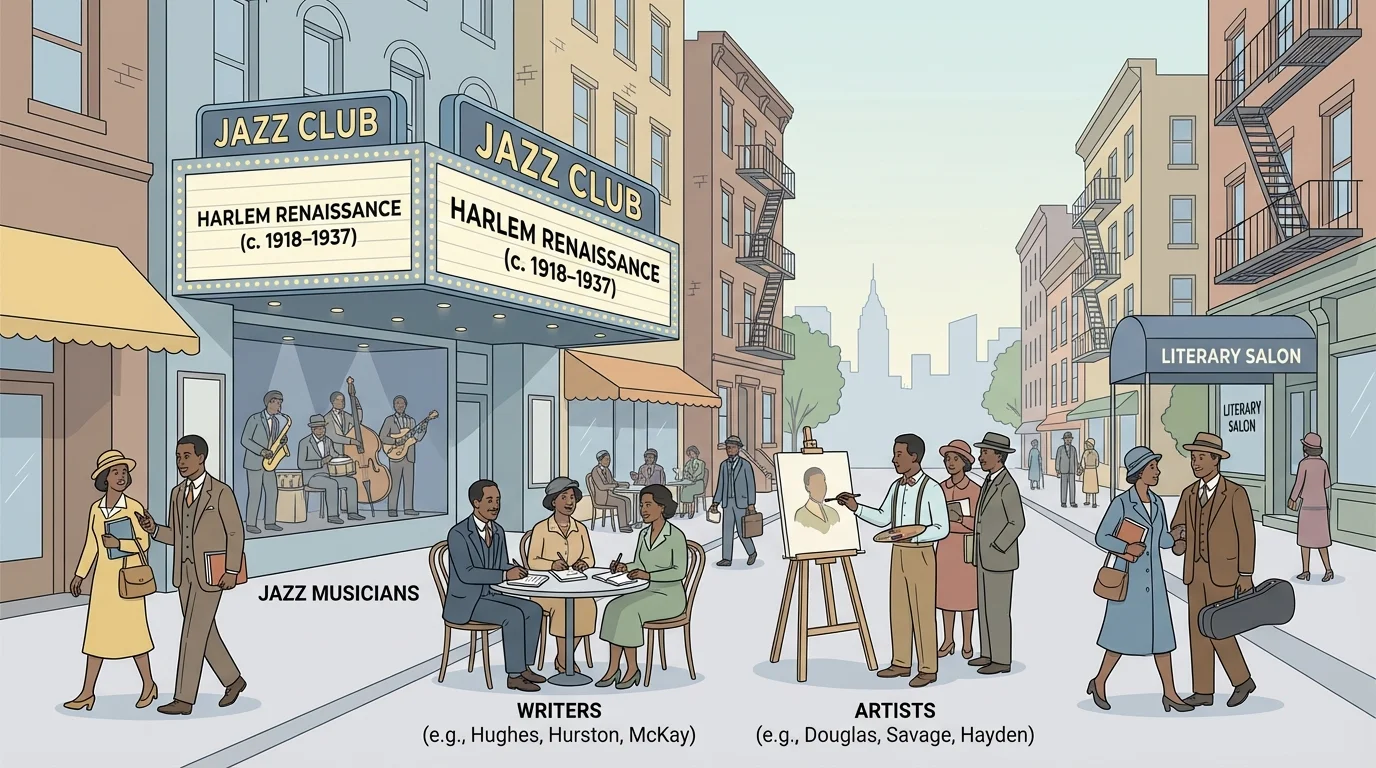
Jazz became one of the most influential U.S. art forms in the world. Emerging from African American musical traditions, jazz emphasized improvisation, rhythm, and collaboration. It was both entertainment and cultural innovation. The popularity of jazz demonstrated unity and diversity at once: it became a national art form while preserving roots in Black communities and experiences.
The Lost Generation included writers such as Ernest Hemingway, F. Scott Fitzgerald, and Gertrude Stein, many of whom reflected disillusionment after World War I. Their works explored alienation, excess, and uncertainty in modern life. If the Harlem Renaissance often expressed cultural creation and affirmation, Lost Generation literature more often captured spiritual drift and dissatisfaction. Together, these movements show the variety of American literary response to modernity.
At the same time, the 1920s saw the revival of the Ku Klux Klan, the spread of nativism, immigration restriction laws, and the clash between modern science and religious fundamentalism. The Scopes Trial of 1925 became a national symbol of conflict over evolution, education, and authority. This was not simply a fight between "old" and "new." It was a struggle over who had the power to define truth in public life.
The Great Depression shifted attitudes toward government. As unemployment and bank failures spread, many Americans lost faith in the idea that markets alone could solve social problems. Franklin D. Roosevelt's New Deal expanded federal action and strengthened modern liberalism. Programs created jobs, regulated finance, and offered social protections. Critics argued this threatened free enterprise and local control. Supporters argued government intervention was necessary to protect democracy from economic collapse.
Isolationism remained strong in the 1930s, shaped by the memory of World War I and the belief that the United States should avoid another foreign disaster. But the attack on Pearl Harbor in 1941 changed public opinion rapidly. World War II produced intense patriotism, military mobilization, and a new role for the United States as a global power. Yet even in a war against fascism, the nation interned Japanese Americans and maintained segregation in much of military and civilian life. Again, American ideals and American practices did not always match.
"I, too, sing America."
— Langston Hughes
Hughes's line captures a central theme of U.S. history: groups excluded from full equality repeatedly claimed the nation as their own and demanded recognition. The arts often made those demands visible before politics did.
[Figure 3] After 1945, the United States combined global confidence with deep anxiety. Postwar America was marked by prosperity, suburbs, television, and expanding consumer culture, but also by nuclear fear, anti-communist suspicion, and fierce debates over freedom. This era demonstrates how one society can project unity while containing major conflicts.
Anti-communism shaped foreign policy through containment, the Korean War, the Vietnam War, and alliances such as NATO. Domestically, the Red Scare and McCarthyism damaged civil liberties. People in government, Hollywood, education, and labor could be accused with little evidence. Fear of communism became a tool for political control. Historians evaluate anti-communism carefully because it arose from real international rivalry, yet often produced injustice at home.
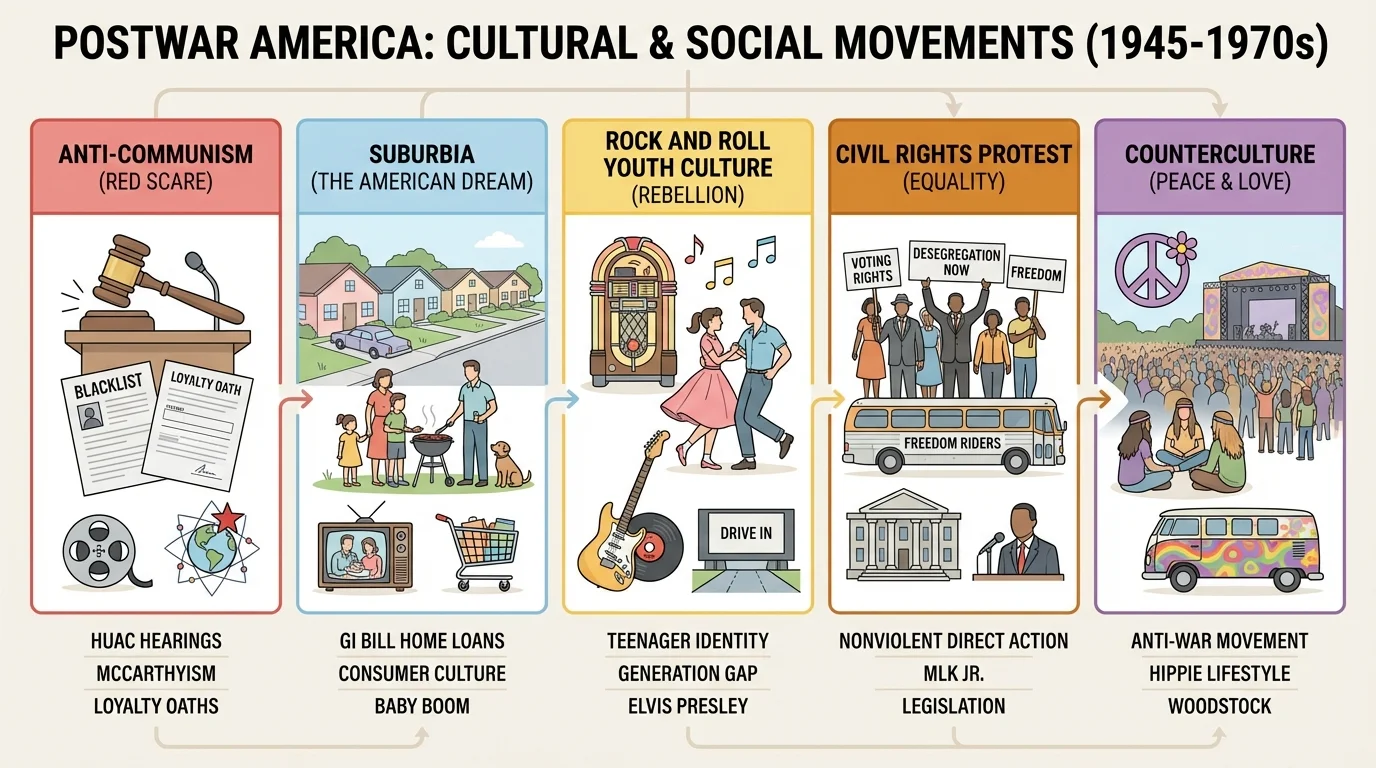
The civil rights movement challenged the continuity of racism in American life. Leaders such as Martin Luther King Jr., Ella Baker, Rosa Parks, and many local activists used court cases, boycotts, marches, and civil disobedience to attack segregation and disenfranchisement. Their movement appealed to both justice and patriotism: activists argued that the nation should finally live up to its own founding ideals. This is an important reminder that patriotism is not always support for the status quo; it can also be a demand for reform.
Rock and Roll emerged in the 1950s from African American musical traditions including rhythm and blues, then spread rapidly across racial and regional boundaries. Artists such as Chuck Berry, Little Richard, and Elvis Presley changed youth culture, fashion, and performance. Adults often saw rock and roll as rebellious or morally threatening. That reaction reveals how cultural forms can become battlegrounds over race, generation, and authority.
By the 1960s, music had become a language of protest. Folk and rock artists such as Bob Dylan, Joan Baez, Nina Simone, and later Marvin Gaye used songs to comment on civil rights, war, inequality, and social change. Protest songs mattered because they reached audiences emotionally as well as intellectually. A speech may persuade the mind; a song can move the mind and memory at once.
The postwar years also brought competing political visions. Liberalism expanded through the Great Society, civil rights legislation, Medicare, Medicaid, and anti-poverty programs. Conservatism grew in response, criticizing high taxes, expanding federal bureaucracy, permissive culture, and social unrest. Barry Goldwater's 1964 campaign and Ronald Reagan's rise later helped reshape national politics. Extremism also appeared in this period, from racist violence against civil rights workers to militant revolutionary groups and political assassinations.
American literature after World War II reflected these tensions. Writers such as Ralph Ellison, James Baldwin, Arthur Miller, Toni Morrison, Sylvia Plath, and Kurt Vonnegut explored identity, power, conformity, trauma, race, and memory. Their works often asked whether prosperity had produced justice, whether freedom could survive fear, and whose voices had been left out of the official national story.
[Figure 4] Recent U.S. history is shaped less by a single dominant ideology than by overlapping movements and reactions. The period includes distrust of government after Watergate, economic restructuring, globalization, culture wars, the end of the Cold War, and debates over immigration, identity, and security.
Modern environmentalism gained force from events such as the 1969 Santa Barbara oil spill, the 1970 celebration of Earth Day, and the influence of Rachel Carson's Silent Spring. Environmental activists pushed for clean air and water laws, endangered species protection, and conservation. Critics sometimes argued environmental regulation hurt business growth. This tension between economic development and ecological responsibility remains central today.
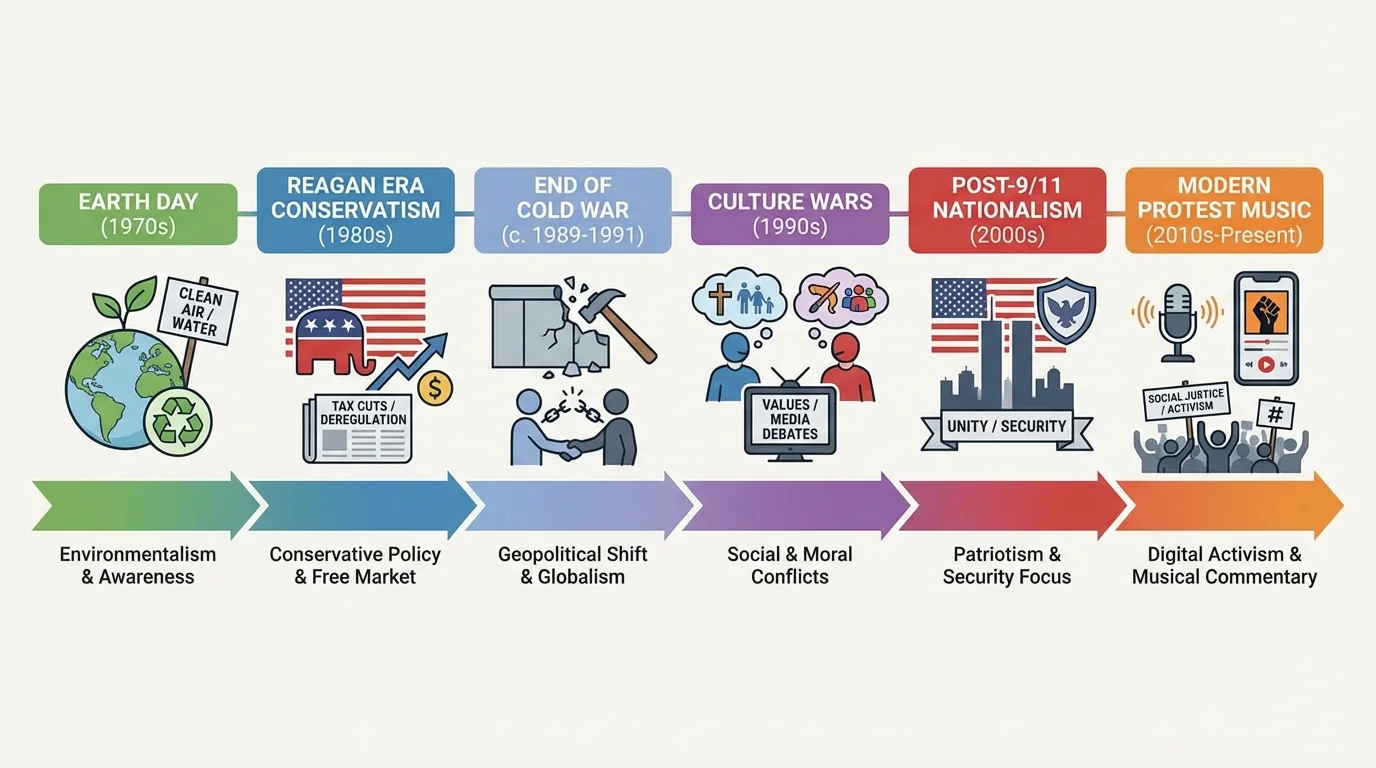
Conservatism expanded powerfully in the late twentieth century. Ronald Reagan's presidency emphasized tax cuts, deregulation, anti-communism, and a renewed language of national strength and traditional values. Religious conservatives became increasingly influential in public debates over abortion, school policy, family life, and the role of religion in society. At the same time, liberals continued to support civil rights protections, social welfare programs, and broader government action on issues such as discrimination and the environment.
After the Cold War, the United States briefly appeared to many as the world's only superpower. The attacks of September 11, 2001, however, intensified debates over nationalism, patriotism, security, immigration, and civil liberties. Some Americans saw unity and shared purpose; others warned that fear could justify overreach, discrimination, or endless war. These debates echo earlier tensions from the Red Scare and wartime periods.
Arts and literature continued to shape public life. Hip-hop, spoken word, documentary film, graphic journalism, and digital media became major cultural forces. Contemporary novels and memoirs have explored race, migration, gender, inequality, and memory. Political cartoons remain influential because they condense arguments into striking images, just as they did in the era of Thomas Nast. Americana, meanwhile, often celebrates symbols such as highways, diners, baseball, folk music, small towns, and the open road. Sometimes Americana expresses nostalgia and unity; at other times, artists use it critically to ask who was included in that national image and who was left out.
The arts are not just decoration; they are historical evidence. Songs, poems, novels, murals, cartoons, and films reveal what people feared, admired, resisted, and imagined. They can reinforce national myths, challenge injustice, preserve memory, and create new identities. Historians study art not only for beauty, but for insight into the values and conflicts of a society.
Modern protest music carries this tradition forward. From antiwar songs to hip-hop critiques of policing and inequality, music remains a way to document and challenge power. The same nation that invents popular culture also uses that culture to argue about democracy itself.
To analyze the historical development and impact of the arts and literature, students should ask several questions. Who created the work? What audience did it reach? What social issue does it address? Does it support dominant beliefs or challenge them? A political cartoon attacking corruption, a jazz performance expressing improvisational freedom, and a novel about migration all offer evidence about their times.
Primary sources are materials created in the period being studied, such as speeches, songs, newspaper cartoons, letters, posters, novels, and recordings. Secondary sources are later interpretations by historians, critics, or scholars. A student might read Langston Hughes as a primary source for the Harlem Renaissance and then read a historian's essay explaining how Hughes influenced later movements. Both matter, but they serve different purposes.
Reading culture historically
Consider how three different cultural forms reveal American history.
Step 1: A muckraking article exposes corruption.
It tells us that some journalists saw democracy being threatened by concentrated power.
Step 2: A jazz recording from the 1920s spreads nationally.
It shows how African American creativity reshaped mainstream culture.
Step 3: A protest song from the 1960s criticizes war or segregation.
It reveals that popular culture can become a form of civic argument.
Each source reflects its era, but each also influences what happens next.
American literature across these periods includes realism, modernism, regional writing, African American literature, immigrant narratives, postwar drama, and contemporary multicultural fiction. Writers helped Americans imagine the nation, criticize it, and redefine it. That is why literature belongs in history classrooms, not only in English classrooms.
The same is true of music. Jazz, blues, folk, rock and roll, soul, country, hip-hop, and protest music have all shaped ideas about freedom, rebellion, belonging, and identity. As seen earlier in [Figure 2], art forms rooted in specific communities can become national forces without losing their political significance. And as the comparison in [Figure 3] makes clear, postwar culture often advanced through tension between conformity and creative resistance.
Evaluation requires judgment based on evidence. Students should not simply memorize terms like populism or liberalism. They should ask: What problem was this idea trying to solve? Who benefited? Who was excluded? What unintended consequences followed? For example, progressivism helped regulate industry and expand democracy, but some progressives also embraced racist or coercive policies. Anti-communism responded to a real geopolitical conflict, but in practice it sometimes damaged free speech and due process.
Historical thinking also means comparing ideals and reality. American patriotism has inspired military service, civil rights activism, disaster relief, voting, and public sacrifice. Yet patriotic language has also been used to pressure minorities, suppress criticism, or justify war. Nationalism has unified people in crises, but it can also narrow the definition of who belongs. Conservatism and liberalism have both contributed important ideas to public life, but both have also faced criticism depending on how their policies affected liberty, equality, or stability.
When historians examine continuity and change, they notice that some debates never fully disappear. The arguments over federal power, markets, race, religion, national identity, and America's global role continue across generations. What changes are the circumstances, the vocabulary, and the forms of expression. A nineteenth-century cartoon, a 1920s jazz composition, a 1960s protest song, and a modern digital video may all be part of the same ongoing national conversation.
Understanding American history therefore means studying both institutions and imagination. Laws and elections matter, but so do novels, lyrics, murals, and satire. They show how Americans have defined freedom, challenged injustice, celebrated belonging, and argued over the nation's future.
