A single invention can reorder daily life so completely that later generations forget the world ever worked differently. Most students today can search the web in seconds, receive vaccines before they can remember, and live in cities shaped by factories, electricity, and mass communication. Yet each of those realities grew out of specific historical turning points. Scientific and technological innovations do not simply add new gadgets; they change how people work, think, govern, travel, communicate, fight wars, and imagine the future.
To study major innovations historically, it helps to focus on several ideas. Continuity and change asks what remained the same and what shifted over time. Cause and effect asks why an innovation appeared and what consequences followed. Complexity reminds us that inventions rarely produce only positive or only negative results. Unity and diversity helps us see that innovations can connect the world while affecting groups differently. These ideas matter because history is not just a list of inventions; it is the story of how people used them.
Innovation also depends on earlier conditions. The Renaissance encouraged curiosity, observation, and the recovery of classical knowledge. Expanding trade networks connected Europe, Africa, Asia, and the Americas. Governments sought military and economic advantage. Merchants looked for faster ways to produce and sell goods. Scientists built on one another's discoveries. In other words, major innovations usually emerge from networks of people, resources, and ideas rather than from a lone genius working in isolation.
Innovation is the introduction of a new idea, method, or device that changes how people solve problems or organize life. Industrialization is the large-scale shift from hand production to machine-based manufacturing. Public health is the effort to protect the health of entire populations through medicine, sanitation, and policy.
Historians study innovation through both primary sources and secondary sources. A factory worker's diary, a patent document, a vaccination campaign poster, a government speech about Sputnik, or an early Internet protocol memo are primary sources because they come from the period being studied. A historian's book explaining why those sources matter is a secondary source. Using both kinds of evidence helps us move beyond myths and judge impact more carefully.
Before the rapid transformations of the modern era, most people lived in rural communities, worked in agriculture, and produced many goods by hand. Information moved slowly. Disease spread easily but was poorly understood. Travel was difficult and dangerous. Political authority was often local or dynastic, and education was available to a minority. This does not mean earlier societies lacked sophistication. China, the Islamic world, South Asia, Africa, Europe, and the Americas all developed complex technologies and systems of knowledge. But the pace and scale of change accelerated sharply after the Renaissance.
One reason was the growth of shared knowledge. Scientific thinking increasingly emphasized observation, experimentation, and the testing of claims. This did not replace religion or older beliefs overnight, but it changed how many people investigated nature. A useful example is the scientific method: instead of accepting an idea because of authority alone, investigators gathered evidence. That shift prepared the ground for later breakthroughs in medicine, physics, engineering, and communications.
The movable type printing press transformed communication by making it possible to produce texts far more quickly and cheaply than manuscript copying. Johannes Gutenberg's mid-fifteenth-century press in Europe did not create printing from nothing—woodblock printing and movable type had earlier histories in Asia—but it did help trigger a dramatic expansion in European book production.
[Figure 1] Before printing, books were expensive and rare. After printing spread, literacy slowly increased, universities gained wider access to texts, and ideas circulated with new speed. Religious change was deeply affected. Martin Luther's writings during the Protestant Reformation spread through printed pamphlets that could be copied in large numbers. Scientific change was also affected because scholars could compare observations, criticize errors, and build on earlier work more efficiently.
The printing press shows both continuity and change. People still valued learning, religion, and political authority, but the means of shaping opinion changed. Rulers and churches now faced a public that could access more ideas. Censorship expanded alongside printing because authorities recognized its power. That is a pattern seen again later with radio, television, and the Internet: every communication revolution widens access while also raising questions about control.
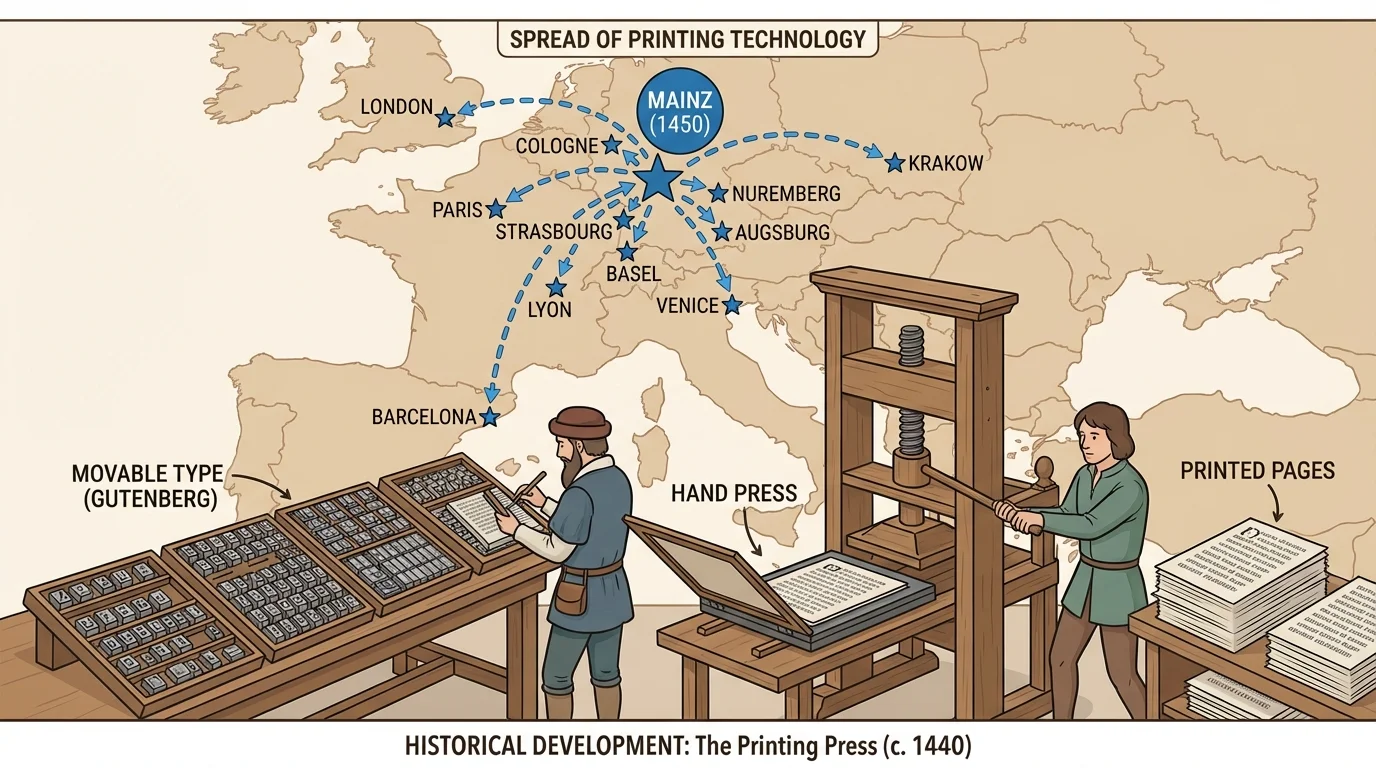
A famous primary source from this era is the printed Bible itself. Its significance was not only religious. It demonstrated that knowledge could be reproduced in standardized form. Historians also examine printers' records, letters between scholars, and banned-book lists to see how governments responded. Much later, the same broad issue reappears in digital debates over censorship, open access, and misinformation, a connection that becomes clearer when compared with modern networks in [Figure 4].
Some historians estimate that within decades of Gutenberg's press, millions of books had been printed in Europe. For comparison, that was a communication shift as disruptive for its era as social media and smartphones have been for ours.
The long-term impact of printing reached beyond Europe. Printed maps aided exploration and empire. Standardized textbooks supported education. Newspapers helped create public opinion and, eventually, modern politics. The press did not make societies equal, but it made information harder for elites to monopolize completely.
The factory system changed production by concentrating workers, machines, and power sources in one place. This transformation began most famously in Britain in the eighteenth and nineteenth centuries. Britain's access to coal, overseas markets, capital, political stability relative to many rivals, and agricultural changes all helped create conditions for industrial growth.
[Figure 2] Textile production was one of the first sectors to change dramatically. In earlier cottage industries, families spun thread and wove cloth at home. New machines such as the spinning jenny, water frame, and power loom increased output. James Watt's improvements to the steam engine made power more flexible because factories no longer needed to stand only beside fast-moving water. Production increased, prices often fell, and manufactured goods became more widely available.
But industrialization was not just about machines. It reorganized time, labor, and social life. Factory bells and schedules replaced more flexible rhythms of rural work. People moved from countryside to city. Industrial cities grew rapidly, often with overcrowded housing, polluted air, and dangerous working conditions. Children and women worked long hours for low pay in many factories. These problems led to labor reform movements, trade unions, and new laws regulating work.
Industrialization is a clear example of complexity. It generated wealth and expanded national power, yet it also deepened inequality and damaged environments. It improved transportation through canals and railroads, allowing raw materials and goods to move faster. It encouraged consumer culture. At the same time, it contributed to imperial expansion because industrial states demanded cotton, rubber, metals, and markets. The Industrial Age was therefore both a story of progress and exploitation.
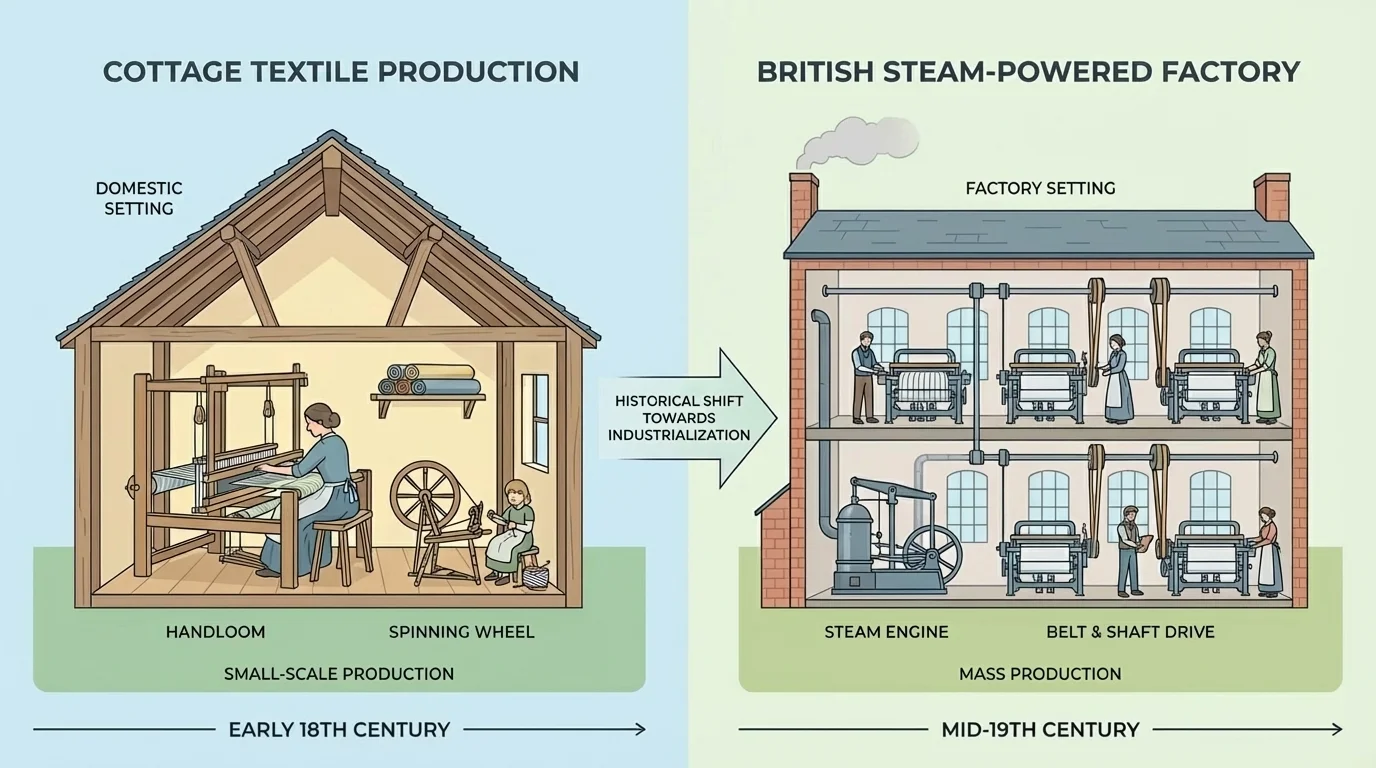
Primary sources from the Industrial Age include factory rules, workers' testimonies before Parliament, photographs of city slums, and business records. A parliamentary report on child labor reveals how technological change affected daily life. Secondary sources help explain why Britain industrialized first and how industrialization spread to Europe, the United States, Japan, and beyond. As we saw in [Figure 2], the key shift was not merely invention but the reorganization of society around machine production.
Case study: Cotton, factories, and global connections
The British textile industry depended on more than local inventors. It linked fields, ships, mills, and consumers across continents.
Step 1: Cotton was grown in large quantities in places such as the American South and India.
Step 2: Raw cotton was shipped to British mills, where machines turned it into thread and cloth.
Step 3: Finished textiles were sold in domestic and global markets, generating profits for merchants and factory owners.
Step 4: Workers, colonized peoples, and enslaved laborers experienced the system very differently, showing that industrial growth created both unity and inequality.
This case shows how one innovation can reshape the world economy.
The Industrial Age also set patterns that continue today. Modern global supply chains, debates over workers' rights, and concerns about fossil fuels all have roots in industrialization. In that sense, the past remains present.
Vaccination is one of the most important medical advances in history because it prevented disease before illness began. In the late eighteenth century, Edward Jenner observed that exposure to cowpox could protect people from smallpox. His work did not instantly create modern immunology, but it opened a path toward systematic disease prevention. In the nineteenth century, scientists such as Louis Pasteur built on germ theory, helping people understand that microorganisms cause many diseases.
This was a revolutionary shift in cause-and-effect thinking. Before germ theory, many people explained disease through bad air, imbalance, or divine punishment. Some public health actions, such as quarantine, could still help, but the underlying mechanism was unclear. Once scientists better understood microbes, governments and doctors could organize vaccination programs, sanitation systems, and campaigns against epidemics with much greater effectiveness.
The impact was enormous. Smallpox, once one of history's deadliest diseases, was eventually eradicated through global vaccination efforts. That means there were no naturally occurring cases worldwide. Fewer children died. Life expectancy rose. Armies, schools, and workplaces became less vulnerable to devastating outbreaks. Vaccination also changed the relationship between individuals and the state because governments increasingly took responsibility for public health.
Why vaccination changed society
Vaccines do more than protect one person. When enough people are immunized, disease has fewer chances to spread through a population. This creates broader community protection, especially for people who cannot safely receive certain vaccines. That is why vaccination is both a medical and a social innovation.
Yet vaccination history also includes conflict. Some people resisted vaccines because of fear, religious belief, mistrust of authorities, or painful past experiences with unequal medical systems. That complexity matters. Scientific evidence can be strong, but public acceptance depends on culture, communication, and trust. Historians study posters, medical journals, government records, and personal letters to understand both support and resistance.
Vaccination illustrates unity and diversity especially well. A disease can be global, but the ability to access medical protection is often unequal. Wealthier countries have usually obtained vaccines faster than poorer ones. During modern pandemics, the same problem has reappeared. Science can unite humanity around a shared solution while still revealing deep inequalities in distribution.
When the Soviet Union launched Sputnik in 1957, the event marked the beginning of the Space Age in a way that was both symbolic and practical. Sputnik was the first artificial satellite to orbit Earth. Technically, it was a metal sphere transmitting radio signals. Politically, it was a shock. Many Americans feared that if the Soviet Union could send an object into orbit, it might also be able to deliver weapons across continents.
[Figure 3] The launch intensified the Cold War competition between the Soviet Union and the United States. It pushed the United States to invest more in science education, engineering, and research. NASA was created in 1958. Schools placed greater emphasis on mathematics and physics. Government funding expanded for universities and laboratories. This is a classic example of cause and effect: one satellite influenced not only military strategy but also classrooms and careers.
The Space Age produced technologies that still shape everyday life. Satellites support weather forecasting, GPS navigation, telecommunications, disaster monitoring, and scientific observation of Earth. Space research also accelerated developments in materials science, computing, and miniaturized electronics. The moon landing in 1969 became a global media event that displayed technological capability and national prestige.
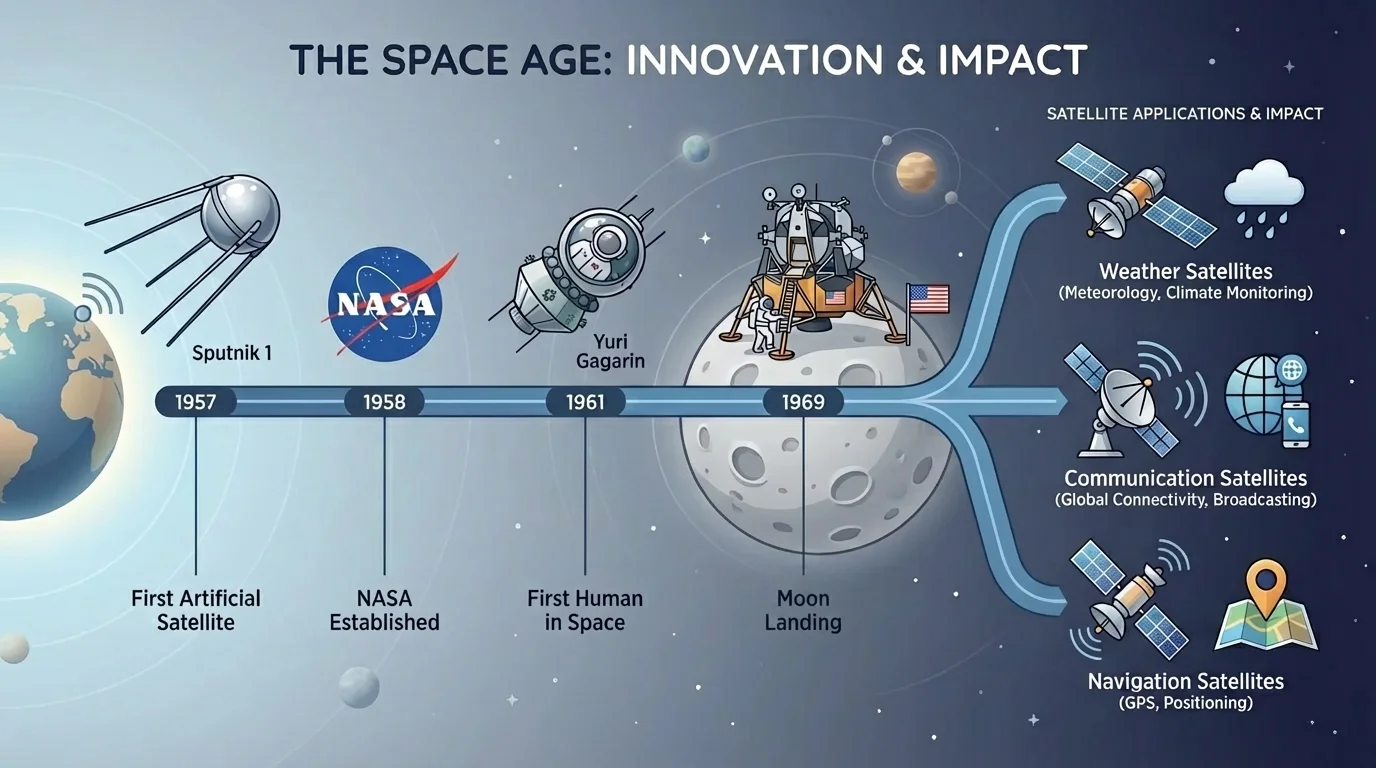
However, the Space Age was never just a story of exploration. It was tied closely to missile technology, surveillance, and military rivalry. The same rockets that launched satellites were related to weapons systems. This dual use of technology is a recurring historical theme. Nuclear science, computing, and the Internet all show similar mixtures of civilian and military purpose. Looking back at [Figure 3], it becomes clear that each major milestone carried both scientific excitement and geopolitical tension.
"That's one small step for man, one giant leap for mankind."
— Neil Armstrong, 1969
Primary sources for this era include radio broadcasts, government speeches, satellite images, propaganda posters, and astronauts' testimonies. These sources reveal how space achievements were used to shape public opinion. Secondary historians then compare the promises of the Space Age with its actual social effects.
Nuclear fission is the splitting of an atomic nucleus to release energy. Discoveries in atomic physics during the early twentieth century made this process understandable and usable. During World War II, the Manhattan Project turned nuclear science into the atomic bomb, first used in warfare at Hiroshima and Nagasaki in 1945. This immediately changed global politics by introducing a weapon of unprecedented destructive power.
After the war, many leaders and scientists promoted peaceful uses of nuclear energy. Nuclear power plants generate electricity by using heat from fission to produce steam, which turns turbines. Compared with coal-fired plants, nuclear plants emit far less \(\textrm{CO}_2\) during operation, which is why some countries view them as part of a strategy against climate change. Nuclear technology also has medical uses, including cancer treatment and imaging.
Yet nuclear power raises serious concerns. Radioactive waste remains dangerous for long periods. Accidents such as Chernobyl in 1986 and Fukushima in 2011 damaged trust and demonstrated how technical failure, natural disaster, and human error can combine. Nuclear weapons proliferation remains a global threat. Here again, innovation created both extraordinary capability and profound danger.
Real-world application: why countries debate nuclear energy
Governments often weigh multiple factors when deciding whether to use nuclear power.
Step 1: Nuclear plants can generate large amounts of electricity reliably.
Step 2: They reduce dependence on fossil fuels in many energy systems.
Step 3: Construction costs, waste storage, and accident risks make long-term planning difficult.
Step 4: Public memory of war and disasters influences political decisions as much as engineering calculations do.
This shows that technological choices are also ethical and political choices.
The history of nuclear power demonstrates continuity and change in a striking way. Humans have always sought stronger energy sources, but the nuclear era changed the scale. A single scientific breakthrough could now power cities or destroy them. Few innovations reveal the moral weight of science more clearly.
The Internet is a global network of interconnected computer systems. Its origins lie partly in Cold War research, especially the U.S. Defense Department's ARPANET, created in the late 1960s to connect computers and share information efficiently.
[Figure 4] Over time, networking protocols allowed different machines to communicate. The development of the World Wide Web in the early 1990s made the Internet far more accessible to ordinary users by organizing information through linked pages and browsers. What followed was one of the fastest social transformations in history. Email changed communication. Search engines changed research. Online commerce changed business. Social media changed politics, culture, and identity.
The Internet has similarities to the printing press but operates at much greater speed and scale. Both democratized access to information. Both challenged authorities' control over knowledge. Both spread new ideas quickly. But the Internet also allows immediate interaction, algorithmic sorting, and global communication across borders in real time. A printed pamphlet might take days or weeks to circulate; a digital post can reach millions in minutes.
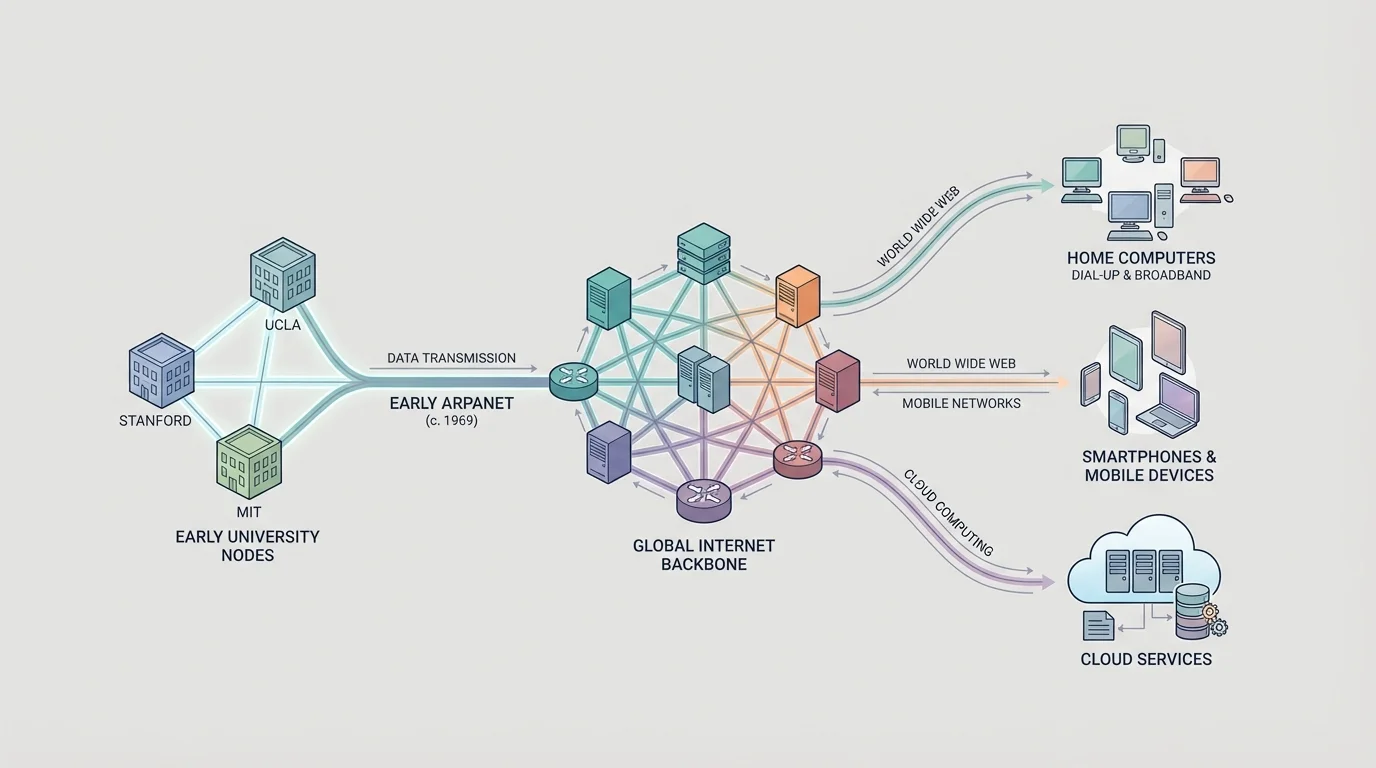
The effects are deeply complex. The Internet supports education, activism, telemedicine, entertainment, and scientific collaboration. It also enables surveillance, cybercrime, harassment, addiction-like usage patterns, and the rapid spread of false information. As with earlier innovations, power matters. Large companies and governments can shape what people see and how their data is used. The question is not only what the technology can do, but who controls it and under what rules. That issue echoes the struggles over print regulation described earlier and becomes clearer when compared with [Figure 1].
The digital age also changed work and globalization. Companies can outsource services across continents. Students can take online courses from faraway institutions. Remote collaboration allows teams to create software, conduct research, or design products without sharing the same building. At the same time, access remains unequal. The digital divide separates those with reliable devices and connectivity from those without them. Unity and diversity appear again: the world becomes more connected, but not everyone benefits equally.
| Innovation | Approximate period of major expansion | Major benefits | Major concerns |
|---|---|---|---|
| Printing press | 1400s–1500s | Spread of literacy, religion, science, public debate | Censorship, propaganda, conflict |
| British factory system | 1700s–1800s | Mass production, cheaper goods, economic growth | Labor exploitation, pollution, inequality |
| Vaccinations | 1700s to present | Disease prevention, longer life expectancy, public health gains | Mistrust, unequal access, political controversy |
| Sputnik and the Space Age | 1950s onward | Satellites, research, navigation, inspiration | Militarization, rivalry, surveillance |
| Nuclear power | 1940s onward | High energy output, low operational carbon emissions, medical uses | Weapons, accidents, waste |
| Internet | 1990s onward | Instant communication, information access, global collaboration | Misinformation, privacy loss, digital inequality |
Table 1. Comparison of major innovations, their periods of expansion, and their major benefits and concerns.
When these innovations are compared, several major historical patterns appear. First, innovations often emerge from earlier networks of knowledge. Gutenberg built on earlier printing traditions. Industrial inventors relied on metalworking, trade, and finance. Vaccine science advanced through observation and laboratory research. Space technology depended on physics and wartime rocketry. The Internet grew from computer science and military funding. Breakthroughs are usually cumulative.
Second, the effects of innovation are uneven. A factory owner, a child laborer, a scientist, a patient, and a colonized worker may experience the same system very differently. This is why historians pay attention to class, gender, race, empire, and geography. Scientific and technological change can unify societies around shared tools while also dividing them by access and power.
Third, every major innovation creates debates about ethics and authority. Who should regulate printing? Should children work in factories? Can governments require vaccines? Should space research serve military goals? Is nuclear risk acceptable? How much control should corporations have over online data? These are not side issues. They are central to the historical impact of innovation.
Earlier studies of the Renaissance, Reformation, imperial expansion, and the Cold War help explain why these innovations mattered. Technologies do not act alone; they become powerful within political systems, cultural beliefs, and economic structures.
Finally, significant ideas often outlast the original invention. The printing press helped establish the modern idea that knowledge can circulate widely. Industrialization strengthened the idea that societies can increase productivity through mechanization. Vaccination reinforced the idea that science can prevent suffering at the population level. The Space Age popularized the idea that humanity can transcend earthly limits. The Internet spread the idea of constant global connection. Whether these ideas bring freedom, control, or both depends on how people use them.
To investigate these topics seriously, historians compare different kinds of evidence. A nineteenth-century factory inspector's report may describe injuries in mills. An advertisement for electric appliances may present technology as progress without mentioning pollution. A Cold War speech may celebrate space exploration while hiding military motives. A social media platform's founding statement may promise openness while its business model collects data. Historical thinking requires students to ask who created a source, why it was created, and what perspective it leaves out.
Secondary sources are equally important because they help organize evidence into arguments. One historian might emphasize that the Industrial Revolution improved long-term living standards. Another might stress exploitation and empire. These interpretations are not necessarily opposites; both may contain truth. History often involves evaluating complex evidence rather than choosing a single simple answer.
Major scientific and technological innovations have shaped the world from the Renaissance to the present by changing communication, production, health, power, energy, and daily life. Their histories show that progress is real, but never automatic or evenly shared. Every innovation opens new possibilities while creating new responsibilities.
