A painting can challenge a king, a poem can carry a revolution, and a novel can change how millions of people see themselves. That is one of the most remarkable facts in world history: art and literature are not just decorations of culture. They are evidence of what people believed, feared, loved, and fought for. If you want to understand how societies changed from the Renaissance to today, it is not enough to study wars and laws. You also need to study what people created.
Historians often read artworks, plays, poems, novels, songs, and architecture the way scientists read data. These cultural works reveal values, conflicts, and identities. They also show continuity and change: some ideas survive across centuries, while others are challenged or replaced. Across world history, the arts have expressed both unity and diversity. Many societies use stories, images, and performance to teach values, but they do so in different styles shaped by local history.
Art and literature matter because they do two things at once. First, they reflect society. A portrait of a ruler, a religious epic, or a protest song tells us something about the time and place in which it was created. Second, they can shape society. A powerful book or image can persuade people, challenge authority, or create a shared identity.
Humanism was an intellectual movement that emphasized human potential, classical learning, and careful study of history, language, and ethics. Patronage was the financial support that wealthy individuals, rulers, or religious institutions gave to artists and writers. Modernism was a broad movement in the arts and literature that rejected many traditional forms and experimented with new ways of representing reality.
Because of this double role, art and literature are deeply connected to cause and effect. Political revolutions, religious conflicts, industrialization, imperialism, and new technologies all influenced culture. At the same time, cultural works influenced those historical developments in return. A novel exposing injustice might help build support for reform. A painting glorifying empire might strengthen public support for conquest. The relationship is rarely simple, which is why historians emphasize complexity.
The Renaissance, as shown in [Figure 1], began in Italian city-states such as Florence during the late Middle Ages and grew into a major cultural movement that reshaped Europe. The word means "rebirth," and it refers to renewed interest in the classical civilizations of Greece and Rome. Renaissance thinkers studied ancient texts, but they did not simply copy the past. They adapted old ideas to new conditions, creating fresh approaches to art, politics, science, and literature.
One of the central ideas of the Renaissance was humanism. Humanists focused on human experience, language, and achievement. In art, this encouraged more realistic depictions of the body, space, and emotion. In literature, it encouraged close study of rhetoric, history, and moral choice. Artists such as Leonardo da Vinci, Michelangelo, and Raphael used perspective, anatomy, and balance to create works that seemed more lifelike than much earlier medieval art. Writers such as Petrarch, Boccaccio, and later William Shakespeare explored human motives with unusual depth.
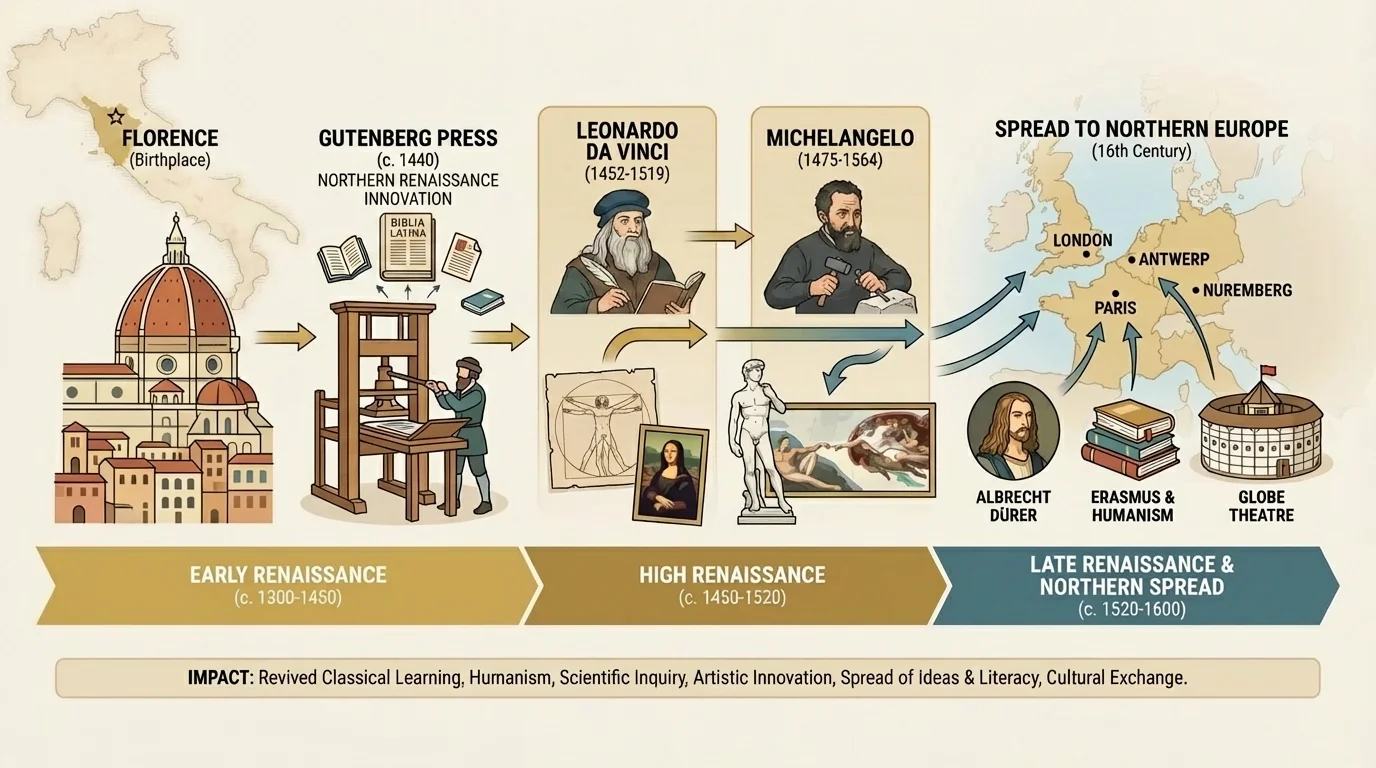
The invention of the printing press by Johannes Gutenberg in the mid-15th century was a turning point. Before printing, books had to be copied by hand, which made them slow and expensive to produce. Printing lowered costs and increased the speed at which ideas could spread. This had enormous effects on religion, politics, and education. It helped spread Renaissance ideas beyond Italy and later helped fuel the Protestant Reformation.
Renaissance culture shows both continuity and change. There was continuity in the ongoing importance of religion; many famous Renaissance works were still deeply religious. Yet there was also change in the growing focus on the individual, secular learning, and observation of the natural world. These shifts influenced not only Europe but eventually the wider world through trade, colonization, and cultural exchange.
Case study: Michelangelo's David
This sculpture reflects Renaissance values in a highly visible way.
Step 1: Consider the subject.
David comes from the Bible, so the work keeps a strong religious connection to earlier European culture.
Step 2: Consider the style.
The human body is shown with realistic anatomy and idealized balance, reflecting classical influence and humanist interest in the individual.
Step 3: Consider the meaning.
The sculpture also symbolized civic pride in Florence, showing how art could serve political purposes as well as religious ones.
One work of art can therefore reveal religion, politics, classical influence, and changing ideas about humanity all at once.
Literature changed too. The Prince by Machiavelli examined political power in a direct, sometimes unsettling way. Shakespeare's plays explored ambition, jealousy, love, and identity with complexity that still feels modern. These texts remain important because they ask enduring questions: What makes a good leader? What drives human behavior? How much control do individuals have over their fate?
As early modern empires expanded, cultural exchange intensified, as [Figure 2] shows through major routes connecting continents. European art and literature did not develop in isolation. Trade linked Europe with Africa, Asia, and the Americas, bringing new materials, ideas, and wealth. Silver from the Americas, textiles from India, porcelain from China, and intellectual exchanges across the Mediterranean and Indian Ocean worlds all shaped cultural life.
At the same time, art became a tool of political and religious authority. During the Baroque period, dramatic architecture, sculpture, and painting were often designed to inspire awe. In Catholic Europe, the Church used Baroque art to respond to the Protestant Reformation. Grand churches, intense emotional scenes, and dynamic movement aimed to strengthen faith. Figures such as Caravaggio, Bernini, and Rembrandt showed how art could combine spiritual intensity with striking realism.
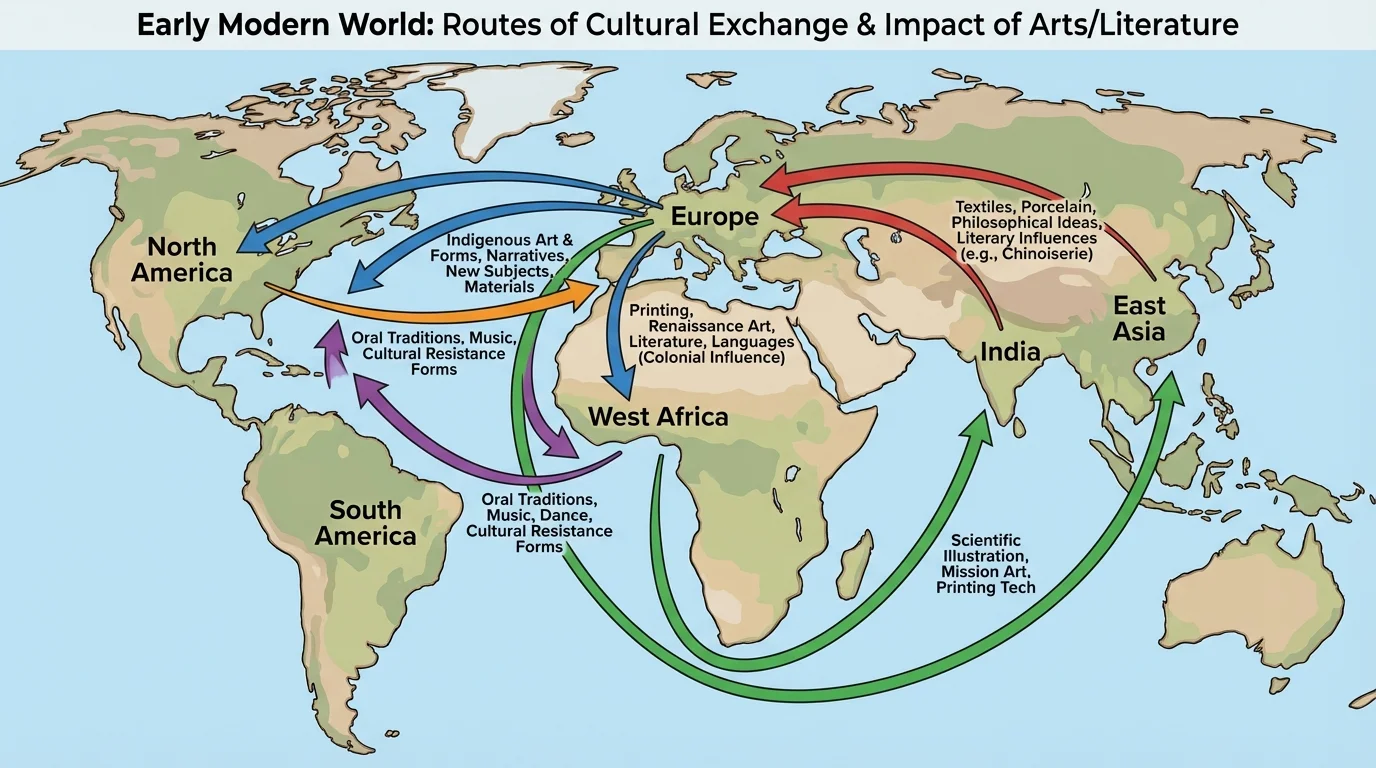
But cultural exchange also took place through violence and inequality. Colonization often involved the destruction, suppression, or reshaping of Indigenous cultures. Missionaries, colonial officials, and settlers sometimes attempted to replace local languages, beliefs, and artistic traditions. Yet Indigenous and colonized peoples did not simply disappear. They adapted, preserved, and transformed traditions. In Latin America, for example, colonial churches often included local artistic influences. In literature and oral tradition, communities maintained histories and identities despite conquest.
This period reveals the complexity of world culture. There was no single "global culture." Instead, there were constant interactions among peoples with unequal power. Some artistic forms spread because they were admired. Others spread because empires enforced them. Understanding this difference is essential when analyzing the historical impact of the arts.
By the 18th century, the Enlightenment encouraged reason, debate, and criticism of traditional authority. Writers such as Voltaire, Mary Wollstonecraft, Denis Diderot, and Jean-Jacques Rousseau used essays, books, and pamphlets to discuss government, education, rights, and human nature. Literature became a powerful vehicle for political ideas. Print culture expanded, and more people could participate in public debate.
The relationship between writing and politics became especially clear during the American, French, Haitian, and Latin American revolutions. Revolutionary documents and speeches relied on literary language to persuade audiences. At the same time, art celebrated new national heroes and symbols. Ideas about liberty and rights spread across borders, though they were often applied unevenly. A society might speak of freedom while maintaining slavery or denying rights to women.
"I do not wish them [women] to have power over men; but over themselves."
— Mary Wollstonecraft
Romanticism emerged partly as a response to the Enlightenment and to rapid political change. Romantic artists and writers valued emotion, imagination, nature, and individual feeling. They were often skeptical of cold rationality and industrial society. In literature, writers such as William Wordsworth, Lord Byron, and Mary Shelley explored intense personal and moral struggles. In art, painters such as Francisco Goya and J. M. W. Turner emphasized drama, power, and emotion.
Romanticism also helped shape nationalism. Poems, songs, legends, and paintings gave people a sense of shared past and identity. This could unite people against imperial rule, but it could also divide societies by encouraging exclusion. Here again, art and literature acted as forces of both unity and conflict.
The Industrial Revolution transformed daily life through factories, urbanization, and new social classes. These changes affected culture directly. Instead of focusing mainly on heroic leaders or ideal beauty, many artists and writers turned toward ordinary life. Realism aimed to represent the world more truthfully, including poverty, labor, and social inequality.
Novelists such as Charles Dickens, Gustave Flaubert, Leo Tolstoy, and Émile Zola portrayed the pressures of modern society. Their works often criticized class divisions, harsh working conditions, and moral hypocrisy. Literature became an important way to reveal hidden suffering. Readers could encounter the realities of child labor, debt, or urban crowding through vivid stories rather than statistics alone.
Serialized novels were often published in parts in newspapers or magazines. That meant literature reached readers over time, almost like following episodes of a modern streaming series, and authors could influence public debate while a work was still appearing.
In visual art, painters such as Gustave Courbet and later the Impressionists responded to changing life in different ways. Realists highlighted labor and ordinary people. Impressionists studied light, movement, and modern urban scenes. Both movements reflected a world transformed by railroads, factories, photography, and new leisure spaces.
Cause and effect are especially clear here: industrialization changed social life; changing social life changed the subjects and techniques of art; and those works then influenced how people understood modernity itself.
The late 19th and early 20th centuries brought enormous disruption: global empires, technological change, mass cities, and devastating warfare. [Figure 3] highlights how sharply modernist artists and writers broke with older expectations of balance, realism, and linear storytelling. Many creators felt that traditional forms could no longer capture the reality of modern life.
Modernism was not one single style, but it shared a spirit of experimentation. In art, movements such as Cubism, Surrealism, and Expressionism rejected ordinary perspective and straightforward representation. Artists such as Pablo Picasso, Wassily Kandinsky, and Salvador Dalí explored abstraction, distorted forms, and dreamlike imagery. In literature, writers such as James Joyce, Virginia Woolf, T. S. Eliot, and Franz Kafka used fragmented structure, symbolism, and stream of consciousness to represent inner thought and uncertainty.
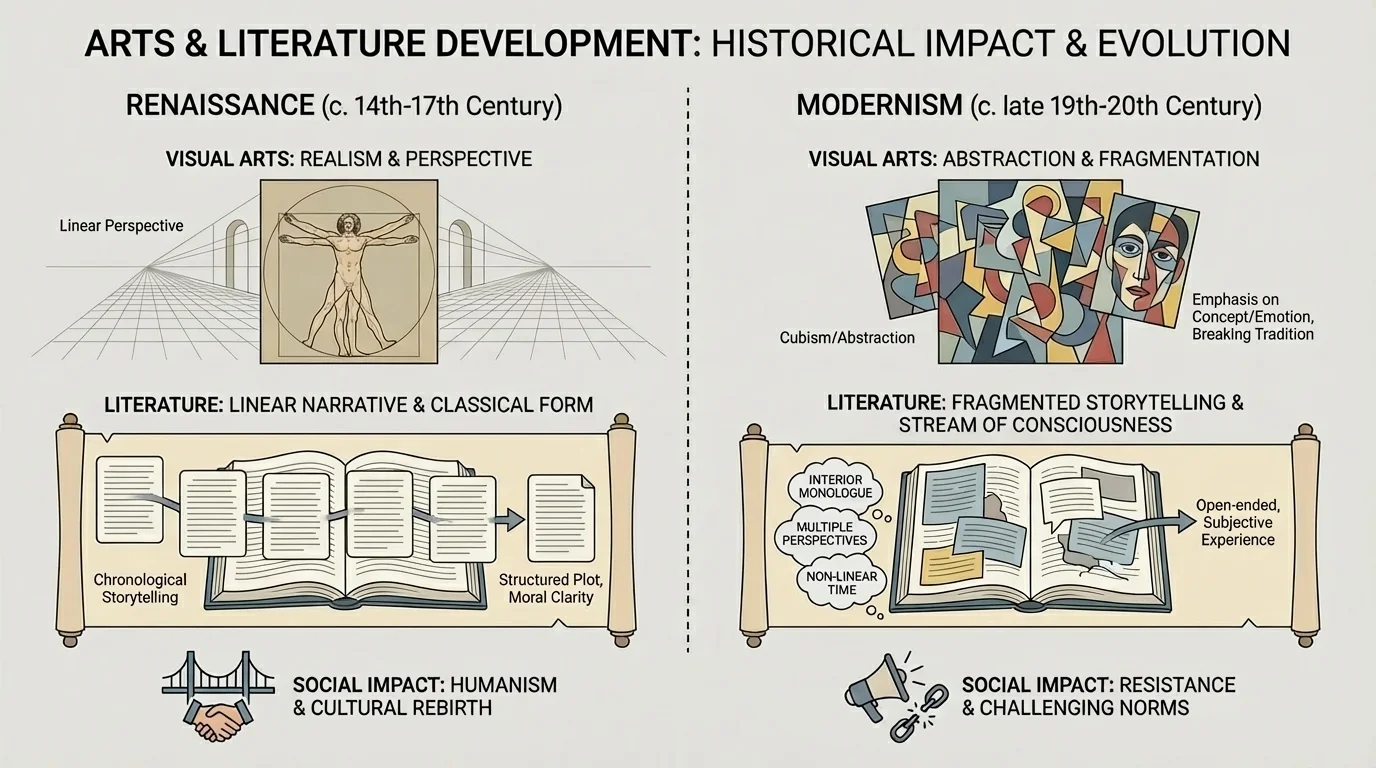
World War I had a profound impact on modernism. The scale of destruction shattered faith in steady progress and rational civilization. After such violence, many artists and writers questioned whether old cultural forms still made sense. Some works seem disorienting on purpose because the world itself seemed disorienting.
Modernism spread far beyond Europe. Writers and artists in colonized and newly independent societies adapted modernist forms to local experiences. This is an important example of unity and diversity: a broad global movement shared certain techniques, but each region used them differently. As we saw earlier in [Figure 1], cultural movements often begin in one setting and then transform as they travel.
Why modernism mattered
Modernism did not just make art "strange." It changed expectations about what art and literature could do. Instead of offering neat order, a work could express confusion. Instead of copying visible reality, it could represent memory, fear, or unconscious desire. This helped later generations treat art as a space for questioning reality rather than simply imitating it.
The impact of modernism is still visible today in film editing, abstract design, psychological fiction, and experimental music. What once seemed shocking became part of mainstream culture.
Across the modern world, the arts have been used not only to express culture but to fight for dignity, rights, and freedom. [Figure 4] presents several forms of resistance together because protest culture appears in many media: murals, poems, songs, novels, theater, and performance. When formal political power is limited, culture often becomes a crucial space for resistance.
The Harlem Renaissance of the 1920s is a powerful example. African American writers, musicians, and artists such as Langston Hughes, Zora Neale Hurston, Duke Ellington, and Aaron Douglas celebrated Black identity, creativity, and intellectual life. Their work challenged racist stereotypes and demanded fuller recognition of Black humanity and citizenship. This was art as social progress and cultural self-definition.
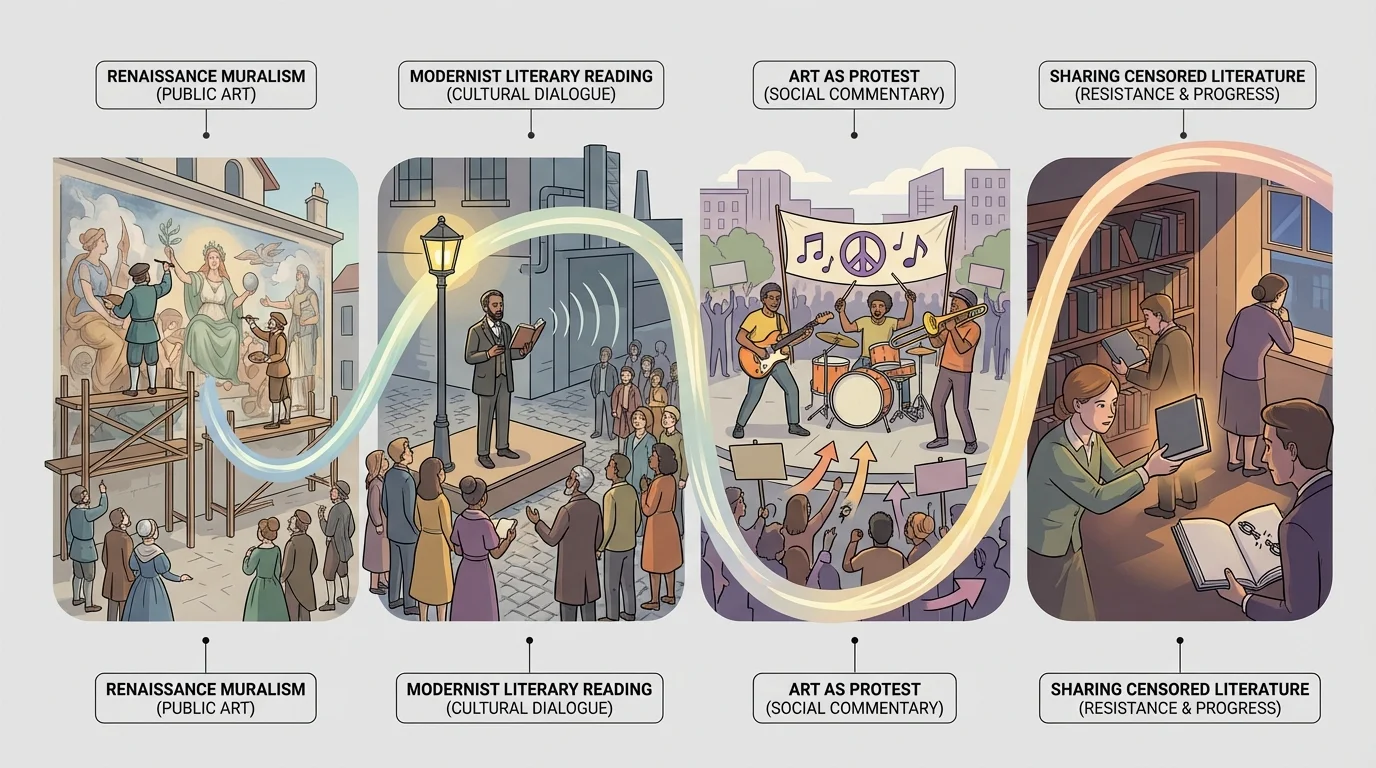
In Mexico, muralists such as Diego Rivera, José Clemente Orozco, and David Alfaro Siqueiros created public art that told stories of labor, revolution, and Indigenous history. Because murals were placed in public spaces, they reached people beyond elite audiences. They turned walls into historical arguments.
In colonized societies, literature often became a tool of anti-colonial resistance. Writers such as Chinua Achebe, Ngũgĩ wa Thiong'o, and Aimé Césaire challenged colonial narratives that presented European rule as civilized and necessary. They restored local voices, questioned imposed languages, and showed the psychological and social damage of empire.
Feminist writers and artists also used culture to expose inequality. From Simone de Beauvoir to Toni Morrison to contemporary visual artists, creators have challenged the ways gender shapes power and identity. Protest music played similar roles during the U.S. civil rights movement, anti-apartheid struggles in South Africa, and democracy movements around the world. Songs could spread quickly, unite crowds, and preserve memory.
Case study: Literature against empire in Things Fall Apart
Chinua Achebe's novel shows how literature can resist harmful historical narratives.
Step 1: Identify the older narrative.
Many colonial texts described African societies as simple, chaotic, or without meaningful history.
Step 2: Examine Achebe's response.
The novel presents Igbo society as complex, structured, and deeply human before colonial disruption.
Step 3: Analyze the effect.
Readers are pushed to question whose perspective history usually centers and whose voices have been ignored.
This is literature functioning as historical correction and resistance at the same time.
Resistance art often faces censorship. Governments have banned books, imprisoned writers, and attacked artists because they understood a basic truth: culture matters. A censored poem is evidence that words can be powerful enough to threaten authority. The same point appears in a different form in [Figure 4], where public performance and shared reading become acts of collective courage.
Since the late 20th century, the cultural world has become even more interconnected. Global media, migration, the internet, and digital technology allow artistic styles to move rapidly across borders. A filmmaker in South Korea, a novelist in Nigeria, a muralist in Brazil, and a musician in the United States may influence one another in real time.
Some scholars use the term Postmodernism to describe cultural tendencies that question grand narratives, mix high and low culture, and play with irony, collage, and self-reference. In practice, contemporary culture includes many overlapping styles rather than one dominant movement. Graphic novels, spoken word poetry, digital art, video essays, and streaming media all shape how stories are told.
At the same time, debates over representation and identity remain central. Who gets to tell a story? Which histories are preserved in museums, textbooks, and films? How should societies respond to art linked to colonialism, racism, or dictatorship? These questions show that the arts are still sites of conflict as well as creativity.
Historical thinking is not only about naming events. It also means asking who created a source, for what audience, under what conditions, and with what purpose. Artworks and literary texts should be analyzed with those same questions.
Modern digital culture has increased access, but it also creates new challenges. Social media can amplify marginalized voices, yet algorithms and commercial pressures may reward speed over depth. Even so, the basic historical pattern continues: new technology changes culture, and culture changes society in return.
From the Renaissance to the present, the historical development of art and literature reveals several major patterns. One is continuity and change. Human beings across time have used stories, images, and performance to express values and identity. Yet the forms, audiences, and purposes of those works change as societies change.
Another pattern is cause and effect. The printing press expanded literacy and debate. Industrialization changed the subjects of novels and paintings. War and political upheaval contributed to modernist experimentation. Decolonization and civil rights movements inspired powerful new forms of cultural resistance.
A third pattern is complexity. Art can support authority or oppose it. A beautiful building may symbolize faith, imperial power, civic pride, or all three at once. A novel may be both a personal story and a political argument. Historical interpretation becomes richer when we resist simple answers.
Finally, the arts reveal both unity and diversity. Every culture creates forms of expression, but not in the same way. Global movements such as the Renaissance or modernism spread across regions, yet they were always reshaped by local traditions, languages, beliefs, and struggles. The result is a world culture that is connected, but never identical.
When historians study paintings, plays, novels, songs, and public monuments, they are not stepping away from history. They are entering one of its most revealing archives. Through the arts and literature, we can see how people imagined the world they lived in—and how they tried to change it.
