A city can have luxury apartments with rooftop gardens only a few miles from neighborhoods where tap water is unsafe, public transit is limited, and asthma rates are high. That contrast is not random. It reflects geography, history, economics, and politics working together. When governments make policies about land, water, energy, food, transportation, and climate, they are not just managing resources. They are deciding who benefits, who bears the risks, and whose knowledge counts.
Geography is not only the study of maps and landforms. It also examines how people interact with places and environments. A policy that looks efficient on paper may affect communities very differently depending on where they live, how they make a living, what histories they carry, and whether they have political power. A coastal fishing village, an urban neighborhood near refineries, and a desert farming town all face sustainability in different ways.
One reason this topic matters is that public debates often use broad words like sustainability, resource distribution, and development as if everyone means the same thing. In reality, groups may agree that resources should be protected but disagree about what protection requires. One community might prioritize jobs in energy production, while another emphasizes long-term water quality, sacred land, or health outcomes.
Sustainability means using resources in ways that meet present needs without destroying the ability of future generations to meet theirs. Resource distribution refers to how access to land, water, food, energy, housing, and public services is shared across places and populations. Viewpoint means a perspective shaped by experience, culture, location, and values.
For high school students, an important skill is learning to interpret viewpoints rather than assuming one group speaks with a single voice. Communities are internally diverse. Age, class, religion, gender, immigration status, and urban or rural location all affect opinions within the same group.
Geographers ask how geographic variables such as location, climate, topography, infrastructure, land use, and political boundaries shape human life. These patterns of inequality become visible across space, as [Figure 1] shows in the contrast between industrial corridors, residential districts, and public services. People do not simply live on land; they live in systems shaped by zoning laws, transportation routes, investment, and environmental hazards.
Consider two neighborhoods in the same metro area. One has tree cover, reliable transit, supermarkets, parks, and well-funded schools. The other sits near highways and warehouses, has fewer clinics, less green space, and higher flood risk. The difference affects heat exposure, health, educational opportunity, and even insurance rates. Resource use is therefore never just about nature. It is also about who can access clean air, safe water, and political influence.
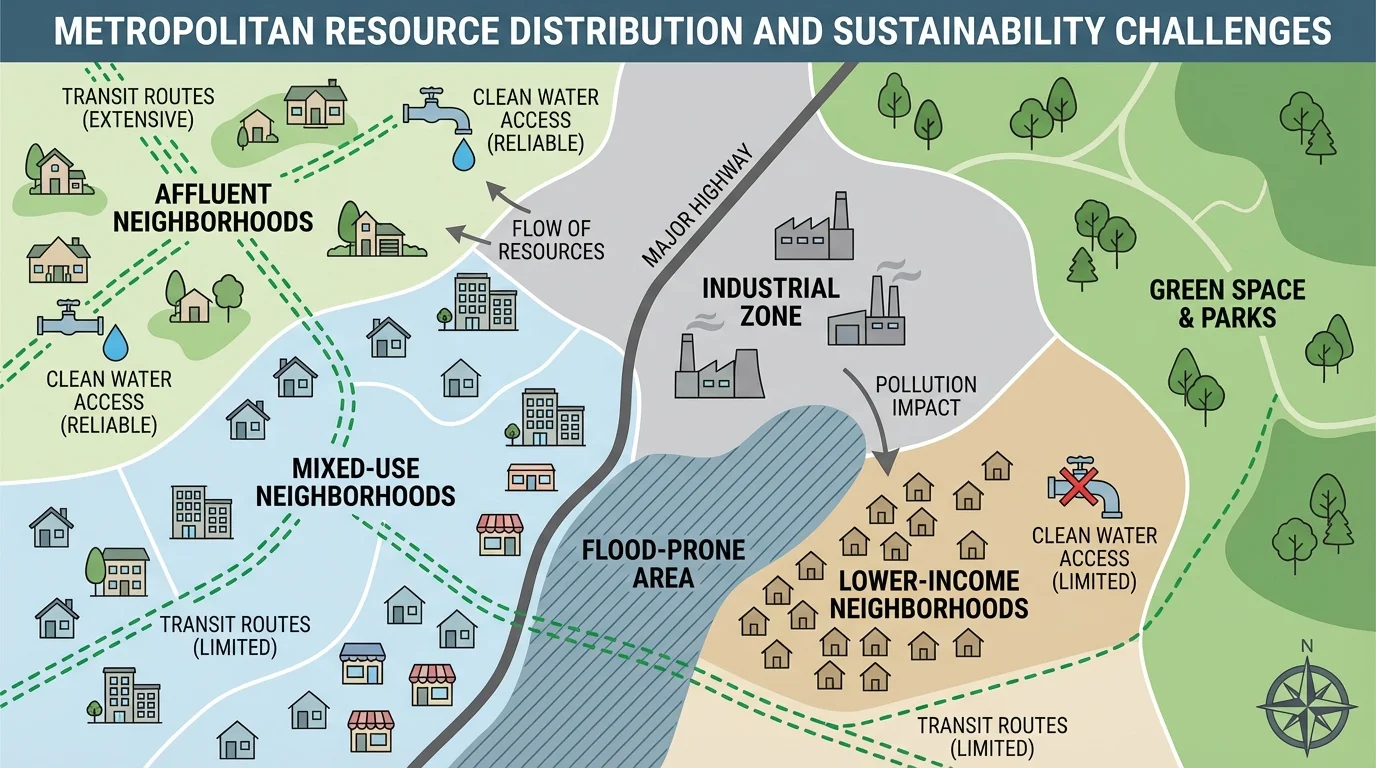
Historical processes matter too. Redlining, forced relocation, reservation systems, segregation, labor recruitment, and exclusion laws shaped where many communities could live and work. Those older decisions still influence present-day sustainability issues, from toxic exposure to home ownership and disaster recovery.
| Geographic factor | How it affects resource use | Possible policy impact |
|---|---|---|
| Location near industry | Greater exposure to pollution and truck traffic | Stricter air-quality rules, health monitoring |
| Distance from water sources | Higher cost and competition for water access | Water conservation programs, infrastructure investment |
| Coastal setting | Exposure to storms, sea-level rise, fisheries pressure | Evacuation planning, shoreline protection |
| Rural isolation | Limited services and transportation | Expanded broadband, medical and transit access |
| Political boundaries | Different legal rights and budgets across districts | Regional coordination, funding reform |
Table 1. Geographic factors that influence access to resources and the kinds of policies communities may demand.
Many African American viewpoints on sustainability are shaped by the long history of segregation, disinvestment, and environmental justice struggles. In many cities, Black communities have been more likely to live near landfills, highways, incinerators, petrochemical plants, and aging water systems. As a result, sustainability is often connected not only to conservation but also to health, civil rights, and fair treatment.
The term environmental racism is often used to describe patterns in which communities of color face disproportionate environmental burdens. The Flint water crisis is one major example. Residents, many of them African American, faced contaminated water after policy decisions about cost-saving and infrastructure. Their perspective on resource policy centered on accountability, public health, and the right to safe water.
Case study: Urban heat and unequal infrastructure
Step 1: Identify the geographic pattern.
Historically segregated neighborhoods often have fewer trees, more pavement, and older housing.
Step 2: Connect place to lived experience.
These areas can become hotter during summer, increasing heat stress and energy costs.
Step 3: Interpret the viewpoint.
Residents may support sustainability programs such as tree planting, weatherization, and transit expansion, but they may also ask whether those programs prevent displacement.
This perspective links environmental improvement with housing justice.
African American communities have also contributed leadership to sustainability through church networks, community gardens, food justice projects, and anti-pollution campaigns. Their viewpoints often emphasize that a green policy is not truly sustainable if it improves the landscape while pushing out long-term residents through rising rents.
Latino communities are extremely diverse, including families with roots in Mexico, Central America, South America, the Caribbean, and many generations of life in the United States. Geography matters here as well. In farm regions, many Latino workers experience sustainability through labor conditions, pesticide exposure, and water scarcity. In cities, the issues may include housing quality, air pollution, transit access, and workplace safety.
Immigration policy strongly shapes many Latino perspectives on resource use. Borderlands are not empty spaces; they are regions where ecosystems, communities, trade, and state power intersect. Wall construction, surveillance systems, and militarized border enforcement can disrupt wildlife movement, Indigenous mobility, and access to water in desert environments. For migrants, water itself can become a survival issue.
Latino environmental activism often connects worker dignity and sustainability. Farmworkers have raised concerns about heat protection, chemical exposure, and the right to clean drinking water in agricultural regions. In places such as California's Central Valley, debates over groundwater, drought, and industrial agriculture are also debates about whose lives are treated as expendable.
Some of the most important environmental justice campaigns in the United States have been led by farmworker and immigrant communities, especially around pesticide regulation, drinking water access, and workplace heat protections.
Latino viewpoints on urban sustainability also frequently include support for public transit, affordable housing near jobs, and cleaner air near ports and freight corridors. Yet these communities may distrust policy plans if past redevelopment projects displaced residents or ignored language access.
Asian American viewpoints on sustainability are shaped by migration, labor history, urban settlement, and transnational ties. Different communities may focus on different concerns: refugee neighborhoods may emphasize safe housing and flood resilience, while fishing or coastal communities may focus on marine ecosystems and shoreline change. Many Asian American neighborhoods have also faced industrial pollution, overcrowding, and increased disaster risk.
It is important not to merge Asian Americans with Hawaiian and Pacific Islander communities as if their histories were identical. Native Hawaiians and many Pacific Islanders have distinct relationships to land, ocean, ancestry, and colonialism. For them, sustainability can involve protection of reefs, fisheries, freshwater systems, and sacred places, as well as resistance to militarization, overdevelopment, and tourism that strains local resources.
Sea-level rise is especially urgent for many Pacific Island communities. Climate change threatens homes, burial grounds, freshwater supplies, and cultural continuity. In this context, sustainability is not only about reducing emissions. It is also about survival, self-determination, and whether displaced people will be recognized with dignity and rights.
In Hawaii, debates over water diversion, telescope construction, resort development, and coastal management have shown how environmental issues are also political and cultural questions. A policy that promises economic growth may be viewed very differently by communities concerned with sacred landscapes and Indigenous authority.
Among many Indigenous communities, resource policy is inseparable from sovereignty, treaty rights, and relationships to land and water. Competing land uses become easier to understand when mapped, and [Figure 2] illustrates how a pipeline route, a river system, and a treaty area can overlap in ways that produce conflict. For many Indigenous Peoples, land is not just property or a commodity. It is tied to identity, responsibility, ceremony, kinship, and survival.
A major concept here is traditional ecological knowledge, often abbreviated as TEK. This refers to environmental understanding developed through long-term observation and long-term relationships with ecosystems. TEK can include knowledge of fire management, water cycles, migration patterns, soil conditions, and sustainable harvesting. It is not folklore in the dismissive sense; it is a sophisticated body of knowledge.
Land stewardship and reciprocity are central ideas in many Indigenous perspectives. Stewardship means caring for land and water so they remain healthy over time. Reciprocity means humans take from ecosystems with responsibility, respect, and limits rather than assuming unlimited extraction is acceptable.
Conflicts over mining, dams, logging, oil pipelines, and water diversion often reveal a deep difference in worldview. Governments or corporations may see a resource to be extracted for profit or national growth. Indigenous communities may see a river as a living relation, a treaty-protected space, or a source of cultural continuity. That difference affects how each side defines harm.
Examples include resistance to the Dakota Access Pipeline, defense of salmon fisheries in the Pacific Northwest, and Indigenous-led fire stewardship in California. These cases show that sustainability policies can become stronger when they include Indigenous leadership rather than treating Native communities as one more stakeholder group.
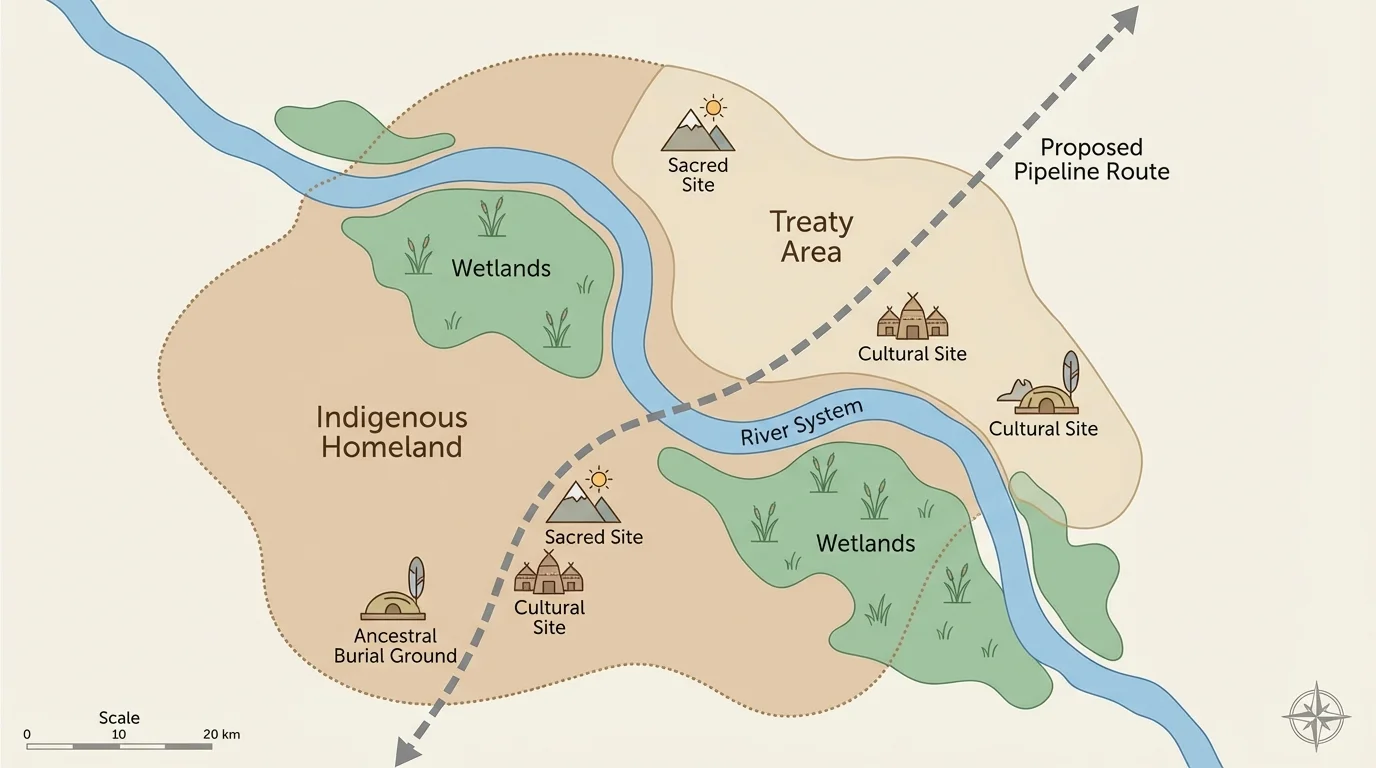
Later debates about water rights, fisheries, and land restoration still return to the same issue: different legal systems and cultural values can overlap in one place. Interpreting Indigenous viewpoints responsibly means paying attention to tribal governments, treaty documents, oral traditions, and the diversity among nations.
Sustainability debates are sometimes presented as if identity categories such as gender, sexuality, or religion are separate from geography. In reality, they shape vulnerability and access. LGBTQ youth, for example, face higher risks of housing instability in some regions. During disasters, access to shelters, healthcare, identification documents, and safe public space can affect survival. Inclusive emergency planning is therefore part of sustainability.
LGBTQ perspectives may also emphasize the importance of public space, neighborhood safety, affordable housing, and healthcare access in climate adaptation plans. A city cannot claim resilience if some residents avoid shelters or aid centers because they fear discrimination.
Religious minorities bring another set of important viewpoints. Many faith traditions include teachings about stewardship, charity, restraint, hospitality, or care for creation. Muslim, Jewish, Sikh, Hindu, Buddhist, Christian, and other communities may support sustainability for different ethical reasons. At the same time, religious minorities can face zoning conflicts over houses of worship, cemetery space, dietary needs in disaster response, or discrimination in public participation.
"The earth is what we all have in common."
— Wendell Berry
Not all religious viewpoints are the same, and some may disagree sharply about specific policies. Still, many communities connect environmental responsibility to moral duty. Faith-based organizations have often played major roles in disaster relief, refugee support, food distribution, and urban farming.
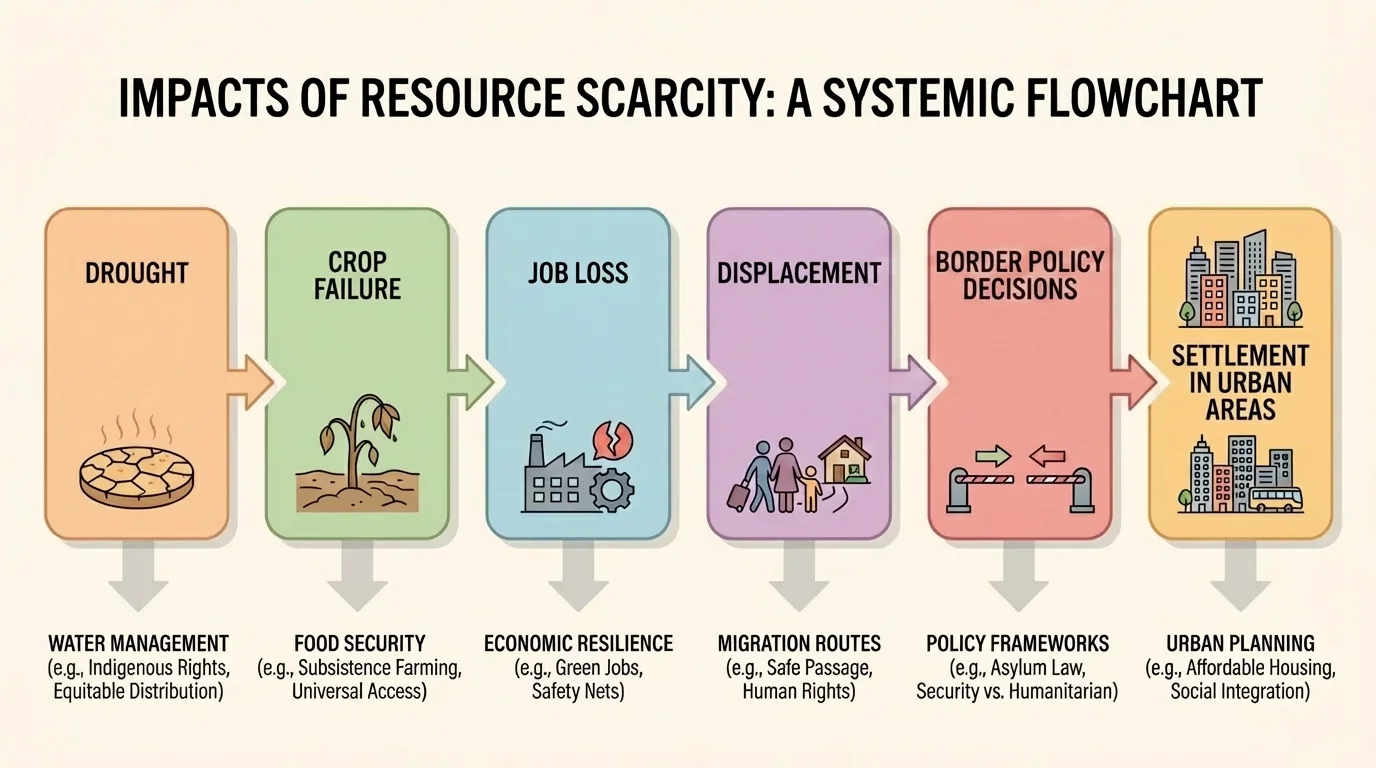
Universal human rights provide a framework for asking whether every person has access to basic conditions for life and dignity. Migration is often shaped by linked causes rather than a single choice, and [Figure 3] traces how drought, crop loss, economic pressure, and border policy can connect environmental stress to displacement. When climate impacts destroy livelihoods, people may move within a country or across borders.
This makes immigration a resource issue as well as a legal one. New arrivals may need housing, water, schools, jobs, healthcare, and transit in receiving areas. At the same time, migrants often contribute labor, knowledge, taxes, and entrepreneurship. Debates over immigration policy therefore include questions about fairness, rights, labor systems, and the capacity of cities and regions.
The UN Sustainable Development Goals, often called the SDGs, connect these issues globally. Goals related to clean water, reduced inequalities, sustainable cities, climate action, health, education, and life below water are deeply connected. A city trying to improve transportation, for example, may also affect air quality, job access, and public health.
Human rights frameworks are especially useful when comparing perspectives. They ask whether policy protects access to food, housing, water, health, culture, and participation in public life. But they can also create debate. Some groups focus strongly on national sovereignty and border control, while others emphasize humanitarian obligations to refugees and displaced persons.
| Issue | Human rights question | Related global goal |
|---|---|---|
| Water contamination | Do people have safe and affordable water? | Clean water and sanitation |
| Climate migration | How are displaced people protected? | Reduced inequalities; sustainable cities |
| Air pollution | Who is exposed to unhealthy air? | Good health; sustainable cities |
| Land extraction | Are cultural and land rights respected? | Life on land; peace and justice |
| Food insecurity | Can communities access nutritious food? | Zero hunger |
Table 2. Examples of how human rights questions connect sustainability issues to global development goals.
Climate displacement in Pacific islands, drought-related migration in Central America, and refugee resettlement in major cities all show that migration is geographic. The chain of causes in [Figure 3] reminds us that environmental change, economics, and law often interact rather than operate separately.
Researching viewpoints requires more than finding one quote from one person. Students should ask: Who is speaking? What community or institution do they represent? What is their location? What historical experiences shape their perspective? What evidence do they use? Are there competing voices within the same group?
Primary sources such as speeches, interviews, maps, oral histories, government testimony, and community organization statements can reveal how people describe their own concerns. Secondary sources such as scholarly articles, documentaries, and reputable journalism help place those statements in broader context. A responsible interpretation compares both.
Correlation is not the same as causation. If a community lives near pollution, students should examine how policy, zoning, labor markets, and historical discrimination created that pattern instead of assuming it happened naturally.
Avoid stereotypes. Not all African Americans prioritize the same policies. Not all Latinos share one immigration view. Not all Indigenous nations hold the same legal status or land relationships. Not all religious minorities approach sustainability through the same theology. Good geographic analysis recognizes both common patterns and internal diversity.
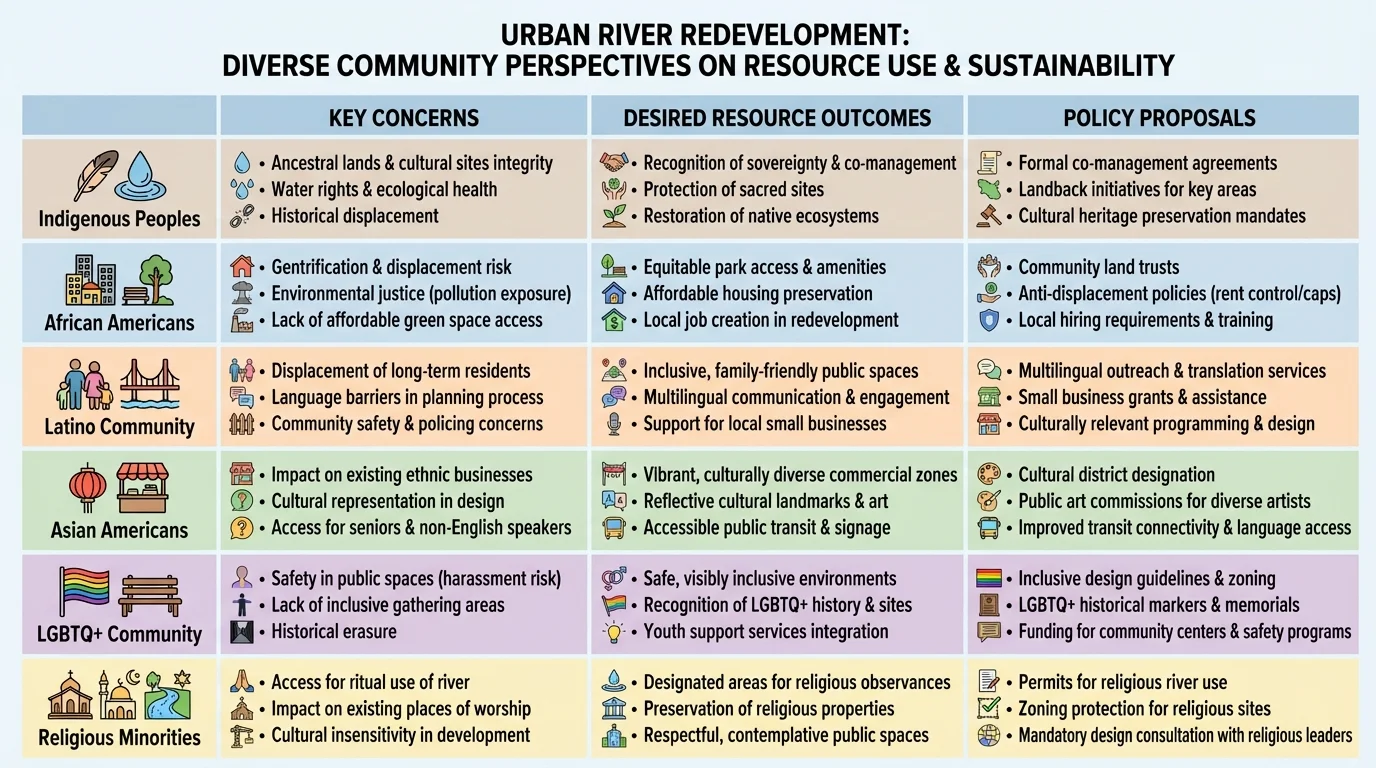
Real policy making often involves several communities at once. A side-by-side comparison helps reveal where viewpoints conflict and where they overlap. Consider an urban river redevelopment project. [Figure 4] City officials may want economic growth, developers may want housing and retail, nearby residents may want flood control and park access, tribal representatives may emphasize restoration and cultural protection, and immigrant street vendors may worry about losing informal economic space.
Another example is wildfire policy in the American West. Homeowners may focus on property protection. Insurance companies may push for risk reduction. Indigenous fire practitioners may advocate controlled burning based on long-standing knowledge. Conservation groups may emphasize habitat protection. Farmworkers and rural poor communities may worry about smoke exposure, wages, and housing after fires. A single policy can succeed only if it understands these overlapping realities.
Case study: Designing a fair city cooling program
Step 1: Map vulnerability.
Officials identify neighborhoods with high heat, low tree cover, high asthma rates, and many older residents.
Step 2: Gather viewpoints.
African American residents ask for investment without displacement. Latino tenants ask for language access and renter protections. LGBTQ youth organizations ask for safe cooling centers. Faith groups offer building space and volunteer networks.
Step 3: Build policy.
The city funds trees, shaded bus stops, utility assistance, anti-eviction measures, and inclusive emergency centers.
This approach treats sustainability as both environmental protection and social equity.
The same comparison visible in [Figure 4] applies to food systems, transit plans, coastal adaptation, and disaster relief. Effective programs do not erase differences. They identify them clearly and design policy around real conditions.
Public policy is strongest when it listens to those most affected. Communities that experience pollution, displacement, water insecurity, border violence, or cultural loss often notice problems long before officials do. Their viewpoints are not obstacles to progress. They are essential evidence about how systems actually work.
Studying diverse perspectives also changes how students understand geography. Places are not neutral containers. They are shaped by power, memory, movement, and environmental limits. To interpret policy well, students must connect maps to lived experience and sustainability to justice.
