A teenager in Nairobi may wear sneakers designed in the United States, listen to K-pop from South Korea, message friends in English and Swahili, and debate human rights ideas promoted by global organizations. That one ordinary day reveals something powerful: cultures do not stay sealed inside borders. They move, mix, adapt, and sometimes collide. Understanding that movement is one of geography's biggest questions because it helps explain why places become more connected, why identities change, and why cultural contact can produce both creativity and conflict.
Geographers study patterns across space, and culture creates some of the most important patterns on Earth. Languages spread across continents. Religions expand through trade routes and migration. Music, fashion, and political ideas move through the internet in seconds. At the same time, some communities fight to protect traditions that are endangered by outside influence. When we examine cultural change, we are really studying the relationship between people, power, and place.
Two major ideas help explain this process: cultural diffusion and assimilation. They are related, but they are not the same. One emphasizes the spread of cultural traits; the other focuses on how individuals or groups may adopt the dominant culture of a society.
Cultural diffusion is the spread of ideas, customs, technologies, languages, religions, or other cultural traits from one group or place to another.
Assimilation is the process by which a person or group comes to adopt the culture of a dominant society, often losing some original cultural practices in the process.
Acculturation is cultural change that results from contact between groups, often without complete loss of the original culture.
These ideas matter because they affect rights, identity, and opportunity. In some situations, cultural exchange expands freedom and understanding. In others, it erases languages, pressures minorities to conform, or justifies discrimination. To make sound judgments, students need to look at evidence, geography, and historical context together.
From a geographic point of view, culture is not only about beliefs and traditions; it is also about where those beliefs and traditions are found, how they move, and what happens when they meet. As [Figure 1] shows, the spread of culture across regions is different from the pressure to blend into one dominant culture within a society. Diffusion can happen over long distances between places, while assimilation often happens inside countries, cities, schools, and workplaces.
Globalization has accelerated both processes. Air travel, international trade, streaming platforms, and social media reduce the effect of distance. A trend can move from one city to another across the globe almost instantly. But proximity still matters. Ports, border cities, migration corridors, and major urban centers often become hotspots of cultural interaction because that is where people from different backgrounds meet most often.
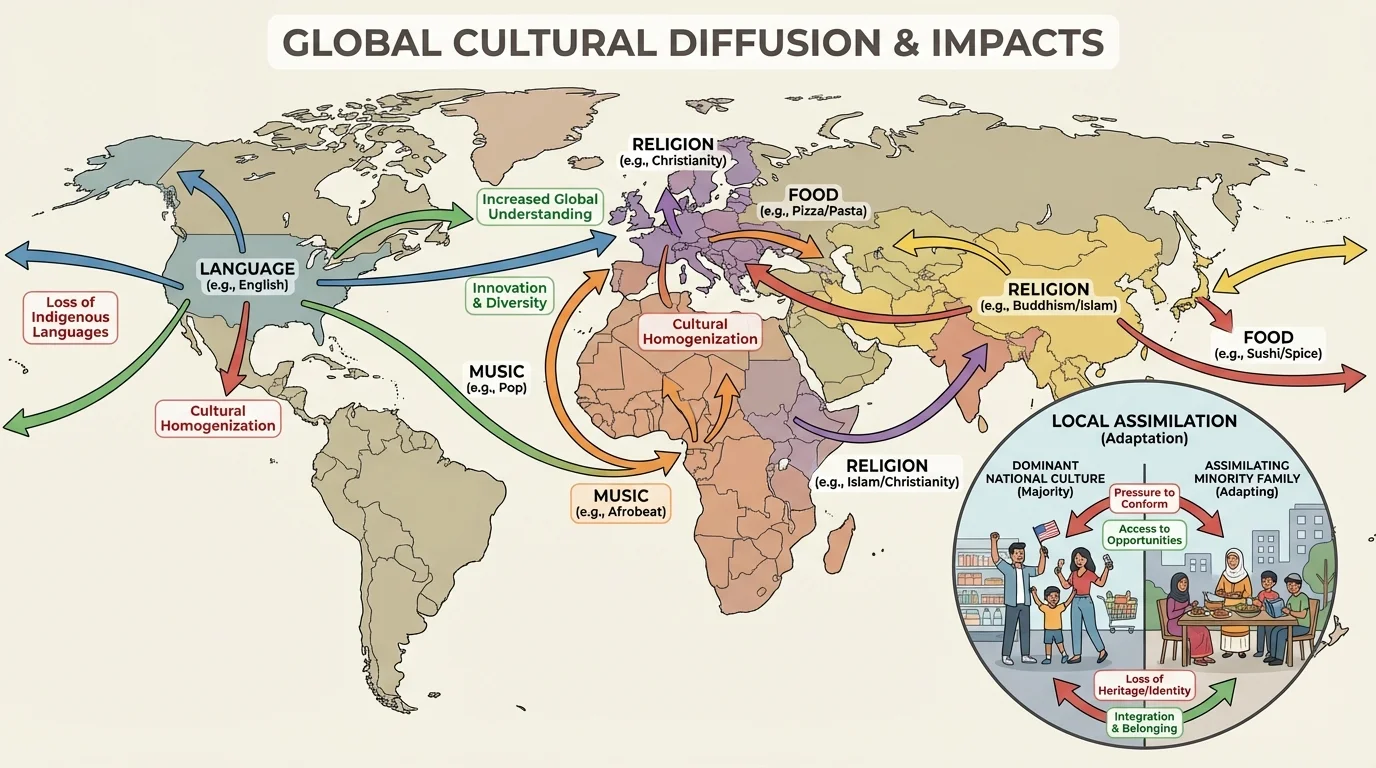
Geographers also ask whether change is voluntary or forced. If people choose to learn a new language in order to participate in a global economy, that is different from a government banning their native language in schools. Choice, power, and law are central to understanding whether cultural change is beneficial, harmful, or mixed.
Geographic pattern and power
Cultural exchange does not happen on a level playing field. Some cultures have greater influence because of military power, colonial history, media industries, or economic dominance. This means diffusion often follows networks of power. A global language may spread because it is useful, but also because the countries that use it control major institutions, markets, or technologies.
This is why geography and history work together. Maps can show where a religion spread, where a language dominates, or where minority groups are concentrated. History explains why those patterns developed. Together, they help us draw stronger conclusions than either subject could alone.
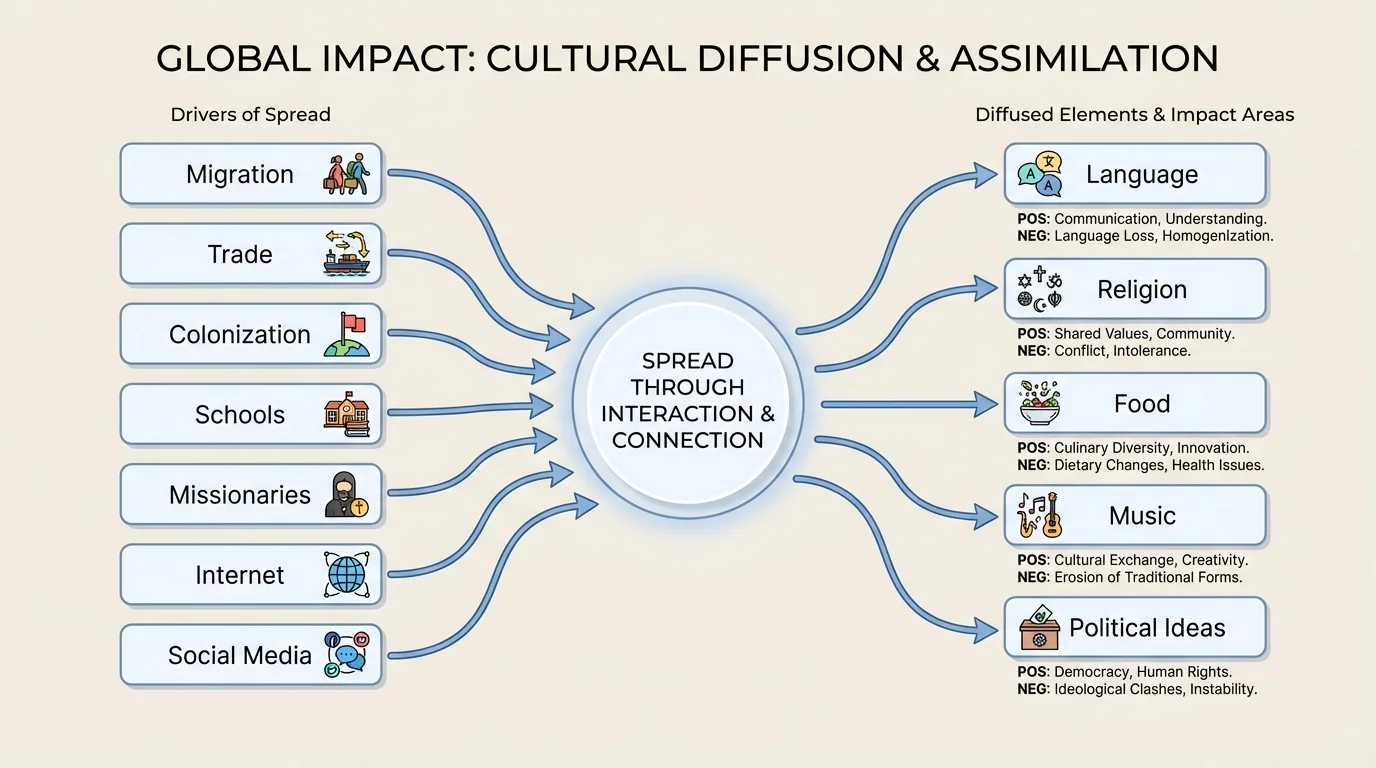
Cultural traits spread through several major pathways, and understanding these pathways helps explain why some influences become global. As [Figure 2] illustrates, migration, trade, conquest, missionary activity, education systems, and digital communication all connect places and carry culture with them.
Migration moves people physically from one place to another. Migrants bring language, religion, food, music, and customs into new regions. Over time, immigrant neighborhoods may preserve original traditions, mix them with local culture, or become more assimilated into the majority culture.
Trade has spread culture for thousands of years. The Silk Roads did not just exchange silk and spices; they also carried religious beliefs, artistic styles, technologies, and languages across Asia, the Middle East, Africa, and Europe. Today, global trade continues this process through brands, consumer goods, and labor networks.
Empire and colonialism spread culture by force as well as contact. European colonial powers imposed languages, religions, and political systems on many parts of Africa, Asia, and the Americas. Some of those influences remain deeply embedded today. The widespread use of English, Spanish, French, and Portuguese in former colonies is a clear example.
Technology and media now spread culture faster than any caravan or ship ever could. A dance style, political slogan, or fashion trend can circulate worldwide in hours. This speed increases cultural exchange, but it also raises questions about who profits, whose voices are amplified, and which local traditions get pushed aside.
Not all diffusion looks the same. Some is direct diffusion, caused by close contact between neighboring societies. Some is indirect diffusion, when traits pass through intermediaries. Some is forced diffusion, when one culture imposes traits on another. Those differences matter because they shape whether outcomes feel enriching, neutral, or traumatic.
One positive effect of cultural diffusion is the spread of ideas about human rights. After World War II, many nations supported international declarations that argued all human beings deserve dignity, legal protection, and basic freedoms. These ideas were influenced by different philosophical and religious traditions, but global institutions helped spread them more widely. As a result, activists in many countries have used shared human rights language to challenge segregation, discrimination, censorship, and political repression.
Language diffusion can also create opportunity. A shared global language such as English may help people participate in international business, science, diplomacy, and higher education. Students in one country can collaborate with peers across the world, read research from many regions, and access wider job markets. Multilingual people often gain cultural flexibility and broader perspectives.
The most widely spoken languages in the world spread not only because of population size, but also because of migration, empire, trade, and global media. A language can become influential far beyond the borders where it first developed.
Religion can spread values of charity, justice, compassion, and community across borders. The diffusion of Buddhism from India into East and Southeast Asia, Islam through trade networks across North and West Africa, and Christianity through Europe, Africa, and the Americas all shaped architecture, education, moral systems, and artistic traditions. In many cases, religions blended with local customs rather than completely replacing them, producing distinctive regional forms.
Cultural exchange also encourages innovation. Foods, musical styles, and technologies often become richer when traditions interact. Jazz developed from African American musical traditions influenced by African rhythms and European instruments. Many modern cuisines are the result of centuries of exchange, including ingredients that originated on different continents.
Ethnic diversity in large cities can strengthen economies and civic life. Places such as Toronto, London, Singapore, and New York function as global crossroads. Different communities bring entrepreneurial networks, specialized knowledge, and creative energy. In such places, cultural diffusion can make society more dynamic and resilient.
The same processes that create opportunity can also produce loss. One major danger is language loss. When a dominant language becomes necessary for school, work, or government, smaller languages may decline. If children stop learning an ancestral language, a community may lose oral history, literature, and identity along with it.
Assimilation becomes especially harmful when it is forced. Governments and institutions have sometimes treated minority cultures as problems to be erased rather than communities to be respected. That can include banning traditional dress, restricting religion, separating children from families, or punishing people for speaking their language. In these cases, assimilation is not simply adaptation; it is cultural oppression.
Religious diffusion has also had negative effects when tied to conquest or intolerance. Conversion by persuasion differs greatly from conversion under threat. History includes many cases in which sacred sites were destroyed, local beliefs were mocked, or minority faiths were legally restricted. Such actions often deepen conflict for generations.
"The real question is not whether cultures change, but who has the power to decide how they change."
Cultural diffusion can become unequal when powerful media industries dominate global attention. A few countries may shape what the world watches, wears, and values. Local artists then struggle to compete, and younger generations may see their own heritage as less modern or less important. This does not mean global popular culture is bad by itself; the issue is imbalance.
Ethnicity can also be affected in painful ways. Stereotypes may spread along with cultural contact. Minority groups may face pressure to hide their names, accents, or customs in order to gain acceptance. In extreme cases, the state may try to redefine who belongs to the nation and who does not, leading to exclusion, persecution, or even ethnic cleansing.
These patterns become clearer when we examine specific places. The world map in [Figure 3] highlights how diffusion and assimilation play out differently across regions. A global process may exist everywhere, but the outcomes depend on local history, political systems, and relationships between majority and minority groups.
Case study 1: Indigenous boarding schools in the United States and Canada. In the nineteenth and twentieth centuries, many Indigenous children were removed from their families and placed in boarding or residential schools. Officials aimed to assimilate them into Euro-American society. Students were often forbidden to speak their native languages or practice cultural traditions. This policy weakened communities, caused trauma, and contributed to long-term language decline. It is one of the clearest examples of assimilation producing harmful effects.
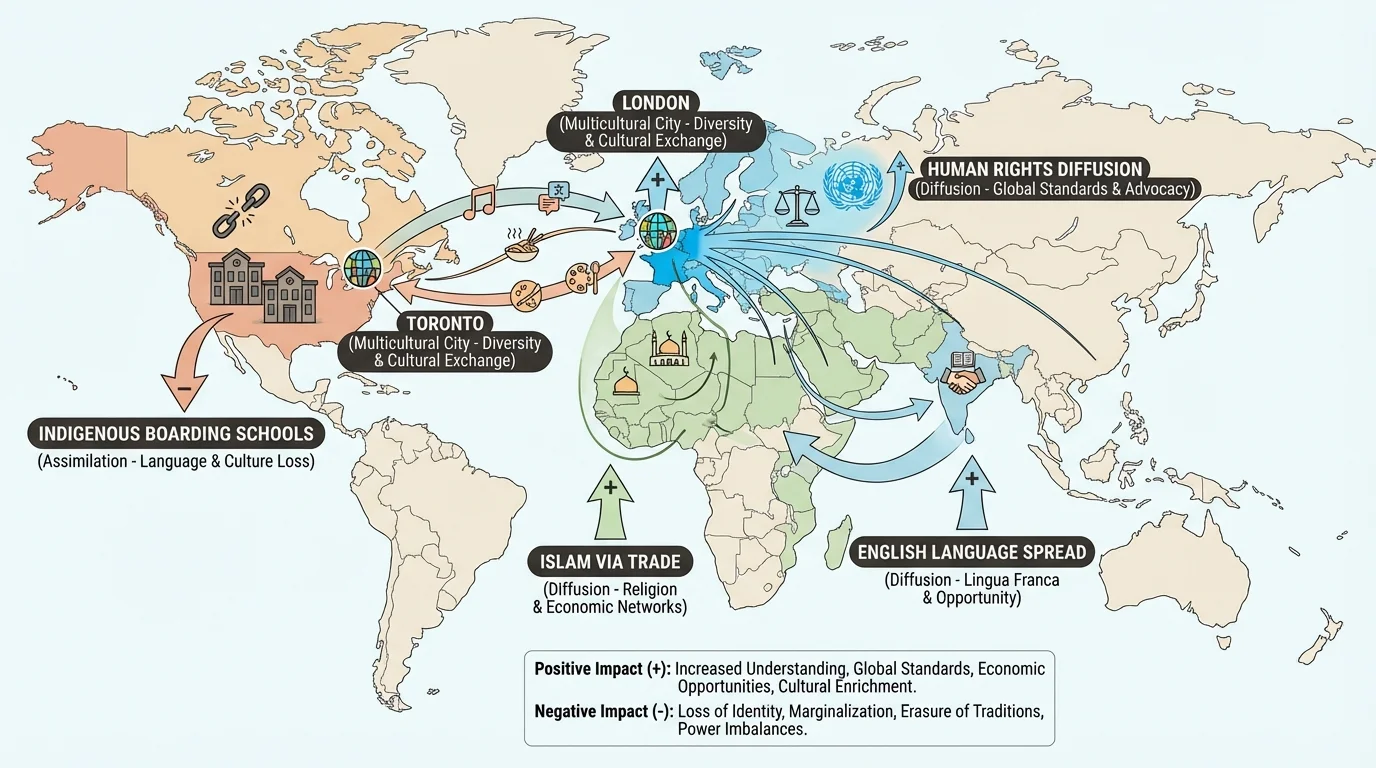
Case study 2: The global spread of English. English became widespread through the British Empire and later through the economic, scientific, and cultural influence of the United States. Today it serves as a global lingua franca in aviation, diplomacy, business, and the internet. This has clear advantages for communication, but it can also overshadow local languages. The conclusion is not simply that English is good or bad; its effects vary depending on whether multilingualism is supported or local languages are neglected.
Case study 3: Islam along African trade routes. Islam spread into North and West Africa through merchants, scholars, and rulers connected to trans-Saharan trade. In many areas, it mixed with preexisting customs and social structures. This demonstrates that diffusion does not always erase earlier traditions. Often, cultural contact creates hybrid identities rather than total replacement.
Case study 4: Human rights norms after World War II. International organizations, treaties, and activism helped spread shared standards about genocide, refugees, civil rights, and discrimination. While countries still violate these principles, the global diffusion of rights language gives people common tools to challenge injustice. Anti-apartheid movements, women's rights movements, and campaigns for Indigenous rights all drew strength from these international ideas.
Case study 5: Global cities. In cities such as London and Toronto, people from many ethnic and religious backgrounds live in close contact. Restaurants, festivals, schools, and neighborhoods show strong cultural diffusion. At the same time, debates continue over integration, discrimination, and belonging. These cities reveal that diversity alone does not guarantee equality; laws and social attitudes matter too. The same point also highlights the difference between exchange across cultures and pressure to conform within one dominant system.
| Case | Main Process | Positive Effects | Negative Effects |
|---|---|---|---|
| Global English | Diffusion through empire, trade, media | International communication, education, careers | Smaller languages may decline |
| Indigenous boarding schools | Forced assimilation | Very limited claimed benefits by authorities | Trauma, identity loss, language suppression |
| Islam in West Africa | Diffusion through trade and scholarship | Shared learning networks, law, architecture | Sometimes tension with older practices |
| Human rights norms | Diffusion through institutions and activism | Protection against abuse, global solidarity | Implementation uneven; sometimes politicized |
| Global cities | Migration, diffusion, partial assimilation | Diversity, innovation, economic growth | Discrimination, segregation, identity pressure |
Table 1. Comparison of major case studies showing different pathways and consequences of diffusion and assimilation.
Predictions are strongest when they rely on trends and conditions rather than guesses. As [Figure 4] suggests, students can ask several key questions: Is the change voluntary or forced? Is power equal or unequal? Are minority rights protected by law? Is technology amplifying one culture while silencing another? The answers help forecast whether the impact will likely be positive, negative, or mixed.
For example, if migration continues to increase and translation technologies improve, more people may become multilingual. That could support wider communication while allowing people to keep home languages. But if schools and media reward only dominant languages, then minority languages may weaken faster. The future depends on policy choices as much as on technology.
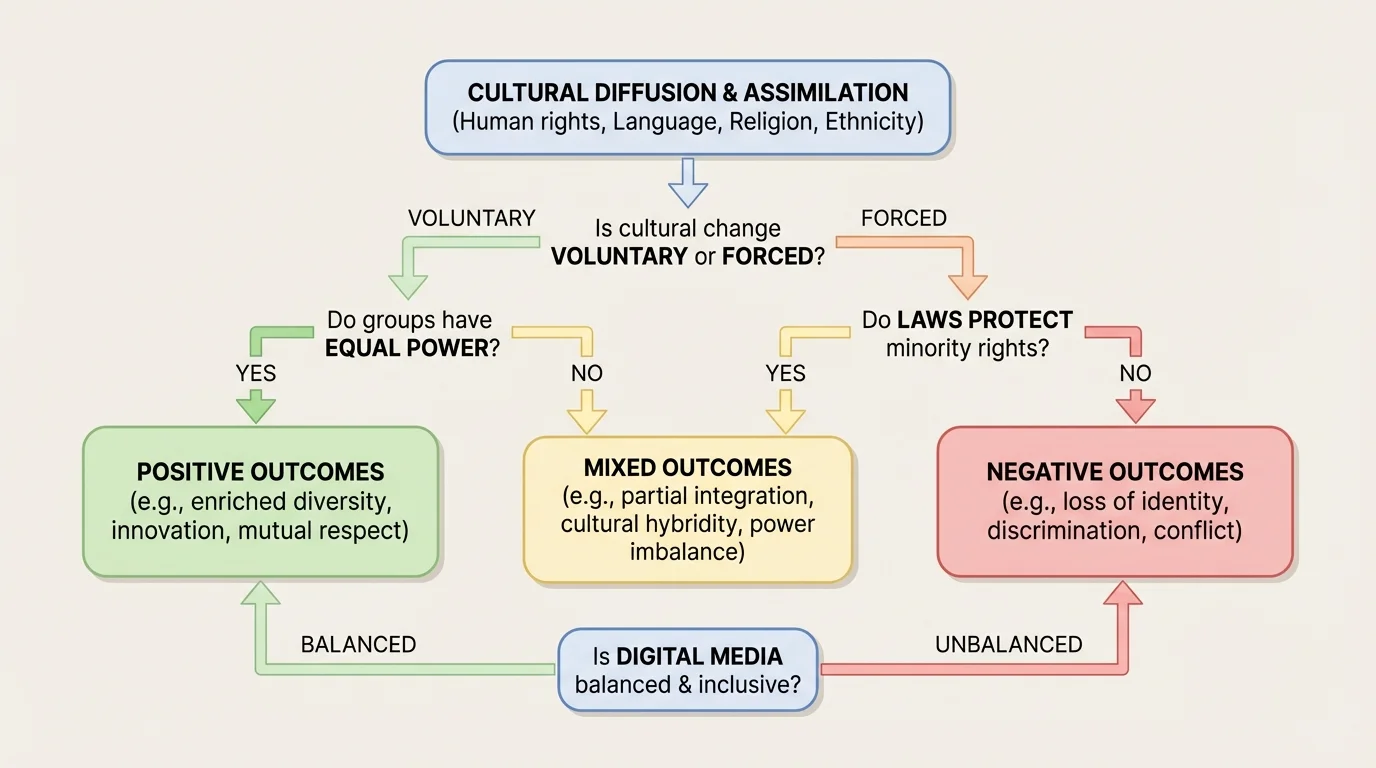
We can make similar predictions about religion and ethnicity. In countries that protect freedom of worship and minority rights, religious diversity is more likely to coexist peacefully. In countries where one group controls the state and excludes others, assimilation pressures and ethnic tension are more likely to grow. Rapid online communication may spread tolerance campaigns, but it can also spread hate speech and conspiracy theories.
Using evidence to make a prediction
A country is experiencing large-scale immigration, strong internet access, and democratic laws that protect minority languages.
Step 1: Identify diffusion pathways
Migration and digital communication both increase contact among groups.
Step 2: Check the power relationship
If minority languages are protected by law, the pressure to abandon them is lower.
Step 3: Predict the likely outcome
The society will probably experience strong cultural diffusion with a better chance of multilingualism and hybrid culture than forced assimilation.
This prediction is not certain, but it is evidence-based because it uses geography, policy, and social conditions together.
Another likely future trend is the growth of hybrid identity. Many young people already combine local traditions with global influences in clothing, music, language, and politics. That does not necessarily mean identity becomes weaker. In many cases, identity becomes more layered: local, national, ethnic, religious, and global at the same time.
To draw a strong conclusion, historians and geographers compare evidence from multiple sources. That means looking at maps, census data, migration patterns, language-use statistics, laws, testimonies, and historical records. A conclusion should explain not only what happened, but why it happened and for whom it was beneficial or harmful.
One weak conclusion would be: "Cultural diffusion is always good because it connects people." Another weak conclusion would be: "Assimilation is always bad." Reality is more complex. Voluntary adaptation to a new society can help people access education and economic opportunity. But forced assimilation violates rights and damages identity. Diffusion can enrich life through exchange, yet it can also spread domination. Good conclusions recognize both pattern and variation.
When evaluating evidence, remember the difference between cause and effect. Migration, trade, and empire are causes or pathways. Language change, legal reform, ethnic tension, and hybrid culture are effects. Mixing these up leads to weak analysis.
A balanced conclusion might sound like this: cultural diffusion generally increases global interconnectedness and can promote creativity, communication, and shared rights, but its outcomes become harmful when power is unequal and groups are forced to abandon their language, religion, or ethnicity. That kind of conclusion is stronger because it identifies the conditions under which outcomes change.
The case studies earlier, including those mapped in [Figure 3], support this pattern. Human rights language spread across borders and helped many movements. English spread and opened opportunities, but also contributed to language decline in some places. Indigenous boarding schools show that when assimilation is imposed by institutions, the damage can last for generations.
Societies do not have to choose between complete isolation and total cultural blending. Many of the best outcomes come from protecting diversity while allowing exchange. Governments can support bilingual education, legal rights for minority religions, anti-discrimination laws, and preservation of Indigenous languages. Communities can celebrate festivals, document oral histories, and teach younger generations their heritage while still participating in a globalized world.
This balance is one of the major geographic challenges of the modern era. The world is interconnected, but people still need roots. The goal is not to freeze culture in place; cultures have always changed. The goal is to ensure that change happens with dignity, choice, and respect. When that happens, diffusion can widen horizons without erasing identity.
That is why the study of cultural diffusion and assimilation belongs at the heart of geography. It explains how people, ideas, and places shape one another across time and space. It also helps us think more clearly about one of the biggest questions in public life: how can a connected world remain both diverse and just?
