When people cannot find enough food, fuel, jobs, or housing, fear spreads quickly. Under those conditions, the most dangerous political leaders do not calm the public; they give people someone to blame. Genocide is never an automatic result of a recession or shortage, but economic crisis can create an environment in which hatred, exclusion, and mass violence are easier to justify. To understand how that happens, it helps to look at economics and history together.
An economic crisis is a period of severe disruption in production, employment, prices, trade, or access to basic goods. A society may face high unemployment, inflation, falling wages, debt, shortages, or all of these at once. In a mixed economic system, markets usually help producers and consumers allocate resources, but governments also intervene through taxes, spending, regulations, welfare programs, and emergency measures. In a crisis, those normal systems become stressed. If institutions are weak, leaders may use that stress to turn economic pain into political hatred.
Economics is about choices under conditions of scarcity. Scarcity means that people want or need more than is available at a given time. In ordinary circumstances, markets balance supply and demand through prices. But when a war, depression, drought, sanctions, state corruption, or financial collapse sharply reduces supply, the competition for necessities becomes more intense. Households worry about survival, businesses worry about losses, and governments worry about unrest.
Economic crisis is a serious breakdown in a country's economy, often involving unemployment, shortages, inflation, or collapsing production.
Rationing is a system that limits how much of a scarce good each person can buy or receive.
Scapegoating is blaming a person or group for problems they did not cause, often to protect those actually responsible.
Dehumanization is treating people as less than human, which makes cruelty against them easier to excuse.
Crises affect behavior because they change what people fear most. A student might compare this to a team under pressure in a championship game: stress can reveal discipline, but it can also lead to panic and bad decisions. In a nation, the stakes are far higher. If public trust falls and institutions fail, people may become more willing to accept extreme policies that promise order, jobs, cheap food, or restored national pride.
That does not mean poor societies inevitably become violent. Many societies suffer hardship without genocide. The key issue is how political leaders, media systems, armed groups, and state institutions respond to hardship. Economics helps explain the pressure; politics explains how that pressure is used.
[Figure 1] During severe shortages, governments often turn to rationing to control the distribution of food, fuel, medicine, or clothing. This can be a fair emergency measure if it is applied equally. But the same tool can become a weapon of exclusion. The chain from shortage to rationing to unequal access to social tension appears clearly. When basic needs are controlled by the state or by armed groups, access to survival itself becomes political.
Ration cards, permits, checkpoints, and identity papers can determine who eats, who travels, and who works. If a government decides that one ethnic, religious, or political group is less deserving, that group may be denied food or forced to wait longer, pay more, or depend on illegal markets. This creates not only suffering but also public humiliation. It sends a message that some lives matter less.
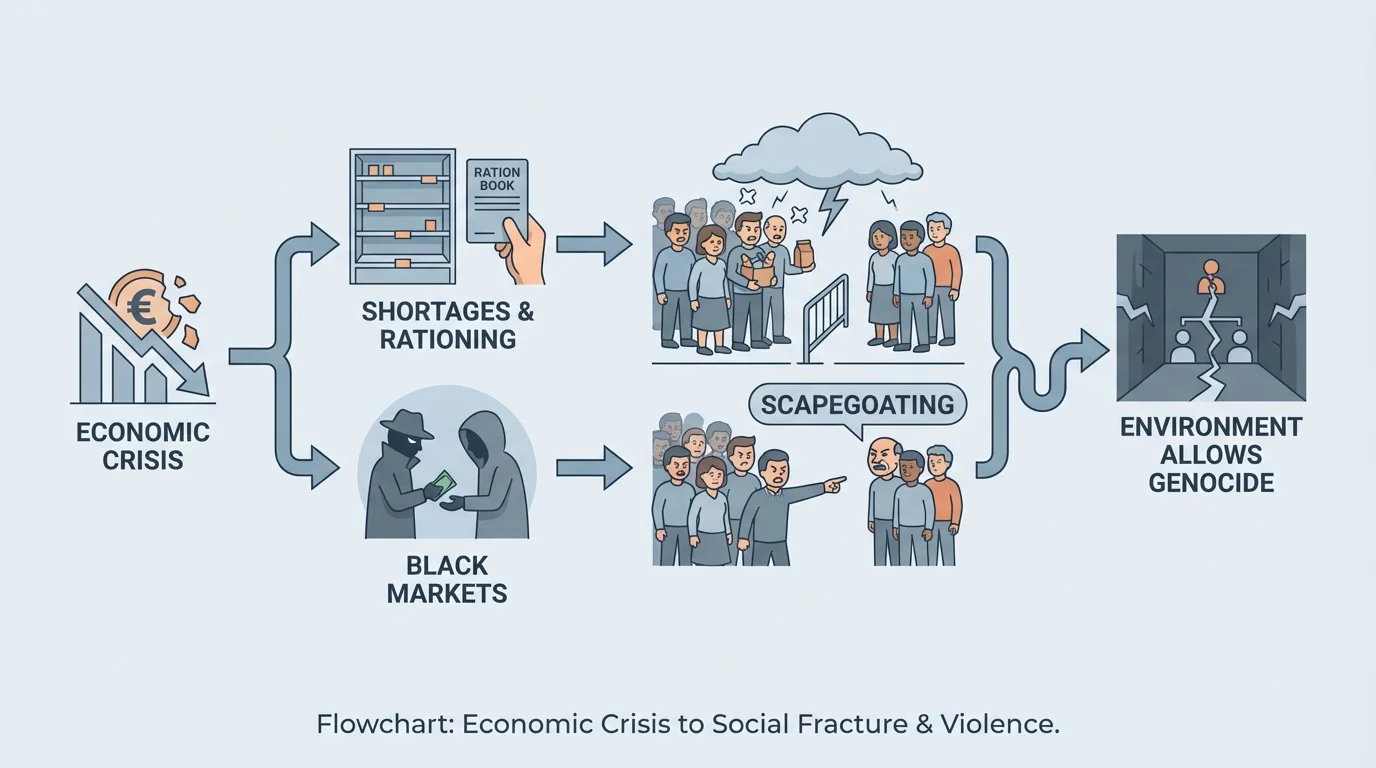
Shortages also encourage black markets, where goods are sold illegally at high prices. In these markets, those with money, political connections, or armed protection get access first. Poorer families suffer more. If leaders spread propaganda claiming that minorities are hoarding supplies or cheating the system, ordinary people may begin to see neighbors as enemies rather than fellow citizens facing the same crisis.
Historically, controlling food has been a powerful form of domination. In some genocidal settings, targeted groups were first excluded from legal employment, then from normal markets, and finally from access to food relief. By the time mass killing began, the victims had already been economically isolated. This is one reason genocide often develops gradually: economic exclusion weakens a group before physical destruction begins.
Scapegoating works because it offers a simple answer to complicated problems. Inflation may result from war, debt, supply disruption, or poor policy. Unemployment may come from technological change, financial collapse, or corruption. But a leader seeking power may claim, falsely, that one minority group caused the suffering. That message can be emotionally powerful because it turns fear into anger.
In economic terms, scapegoating distorts how people understand market outcomes. Instead of recognizing that shortages may come from damaged supply chains, monopolistic control, state failure, or collapsing demand, the public is encouraged to believe that a visible group is "stealing" jobs, manipulating prices, or draining public resources. This false explanation hides the role of real decision-makers.
Why scapegoating can spread quickly
People under stress often search for certainty. Propaganda gives them a target, a story, and the illusion of control. If newspapers, radio, schools, or social media repeat the same accusation, the lie can begin to feel true, especially when it matches existing prejudice.
Scapegoating also changes the relationship between producers and consumers. Producers may stop hiring targeted groups. Consumers may boycott their businesses. Banks may deny them loans. Officials may seize their property. A group that was once active in the economy is pushed out of it. This makes the group look poorer and weaker, which in turn is used as "proof" that it does not belong. The cycle is self-reinforcing.
Competition can also be manipulated. In healthy markets, competition can lower prices and improve quality. But in a crisis, governments can reshape competition so that favored groups win and targeted groups lose. Licenses, contracts, land rights, and import permits may be distributed unfairly. Economic policy becomes a tool of persecution.
[Figure 2] Dehumanization rarely begins with killing. It begins with words, symbols, jokes, legal restrictions, and repeated messages that some people are dirty, dangerous, disloyal, parasitic, or less civilized. The step-by-step pattern traces how prejudice can become organized destruction over time.
Why does this matter economically? Because once a minority is portrayed as less than fully human, harming that group can be reframed as practical rather than immoral. Confiscating property becomes "recovery." Forced labor becomes "efficiency." Segregation becomes "security." Starvation becomes "necessary management of scarce resources." Dehumanizing language hides violence behind administrative language.
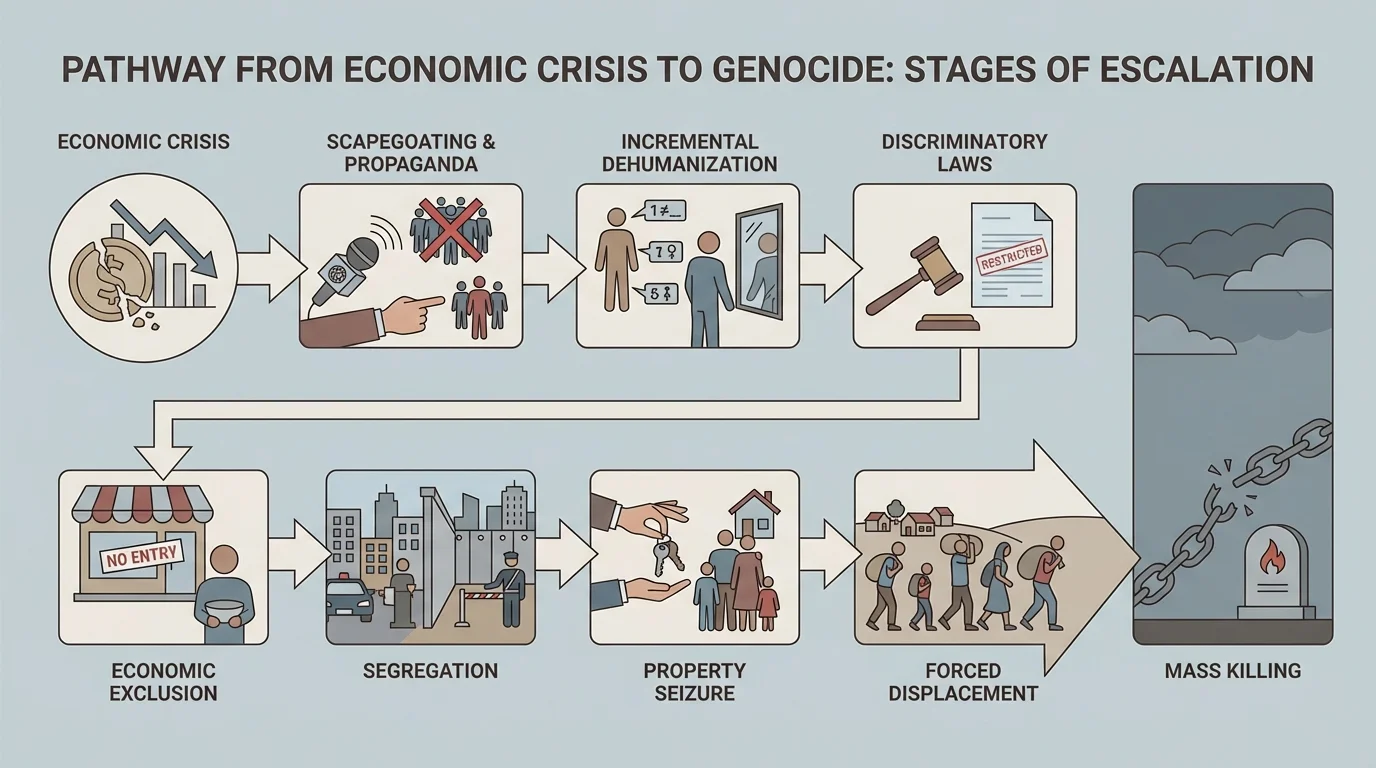
Incremental dehumanization often follows recognizable stages. First, stereotypes spread. Then legal discrimination appears: citizenship limits, business restrictions, land seizure, or school exclusion. Next come forced identification measures, segregation, internment, or expulsion. Violence becomes more public, and bystanders become accustomed to it. By the time mass killing begins, many people have already accepted the idea that the victims are outside the protection of law and empathy.
This process is especially dangerous during crisis because hardship makes harsh measures seem normal. If a society has been told for years that there is "not enough" for everyone, then removing one group from the economy may be presented as a solution. In reality, genocide does not solve scarcity. It destroys trust, labor, investment, and social stability. It makes economies worse in the long run while causing irreversible human loss.
The study of economics asks how mixed economic systems, market structures, competition, government policies, and the decisions of producers and consumers affect outcomes. In periods of peace, these ideas help explain prices, wages, and trade. In periods of political extremism, they also help explain exclusion. Markets do not operate in a moral vacuum. Rules matter.
A mixed economic system combines private decision-making with government intervention. In a crisis, governments may increase control over prices, labor, transportation, trade, and distribution. Such intervention can protect people through relief programs, public works, and anti-hoarding rules. But intervention can also be abused. A state that controls transportation can block refugees. A state that controls food can starve opponents. A state that regulates business can strip minorities of legal ownership.
Market structure matters too. If a few firms or political allies dominate key industries such as grain, fuel, media, or transport, they can shape public life far beyond ordinary business decisions. Monopoly-like power can support discriminatory policy by restricting supplies, controlling information, or rewarding loyalists. When law is weak, economic concentration and political extremism become a dangerous combination.
Case example: how policy can change outcomes
Consider two governments facing the same wheat shortage.
Step 1: Government A uses equal rationing, transparent records, anti-corruption inspections, and emergency imports.
Step 2: Government B gives preferred access to one ethnic majority, spreads rumors that minorities are hoarding grain, and allows officials to seize minority-owned shops.
Step 3: Government A reduces panic and preserves trust. Government B increases resentment, isolates a target group, and normalizes abuse.
The shortage is similar, but the policy choice is different. Economic stress does not force genocide; leaders choose whether scarcity becomes cooperation or persecution.
Consumers also matter. People make choices about where they shop, what rumors they believe, and whether they participate in boycotts, looting, or denunciations. Producers matter because employers, merchants, transporters, and bankers can either resist discrimination or help enforce it. In genocidal systems, ordinary economic actors are often pressured into becoming participants.
[Figure 3] Several major genocides show similar patterns of crisis, exclusion, and violence. The details differ greatly, and each case has its own political and historical context, but economics often helps explain why extremist messages gained support and how states or militias organized persecution.
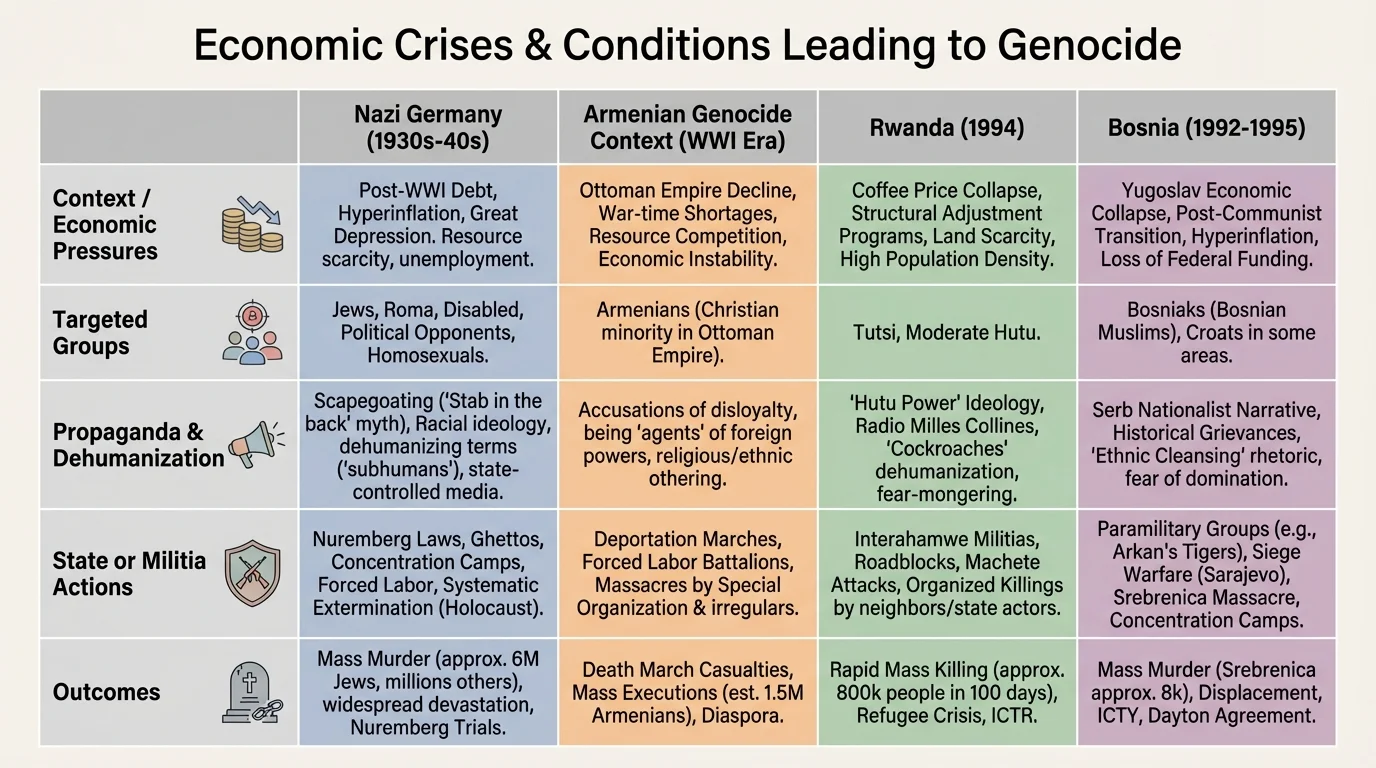
Nazi Germany is one of the clearest examples. The Great Depression caused mass unemployment, business collapse, and widespread insecurity. The Nazi regime exploited that pain by blaming Jews and other groups for Germany's problems. Anti-Jewish laws removed Jews from professions, stripped businesses, seized property, and excluded people from markets and citizenship. The regime presented theft as economic correction and mass murder as national purification. Primary sources such as propaganda posters, laws such as the Nuremberg Laws, and wartime records show how economic exclusion prepared the way for genocide.
The Armenian Genocide, during World War I, also unfolded in a context of military crisis, resource strain, and state fear. The Ottoman government targeted Armenians as disloyal and dangerous. Deportations removed communities from their homes, property was confiscated, and survival resources were denied. Wartime emergency conditions made extreme acts easier to hide and justify.
Rwanda in 1994 demonstrates how land pressure, poverty, political crisis, and propaganda can interact. Economic hardship alone did not cause genocide, but it intensified social stress. Extremist leaders used radio and local networks to portray Tutsi as enemies and threats. Once killing began, access to land, property, and local power became tied to violence. Neighbors were encouraged to see murder not only as political obedience but also as material opportunity.
Bosnia in the 1990s shows that genocide can occur in a modern society with markets, industry, and urban life. As Yugoslavia broke apart, war, economic collapse, nationalism, and competition for territory fed ethnic violence. "Ethnic cleansing" involved removing populations from economically and strategically important areas. Homes, businesses, and land were part of what was being seized, not just symbols of identity.
These cases remind us that genocide is both ideological and material. Hatred matters, but so do jobs, land, prices, supply systems, and state control. Looking only at ideas misses how perpetrators use institutions and resources to carry out violence.
If crises can create danger, good policy can reduce it. The first priority is to prevent scarcity from becoming a struggle between groups. Fair distribution systems, transparent rationing, anti-corruption enforcement, and emergency aid reduce the fear that others are secretly taking what is needed. When people believe the system is fair, they are less vulnerable to scapegoating.
Some societies under severe wartime stress avoided mass internal violence because rationing was broadly shared and institutions retained public trust. Shared sacrifice can strengthen solidarity when leaders refuse to divide the population.
Governments can also reduce risk by protecting competition and preventing politically connected elites from monopolizing essential goods. If one faction controls grain, fuel, media, and transport, it can turn economic power into coercive power. Strong courts, free journalism, and independent monitoring make it harder for leaders to weaponize shortages.
Social policy matters as well. Unemployment relief, public health programs, price stabilization, and support for displaced families can lower the desperation that extremist movements exploit. Schools and media literacy programs can help people recognize propaganda. International institutions can support food security, refugee protection, sanctions against perpetrators, and documentation of abuses before violence escalates further.
Long-term peace also depends on inclusion. Minority groups need equal access to property rights, credit, education, and political participation. When people can compete fairly in the economy, they are less likely to be cast as outsiders living at others' expense. As we saw earlier in [Figure 1], unequal access to necessities can quickly produce resentment; preventing that inequality is therefore a form of conflict prevention.
Historians use primary sources such as laws, speeches, ration cards, newspapers, diaries, photographs, and official reports to study how economic crisis and genocide interact. They also use secondary sources, such as scholarly books and articles, to compare evidence and debate causes. This matters because genocidal regimes often lie about what they are doing. They describe theft as reform, imprisonment as relocation, and murder as security policy.
Careful study also prevents a major mistake: economic determinism, the belief that economics alone explains everything. Economic crisis can create conditions of fear, dependency, and competition, but people still make moral and political choices. Leaders choose whether to distribute aid fairly or selectively. Officials choose whether to obey criminal orders. Citizens choose whether to join boycotts, spread rumors, hide neighbors, or resist.
"The road to genocide is built through institutions, language, and choices long before the killing starts."
The pattern of incremental escalation remains crucial. As [Figure 2] shows, persecution usually moves from words to laws, from laws to exclusion, and from exclusion to open violence. Recognizing those earlier steps is one of the most important lessons history offers.
Economic systems are supposed to organize production and distribution so people can live, work, and exchange fairly. When fear, propaganda, and state power turn those systems into tools for excluding a minority, the market no longer serves society; it becomes part of a machinery of oppression. Understanding that relationship helps explain not only past genocides but also warning signs in the present.
