A government can lower taxes, raise spending, increase interest rates, reduce regulations, protect an industry, or tighten pollution rules. Each action sounds like a solution to some problem. But here is the hard truth of economics: there is no such thing as a policy with only winners and no costs. A policy that helps borrowers may hurt savers. A policy that protects jobs in one industry may raise prices for consumers. A policy that reduces inflation today may increase unemployment tomorrow. To understand public policy, we have to look beyond slogans and ask a tougher question: who benefits, who pays, and when?
In an economic system, people and institutions are connected. Households earn income, buy goods, save money, and pay taxes. Businesses hire workers, invest, borrow, and produce output. Governments collect revenue, provide services, and set rules. Because these parts are linked, any policy change sends effects through the entire system. That is why economists study not only whether a policy has a goal, but also its trade-offs, side effects, and distribution of costs and benefits.
A public policy is a course of action taken by government to influence economic outcomes. Policies can aim to reduce unemployment, slow inflation, protect the environment, support certain industries, or promote economic growth. Even when a goal is widely accepted, the method of reaching it creates choices. Using resources in one way means those same resources cannot be used somewhere else.
This idea is connected to opportunity cost, the value of the next best alternative given up when a choice is made. If the government spends billions on road construction during a recession, that money cannot also be used for healthcare, education, or debt reduction. If a central bank raises interest rates to fight inflation, it may reduce spending and investment that could have supported jobs. The cost is not always a direct payment. Sometimes the cost is slower growth, fewer jobs, or less purchasing power.
Trade-off means giving up one thing to gain another. Costs are what individuals, businesses, or governments lose, sacrifice, or must pay because of a policy. Benefits are the gains or improvements created by a policy. In economics, these costs and benefits can be financial, social, or long-term rather than immediate.
Policies also create winners and losers because people do not start from the same position. A rise in fuel taxes may be easier for a high-income commuter to absorb than for a low-income worker who must drive long distances. A subsidy for electric vehicles may help buyers who can already afford new cars more than families who cannot. Looking at policy only from a national average can hide these uneven effects.
When economists evaluate policy, they often focus on several big ideas. One is incentive. An incentive is something that encourages or discourages behavior. A tax on cigarettes is meant to discourage smoking. A tax credit for solar panels is meant to encourage clean energy investment. Policies work partly because they change what people find worthwhile.
Another idea is efficiency, which refers to using resources in a way that produces the greatest possible value with the least waste. A policy can be well intentioned but inefficient if it costs too much relative to what it achieves. A related idea is equity, or fairness. A policy may be efficient overall but unfairly burden one group. Economic debates often happen because people value efficiency and equity differently.
Economists also pay attention to externality, a cost or benefit of an action that affects people who were not directly part of the decision. Pollution is a classic negative externality because a factory may profit while nearby residents bear health costs. Vaccination creates a positive externality because one person's choice can reduce disease spread for others. Policies are often designed to reduce harmful externalities or encourage beneficial ones.
Stakeholders and economic impact
A policy should be judged by how it affects different stakeholders, including consumers, workers, firms, taxpayers, investors, and future generations. A policy can increase total output while still harming a particular region or age group. Careful analysis asks not just whether the economy changes, but how the change is distributed.
This is why economic policy is rarely simple. Two people can agree on the problem and still disagree on the policy because they predict different incentives, different side effects, or different impacts on stakeholders.
[Figure 1] The business cycle is the pattern of expansion, peak, recession, trough, and recovery in economic activity over time. During an expansion, output rises, businesses hire more workers, and incomes tend to grow. During a recession, production falls, unemployment rises, and consumer confidence often weakens. Governments often use policy to reduce the severity of these swings.
Why does this matter? Because the same policy may be helpful in one phase of the cycle and harmful in another. Increasing government spending during a recession can support demand and jobs. Doing the same thing when the economy is already overheating may add to inflation. Lowering interest rates can encourage borrowing when demand is weak, but if prices are already rising too fast, it can make inflation worse.
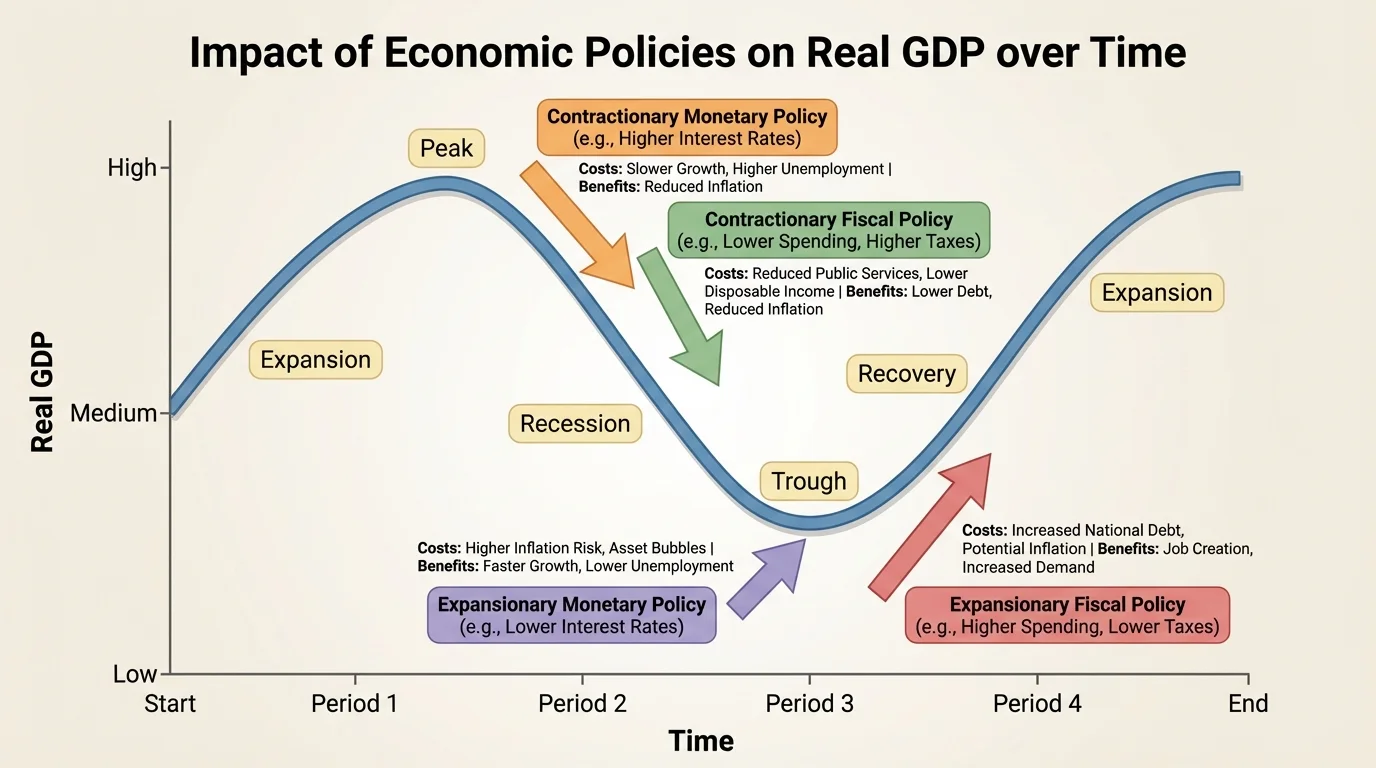
Stabilization policy aims to reduce extreme ups and downs in the economy. Governments and central banks do not control the economy perfectly, but they try to smooth the business cycle. This can protect workers from severe unemployment, businesses from collapsing demand, and families from sudden income losses. At the same time, stabilization policies can create new costs such as higher deficits, future inflation, or delayed market adjustments.
One challenge is timing. By the time officials recognize a recession, debate a response, and implement the policy, conditions may already be changing. A policy that is too late can miss its target. That is one reason economists often disagree not only about what to do, but also about when to do it.
[Figure 2] Fiscal policy refers to government decisions about spending and taxation. It affects the economy directly through public purchases and indirectly through household and business income. When government changes taxes or spending, the effects spread through households and firms rather than stopping at the first transaction.
Suppose the government increases spending on infrastructure during a recession. Construction firms receive contracts, workers earn wages, and suppliers sell materials. Those workers and firms then spend part of their income elsewhere, creating further rounds of economic activity. The benefit may be lower unemployment and improved roads or bridges. The cost may be a larger budget deficit, more government debt, or the risk that the money is spent inefficiently.
Now consider a tax cut. Households may have more disposable income, which can raise spending. Businesses may keep more profit, which can encourage hiring or investment. But not every family spends the extra money in the same way, and not every business uses it to expand. Some save it, pay debts, or hold cash. That means the results can vary by income level and by economic conditions.
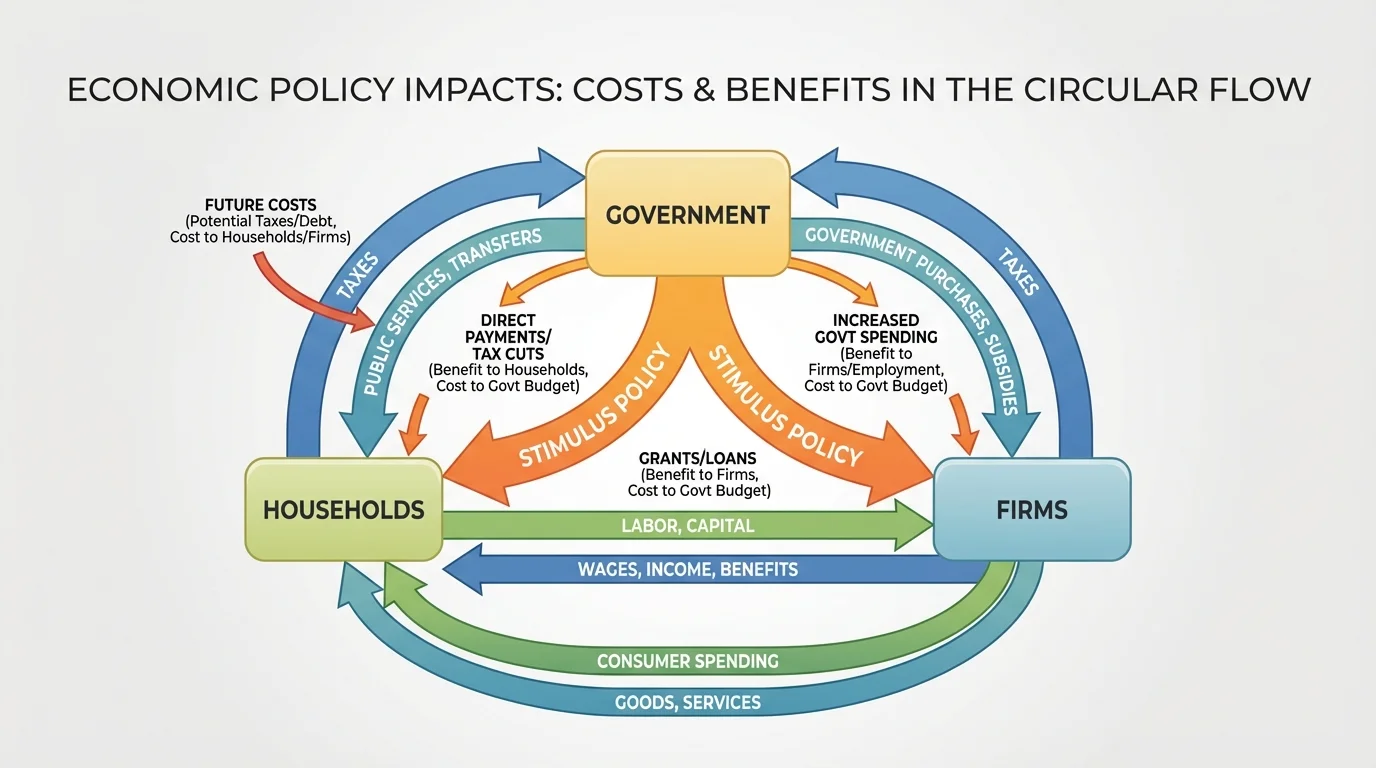
Fiscal policy also raises questions of fairness. If taxes are cut mainly for high-income households, those families receive more direct benefit, but lower-income families may not feel much immediate relief. If government spending focuses on one region, people elsewhere may help pay through taxes without receiving equal benefit. If borrowing pays for a program today, future taxpayers may bear part of the cost.
Automatic stabilizers are an important part of fiscal policy. These are features of the economy that change government spending or tax collection without a new law being passed. For example, during a recession, income tax payments usually fall because people earn less, while unemployment benefits may rise because more people qualify. These automatic changes support demand, but they also increase government spending or reduce revenue.
Case study: recession stimulus
A country faces a sharp downturn. The government approves a $200 billion spending package for transportation, school repair, and emergency aid.
Step 1: Identify the intended benefit.
The policy is meant to increase demand, protect jobs, and prevent a deeper recession.
Step 2: Identify direct winners.
Construction workers, suppliers, local governments, and unemployed households receiving aid may benefit quickly.
Step 3: Identify possible costs.
The package may increase the budget deficit, add to national debt, or fund projects that are slow to start.
Step 4: Consider who may not benefit equally.
Regions without funded projects or workers outside the supported sectors may see less immediate improvement.
The same policy can therefore be both helpful and costly, depending on the stakeholder and time frame.
Later in the lesson, the same logic from [Figure 2] matters again: once money enters one part of the economy, the effects spread through incomes, purchases, taxes, and savings choices.
[Figure 3] Monetary policy is the use of tools by a central bank to influence interest rates, credit conditions, and the money supply. Changes in interest rates affect borrowers, savers, businesses, and consumers in different ways. Lower rates tend to encourage borrowing and spending; higher rates tend to discourage them.
If the central bank lowers interest rates during a recession, loans for homes, cars, and business investment may become cheaper. That can boost spending and hiring. The benefit is stronger economic activity and possibly lower unemployment. The cost is that savers may earn less on deposits, and if demand rises too much, inflation may follow.
If the central bank raises rates to fight inflation, the opposite pattern often happens. Borrowing becomes more expensive, which can slow business investment and consumer spending. This may reduce inflationary pressure. However, firms may delay expansion, homebuyers may struggle with mortgage costs, and unemployment may rise if the slowdown becomes significant.
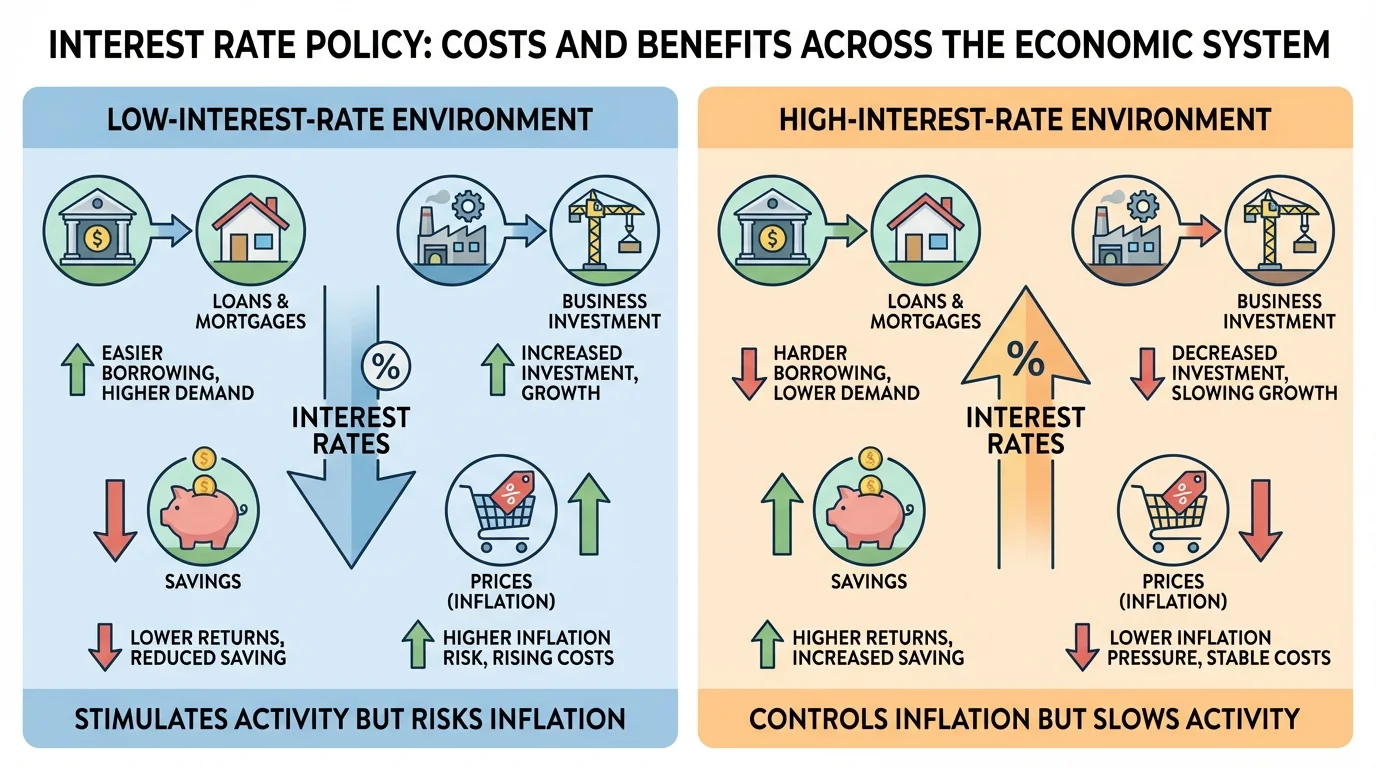
This creates one of the most debated trade-offs in macroeconomics: the balance between inflation and unemployment in the short run. Rapid price increases hurt people whose wages do not keep up, especially retirees or workers on fixed incomes. Yet policies that slow inflation too aggressively can reduce job opportunities. A central bank is often trying to avoid both high inflation and high unemployment, but it cannot always reduce each problem at the same time.
Monetary policy also has unequal effects. Young families trying to buy homes may be strongly affected by higher rates. Large firms with access to credit markets may adapt more easily than small businesses. Savers may welcome higher returns, while debtors feel pressure. This is another reminder that a policy should not be judged only by a headline number.
Even small changes in interest rates can have large effects when households and businesses carry major loans. A change of just a few percentage points can alter monthly payments enough to change spending decisions across the economy.
The contrast in borrowing and saving choices remains clear in [Figure 3]: a policy that helps contain inflation can at the same time make credit less affordable for millions of people.
Not all policies are aimed mainly at demand. Some try to change how the economy produces goods and services. These include tax incentives for investment, education and training programs, subsidies, tariffs, labor rules, and environmental regulations. Their goals may include raising productivity, protecting workers, strengthening national industries, or reducing harm.
A subsidy is government financial support for a person, business, or industry. Subsidies can encourage useful activities such as renewable energy, farming, or research. The benefit is that socially valuable production may increase. The cost is that taxpayers finance the subsidy, and inefficient firms may survive longer than they would in a fully competitive market.
A tariff is a tax on imported goods. Supporters argue that tariffs can protect domestic jobs and industries from foreign competition. Critics note that tariffs often raise prices for consumers and for businesses that rely on imported materials. A steel tariff, for example, may help domestic steel producers but increase costs for car manufacturers, appliance companies, and buyers of those products.
Environmental regulation provides another important example. A rule limiting pollution may impose costs on firms that must install cleaner equipment or change production methods. Yet the benefits can include better health, cleaner water, lower medical costs, and reduced environmental damage. If policymakers ignore only the firms' costs, they miss the public benefits. If they ignore compliance burdens, they miss the pressure placed on producers and workers.
Case study: minimum wage policy
A government raises the minimum wage from one level to a higher level to improve earnings for low-wage workers.
Step 1: Identify the intended benefit.
Workers who keep their jobs may earn higher income and have greater purchasing power.
Step 2: Consider possible costs to firms.
Businesses with thin profit margins may face higher labor costs.
Step 3: Think about responses.
Some firms may raise prices, reduce hours, invest in automation, or hire fewer workers.
Step 4: Judge distribution.
The policy may benefit employed low-wage workers but create challenges for some small businesses or for job seekers if hiring slows.
The debate is not whether the policy has benefits. It is whether the benefits are greater than the costs and for whom.
Policies like these show that economics is not just about totals. It is also about distribution, timing, and unintended consequences.
[Figure 4] The same policy can help one group immediately while creating costs for another group later. That is why economists distinguish between short-run and long-run effects. A stimulus package may quickly reduce unemployment, but over time it may add to debt or inflation. A pollution rule may raise costs now, but over years it may improve health and productivity.
Economists also distinguish between intended and unintended consequences. A rent control policy may aim to keep housing affordable for tenants. But if landlords build fewer apartments or maintain them less carefully, the long-run housing supply may shrink. A farm subsidy may stabilize rural incomes, but it may also encourage overproduction or distort prices.
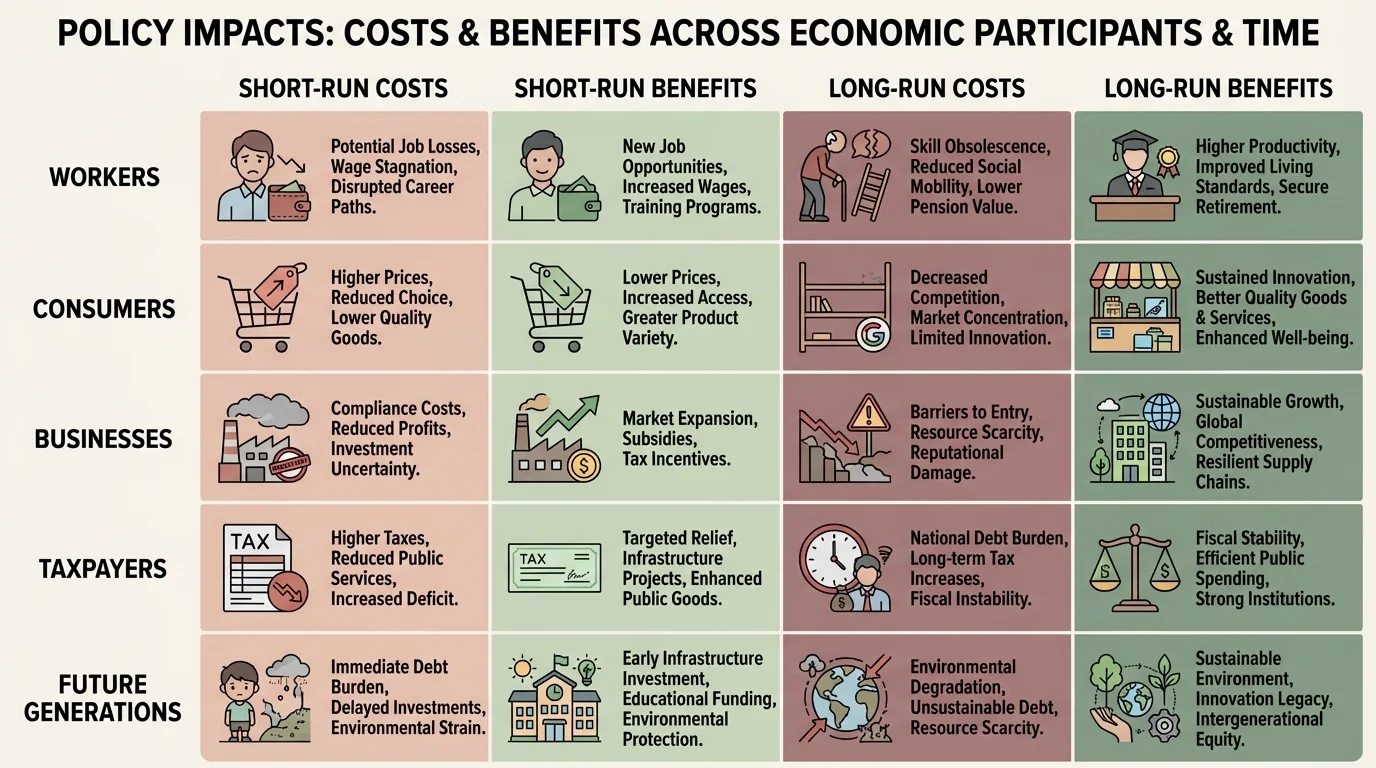
Distribution matters politically as well as economically. A policy with small costs spread across millions of people and large benefits concentrated on one group may still pass because the benefiting group is highly organized. On the other hand, a policy with broad long-term benefits may be unpopular if the short-term costs are immediate and visible.
| Policy | Main intended benefit | Possible cost | Groups likely to benefit most | Groups likely to bear more cost |
|---|---|---|---|---|
| Expansionary government spending | Higher demand and employment | Larger deficit, possible inflation | Unemployed workers, contractors, local communities | Future taxpayers, inflation-sensitive households |
| Higher interest rates | Lower inflation | Slower growth, weaker borrowing | Savers, people hurt by inflation | Borrowers, homebuyers, some businesses |
| Tariff on imports | Protection for domestic producers | Higher prices, possible retaliation | Protected industries and some workers | Consumers, import-using firms, exporters |
| Pollution regulation | Cleaner environment and public health | Compliance costs for firms | Communities, future generations | Some producers, possibly workers in affected industries |
Table 1. Examples of how common policies create different benefits and costs for different groups.
When we revisit the stakeholder comparison in [Figure 4], the key insight is that time horizon changes judgment. A policy that looks expensive today may produce major long-term gains, while a policy that feels helpful now may create future burdens.
Consider inflation after a period of rapid recovery. Prices rise quickly for food, housing, and transportation. The central bank raises interest rates. People with savings accounts may finally earn better returns, and slower demand may help reduce inflation. But families with adjustable-rate loans may face higher monthly payments, and businesses may postpone hiring. The policy does not have one single effect; it redistributes costs and benefits.
Now consider a recession caused by a collapse in consumer demand. The government increases spending and extends unemployment benefits. People who lost jobs gain crucial support, and local stores may survive because households can still spend. Yet the policy increases government borrowing, and critics may worry about waste or inflation if spending continues after recovery begins.
Trade policy gives another example. Suppose a country places tariffs on imported washing machines. Domestic manufacturers may sell more units and hire more workers. But consumers pay higher prices, and firms using imported parts may face increased costs. If other countries retaliate, exporters in completely different industries may suffer.
"There are no solutions, only trade-offs."
— A principle often used in economics and public policy
The point is not that policy is useless. The point is that serious policy analysis requires looking at the full chain of effects, not just the first visible result.
A responsible evaluation asks several questions. What problem is the policy trying to solve? What is the expected benefit? What are the direct and indirect costs? Which groups gain and which groups lose? Are the effects short-term or long-term? Are there unintended consequences? Could a different policy achieve the goal at lower cost?
Economists often use cost-benefit thinking, even when exact numbers are hard to measure. If a pollution rule costs firms $10 billion but prevents health damage and environmental losses worth more than that, the policy may be justified. But if the rule is poorly designed and achieves only a small improvement at huge cost, a better alternative may exist. The challenge is that some benefits, such as cleaner air or future climate stability, are harder to price than immediate expenses.
Earlier economic learning about scarcity still matters here. Because resources are limited, every policy uses money, labor, time, or political attention that could have been used differently. Scarcity is the reason policy choices always involve opportunity cost.
Evidence matters too. Sometimes a policy sounds convincing in theory but produces weak results in practice. Other times a policy is controversial at first but later proves effective. Good economic reasoning combines theory, data, and awareness of real human behavior.
For students, voters, and future citizens, the most important habit is to look past simple claims. When someone says a policy will create jobs, ask which jobs, for whom, and at what cost. When someone says a policy will lower prices, ask what side effects may follow. Democracy works better when people understand that policy decisions are not magic. They are choices with trade-offs that reach different participants in the economic system in different ways.
