The shoes you wear, the phone you use, the food in a grocery store, and even the parts inside a car often come from many countries at once. A single product may be designed in one country, assembled in another, and sold worldwide. That is why trade policy matters so much: when governments change the rules of trade, they can affect prices in stores, business profits, worker opportunities, and relationships between nations.
International trade is the exchange of goods and services across national borders. Governments influence that exchange through trade policies, which are laws and decisions that either encourage or limit trade. These policies help determine what is imported, what is exported, how expensive products become, and which industries grow.
Trade policy is not only about economics in a textbook. It affects everyday life. If a government places a tariff on imported washing machines, prices may rise for shoppers. If a country signs a trade agreement that lowers barriers, businesses may gain access to bigger markets. If a government subsidizes local farmers, those farmers may compete more successfully at home and abroad. In other words, trade policy shapes the allocation of goods, services, and resources by changing incentives.
Imports are goods and services bought from other countries. Exports are goods and services sold to other countries. A trade barrier is any government policy that makes trade harder or more costly, such as a tariff or quota.
When trade rules change, resources such as labor, land, capital, and entrepreneurship often shift too. Workers may move toward industries that are growing. Investors may put money into firms that now face less foreign competition or greater foreign demand. This is one reason trade policy can create both opportunities and conflict within a country.
[Figure 1] One of the most important ideas in economics is comparative advantage, the idea that countries benefit when they specialize in producing what they can make at lower opportunity cost and trade for other goods. Trade is not just about who is best at everything. It is about relative efficiency. Even a country that is highly productive in many areas can still gain from trade if it focuses on what it does relatively best.
Suppose Country A can produce wheat very efficiently, while Country B can produce cars more efficiently. If each country specializes more in what it produces best and then trades, total output can rise. That larger output means more goods are available overall, often at lower prices than if each country tried to make everything by itself.
This process changes the allocation of resources. More workers, machines, and investment flow into industries with a comparative advantage. Fewer resources stay in industries that are less competitive. That shift can improve total efficiency, but it can also hurt workers and businesses in industries facing stronger import competition.
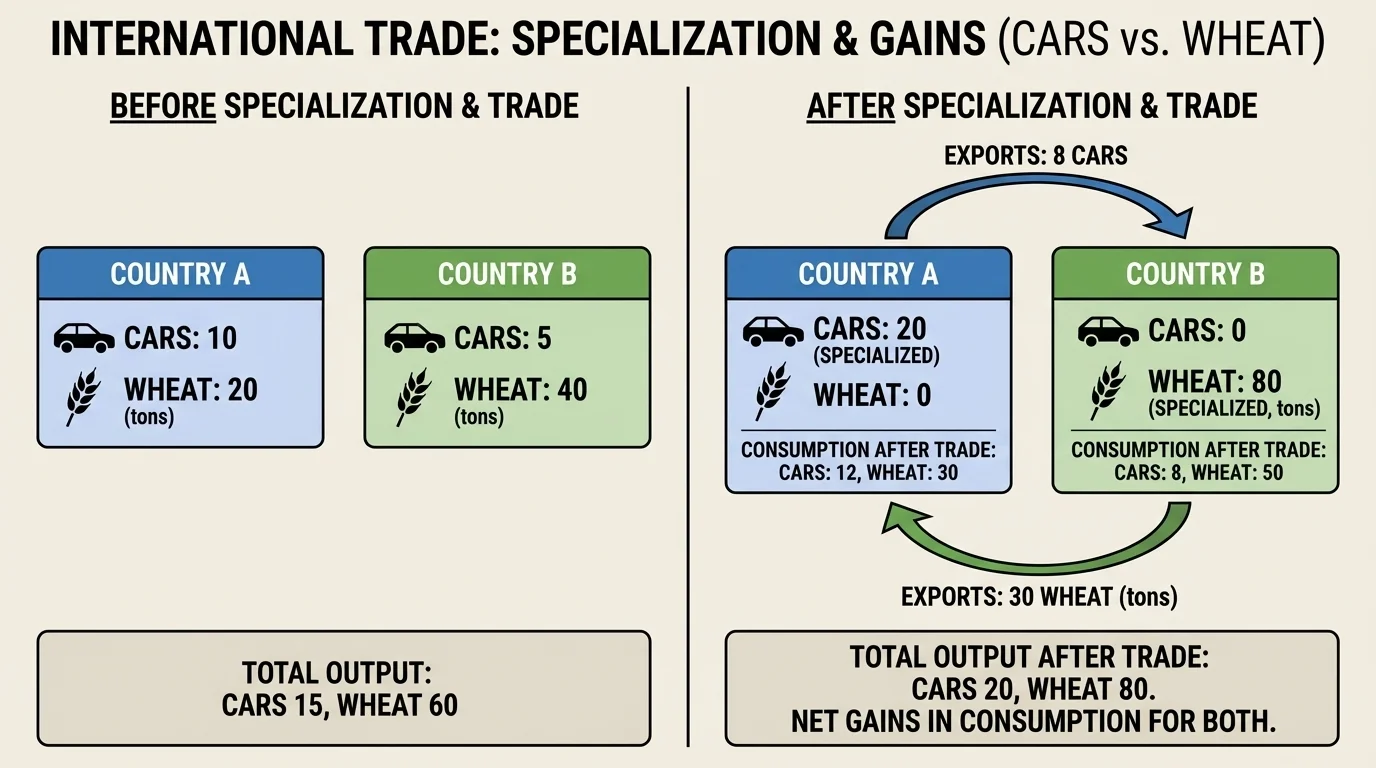
A simple way to think about trade is that it expands the choices available to countries. Without trade, a country is limited to what it can produce domestically. With trade, it can consume combinations of goods beyond its own production possibilities because it exchanges with others.
Trade and allocation of resources means that trade does not only move products; it also redirects labor, capital, raw materials, and technology. If a country imports more clothing but exports more aircraft, resources tend to move out of clothing factories and into aerospace production over time.
This is why trade debates can become intense. A policy that improves efficiency for the whole economy may still create serious losses for specific communities. Economists often point out that total gains from trade can be real while also recognizing that those gains are not always shared equally.
Free trade refers to international trade with few or no government barriers. In a free trade system, tariffs are low, quotas are limited, and countries allow goods and services to move more freely across borders. Supporters of free trade argue that it encourages competition, lowers prices, expands consumer choice, and pushes firms to become more efficient.
For consumers, free trade often means access to a wider variety of products. Stores can stock fruits out of season, electronics from different brands, and clothing from around the world. Because foreign producers compete with domestic producers, prices may fall. If a smartphone made abroad costs less than a similar domestic model, buyers benefit from lower-cost options.
For businesses, free trade can mean larger markets. A company in the United States can sell software to Europe, machinery to South America, or films to Asia. This larger customer base can lead to higher sales and growth. Some firms also benefit from global supply chains, where parts are made in multiple countries to reduce costs and improve efficiency.
However, free trade also creates pressure. Domestic firms that cannot compete with cheaper or better foreign products may lose market share. Workers in those industries may face layoffs. Communities built around a single factory or industry can be hit especially hard. This is one reason some citizens support protectionist policies even if free trade increases overall efficiency.
Many products labeled with one country of origin actually involve production stages in several countries. A car sold in the United States may include engines, chips, steel, and software from different parts of the world.
Economists generally argue that free trade raises total economic welfare over time, but they also note that governments may need education, job training, or adjustment programs to help workers and regions that are harmed by the shift.
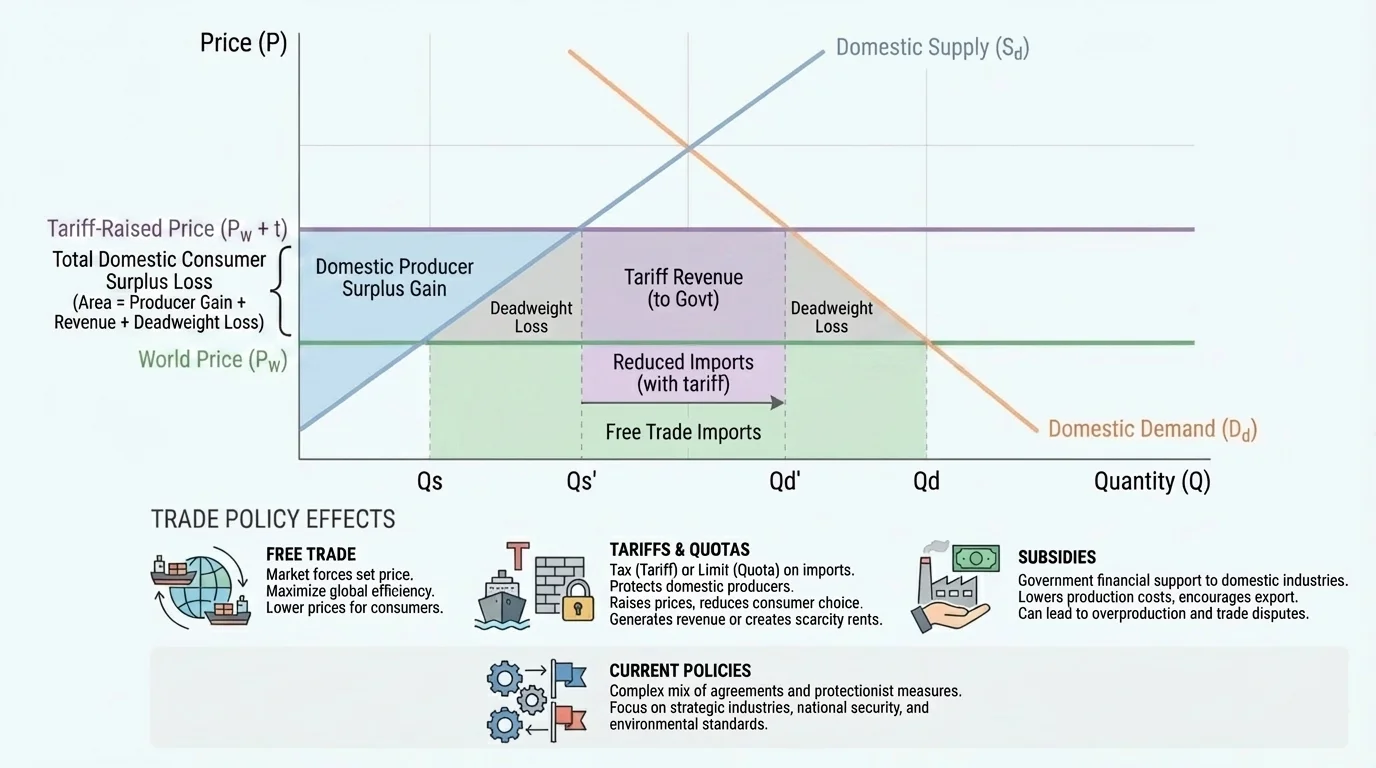
[Figure 2] A tariff is a tax placed on imported goods. The key effect of a tariff is usually to raise the price of imported products in the domestic market. If imported steel becomes more expensive because of a tariff, domestic steel producers may find it easier to compete.
Tariffs can protect domestic industries from foreign competition. This is why governments sometimes use them to support factories, farms, or newer industries. A tariff can increase domestic production because local firms now face less price pressure from imports. It can also generate revenue for the government.
But tariffs have costs. Consumers usually pay higher prices. Businesses that rely on imported inputs, such as car companies using imported steel or electronics firms using imported chips, may face higher production costs. Those costs can then be passed on to buyers through higher final prices.
Tariffs can also reduce the total amount of trade. If the import price rises from a world price of, say, $100 to $125 because of a tariff, some buyers stop purchasing the product. In simple terms, when price rises, quantity demanded usually falls. That means fewer imports and less market competition.
Another important issue is retaliation. If one country places tariffs on another country's goods, the other country may respond with tariffs of its own. This can develop into a trade war, in which both sides impose barriers. In a trade war, exporters on both sides can suffer. For example, if Country X taxes imported aluminum and Country Y responds by taxing farm products, both metal producers and farmers may be affected in different ways.
We can see the basic price logic clearly. If the original imported price is $80 and a tariff of $20 is added, the new import price becomes $100 because \(80 + 20 = 100\). Consumers may buy less, while domestic producers may sell more. The government collects tariff revenue on each imported unit that is still purchased.
Real-world example: tariffs on steel
Suppose a country places tariffs on imported steel to help domestic steel mills.
Step 1: Imported steel becomes more expensive.
If foreign steel had sold for $500 per ton and a tariff of $50 per ton is added, the imported price rises to $550 per ton because \(500 + 50 = 550\).
Step 2: Domestic steel makers gain some protection.
Local steel firms may now sell more because the price gap between domestic and imported steel is smaller.
Step 3: Steel-using industries face higher costs.
Car manufacturers, appliance companies, and construction firms may now pay more for steel, which can raise prices for cars, refrigerators, and buildings.
This example shows that a tariff can help one industry while hurting others.
Later debates often return to the same pattern seen in [Figure 2]: a tariff benefits certain producers and may create revenue for the government, but consumers and import-using firms usually bear significant costs.
[Figure 3] A quota is a direct limit on the amount of a good that can be imported. A quota changes trade through quantity rather than through a tax. If a government allows only a certain number of imported cars, tons of sugar, or tons of steel, the total supply available in the domestic market is reduced.
When supply is restricted, prices often rise. Domestic producers may benefit because there is less foreign competition. Consumers usually lose because they face higher prices and fewer choices. Just like tariffs, quotas can protect local industries, but they also make markets less competitive.
The difference between tariffs and quotas is important. A tariff raises revenue for the government because importers pay the tax. A quota does not automatically create government revenue unless the government charges for import licenses. Instead, the limited right to import can become valuable, and the gains may go to foreign producers or to firms that receive the licenses.
Quotas can be especially strict because they block additional imports even if foreign producers are willing to sell at lower prices. That means a quota can keep prices high even more directly than a tariff in some cases.
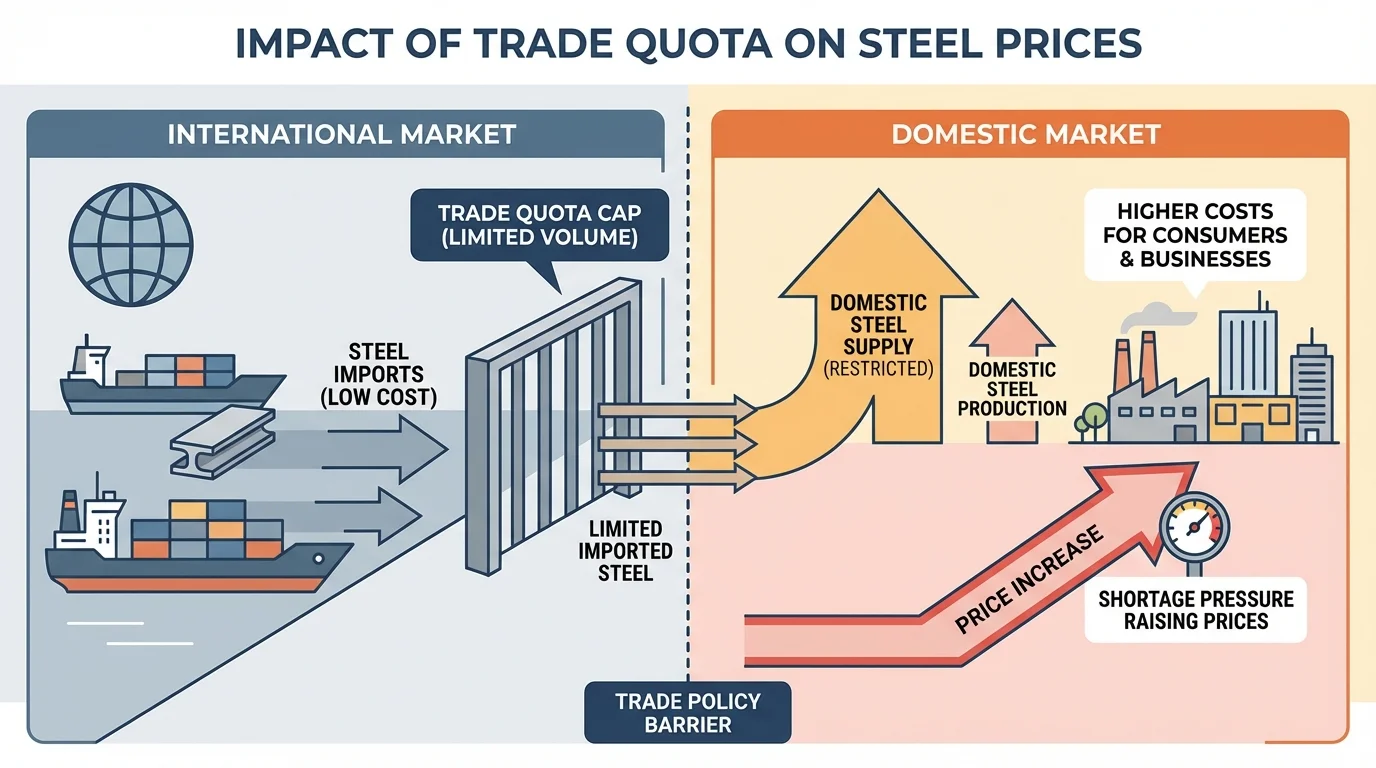
For example, if domestic demand for a product is 1,000 units and domestic firms can supply only 700 units, imports might normally fill the remaining 300 units. But if a quota limits imports to 150 units, the total market supply becomes only 850 units. That shortage pressure can push prices upward because \(700 + 150 = 850\), which is less than the original 1,000 units demanded.
When economists say supply falls, they mean fewer units are available at each price. When supply becomes more limited and demand stays strong, prices tend to rise.
Like tariffs, quotas can trigger tension with trading partners. Countries may view them as unfair restrictions, especially if they limit access to a major market.
A subsidy is government financial support for a business or industry. Instead of making imports more expensive, subsidies lower producers' costs or increase their income. Governments may give direct payments, tax breaks, low-interest loans, or other assistance to domestic firms.
Subsidies can help domestic producers compete against foreign firms. If farmers receive government payments, they may be able to sell crops at lower prices and still remain profitable. If a government supports a solar panel industry, domestic companies may grow faster and invest more in production and research.
Some governments use subsidies to support industries they consider strategically important, such as agriculture, energy, semiconductor manufacturing, or transportation. The goal may be food security, national security, technological leadership, or job creation.
However, subsidies can distort markets. A company may survive not because it is efficient, but because it is heavily supported by the government. Taxpayers also bear the cost. In international trade, subsidies may lead to complaints that one country's firms have an unfair advantage. This can spark disputes in organizations such as the World Trade Organization.
Why subsidies can be controversial is that they often create a trade-off. They may preserve jobs and build strategic industries, but they can also waste public money, encourage overproduction, and disadvantage foreign competitors who are not receiving similar support.
A common example is farm subsidies. They can stabilize farm income when weather, prices, or global demand change sharply. But they may also lead to excess production and lower world prices, making it harder for farmers in poorer countries to compete.
Trade policies almost always create winners and losers. This is one reason they are politically controversial. Different groups experience the same policy in different ways.
| Group | Possible gains from protection | Possible costs from protection |
|---|---|---|
| Domestic producers | Less foreign competition, higher prices, greater market share | Less pressure to innovate, higher input costs if other industries are protected |
| Consumers | Sometimes greater supply security | Higher prices, fewer choices |
| Workers | Jobs may be protected in some industries | Jobs may be lost in export industries if other countries retaliate |
| Government | Tariff revenue, political support from protected groups | Trade disputes, slower growth, higher program costs from subsidies |
| Taxpayers | Possible long-term gains from strategic industries | Pay for subsidies and adjustment programs |
Table 1. Comparison of how protectionist trade policies can affect different groups in the domestic economy.
Consumers usually benefit from lower prices and greater variety under freer trade. Domestic producers facing import competition may prefer tariffs, quotas, or subsidies. Workers in import-competing industries may support protection if they believe it will save jobs. Exporting firms usually prefer lower barriers abroad because foreign retaliation can reduce their sales.
This is why no trade policy is neutral. Each policy changes incentives and redistributes costs and benefits across society. Policymakers must decide which goals matter most: low prices, job protection, national security, competitiveness, fairness, or long-term innovation.
Case study: imported clothing
Suppose a country allows inexpensive clothing imports from abroad.
Step 1: Consumers gain.
Families can buy shirts, shoes, and coats at lower prices, leaving more income to spend on other needs.
Step 2: Domestic clothing factories face pressure.
If local factories have higher costs, they may shrink or close.
Step 3: Resources reallocate.
Workers and capital may gradually move into industries where the country is more competitive, such as medical equipment, software, or advanced machinery.
The economy may become more efficient overall, but the transition can be painful for workers and towns tied to the old industry.
That tension between overall gains and local losses is central to understanding trade policy debates.
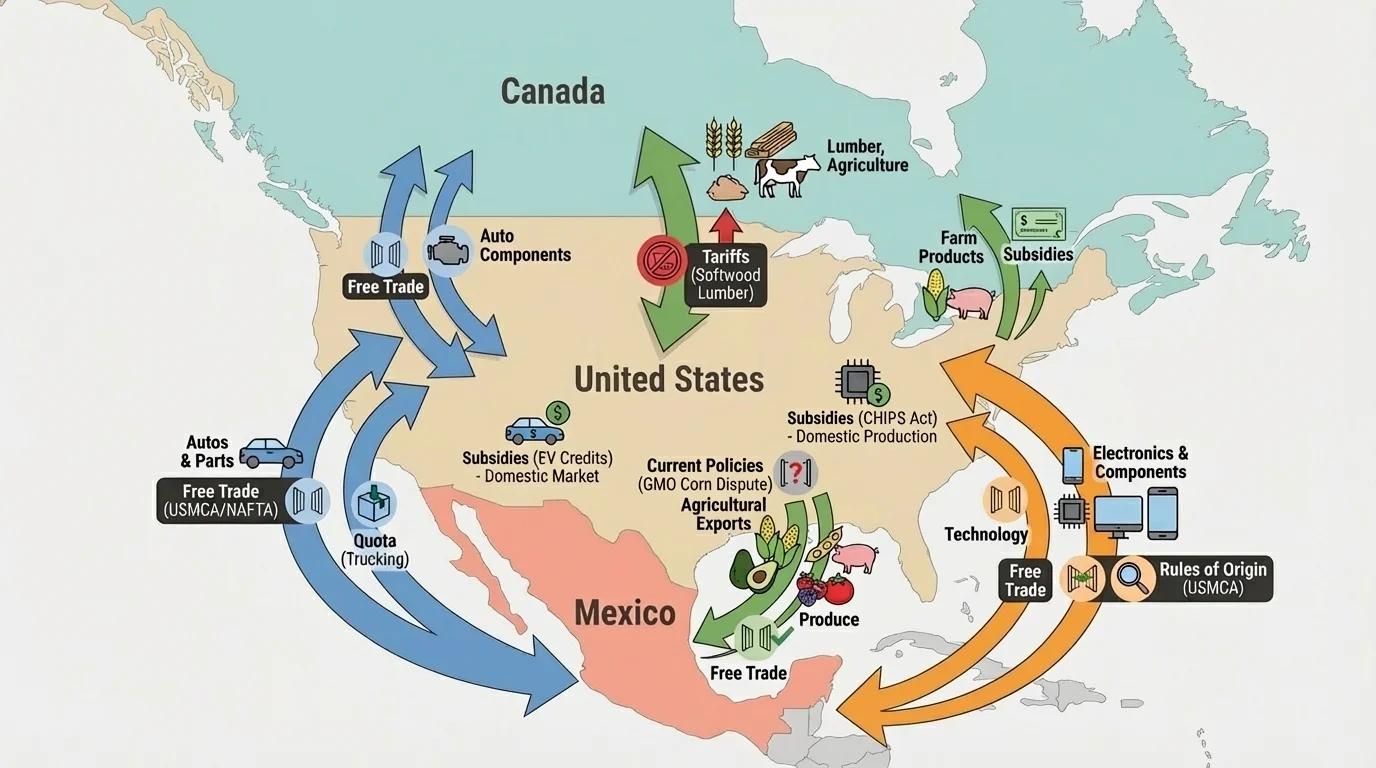
[Figure 4] Modern trade policy is not only about single tariffs or quotas. Countries also negotiate broad trade agreements that reduce barriers and set rules. One important example in North America is the USMCA, the agreement among the United States, Mexico, and Canada. These countries are deeply connected through supply chains in autos, agriculture, and manufacturing.
Trade agreements often address more than tariffs. They may include rules about labor standards, environmental protections, digital trade, intellectual property, and how disputes are settled. Supporters say such agreements create stability and predictability for businesses. Critics argue they may still favor large corporations or fail to protect all workers equally.
Current policies in many countries show that trade is not simply moving toward total openness. In recent years, governments have used tariffs against rival countries, imposed sanctions, restricted access to advanced technology, and encouraged domestic production of strategic goods such as computer chips, batteries, and medical supplies.
For example, the United States and China have imposed tariffs on many products traded between them. These tariffs have affected prices, supply chains, and business decisions. Some companies responded by moving production to other countries to avoid the tariffs. That shows how trade policy can redirect global production rather than simply stopping trade altogether.
Another recent trend is the focus on supply chain resilience. A supply chain is the network involved in producing and delivering a good. Disruptions during the pandemic revealed how dependent many countries were on foreign suppliers for items such as semiconductors, medicines, and protective equipment. As a result, some governments now support reshoring, nearshoring, or diversification so they are less vulnerable to disruptions.
Sanctions are another major policy tool. These are restrictions meant to pressure a country by limiting trade, finance, or access to goods. Sanctions are often used for political or security reasons rather than purely economic ones. Their effects can be large, changing trade flows and domestic prices in multiple countries.
When students hear news about chip factories, battery subsidies, or restrictions on high-tech exports, they are seeing trade policy in action. These policies influence which countries produce key technologies and how domestic industries develop over time. The regional integration shown earlier in [Figure 4] also helps explain why a rule change in one country can quickly affect factories and workers across borders.
Some modern trade disputes focus less on simple consumer products and more on advanced technologies such as semiconductors, telecommunications equipment, electric vehicles, and clean-energy components.
This shows that current trade policy is tied closely to technology, security, and long-term industrial strategy.
Trade policies influence domestic markets in several major ways. First, they affect prices. Tariffs and quotas often raise prices by limiting cheaper foreign goods. Free trade can lower prices by increasing competition. Subsidies can reduce prices for supported products, at least in the short run.
Second, they affect jobs and wages. Protection can preserve jobs in certain industries, at least temporarily. But it can also raise costs for other industries or provoke retaliation that harms exporters. Freer trade can create jobs in competitive sectors while reducing jobs in sectors that cannot match foreign competition.
Third, trade policies affect competition and innovation. Protection may give local firms time to develop, especially if they are infant industries that are still growing. But long-term protection can reduce the pressure to improve quality or efficiency. Firms that are sheltered from competition may become less innovative.
Fourth, they shape resource allocation. Capital, labor, and technology move toward sectors with stronger incentives. A subsidy may attract investment into clean energy. A tariff may attract investment into domestic steel. A free-trade agreement may encourage companies to build distribution systems and factories that serve a wider region.
"Trade can enlarge the economic pie, but policy helps determine how the slices are shared."
Finally, trade policies can affect economic security. Many governments now worry not only about efficiency but also about reliability. A country may accept somewhat higher prices if it believes domestic production is necessary for defense, public health, or energy independence.
Economists often ask several questions when judging a trade policy. Does it improve efficiency? Does it protect an important industry? How much does it cost consumers? Will other countries retaliate? Does it encourage innovation or reduce it? Is the policy temporary and targeted, or broad and permanent?
There is rarely a perfect answer. Free trade tends to increase overall efficiency and consumer choice, but it can cause serious adjustment costs. Tariffs and quotas can protect jobs and industries, but they often raise prices and reduce competition. Subsidies can build strategic sectors, but they can be expensive and distort markets.
That is why trade policy involves both economics and values. A society must decide how to balance low prices, job stability, fairness, national security, and long-term growth. The best policy in one situation may not be the best in another. A country recovering from a supply shock may make different choices than a country focused mainly on consumer prices.
Understanding trade policy means looking beyond a simple question of whether trade is "good" or "bad." The more useful question is: good for whom, at what cost, and for what goal? Once that question is asked, the effects on international trade and domestic markets become much clearer.
