Your phone may be designed in one country, built from minerals mined in another, assembled in a third, shipped across oceans, and sold through an app whose servers are somewhere else entirely. That is not a strange exception. It is one of the clearest signs that globalization is not just a big abstract idea in a textbook. It is the system of worldwide connections that shapes what people buy, where people work, what governments regulate, and who benefits most from economic change.
Globalization is the growing connection of countries through trade, finance, technology, migration, culture, and communication. Earlier forms of globalization involved ships, empires, and long-distance trade. Today, globalization moves at digital speed. A company can transfer money instantly, manage factories across continents, and sell products online to customers in many countries at once.
Modern globalization includes several important trends. One is the growth of global supply chains, in which different stages of production happen in different places. Another is digital trade, where services such as streaming, online education, cloud computing, and software cross borders without being packed into a container. A third trend is the increased power of large multinational companies, which can influence labor practices, prices, and investment decisions in many regions.
International trade is the exchange of goods and services across national borders. Trade policy refers to the laws and government decisions that affect this exchange, such as tariffs, quotas, subsidies, and trade agreements. Foreign direct investment is when a company based in one country builds or buys business operations in another country.
Governments do not simply watch globalization happen. They shape it. Trade agreements can lower barriers between nations. Immigration laws can open or restrict labor movement. Environmental rules can force companies to reduce pollution. Tax policies can attract foreign investment or push companies to move elsewhere. So globalization is not a natural force like weather; it is strongly affected by human decisions.
One of the main economic effects of globalization is that it changes how the world allocates production. A nation may focus on making goods or services that it can produce relatively efficiently, while importing others. Economists often explain this with the idea of comparative advantage, which means a country can benefit by specializing in what it produces at a lower opportunity cost than another country. In real life, this means countries do not need to be best at everything; they can gain from exchange if each focuses on certain strengths, as [Figure 1] illustrates through one product moving through many locations.
This process affects goods, such as clothing, cars, and electronics; services, such as programming, banking, and customer support; and resources, including labor, land, raw materials, energy, and capital. For example, rare minerals used in batteries may come from the Democratic Republic of the Congo, chip design may happen in the United States, manufacturing may occur in Taiwan or South Korea, and final assembly may take place in Vietnam or India.
Because transportation and communication have become faster and cheaper, firms can spread their activities around the world. A company may choose locations based on wages, worker skills, taxes, environmental rules, political stability, access to ports, or closeness to consumers. This is why production is not randomly scattered. It is organized around cost, speed, risk, and policy.
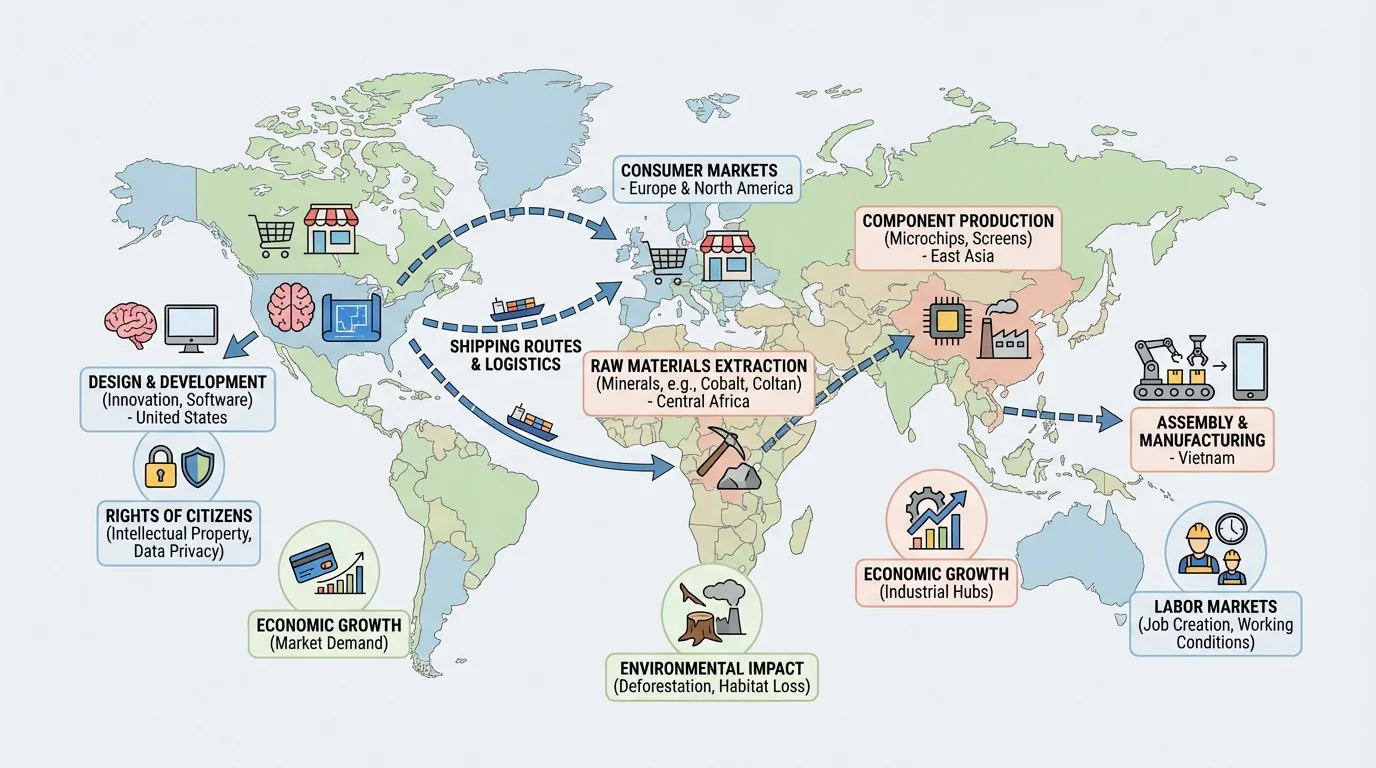
Globalization can make products more available and often less expensive. If imports increase competition, consumers may get lower prices and more choices. If firms can obtain materials and parts from multiple sources, they may become more productive. However, these gains do not automatically help everyone equally. Cheaper products can benefit consumers while workers in certain industries face job losses or wage pressure.
Why specialization raises output
When countries, firms, and workers specialize, they often become more efficient through practice, better technology, and larger-scale production. If one country produces textiles efficiently and another produces machinery efficiently, both may end up with more total goods after trade than if each tried to produce everything alone. This is one reason economists link trade to higher overall output, even though the distribution of those gains can be uneven.
Another important change is the role of information. In the past, trade mainly involved physical goods. Today, data itself is an economic resource. Streaming platforms, online marketplaces, remote design work, and cloud services all show that globalization includes information flows as well as shipping routes.
Economic growth means an increase in the production of goods and services over time. Globalization can support growth by expanding markets, increasing competition, attracting investment, and spreading technology. A factory built with foreign investment can create jobs, train workers, and improve infrastructure. A country that gains access to larger export markets can increase sales and income.
East Asian economies provide strong examples. South Korea, Taiwan, and later Vietnam used export-driven development to expand manufacturing and raise incomes. Millions of people moved from rural poverty into industrial and urban jobs. China's economic rise was also deeply connected to international trade and investment, though guided by strong state policy.
Yet growth does not automatically mean fairness. Some regions gain investment while others lose factories. Owners of capital, advanced skills, or valuable technology may benefit much more than workers with fewer options. This can widen inequality within a country even when the total economy grows. A nation's gross domestic product may rise while some communities experience declining wages, unstable work, or loss of local businesses.
| Possible Benefits of Globalization | Possible Costs of Globalization |
|---|---|
| Lower prices for consumers | Job loss in some industries |
| New export markets | Wage pressure for some workers |
| Technology transfer | Greater income inequality |
| Foreign investment | Dependence on unstable supply chains |
| Faster innovation | Pressure on weak regulations |
Table 1. Common economic gains and costs associated with globalization.
Economic growth also depends on institutions. Countries with effective education systems, stable laws, transportation networks, and anti-corruption efforts are often better able to turn trade into broad prosperity. Where institutions are weak, globalization may enrich a small elite while leaving many citizens with low wages and weak protections.
Some of the fastest-growing economies in recent decades have not grown by isolating themselves, but by combining trade with strategic government planning, investment in education, and infrastructure development.
Another issue is vulnerability. If a country depends heavily on one export, such as oil, coffee, or copper, global price changes can strongly affect jobs and government revenue. In that case, globalization links growth to world demand, but it also links hardship to world downturns.
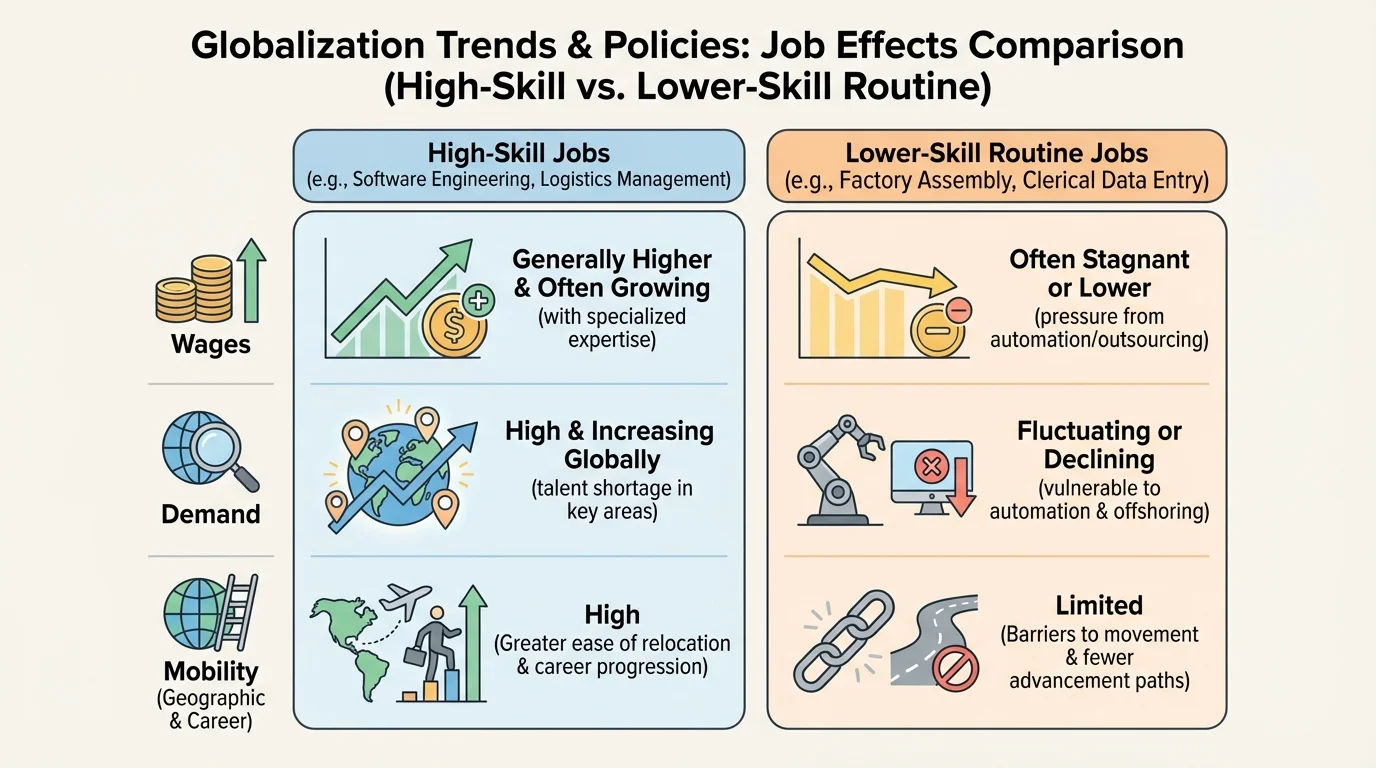
A labor market is the system in which workers offer their labor and employers hire them. Globalization changes labor markets because firms can search worldwide for workers, locations, and contractors. That means the effects are different for different people, as [Figure 2] shows in the contrast between occupations that gain from global integration and those that face stronger pressure.
Some jobs increase because companies expand exports or attract foreign investment. Ports, shipping firms, software companies, financial services, and advanced manufacturing can all grow in globally connected economies. Highly skilled workers in engineering, logistics, finance, and technology may see new opportunities because their skills are valuable across borders.
Other jobs become less secure. If a company can move garment production, call-center work, or routine office tasks to a lower-cost location, workers in the original location may lose bargaining power. This is often called outsourcing, the practice of moving certain business activities to outside firms or other countries. At the same time, automation can combine with globalization so that some jobs are replaced not only by workers elsewhere, but also by machines and software.
Skill levels matter. Workers with education and training that fit changing industries are often more able to adapt. Workers whose jobs are routine and easy to relocate may face greater risk. This helps explain why some communities strongly support free trade while others oppose it. Their daily experiences are different.
Labor rights are also crucial. In some export industries, workers have gained jobs that provide more income than local alternatives. In others, workers face long hours, unsafe buildings, child labor, or suppression of unions. The 2013 Rana Plaza factory collapse in Bangladesh, which killed more than 1,100 people, drew global attention to how cheap clothing can be linked to dangerous labor conditions. Consumers in wealthy countries, factory owners, global brands, and governments were all connected to that tragedy.
Case study: why trade can affect workers differently
Suppose one town depends heavily on furniture manufacturing, while another has many software and logistics firms.
Step 1: A new trade agreement lowers import barriers on furniture.
Imported furniture becomes cheaper, and local factories face stronger competition.
Step 2: Workers in the furniture town may face layoffs or lower wages.
Their skills may not transfer easily to new industries, so adjustment is difficult.
Step 3: The software and logistics town may benefit.
More trade means more demand for shipping coordination, digital systems, and international business services.
The same policy can therefore produce both gains and losses, depending on local economic structure.
Migration adds another layer. Workers may move across borders to find jobs, send money home, and fill labor shortages. Migrant labor supports agriculture, construction, health care, and domestic work in many countries. But migration can also lead to exploitation when legal protections are weak.
As seen earlier in [Figure 1], supply chains connect workers who may never meet each other but still depend on one another's labor. A delay in one port, a strike in one factory, or a new labor law in one country can affect prices and employment across the chain.
Globalization affects not only markets, but also the rights of citizens. These include labor rights, consumer protection, privacy rights, access to medicine, and political voice. When companies operate across borders, the question becomes: whose laws apply, and who is responsible when harm occurs?
Trade agreements can include rules about patents, investment, and dispute settlement. These rules may encourage innovation and investment, but they can also create tension. For example, strong patent protection may help pharmaceutical companies recover research costs, yet it can also keep medicine prices high in poorer countries. During global health crises, this creates debate over whether public health should outweigh private intellectual property claims.
Why rights can become harder to protect across borders
A citizen can vote in a national election, but many economic decisions affecting that citizen may be made by multinational firms, global investors, or international institutions. This creates a gap between economic power and democratic control. Governments may fear losing investment if they raise wages, strengthen unions, or tighten environmental rules, leading to a "race to the bottom" in some cases. In other cases, public pressure pushes companies upward toward better standards.
Consumer rights matter too. If a toy, food item, or digital service crosses borders, governments must decide how to inspect it, label it, and regulate it. A product sold online may be produced under very different safety rules from those in the buyer's country. This is why international standards and certifications have become more important.
Digital globalization raises new issues. Social media companies, e-commerce platforms, and cloud services operate globally, but data privacy laws differ from country to country. The European Union has adopted strong data-protection rules, while other regions regulate digital platforms less strictly. This means globalization now includes arguments about who controls information and how citizens' data should be used.
"There can be no trade without rules, and the real question is whose rules, and in whose interests."
Some international organizations and civil society groups try to protect rights by monitoring elections, labor standards, or environmental practices. Yet enforcement is uneven. A right written on paper does not always become a right protected in daily life.
Environmental effects appear at every stage of a product's life cycle, as [Figure 3] makes clear: resources are extracted, materials are processed, goods are manufactured, products are shipped, consumed, and eventually thrown away or recycled. Globalization increases the scale and speed of all of these activities.
Trade can increase pollution when firms move production to places with weaker environmental laws. Mining for cobalt, lithium, and other minerals can damage land and water. Factories may release waste into rivers or air. Shipping burns fuel and adds greenhouse gas emissions. Fast fashion encourages rapid clothing production and disposal, which increases waste and water use.
At the same time, globalization can also spread environmental solutions. Solar panels, wind turbines, electric vehicles, and cleaner production methods often become more affordable when produced at large scale and traded internationally. International scientific cooperation helps track climate change, deforestation, and ocean health. Environmental treaties, while imperfect, try to coordinate action on global problems that no single country can solve alone.
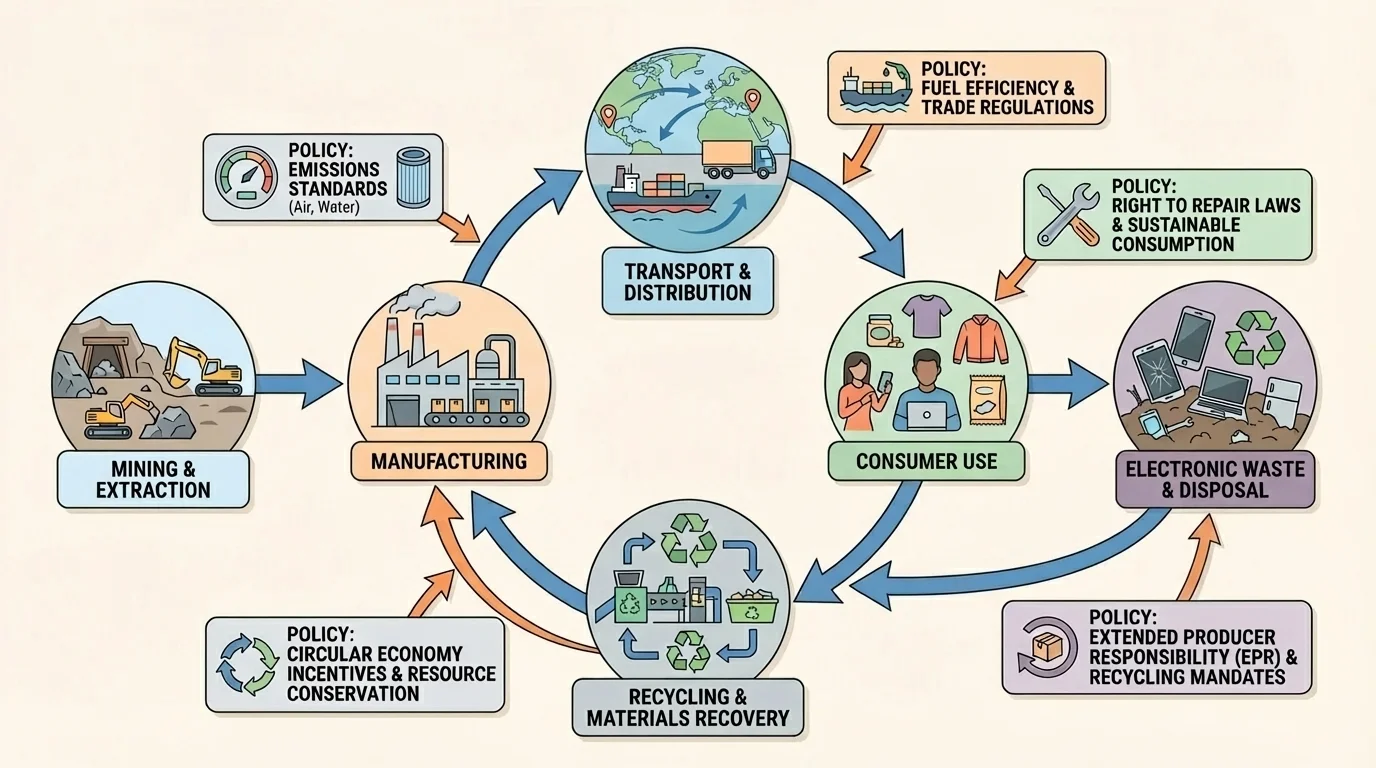
One major challenge is that environmental costs are often not fully included in market prices. If a product is cheap because pollution damage is ignored, consumers may not see the true cost. Economists call this an externality, a cost or benefit that affects others who are not directly part of the transaction. Carbon emissions are a classic example: the producer and buyer gain from the sale, but the climate impact is shared much more widely.
Policies such as carbon taxes, emissions rules, recycling laws, and protected areas aim to reduce these hidden costs. If governments cooperate, they can prevent companies from simply shifting pollution to another country. If governments do not cooperate, firms may relocate to avoid regulation.
The issue is not whether globalization is automatically good or bad for the environment. The real issue is whether global economic activity is being governed in a way that reflects long-term ecological limits. The same networks that spread pollution can also spread cleaner technology and stronger standards.
About 90% of world trade by volume moves by sea, which makes shipping essential to globalization but also an important source of emissions and marine environmental risk.
When students think about environmental globalization, they should look beyond factories alone. Packaging, transport distance, energy sources, waste disposal, and recycling systems all matter, which is why the full chain in [Figure 3] remains important even after a product reaches the consumer.
[Figure 4] Globalization does not produce one universal outcome in every place. Countries differ in geography, natural resources, education, government policy, and historical development through a few contrasting examples.
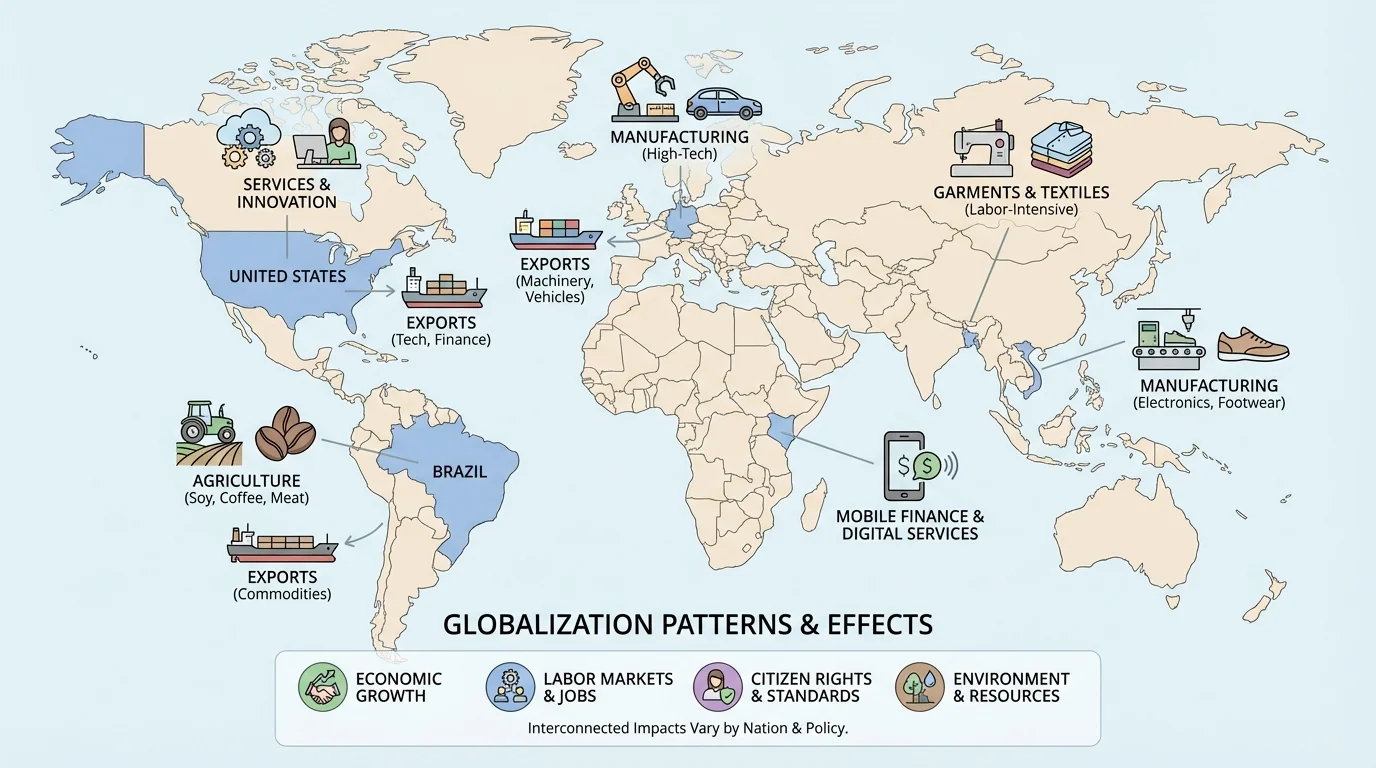
The United States benefits from high-value services, finance, research, entertainment, and technology, but some manufacturing regions have struggled with deindustrialization and import competition. Consumers often gain from lower prices, while workers in certain industries may face disruption.
Bangladesh has used garment exports to create millions of jobs and increase women's participation in paid work. At the same time, low wages and unsafe factory conditions have raised serious concerns about labor rights.
Vietnam has attracted manufacturing investment as firms diversify supply chains beyond China. Export growth has raised incomes, but the country must still balance industrial expansion with labor protections and environmental management.
Germany is a strong exporter of high-quality machinery, vehicles, and industrial goods. Its skilled workforce and vocational training system help it compete globally. This shows that globalization can support advanced manufacturing, not just low-wage production.
Brazil exports agricultural goods, minerals, and industrial products, but it also faces tensions involving deforestation, commodity dependence, and uneven regional development.
Kenya demonstrates that globalization is not only about factories. It has become known for innovation in mobile finance and digital services, showing how technology can connect countries to global markets in new ways.
| Country | Major Global Connection | Main Opportunity | Main Concern |
|---|---|---|---|
| United States | Technology, finance, services | High-value innovation | Regional job loss in some industries |
| Bangladesh | Garment exports | Employment growth | Worker safety and low wages |
| Vietnam | Manufacturing exports | Rising investment | Labor and environmental standards |
| Germany | Industrial exports | Strong skilled production | Dependence on global demand |
| Brazil | Agriculture and commodities | Export revenue | Deforestation and price swings |
| Kenya | Digital and mobile services | Innovation and inclusion | Infrastructure gaps |
Table 2. Examples of how globalization affects countries differently based on their economic structure and policy choices.
These examples show an important truth: globalization does not erase national differences. It often makes those differences more visible, because countries enter the global economy with different strengths and different vulnerabilities.
Because globalization creates both benefits and risks, public policy matters greatly. A tariff is a tax on imports. Governments may use tariffs to protect domestic industries or respond to unfair trade practices. However, tariffs can also raise prices for consumers and provoke retaliation from other countries.
Trade agreements can reduce tariffs and create common rules for investment, labor, or the environment. Supporters say they increase efficiency and cooperation. Critics argue they may give too much power to corporations or weaken local control. The actual effect depends on what the agreement includes and how it is enforced.
Governments also use industrial policy, which means strategic support for sectors they want to develop, such as semiconductors, renewable energy, or medical supplies. This can include subsidies, tax credits, research funding, and training programs. In recent years, many governments have become more interested in supply-chain resilience after disruptions caused by pandemics, wars, and political conflict.
Policy comparison: three different choices
Consider a government deciding how to respond to cheap imported solar panels.
Step 1: Impose tariffs.
This may help local producers compete, but it can also make solar energy more expensive for consumers and slow the shift to cleaner power.
Step 2: Offer subsidies to domestic clean-energy firms.
This can support local jobs and innovation without directly raising import prices, though it costs public money.
Step 3: Negotiate standards with trading partners.
This may reduce unfair competition and improve labor or environmental practices across borders.
Each policy choice affects prices, jobs, investment, and the speed of environmental transition in different ways.
Another major policy area is social protection. If governments provide job retraining, unemployment support, health care, and education, workers are better able to adjust when trade changes local industries. Without those protections, globalization's disruptions feel much harsher and more unequal.
Environmental and labor standards also shape outcomes. Rules on emissions, forest protection, wages, building safety, and collective bargaining can reduce the harmful side of global competition. The goal is not simply to maximize trade volume, but to shape trade so that it supports human well-being.
Current globalization trends suggest a more complex future than the simple idea of ever-increasing free trade. Some firms are shifting production closer to home or to politically allied countries. This is sometimes called regionalization or friend-shoring. Countries want supply chains that are not only efficient, but also secure.
At the same time, digital connections continue to expand. A student can learn from a video made in another country, a musician can release songs to a global audience, and a small business can sell online across borders. Globalization is still deepening in many areas, even when countries become more cautious about physical goods and strategic industries.
The central question is not whether globalization exists. It clearly does. The deeper question is what kind of globalization societies want: one driven only by low cost and speed, or one shaped by rights, resilience, environmental sustainability, and broader prosperity. The answer depends on choices made by governments, businesses, workers, and citizens.
Understanding globalization means seeing both the connections and the consequences. A low price in one store may reflect wages, laws, energy choices, and ecosystems on the other side of the world. Once that becomes visible, economics becomes more than a study of money. It becomes a study of how human decisions connect lives across nations.
