A society does not fall apart only when people disagree. It falls apart when people stop knowing how to disagree. Every day, people argue about school rules, voting laws, water use, housing costs, police practices, tribal sovereignty, online speech, and climate policy. These debates affect real lives. The difference between a noisy argument and a healthy democracy is whether people research issues carefully, weigh evidence honestly, and speak to one another with respect.
For students in high school, this matters right now, not just in some distant adult future. Public issues shape bus routes, graduation requirements, school safety policies, internet access, and the cost of college. The ability to investigate a question, form a reasoned opinion, and discuss it civilly is one of the most important skills in citizenship. It helps people participate in school communities and prepares them to engage in broader public life.
Civil discourse is public discussion in which people address important issues through reason, evidence, listening, and respect. It does not mean being passive, avoiding hard topics, or pretending everyone agrees. It means treating other people as citizens rather than enemies. In a democracy, public policy often emerges from disagreement, compromise, and debate. If citizens cannot discuss issues constructively, decisions become more driven by anger, rumor, and fear than by facts and shared problem-solving.
Civil discourse also protects freedom. In a free society, people have the right to express their opinions, criticize leaders, and advocate for change. But those freedoms work best when paired with responsibility: checking facts before sharing claims, separating evidence from insults, and understanding that other people may have different experiences and values. Strong democracies depend on both liberty and civic discipline.
"Democracy is government by discussion."
— Common principle in democratic theory
That idea captures a basic truth: laws and policies are not only made in legislatures and courts. They are also shaped in community meetings, school board sessions, tribal councils, editorials, classrooms, and conversations at home. Civil discourse is one of the ways citizens help govern themselves.
A public issue is a question or problem that affects a community and often involves government action, law, or public policy. Some issues are intensely local, such as whether a city should build a new recreation center or how a district should handle school attendance boundaries. Others are statewide, such as funding for public universities or regulations on water use. Some concern tribal governments and sovereignty, such as land use, cultural protection, or jurisdictional authority. National issues may include immigration policy, defense spending, health care, or federal voting protections.
Not every disagreement is a public issue. If two friends argue about what movie to watch, that is a private choice. If a town debates whether to ban phones during school hours or whether to build affordable housing near public transit, that becomes a public issue because it affects many people and may require official action. Public issues usually involve at least one of these features: shared impact, competing interests, limited resources, questions of fairness, or government responsibility.
Public policy is a course of action a government chooses to take in response to a public issue. Civil discourse is respectful, reasoned discussion about matters of public concern. Evidence is information used to support a claim, such as facts, data, expert analysis, documents, or firsthand accounts.
Current issues are often complicated because they involve trade-offs. A city might want more housing to reduce rents, but nearby residents may worry about traffic or neighborhood change. A school may want stronger safety rules, but students may raise concerns about privacy or fairness. Many policy debates are not battles between good and bad ideas. They are conflicts among valid goals that cannot all be fully achieved at once.
Researching a public issue begins with asking a focused question. Instead of asking, "Is social media bad?" a better question might be, "Should states require age verification for social media platforms?" Instead of "What about water?" a better question might be, "How should drought-prone regions balance agricultural use, residential use, and tribal water rights?" A clear question helps you identify which evidence matters and which level of government is involved.
Responsible research requires careful source evaluation, and a practical checklist appears in [Figure 1]. Students should ask: Who created the source? What evidence does it provide? When was it published? What is its purpose? Can its claims be confirmed by other reliable sources? These questions help separate trustworthy information from rumors, manipulated content, and opinion disguised as fact.
One useful distinction is between primary source and secondary source sources. A primary source is direct evidence from the time or event being studied, such as a speech, government report, hearing transcript, law, court opinion, interview, or dataset. A secondary source interprets or explains primary material, such as a textbook, documentary, or news analysis. Both matter. Primary sources show what was actually said or decided; secondary sources can provide context, interpretation, and comparison.
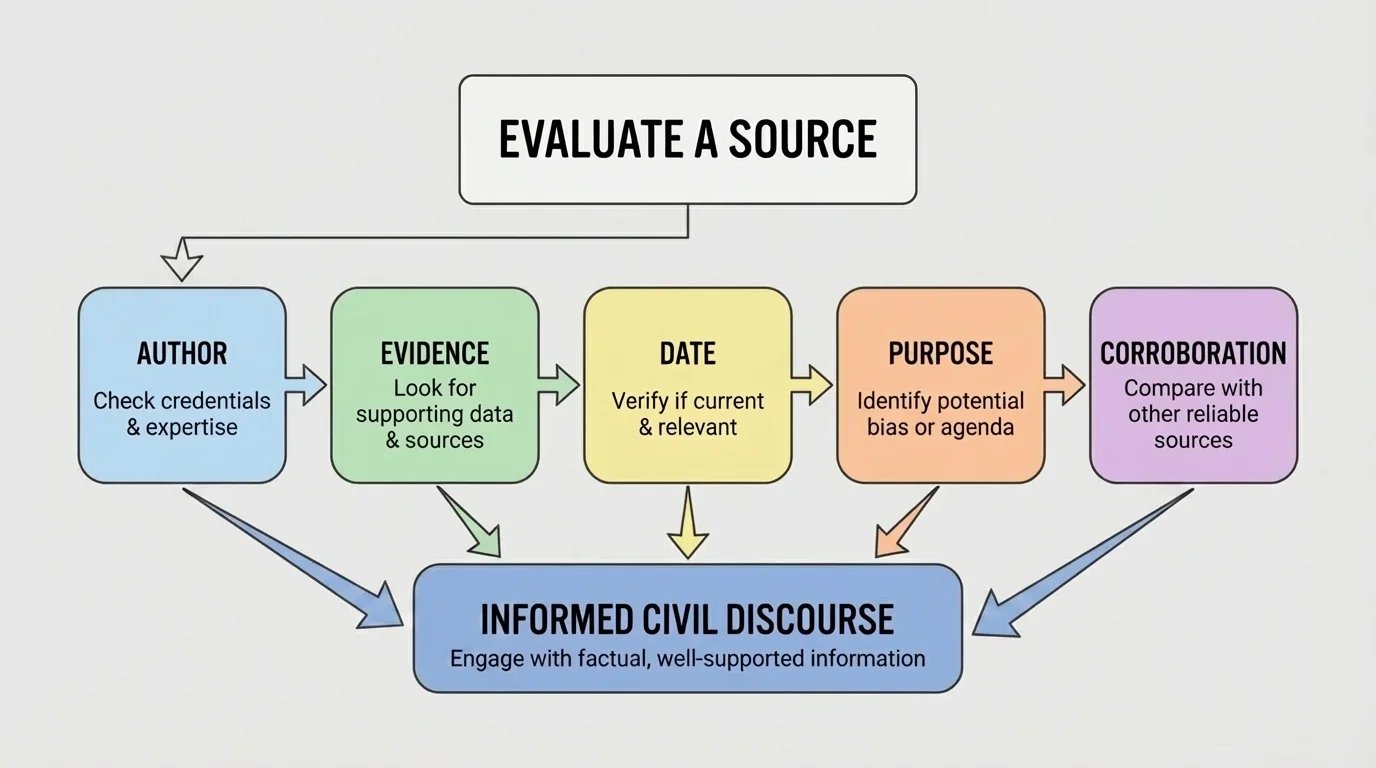
Credibility is not the same as agreement. A source is not reliable just because it says what you already believe. Likewise, a source is not unreliable merely because it challenges your opinion. A credible source typically shows where its information comes from, uses verifiable evidence, identifies authors or institutions, and avoids misleading presentation. Strong research usually combines different types of evidence: official documents, reputable journalism, expert studies, and perspectives from affected communities.
Students should also watch for bias, which means a tendency to present information from a particular viewpoint or with a particular slant. Bias does not automatically make a source useless. An advocacy group, for example, may clearly promote a cause but still provide accurate data. The key is to recognize perspective, compare sources, and verify claims. A balanced understanding often comes from reading across disagreement rather than staying inside one information bubble.
Digital media adds another challenge: speed. Posts can spread faster than verification. Edited clips can remove context. Headlines can exaggerate. Statistics can be presented without explanation. A graph may be technically accurate but designed to create a false impression. As the source checklist in [Figure 1] reminds us, corroboration matters. If an important claim appears in only one weak source, it should not be treated as established fact.
False information often spreads more quickly when it triggers strong emotions such as anger or fear. That is one reason effective citizens pause before reposting sensational claims and ask whether the evidence has actually been checked.
When researching current issues, it is also important to identify what is still uncertain. On many issues, some facts are clear while other questions remain open. Good civic research does not pretend to know more than the evidence supports. It distinguishes between what is known, what is disputed, and what requires judgment.
[Figure 2] Once you have researched an issue, the next step is forming a position. A strong civic argument has a structure: it identifies the issue, states a claim, gives reasons, supports those reasons with evidence, addresses counterarguments, and arrives at a policy conclusion. This structure matters because public discussion is not just sharing feelings. It is explaining why a position should persuade others.
A claim is the main point you are arguing. For example: "Our school district should limit cell phone use during class time but allow phones during lunch and emergencies." That is more useful than saying "Phones are bad," because it names a specific policy. The next part is reasoning: Why should this policy exist? Possible reasons might include reduced distractions, improved focus, and fewer classroom conflicts. Then comes evidence: studies on student attention, disciplinary data, teacher observations, and examples from similar districts.
A good position also recognizes values and trade-offs. Public questions are not solved by facts alone. Facts tell us what is happening and what may result from a policy. Values help determine what should matter most. In a phone-policy debate, one person may prioritize concentration and academic performance; another may prioritize student autonomy or quick family communication. In debates about housing, some may prioritize affordability while others focus on environmental impact or neighborhood stability. Civic maturity means acknowledging these values rather than pretending your side has none.
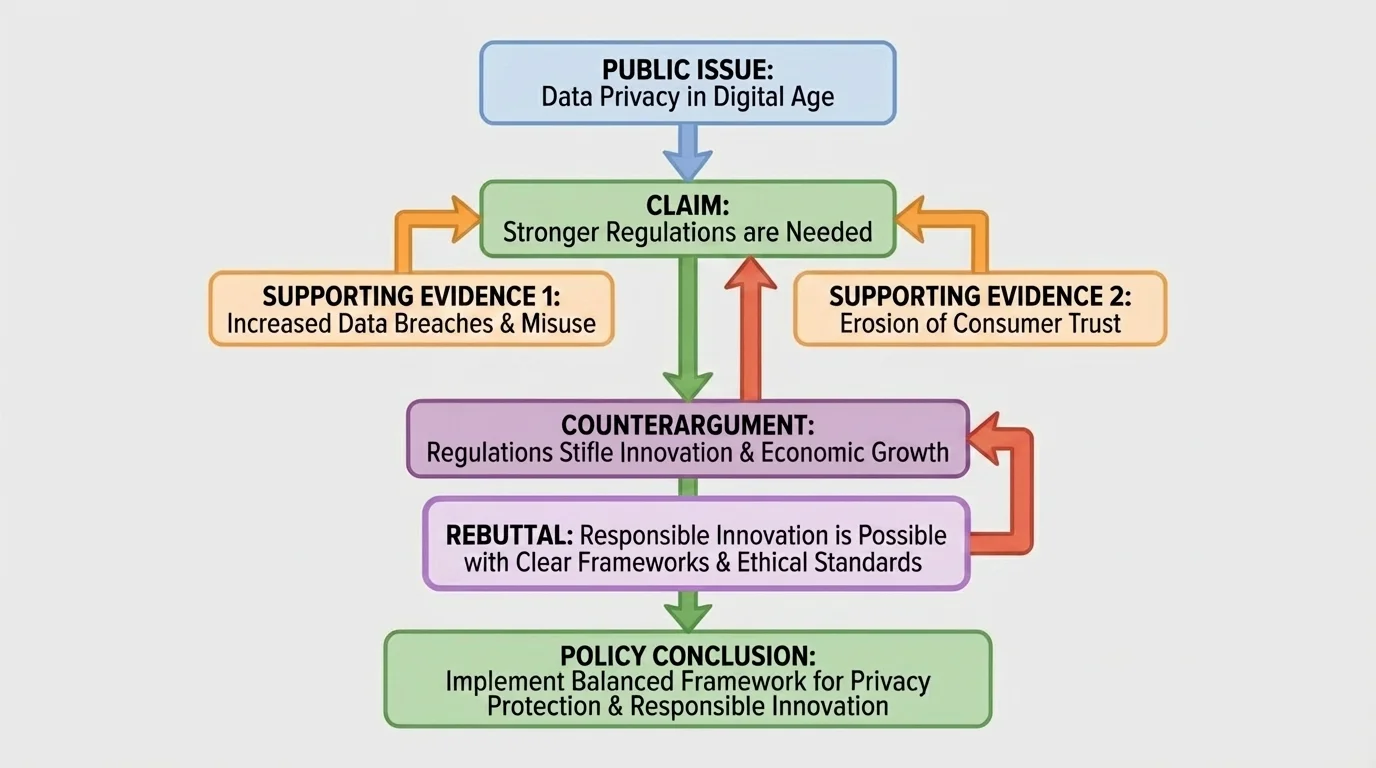
Another essential part of a strong position is the counterargument. A counterargument is a serious response to an opposing view. Addressing one makes your position stronger because it shows you understand the debate rather than oversimplifying it. If you support limits on classroom phone use, you should still consider concerns about safety, accessibility needs, or emergency contact. A good rebuttal does not mock those concerns. It answers them with evidence and policy design.
From opinion to position
An opinion becomes an informed civic position when it is tied to a specific public question, supported by credible evidence, aware of competing viewpoints, and connected to a realistic policy option. The goal is not just to have a belief. The goal is to justify that belief in a way other citizens can evaluate.
One useful test is this: Could someone who disagrees with you still understand your reasoning clearly? If the answer is yes, your position is probably well developed. If your argument depends mostly on slogans, personal attacks, or repeated assertions, it is probably not yet strong enough for serious civic discussion.
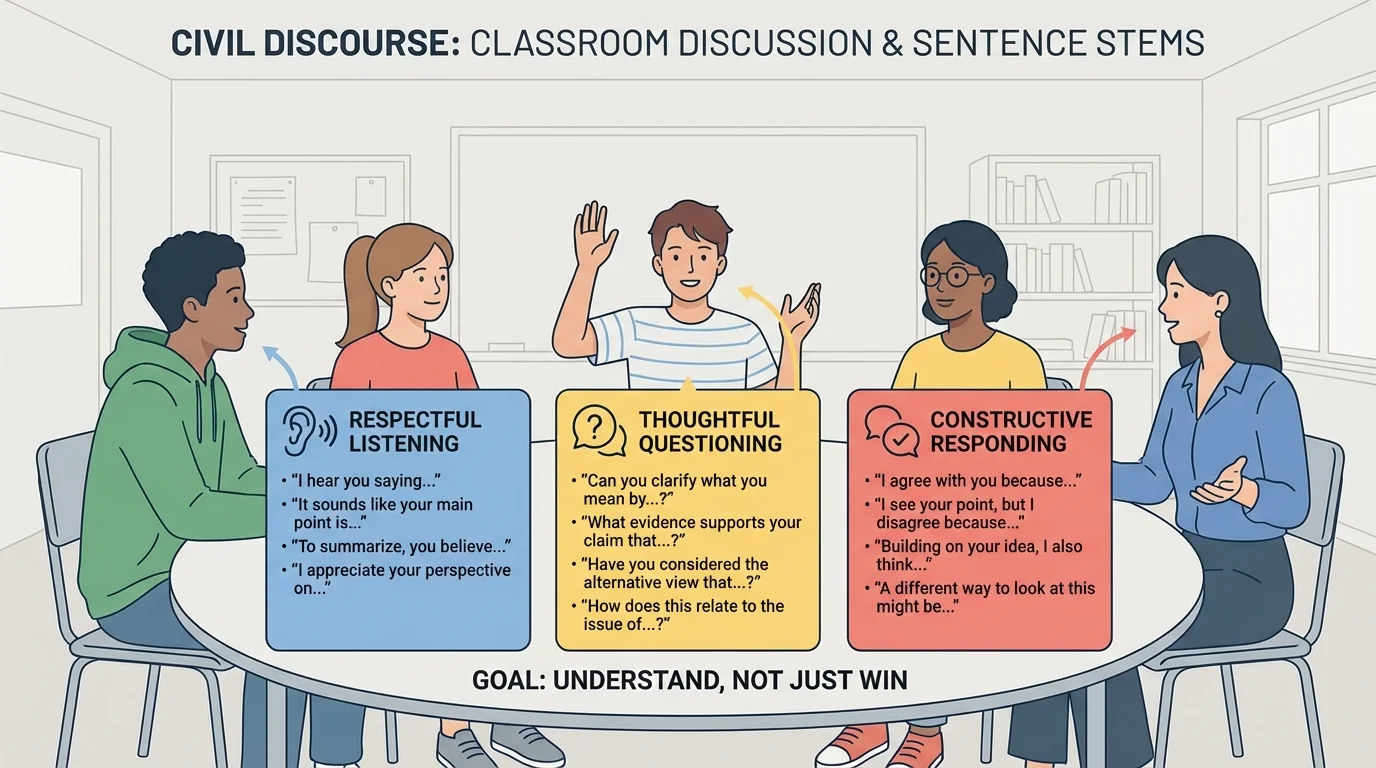
[Figure 3] Respectful democratic discussion involves learned habits. Effective participants listen actively, paraphrase what others say, ask clarifying questions, distinguish disagreement from disrespect, and respond to the strongest version of the other side's argument. These habits reduce confusion and make discussion more productive.
One of the simplest and most powerful skills is paraphrasing. Before responding, restate the other person's point fairly: "If I understand you correctly, you're saying that stricter attendance rules might improve graduation rates but could also punish students facing transportation problems." That sentence does two important things. It shows listening, and it tests understanding. Many heated arguments continue only because people respond to points no one actually made.
Another important habit is using evidence-based language. Compare these two responses: "That's ridiculous and people like you always exaggerate," versus "I see your concern, but the state report from last year suggests a different pattern." The second response still disagrees, but it does so in a way that keeps the conversation open. Civil discourse is not weak. It is disciplined.
Students should also recognize common errors that damage civic conversation. An ad hominem attack targets a person instead of addressing the argument. A false dilemma pretends there are only two options when more may exist. Cherry-picking uses only the evidence that helps one side while ignoring other relevant facts. These mistakes often make debates louder but less truthful.
Listening does not require surrender. You can hear another perspective carefully and still reject it. In fact, careful listening often sharpens disagreement by making it more precise. As shown earlier in [Figure 3], civil discourse works best when participants aim to understand before they aim to win. That approach is especially important when discussions involve identity, history, culture, or painful experiences.
Freedom of speech protects the right to express ideas, including controversial ones. But civic responsibility asks people to use that freedom thoughtfully, with attention to truth, consequences, and the equal dignity of others in the community.
Sometimes the most responsible response is to say, "I need more information before I decide." That is not weakness. It is intellectual honesty. Civic discourse improves when people are willing to revise their views based on better evidence.
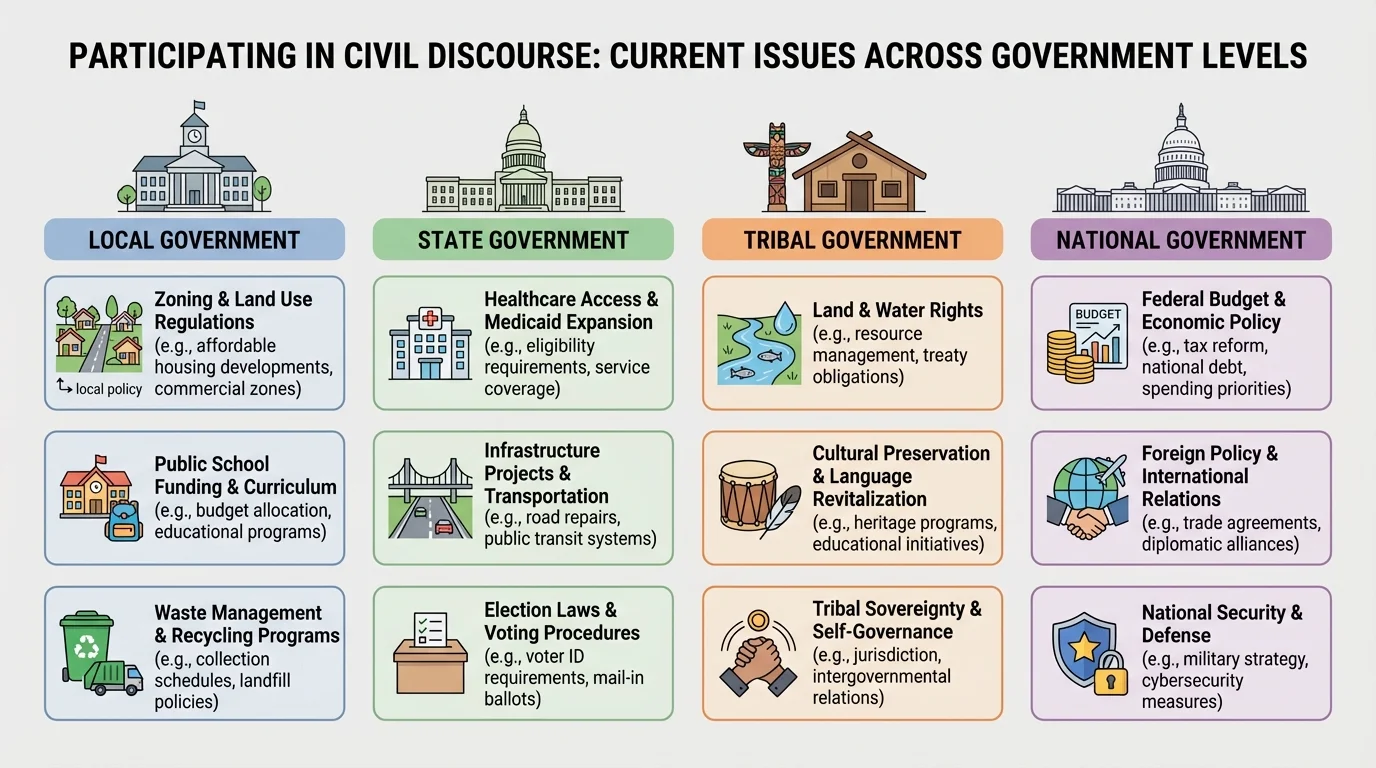
[Figure 4] Not every public issue belongs to the same level of government. The idea of jurisdiction helps citizens identify who has authority to act, and the comparison makes that easier to see. If a student is discussing road repair, zoning, or school board policy, local government may be most relevant. If the issue involves state taxes, graduation requirements, or election rules, the state may be central. Questions involving tribal sovereignty, resource management on tribal lands, or cultural protection may involve tribal governments. Federal agencies and Congress are often key in national defense, immigration, interstate commerce, and major environmental regulations.
Understanding jurisdiction prevents confusion. People sometimes argue passionately about an issue without knowing which officials can actually change it. For example, a city council usually cannot rewrite federal immigration law, and a national official may have little role in a school district's dress code. Effective civic participation depends on directing arguments, questions, and advocacy to the right institutions.
| Level of government | Examples of issues | Typical forms of participation |
|---|---|---|
| Local | School policies, zoning, policing priorities, public transit | School board comments, city council meetings, local petitions |
| State | Education funding, election rules, water regulation, state highways | Contacting state legislators, public hearings, statewide advocacy |
| Tribal | Land use, cultural preservation, sovereignty, tribal services | Tribal council participation, community consultation, cultural advocacy |
| National | Immigration, defense, federal taxation, nationwide environmental policy | Contacting members of Congress, following federal hearings, national campaigns |
Table 1. Examples of public issues and participation methods at different levels of government.
Many issues cross levels of government. Water management, for instance, may involve local conservation rules, state allocation systems, tribal treaty or sovereignty concerns, and federal environmental law. Housing can involve city zoning, state development incentives, and national interest-rate or tax policy. The same issue may therefore require citizens to understand multiple institutions at once, a point reinforced by the government comparison in [Figure 4].
Consider a debate over classroom cell phone policies. At first glance, this may seem like a simple school rule. But a careful civic analysis asks several questions: What evidence exists about phones and attention? Are there differences across age groups or class settings? How would a policy account for emergencies, disability accommodations, translation apps, or family responsibilities? Who decides the rule: teachers, principals, school boards, or state lawmakers? Once those questions are asked, the issue becomes a real exercise in research and civil discourse.
Case study: affordable housing near transit
A city is considering whether to allow higher-density housing near a new rail station.
Step 1: Identify the issue and jurisdiction
This is mainly a local issue involving zoning, planning, and transportation policy.
Step 2: Gather evidence
Students might examine housing prices, commute times, environmental data, traffic studies, and testimony from residents, renters, business owners, and planners.
Step 3: Form positions
One position may support denser housing to reduce costs and car dependence. Another may oppose it because of concerns about congestion, infrastructure strain, or neighborhood change.
Step 4: Practice civil discourse
A strong discussion acknowledges both the need for housing and the concerns about rapid development, then asks what policy design might address both.
Water rights provide another example with even greater complexity. In drought-prone regions, water may be needed by cities, farms, ecosystems, and tribal nations. Evidence may include rainfall patterns, reservoir levels, treaty obligations, agricultural economics, and environmental impact studies. This is not simply a question of who wants what. It is a question about law, history, fairness, and sustainability. Students discussing such an issue must respect the fact that different communities may have very different stakes.
Voting access is another major issue. Debates may center on early voting, identification requirements, mail ballots, or polling place availability. Research should include state laws, turnout data, court rulings, and concerns about both access and election security. Civil discourse requires taking both values seriously, even if one ultimately argues that a particular policy balances them better than another.
Online speech and platform regulation create similar challenges. Citizens may disagree about how to limit harmful content without undermining freedom of expression. Here, policy questions can involve state proposals, federal law, court interpretation, and private company rules. Once again, informed positions depend on distinguishing legal facts, constitutional principles, and policy preferences.
Research and discussion matter most when they lead to informed participation. Citizens act on public issues in many ways: attending public meetings, writing letters or emails to officials, giving testimony, joining community forums, participating in tribal consultations, contributing to student government, or voting when eligible. Even before reaching voting age, students can learn to engage responsibly by asking strong questions, presenting evidence, and understanding institutional processes.
Good civic participation is specific. Instead of saying, "Someone should do something about housing," a student might say, "The city planning commission should consider mixed-income housing near transit and publish clear data on traffic and affordability impacts." Instead of saying, "The election system is broken," a student might ask, "What evidence shows whether the state's identification rules increase security, reduce turnout, or both?" Specificity turns frustration into citizenship.
Writing a short evidence-based position
Suppose a student is preparing to speak at a school board meeting about library book review procedures.
Step 1: State the claim clearly
"The district should use a transparent review process with published criteria rather than removing books based on isolated complaints."
Step 2: Give reasons
The student may argue that transparency protects fairness, helps families understand decisions, and prevents arbitrary censorship.
Step 3: Support with evidence
Evidence might include district policy documents, examples from neighboring districts, and expert guidance from library associations.
Step 4: Address a counterargument
The student should acknowledge concerns about age-appropriateness and explain how clear review standards can address those concerns without abandoning due process.
One of the strongest signs of civic growth is learning that participation is not only about speaking. It is also about reading carefully, listening seriously, and accepting that public decision-making often requires patience. Democratic life can be frustrating because progress is slow and disagreement persists. Yet that is precisely why the habits of research and civil discourse matter. They help communities make decisions without relying on force, intimidation, or ignorance.
In times of polarization, students may hear that civil discussion is impossible or pointless. History and daily experience show otherwise. Productive disagreement happens whenever people examine evidence, define the issue clearly, understand who has authority, and treat each other as members of the same civic community. That work is difficult, but it is one of the foundations of self-government.
