A single email to a city council member, a student speech at a school board meeting, a nationwide boycott, or a carefully researched lawsuit can all change public policy. That fact surprises many people because government can seem distant and powerful. Yet policy is often shaped not only by elected officials, but also by ordinary people who know how to participate effectively. Civic life is not just about having opinions. It is about knowing which method to use, when to use it, and whether that method is likely to be effective and acceptable in a democratic society.
Civic participation means taking part in public life in order to influence decisions that affect a community. Some forms are individual, such as voting or contacting an official. Others are collective, such as organizing a rally, joining an advocacy group, or building a coalition. In all cases, the goal is the same: to shape policy, which includes laws, regulations, budgets, school rules, land use decisions, court rulings, and executive actions.
In a constitutional democracy, participation matters because government gains legitimacy from the people. Citizens do not rule directly on every issue, but they do help direct government through elections, public debate, oversight, and organized action. When people participate, they can raise overlooked problems, offer evidence, pressure leaders to respond, and hold institutions accountable.
Public policy is a course of action adopted by a government or public institution to address an issue. Advocacy is organized support for a cause or policy position. Lobbying is an effort to influence public officials on legislation or policy. Public opinion is the collection of views held by the public on issues and leaders.
Not all participation works in the same way, and not all methods fit every problem. A neighborhood traffic issue may be solved through local meetings and testimony, while a nationwide civil rights issue may require litigation, mass mobilization, media attention, and federal legislation. Understanding the strengths and limits of each method is essential for responsible citizenship.
Government decisions affect transportation, public safety, education, health, voting rights, environmental quality, and economic opportunity. If people remain passive, policy is more likely to reflect only the voices of those who already have power, money, or access. Civic participation broadens representation and helps communities identify what problems need attention.
Participation also teaches democratic habits. It requires listening, evidence, compromise, persistence, and respect for rules. Even when people disagree strongly, a healthy civic culture depends on civil discourse, which means discussing public issues with reason and respect rather than threats, insults, or misinformation.
"The people alone have an incontestable, unalienable, and indefeasible right to institute government, and to reform, alter, or totally change the same, when their protection, safety, prosperity, and happiness require it."
— John Adams
At the same time, participation can create tension. Strong advocacy can energize public life, but aggressive tactics can also divide communities or spread distrust. For that reason, evaluating civic action means asking two different questions: Does it work? and Is it acceptable? Those questions are related, but they are not identical.
People often say they want to "change the government," but the first practical question is which government. Different levels of government handle different issues, and effective participation depends on matching a problem to the institution that actually has power over it. Local governments deal with issues such as zoning, policing practices, public transit, parks, and school board decisions. State governments handle matters such as traffic laws, state taxes, education standards, and many health and election policies.
[Figure 1] Tribal governments exercise authority over matters involving tribal lands, citizenship, cultural preservation, public services, and sovereignty. National government addresses immigration, foreign policy, national defense, federal taxation, and many civil rights protections. A student concerned about cafeteria food quality may need to speak to school administrators or a school board. A student concerned about national student loan policy would need very different strategies aimed at Congress or federal agencies.
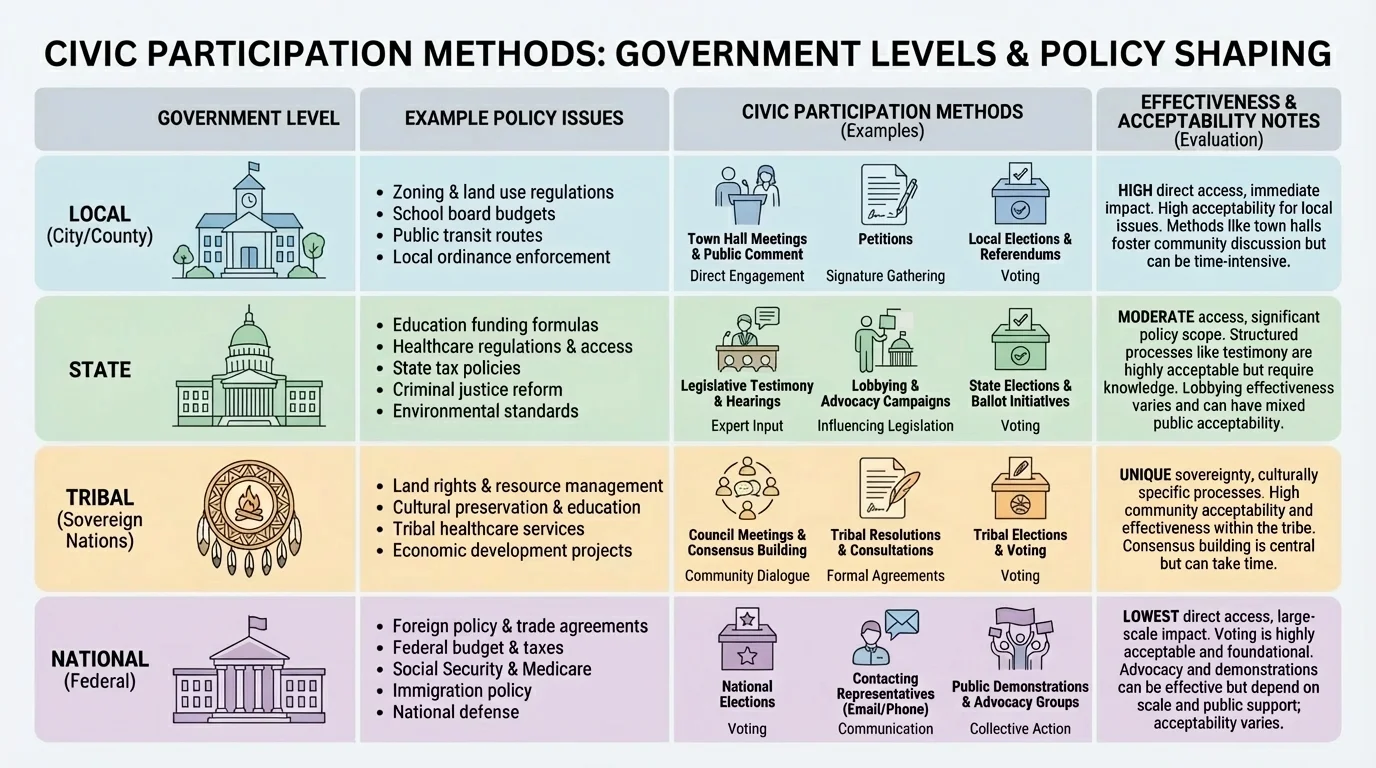
This is why effective civic participation begins with research. People must identify who has authority, what process is used, and when decisions are made. A powerful speech aimed at the wrong institution may gain attention but produce no policy change.
Timing also matters. A citizen who contacts a legislator before a committee vote may influence an amendment. The same message sent after a bill has already passed may have little immediate effect. Policy influence often depends on understanding the calendar of government as much as understanding the issue itself.
Civic participation sometimes works best when it follows a direct route from citizen concern to decision-maker, as [Figure 2] illustrates. The most common direct method is voting. Voting is widely considered both effective and acceptable because it is lawful, institutionalized, and tied directly to democratic representation. Its effect may be indirect, however, because voting chooses leaders rather than deciding every policy question.
Another direct method is contacting public officials through letters, email, phone calls, or office visits. This can be effective when messages are specific, informed, and timely. Officials are more likely to respond when citizens identify a policy clearly, explain how it affects the community, and request a concrete action. A message that says, "Please support the ordinance requiring safer crosswalk lighting near Central High School" is stronger than a vague complaint.
Attending public meetings and offering public comment is especially important at the local and state levels. School boards, city councils, county commissions, planning boards, and legislative committees often reserve time for public input. Speaking in these settings can be effective because it enters the official record and allows decision-makers to hear directly from affected residents. Public testimony is often most persuasive when it combines personal experience with evidence, such as accident data, budget estimates, or legal concerns.
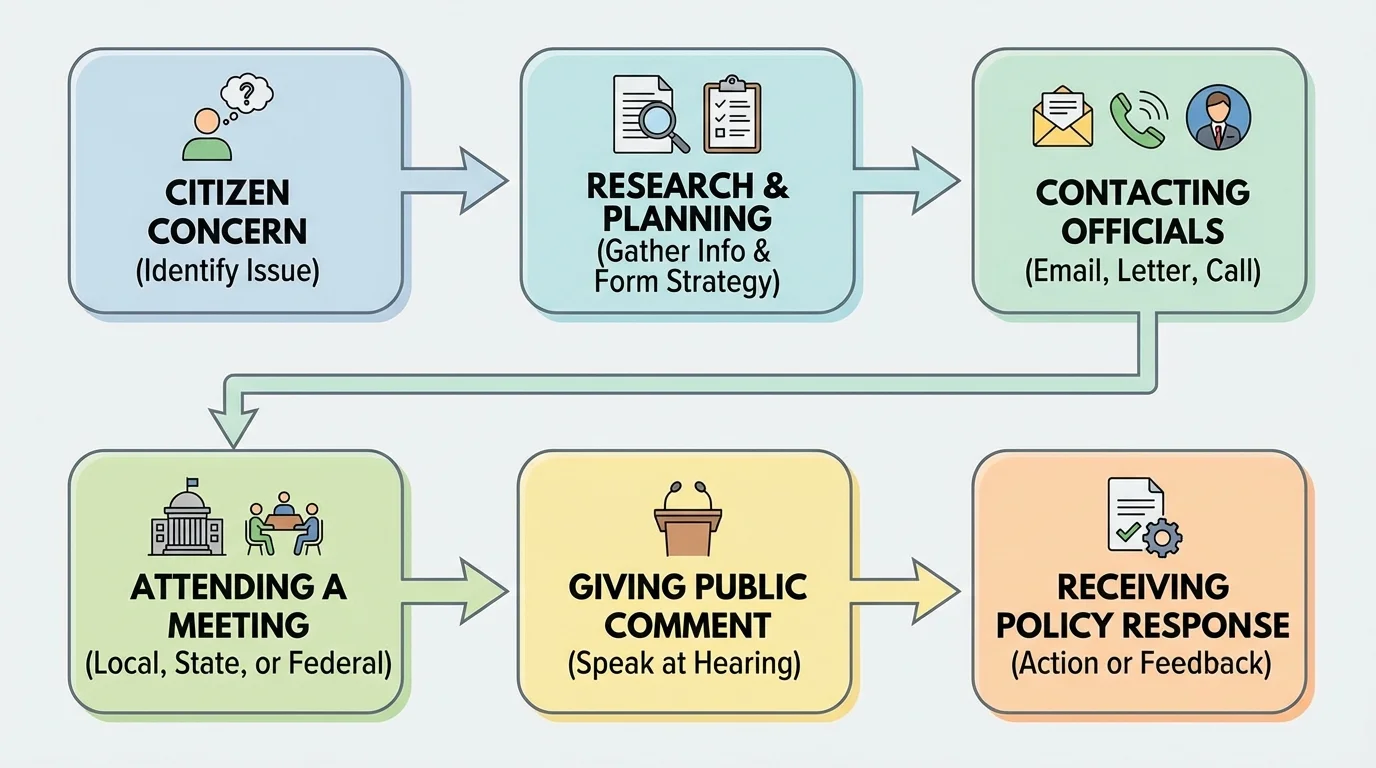
Testifying at hearings is another direct form of participation. For example, if a state legislature considers a bill about distracted driving, students, parents, doctors, and law enforcement officers may testify. Their testimony can help lawmakers understand real-world consequences and improve the bill's language.
Running for office, serving on advisory boards, and participating in jury duty are also direct forms of civic engagement. These methods usually require more time and commitment, but they can have substantial influence because they place individuals inside decision-making systems.
Many local decisions that affect daily life, such as bus routes, library hours, and zoning rules, are made in meetings that receive far less public attention than national elections. In some cases, a small number of informed participants can make a major difference.
Direct methods are usually highly acceptable in a democracy because they follow established rules and promote accountability. Their weakness is that they may have limited reach. A strong testimony may influence one board vote, but it may not build broader public pressure unless it is combined with media, organizing, or coalition work.
When individuals work together, they can increase visibility and pressure. A petition is one common tool. Petitions can demonstrate that many people care about an issue, especially if signers are members of the affected community. Their effectiveness depends on numbers, credibility, and whether officials believe the petition represents actual voters or stakeholders. A petition with 5,000 verified local signatures on a city issue usually carries more weight than one with anonymous names from across the country.
Advocacy groups often use rallies, marches, protests, boycotts, and strikes. These methods are designed to attract attention, alter public opinion, and create pressure on institutions. Historically, collective action has played a major role in labor rights, civil rights, environmental regulation, and voting rights. The Civil Rights Movement, for example, used marches, boycotts, litigation, voter registration campaigns, and media strategy together rather than relying on one method alone.
Protests can be effective when they are disciplined, visible, and connected to clear demands. A march that simply expresses anger may attract attention, but a march tied to specific policy goals, such as ending a discriminatory practice or funding a public program, is more likely to influence decision-makers. Boycotts can affect businesses and institutions economically, which may push them to change behavior or support policy reform.
Collective methods can be highly effective at agenda-setting. That means they can make leaders pay attention to problems that had been ignored. However, their impact on final policy may depend on what follows. A protest may create urgency, but policy often changes only when pressure is followed by negotiation, legislation, rulemaking, or court action.
Agenda-setting and policy change involve different stages. A method may be strong at making an issue visible without being strong at producing a final law or rule. For example, a protest may move an issue onto the public agenda, while testimony, lobbying, and drafting legislation may be needed to turn public attention into actual policy.
Acceptability in collective action depends on both law and ethics. Peaceful assembly and protest are protected and central to democracy. Violence, intimidation, destruction of property, or deliberate disinformation are much less acceptable because they undermine rights and democratic trust. Some tactics also raise difficult questions when they disrupt daily life. A tactic may be legal and still controversial if it imposes heavy burdens on people who are not responsible for the policy problem.
Digital tools have changed civic participation dramatically. Social media campaigns, online petitions, email drives, livestreamed meetings, and digital fundraising can spread messages quickly and cheaply. They allow individuals to connect across distance and help groups organize events, share evidence, and respond rapidly to policy developments.
These methods are often effective at speed and visibility. A hashtag campaign can draw media attention within hours. A recorded school board speech can circulate far beyond the room where it was delivered. Digital spaces can also help people who cannot easily attend meetings because of work schedules, transportation limits, or disability.
But digital participation has major limits. Online support can be shallow. Clicking "like" or signing an online form does not always lead to sustained action. This is sometimes criticized as slacktivism, meaning low-effort online activity that creates the feeling of participation without much real-world impact. Digital spaces can also amplify misinformation, harassment, and echo chambers in which people hear only views similar to their own.
As a result, digital methods are often strongest when combined with offline action. An online campaign that directs people to call legislators, attend hearings, donate to legal action, or register voters is usually more effective than online visibility alone.
Strong civic participation depends on more than passion. It requires research. Citizens should examine credible sources, compare claims, identify who benefits or loses from a policy, and understand costs, legal limits, and possible unintended effects. Officials are more likely to take arguments seriously when they are based on verified information rather than rumors.
This is where lobbying becomes important to understand. Lobbying is not simply pressure; it often involves providing lawmakers with data, draft language, expert analysis, and arguments for or against specific proposals. Professional lobbyists may represent businesses, unions, tribal governments, nonprofit organizations, or public interest groups. Lobbying can be effective because it is detailed and targeted, but it raises concerns when wealthy interests gain more access than ordinary citizens.
Research also improves acceptability. Using accurate information respects other citizens and helps maintain trust in democratic institutions. Deliberately spreading false claims, editing videos deceptively, or threatening opponents may gain attention in the short term, but such tactics weaken civil society.
Rights such as free speech, press, assembly, and petition protect civic participation, but rights are paired with responsibilities. Democratic participation works best when people use freedoms in ways that respect evidence, law, and the rights of others.
Good civic engagement does not require everyone to agree. It requires people to argue honestly, listen carefully, and accept that public decisions often involve compromise. A strong democracy is not silent; it is structured disagreement handled through legitimate processes.
No method is automatically the "best" one. Effectiveness depends on the goal, the audience, the level of government, and the political moment. One useful way to evaluate a method is to compare it by speed, cost, reach, access to decision-makers, and likelihood of producing actual policy change.
[Figure 3] Voting has high legitimacy and long-term impact, but it happens on a schedule and may not address urgent issues quickly. Contacting officials is low-cost and direct, but one message may have little effect unless many constituents participate. Public testimony is powerful when officials are undecided, though it requires preparation and timing. Protests can rapidly increase visibility, but they may not produce detailed policy solutions. Litigation can create major legal change, but it is slow and expensive. Lobbying can shape specific language in laws, but access is unequal.
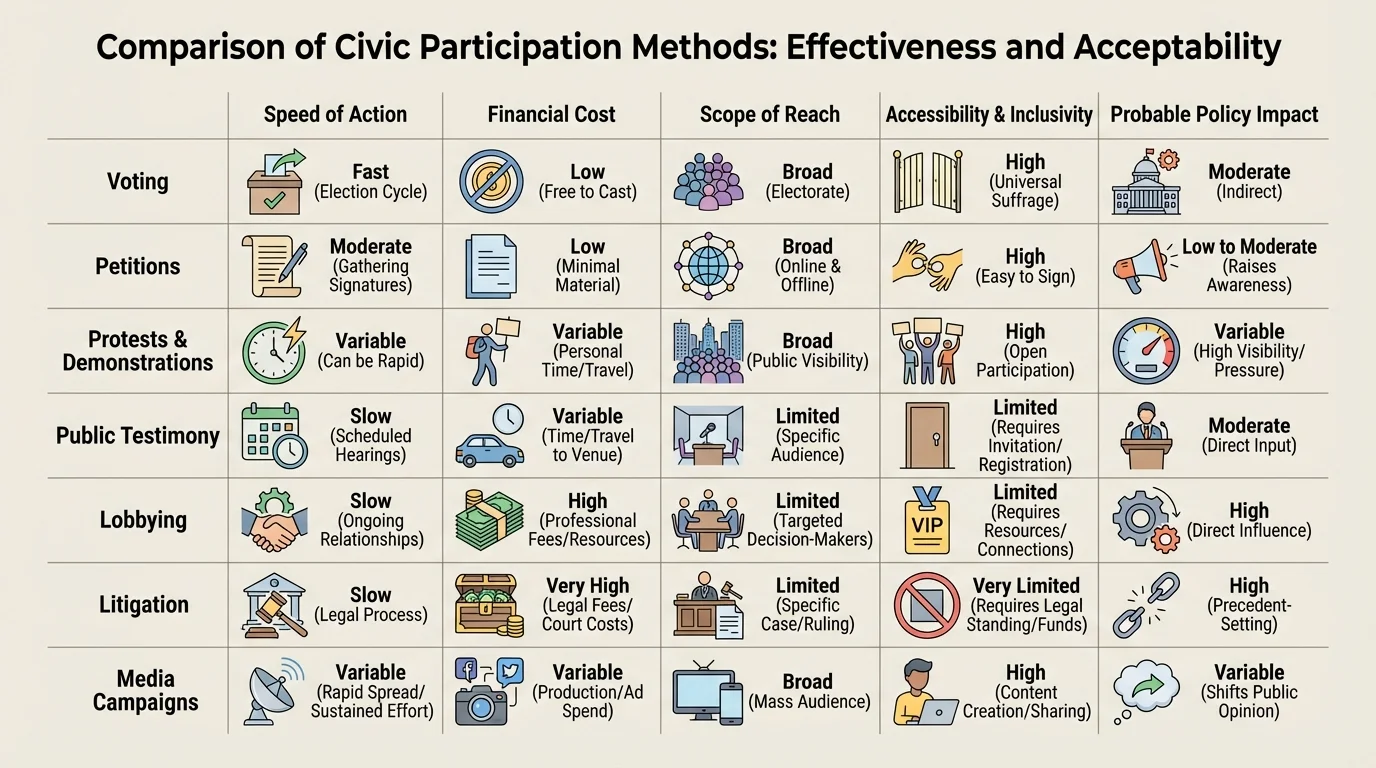
Another useful criterion is sustainability. Some methods create a short burst of attention and then fade. Others build long-term pressure. A single rally may not matter much by itself, but a year-long campaign that includes voter outreach, meeting attendance, coalition-building, and media coverage may be very effective.
Effectiveness also depends on whether the method matches the target. If the goal is to change a school dress code, a local petition and school board testimony may work well. If the goal is to protect constitutional rights, litigation and federal advocacy may be more effective. Matching method to institution is a key part of strategy, as we already saw in [Figure 1].
| Method | Strengths | Limitations | Often Most Effective When |
|---|---|---|---|
| Voting | High legitimacy, broad impact | Indirect, periodic | Selecting leaders and long-term direction |
| Contacting officials | Direct, low-cost | Limited by numbers and timing | Officials are considering a specific decision |
| Public comment/testimony | Official record, local impact | Requires preparation and access | A board, council, or committee is meeting |
| Petitions | Shows support, easy to organize | Can be ignored if weak or unverifiable | Demonstrating visible community backing |
| Protests/marches | Visibility, urgency | May not produce detailed policy | An issue is being ignored |
| Lobbying | Detailed, targeted influence | Access can be unequal | Shaping bill language or regulations |
| Litigation | Can create binding rulings | Slow, expensive | Rights are at stake or laws are challenged |
Table 1. Comparison of common civic participation methods by strengths, limits, and best-use situations.
Acceptability asks whether a method is appropriate in a democratic society, not just whether it works. The first standard is legality. Methods that violate laws protecting safety, property, or rights may be less acceptable, although history also shows that civil disobedience can raise serious moral questions when laws themselves are unjust.
A second standard is ethics. Is the method honest? Does it rely on coercion, fear, or falsehood? Does it respect the rights of opponents? A campaign built on fabricated evidence may be effective in the short term, but it is not democratically acceptable because it corrupts public judgment.
A third standard is inclusion. Some methods are more accessible than others. Requiring expensive travel, legal expertise, or insider connections can exclude many citizens. A method that only wealthy groups can use easily may be less acceptable if it deepens inequality in representation.
A fourth standard is proportionality. Peaceful disruption can be a legitimate way to draw attention to urgent injustice, but methods that create excessive harm compared with their civic purpose are harder to defend. This is why peaceful protest is generally viewed differently from violent unrest.
Evaluating a tactic
A student-led group wants cleaner drinking fountains in an older school building.
Step 1: Identify possible methods.
The group considers posting accusations online, circulating a petition, speaking at a school board meeting, and collecting water-quality test data.
Step 2: Evaluate effectiveness.
A petition and school board testimony are likely to reach the officials who control maintenance decisions. Water-quality evidence increases credibility. Angry social media posts alone may gain attention but may not produce a repair plan.
Step 3: Evaluate acceptability.
Collecting evidence, speaking publicly, and petitioning are lawful and respectful. Posting unverified accusations about specific staff members would be less acceptable because it risks unfair harm and misinformation.
The most effective and acceptable strategy combines research with formal participation.
Acceptability does not always produce easy answers. For example, a sit-in that disrupts business may be controversial, but some people defend it when ordinary channels have repeatedly failed. Evaluating civic action therefore requires both democratic principles and historical awareness.
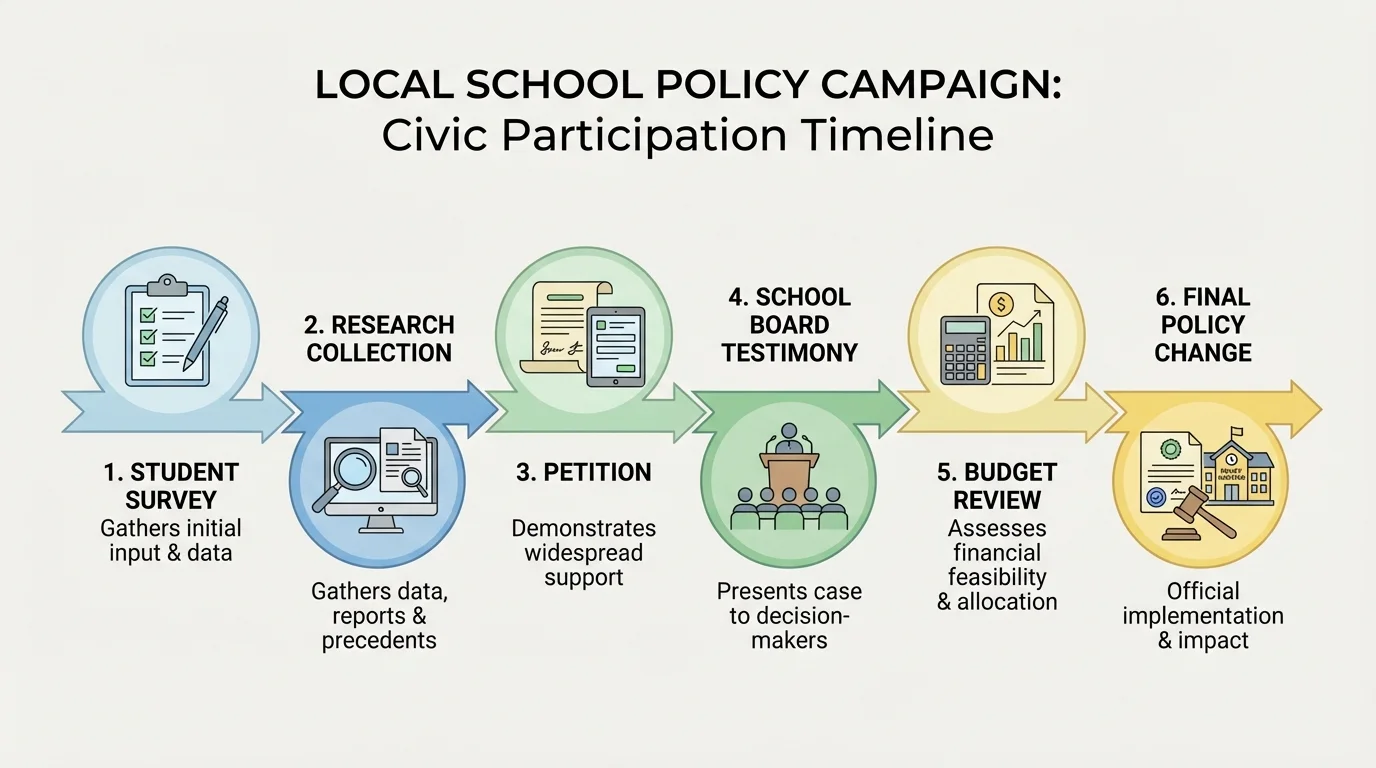
Real policy change usually develops through a sequence of actions rather than a single event. At the local level, students concerned about later school start times might begin with surveys, gather sleep and transportation research, present findings to a school board, and build parent support. The school board may then revise district policy after budget review and public hearings.
[Figure 4] At the state level, advocacy around seat belt laws, distracted driving restrictions, or education funding often combines public testimony, lobbying, media campaigns, and electoral pressure. A bill may move through committee, face amendments, and depend on coalition-building among parents, health experts, and legislators.
At the tribal level, participation may involve tribal council meetings, cultural advocacy, community consultation, and defense of tribal sovereignty. Tribal policy debates can concern language preservation, land management, law enforcement partnerships, and protection of sacred sites. Respect for tribal governance structures is essential when evaluating both effectiveness and acceptability in these contexts.
At the national level, major policy shifts often require many methods at once. The movement for marriage equality involved litigation, public persuasion, elections, media, and legislative advocacy. Environmental policies often involve scientific research, administrative rulemaking, tribal consultation, business lobbying, and public comment periods.
These examples show why no single method guarantees change. Effective civic participation usually combines direct action, evidence, organization, and persistence. The pathway shown in [Figure 2] becomes much stronger when many people follow it together over time.
Not everyone participates under equal conditions. Time, transportation, language barriers, disability access, internet availability, childcare responsibilities, and work schedules all affect who can engage. Age also matters. Students under 18 may not vote, but they can still testify, organize, research, volunteer, contact officials, and influence public opinion.
Political knowledge and confidence matter too. Some people feel that their voices do not matter, a problem sometimes called low political efficacy. This belief can reduce participation even when opportunities exist. Schools, community organizations, and media literacy education can help people overcome this barrier.
Young people who cannot yet vote have often played major roles in policy debates, including civil rights activism, climate advocacy, and school reform campaigns. Influence in civic life is not limited to formal officeholders or adult voters.
Because access is unequal, evaluating civic participation should include a fairness question: who is able to use this method, and who is left out? A democratic society should protect participation that is broad, informed, and open to many voices.
The strongest civic strategy usually begins with several questions. What exact policy do we want to change? Which institution has authority? Who are the key decision-makers? What evidence supports the case? Which allies can help? What method is likely to reach the right audience at the right time?
For a local issue, students might begin with research, petitions, and public comment. For a state issue, they may add coalition-building and legislator meetings. For a national issue, they might combine digital organizing, media outreach, advocacy groups, and electoral involvement. Choosing the right method is not about finding one perfect tool; it is about combining tools intelligently.
Citizens and groups shape policy most successfully when they are informed, strategic, ethical, and persistent. Democracy is not only a system for choosing leaders. It is also a system for ongoing participation, where ideas compete, evidence matters, and ordinary people can influence the direction of public life.
