A single post can reach millions of people before a newspaper even prints its morning edition. That speed is powerful, but it is also risky. In a democracy, people make choices about leaders, laws, and public issues based on information they receive. If that information is weak, manipulated, or false, public decisions can suffer. Learning to evaluate media is not just an academic skill. It is a civic skill.
Citizens in a civil society are expected to discuss issues, weigh evidence, and form reasoned positions on public policy. That becomes difficult when information comes from many directions at once: television, radio, websites, podcasts, influencers, livestreams, and social media feeds. Some of these sources are careful and evidence-based. Others are rushed, opinion-driven, or openly deceptive.
Media helps people learn about school board decisions, tribal sovereignty issues, state laws, elections, court rulings, public health guidance, and national debates. It can uncover corruption, explain complicated policies, and bring attention to voices that were once ignored. But media can also distort events, oversimplify problems, and push people toward emotional reactions instead of careful judgment.
Reliability means a source consistently provides accurate, verifiable information over time.
Credibility means a source is believable because of its expertise, transparency, evidence, and reputation.
Bias is a tendency to present information from a particular viewpoint, sometimes by emphasizing some facts and ignoring others.
Misinformation is false or misleading information shared without necessarily intending harm, while disinformation is false information spread deliberately to mislead.
These ideas matter because democratic participation depends on informed judgment. A person who can recognize strong reporting, weak evidence, and manipulation is better prepared to engage in debate, vote responsibly, and respond to public issues in a thoughtful way.
Traditional media includes older, established systems for distributing information, such as newspapers, magazines, radio, and television. These forms developed over time and often established professional standards such as editing, fact-checking, and corrections. Modern civic life still depends on them, and their evolution across eras is easier to compare when the major forms are placed side by side.
[Figure 1] Non-traditional media includes newer or less formal channels such as blogs, independent websites, podcasts, streaming channels, newsletters, and citizen journalism. These sources can be valuable because they expand who gets to speak. A local resident with firsthand video of a city council confrontation may reveal something that large outlets missed. At the same time, these sources may not always follow professional standards.
Social media refers to digital platforms where users create, share, comment on, and redistribute content. It includes apps and websites built around posts, videos, images, livestreams, and online communities. Social media is different from earlier media because audiences are not only consumers. They are also publishers.
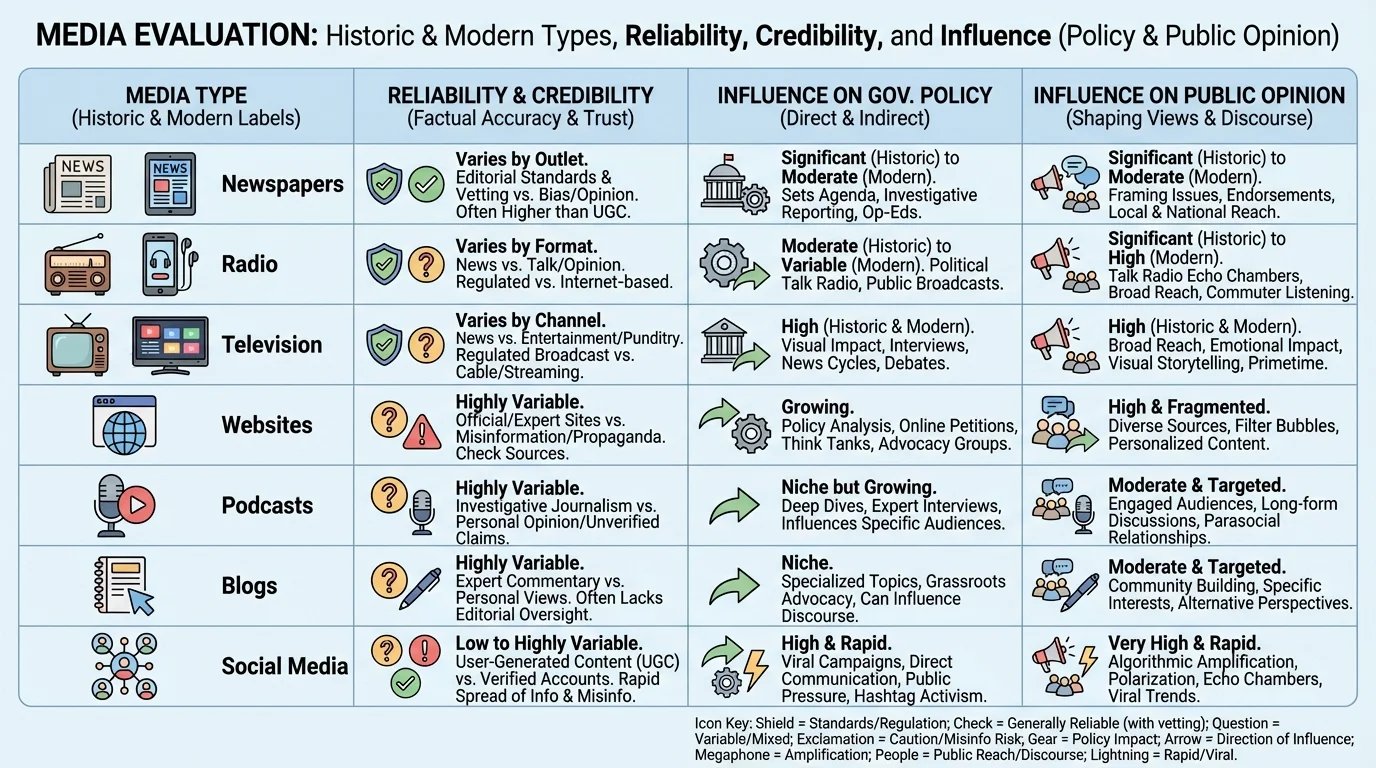
Historic media forms shaped public life long before smartphones existed. Newspapers helped spread political ideas during the founding of the United States. Radio connected leaders and citizens during wars and economic crises. Television transformed politics by making appearance, sound, and visual storytelling central to public communication. Each shift changed not only how people got information, but also what kinds of messages were most persuasive.
Modern media adds even more variation. A newspaper article, a documentary segment, a podcast interview, a personal blog post, and a short video clip may all cover the same issue, yet they differ in length, tone, depth, and evidence. This means students should not ask only, "Where did I see this?" They should also ask, "How was this message created, and what standards shaped it?"
A source can be popular without being reliable. It can look professional without being credible. It can even contain true facts while still presenting a misleading overall picture. That is why media evaluation requires more than spotting obvious falsehoods.
Reliability concerns consistency and accuracy over time. If a source repeatedly publishes verified information and corrects errors when needed, it is more reliable than a source known for exaggeration or rumor. Credibility asks whether the source deserves trust in the first place. A journalist with expertise, named sources, and clear evidence is usually more credible than an anonymous account making dramatic claims without proof.
Bias does not always mean a source is useless. Every person and organization has perspectives shaped by experiences, interests, and values. The key question is whether the source is transparent, evidence-based, and fair to competing viewpoints. Editorials are openly opinion-based, while straight news reporting is expected to separate facts from commentary. Knowing the difference matters.
Students should also recognize common warning signs. Emotional language, all-caps headlines, missing dates, manipulated images, anonymous claims, and one-sided evidence can all reduce trust. Some sources rely on cherry-picking, which means selecting only the facts that support one side while ignoring facts that complicate the story.
False stories often spread faster online than accurate corrections because surprising or emotional content attracts more clicks, shares, and comments. Speed and popularity are not the same as truth.
This is one reason people must slow down before reacting. A dramatic claim may feel convincing in the moment, but civic judgment requires verification, not impulse.
Strong source evaluation follows a sequence rather than a guess. Students can move from a claim to a judgment by asking a series of questions. The more important the issue is, especially when it relates to public policy, the more careful the evaluation should be.
[Figure 2] First, identify the claim. What exactly is the source saying happened, or what argument is it making? If the claim is vague, it is harder to verify. Second, examine the author or organization. Is the author named? What expertise, experience, or record does the person have? Does the organization explain its editorial standards?
Third, inspect the evidence. Reliable reporting often includes documents, interviews, official records, data, or direct observation. Credible opinion writing should still use facts fairly, even when arguing for a position. Fourth, check the date and context. An old image or article can be misleading if it is recirculated as if it happened yesterday.
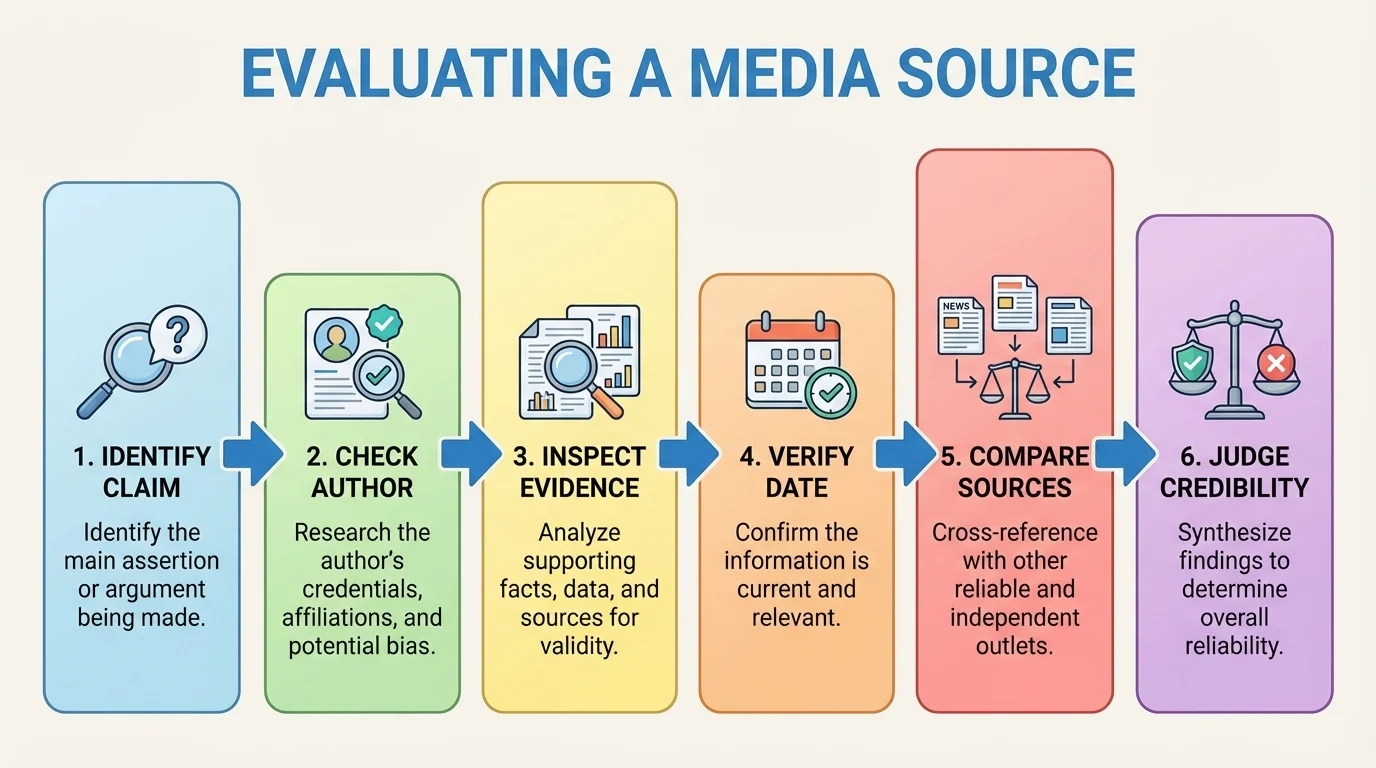
Fifth, compare with other sources. This process is called corroboration, which means confirming information by checking whether independent sources report similar facts. If several reliable outlets with different perspectives verify the same event, confidence increases. If only one vague source reports a shocking claim, skepticism is appropriate.
Sixth, consider purpose and funding. Is the source trying to inform, persuade, entertain, sell, or mobilize support? A campaign advertisement, for example, should not be judged the same way as a news investigation. Finally, look for transparency. Trustworthy sources show where information came from, explain what is unknown, and correct mistakes publicly.
| Question | Why It Matters | Example |
|---|---|---|
| Who created this? | Author expertise and accountability affect trust. | A named health reporter is stronger than an anonymous meme account. |
| What evidence is used? | Claims need support. | Official documents and interviews are stronger than "people are saying." |
| When was it published? | Context changes meaning. | An old wildfire photo may be reused during a new disaster. |
| Why was it made? | Purpose shapes presentation. | An editorial aims to persuade; a straight news report aims to inform. |
| Can it be verified elsewhere? | Independent confirmation increases confidence. | Multiple local outlets confirm a school policy change. |
Table 1. Core questions students can use to evaluate media sources.
When students research local, state, tribal, or national issues, this evaluation process helps them build positions on policy using evidence instead of rumors. It also makes civil discussion stronger because claims can be traced back to sources that others can inspect.
Social media feels personal, but much of what users see is shaped by hidden systems. A platform's algorithm is the set of rules or calculations that helps decide what appears in a feed. These systems often reward engagement, and one post can travel outward through recommendations, reposts, and comments.
[Figure 3] Because platforms prioritize content that keeps people watching, clicking, or reacting, emotional posts may travel farther than balanced explanations. This can amplify anger, fear, or outrage. It can also create echo chambers, where users mostly encounter views similar to their own. Over time, people may begin to assume that their feed reflects reality, when it may only reflect what the platform predicts they will engage with.
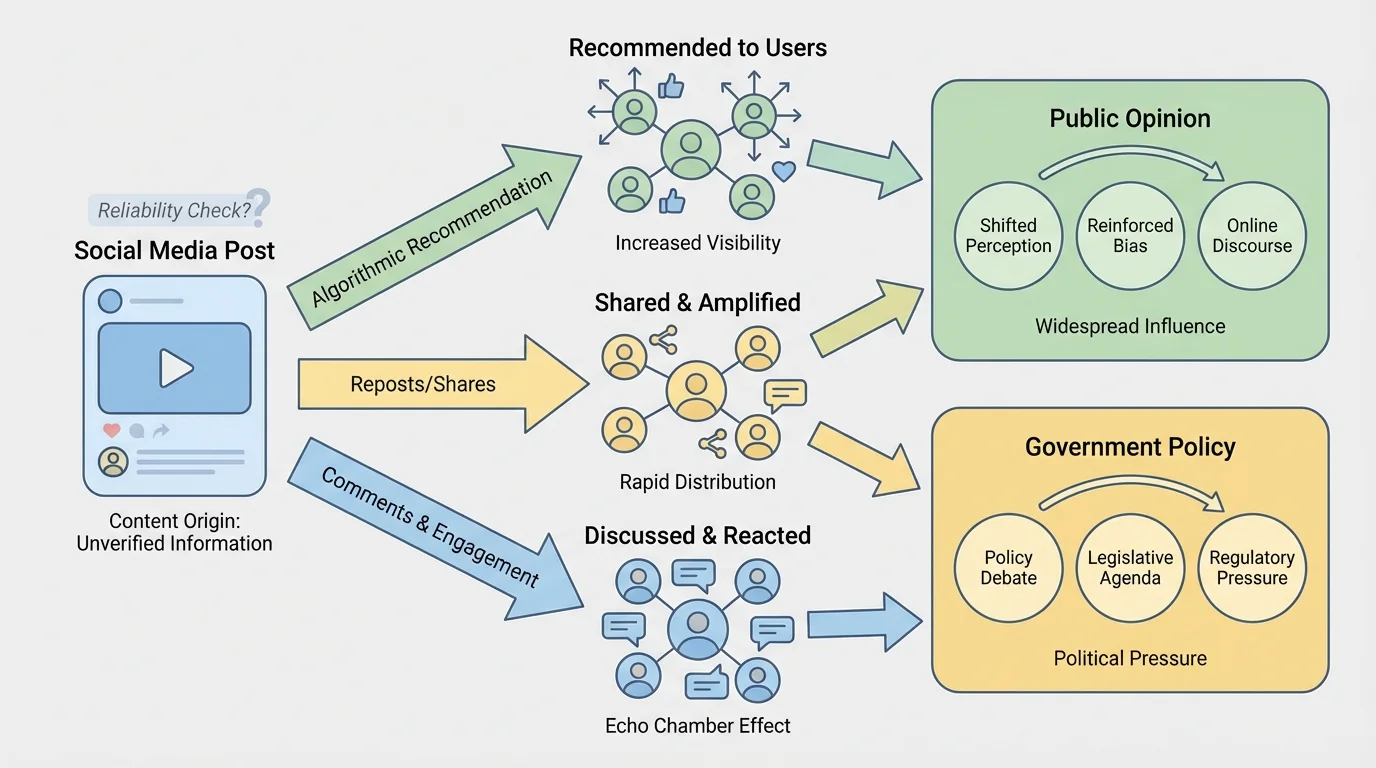
Virality means content spreads rapidly across a network. Viral content is not automatically false, but its speed can make verification difficult. By the time a correction appears, millions may already have absorbed the original claim. This is especially dangerous during elections, emergencies, protests, or public health crises.
Social media also blurs the line between eyewitness reporting and incomplete information. A short clip may be real but misleading if it lacks context. A video from one angle can hide what happened before or after. Rapid sharing often strips away explanation while preserving emotion.
Why algorithms matter for civic life
When platforms rank information by engagement rather than public value, citizens may see more of what is provocative than what is informative. That can change how people understand issues, who they trust, and which problems seem urgent. Media literacy therefore includes asking not only whether content is true, but also why that content reached you.
At the same time, social media can widen participation. Young people, activists, community leaders, and marginalized groups can bring attention to issues that large outlets ignored in the past. The same tool that spreads rumors can also document injustice, organize relief efforts, and connect people to public meetings or civic campaigns.
Media does not simply tell people what to think. More often, it tells people what to think about. This is known as agenda-setting. If news outlets and social platforms focus constantly on immigration, school safety, inflation, or climate disasters, those issues become more prominent in public discussion.
Another important idea is framing. Framing refers to how an issue is presented. A protest can be framed as a demand for justice, a threat to order, an act of civil disobedience, or a constitutional exercise of free speech. The facts reported may overlap, but the angle changes how audiences interpret them.
Repetition matters too. If people hear the same claim again and again, it can begin to feel true even without strong evidence. Images, slogans, and selective examples often affect emotions faster than careful policy analysis. Political campaigns understand this well. So do advertisers and advocacy groups.
Case study: A local policy debate
Suppose a town is debating whether to change school start times.
Step 1: A local newspaper publishes interviews with sleep experts, parents, teachers, and students.
Step 2: A short social media clip goes viral showing only one angry school board exchange.
Step 3: Community members who see only the clip may think the issue is mainly about conflict.
Step 4: People who read the longer reporting may understand the health, transportation, and budget trade-offs.
The different forms of media can lead audiences toward very different impressions of the same issue.
This does not mean long-form journalism is always best or that short-form media is always bad. It means format affects understanding. A sixty-second video may raise awareness, but deeper evaluation usually requires more evidence, more context, and more than one source.
Media can shape policy through a chain of events that begins with attention and often ends with official action. Reporting highlights an issue, the public responds, advocacy groups organize pressure, and elected officials or agencies react. In democracies, policymakers often respond not only to facts, but also to what the public notices and demands.
[Figure 4] Investigative journalism has often triggered reforms by exposing unsafe working conditions, government secrecy, environmental damage, or corruption. Local journalism can influence zoning decisions, school funding, policing policies, and public spending. Tribal media outlets can bring attention to sovereignty issues, cultural preservation, and disputes over land or resources that national media may overlook.
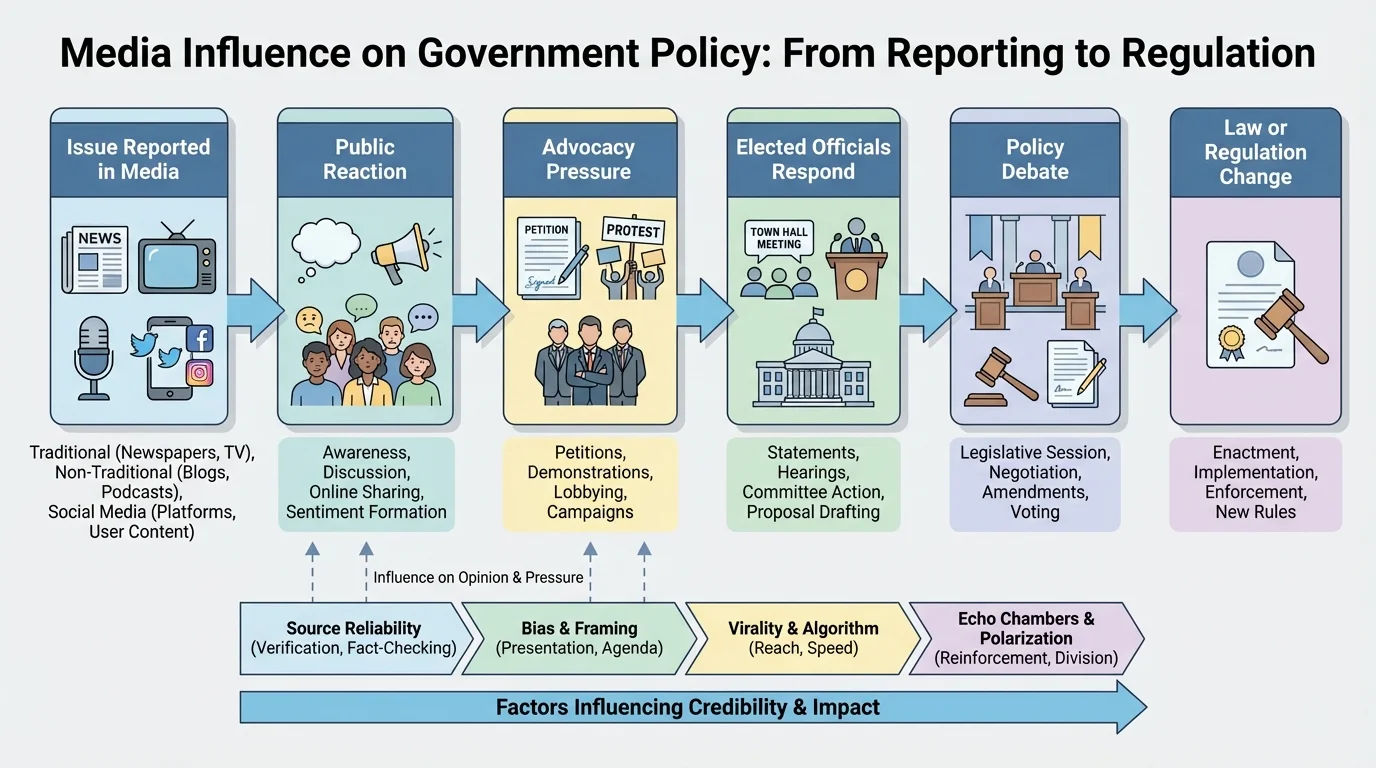
Social media campaigns can accelerate this process. Hashtags, petitions, recorded testimony, and viral videos may push leaders to address a problem more quickly. Public officials monitor media because they know voters do. When enough people contact representatives, attend meetings, or demand hearings, policy discussion can shift.
However, media pressure can also produce rushed policymaking. Leaders may react to public outrage before all facts are known. A dramatic but unusual incident can receive more attention than a widespread but slower problem. For example, a single viral crime story may dominate debate, while long-term housing shortages or water infrastructure problems receive less attention even though they affect more people.
That is why responsible citizens and policymakers should distinguish between what is merely visible and what is most significant. As [Figure 4] suggests, attention is powerful, but attention should lead to informed policy, not just reaction.
History shows that media influence is not new. In the late nineteenth and early twentieth centuries, sensational newspapers sometimes used dramatic headlines to increase sales, a style often called yellow journalism. Such reporting could inflame public opinion and simplify international conflicts.
At other times, journalism has strengthened democracy. Reporting on the Watergate scandal helped reveal abuses of political power and contributed to major public accountability. During the civil rights movement, television coverage brought images of segregation and violence into living rooms across the country, influencing national opinion and increasing pressure for federal action.
Modern examples show a similar pattern with new technology. Videos shared online have drawn attention to police violence, natural disasters, war crimes, and corruption. Online organizing has helped mobilize protests, relief drives, and voter registration efforts. Yet the same environment has also enabled conspiracy theories, election misinformation, and coordinated disinformation campaigns by political groups or foreign actors.
"The press was to serve the governed, not the governors."
— Hugo Black
This principle remains important even in the age of creators and platforms. Independent scrutiny of those in power is a core democratic function. But scrutiny works best when audiences also apply careful judgment to what they consume and share.
Students researching public issues should aim to form positions that are evidence-based, open to revision, and respectful of disagreement. That means using multiple sources, distinguishing reporting from opinion, and checking whether claims are supported by strong evidence. It also means recognizing when a source is trying to provoke rather than inform.
A responsible civic media user asks practical questions: What do I know for sure? What remains uncertain? Which sources have verified this? Whose voices are missing? How might this coverage affect the way people view a policy issue? These questions are essential whether the issue involves local school funding, tribal water rights, state voting laws, or national immigration policy.
Digital citizenship also includes sharing responsibly. Before reposting a claim, especially one that could damage a person or inflame a public issue, students should pause and verify. A citizen who spreads falsehoods, even unintentionally, can contribute to confusion and mistrust. A citizen who checks facts, reads widely, and engages respectfully helps strengthen democratic life.
Strong civic participation does not require everyone to agree. It requires people to use evidence, listen carefully, and make judgments with integrity. Evaluating media is one of the main ways citizens prepare to do that.
Media is not just background noise. It helps shape what a society notices, debates, fears, and hopes for. The ability to evaluate it carefully is therefore part of being informed, independent, and ready to participate in public life.
