A single city council vote can change bus routes, a state law can shape what students learn in school, a tribal government can protect sovereignty and cultural resources, and a federal decision can affect voting rights across the country. Government is not something distant that affects only adults. It shapes roads, water, speech, education, policing, health rules, land use, and access to rights. Because public decisions affect daily life, active community membership matters.
Civic engagement means participating in the life of a community and in the processes that shape public decisions. In a democracy, government is supposed to respond to the people. But that only works when people pay attention, learn about issues, and speak up. If citizens stay silent, decisions still get made; they are just made without as many voices at the table.
For high school students, civic engagement is not limited to voting later in life. Students already live with the results of public policy. School discipline rules, mental health services, access to libraries, internet infrastructure, environmental protections, and transportation are all shaped by public decisions. When students learn how to research issues and communicate with government officials, they are practicing citizenship, not just studying it.
Public policy is a course of action chosen by a government to address a problem or goal. Civil society is the network of communities, organizations, associations, media, and individuals that operate outside government but influence public life. Advocacy is organized action to support a cause, policy, or right.
Active community members do more than complain. They identify a problem, gather evidence, understand who has authority, and choose a strategy. A student concerned about unsafe crosswalks might need to contact the city. A student concerned about graduation requirements may need to speak to the school board or state officials. A student concerned about treaty rights or land use may need to understand the role of tribal and federal governments as well as state law.
Effective civic action begins with knowing which government body has the power to act, as [Figure 1] shows through a comparison of issues and levels of government. Many public problems feel broad, but they are not all handled in the same place. Understanding jurisdiction helps citizens direct their efforts where they can have the greatest impact.
Local government often includes city councils, mayors, county boards, school boards, planning commissions, and local courts. Local governments usually deal with issues such as zoning, policing, parks, sanitation, local roads, school district decisions, and emergency services. If a neighborhood wants a stop sign, a safer park, or changes to a school calendar, local officials are often the first contact.
State government typically handles statewide education policy, state highways, licensing, election rules within the state, criminal law, public universities, and many health and environmental regulations. Governors and state legislatures often influence topics that students notice directly, such as textbook policy, graduation standards, and voting access.
Tribal governments are sovereign governments with authority over their own communities, lands, laws, and cultural matters, though the exact scope of authority depends on history, treaties, federal law, and court decisions. Tribal governments are not simply another type of local government. They have a distinct political status and a government-to-government relationship with the United States. Understanding this matters when issues involve land, natural resources, education, public safety, jurisdiction, and the protection of Native rights.
Federal government handles national defense, immigration, foreign policy, interstate commerce, federal civil rights protections, and national laws. Congress, the president, federal agencies, and federal courts all shape nationwide policy. Some issues, such as free speech rights, disability law, and major environmental rules, may involve federal protections even when the effects are felt locally.
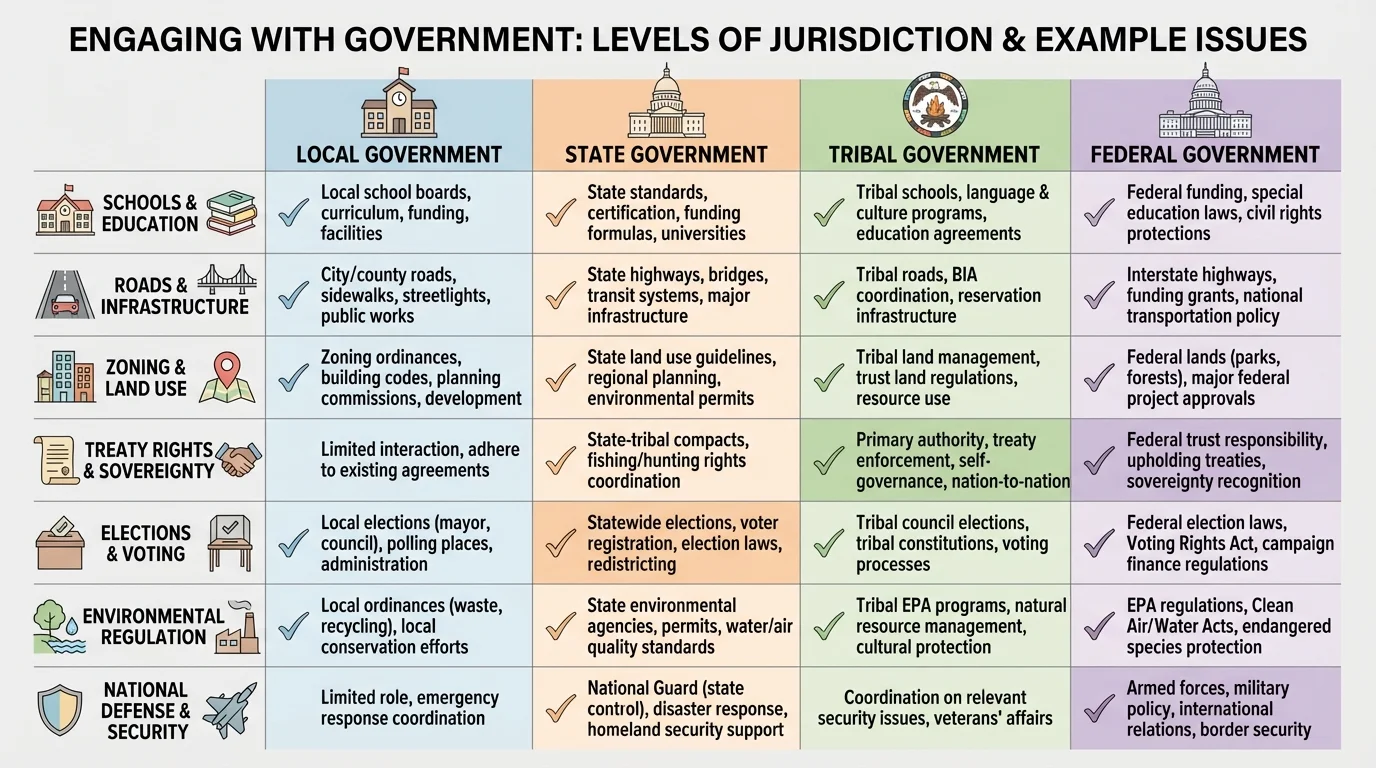
Sometimes one issue involves more than one level. Water quality can involve local infrastructure, state regulation, tribal land and treaty concerns, and federal environmental law. Education can involve local school boards, state curriculum policy, tribal education authority, and federal protections against discrimination. That overlap makes research more complicated, but it also creates more than one path for action.
| Level | Common Areas of Action | Examples of Officials or Bodies |
|---|---|---|
| Local | Schools, roads, zoning, parks, policing | City council, mayor, county board, school board |
| State | State laws, education standards, elections, transportation | Governor, state legislature, state agencies |
| Tribal | Sovereignty, cultural resources, tribal courts, land and community governance | Tribal council, tribal chairperson, tribal court |
| Federal | National laws, civil rights, immigration, defense | Congress, president, federal agencies, Supreme Court |
Table 1. Comparison of government levels, their common responsibilities, and examples of decision-making bodies.
Citizens and residents engage government for many reasons, but one of the most important is to protect or expand rights. Rights can include freedom of speech, freedom of religion, due process, equal protection, voting access, disability access, and the right to seek redress from government. Some rights are clearly written into constitutions or laws; others become real only when people organize and insist that institutions enforce them fairly.
Civil society plays a major role here. Student groups, nonprofit organizations, neighborhood associations, faith communities, youth councils, labor unions, advocacy groups, and independent media all help people share concerns, organize evidence, and pressure institutions to act. Government and civil society are different, but they influence each other constantly.
"The right to be heard does not automatically include the right to be taken seriously."
— Hubert H. Humphrey
That quote is a reminder that speaking is only the beginning. To be effective, civic participation must be informed, organized, respectful, and persistent. People in a civil society do not have to agree, but they do need to engage without threats, harassment, or deliberate falsehoods. Democratic life depends on disagreement being handled through evidence, law, public debate, and peaceful action.
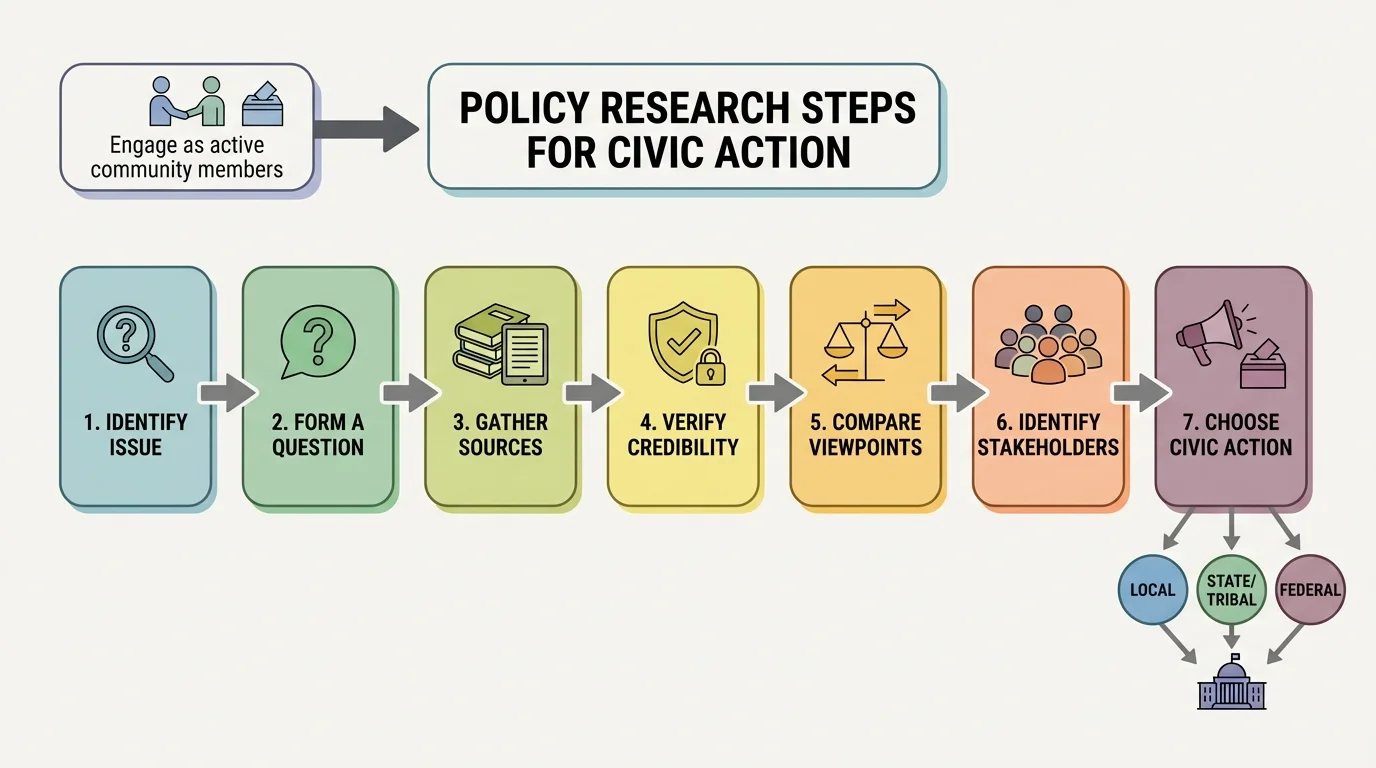
Good civic action follows a process, and [Figure 2] lays out the sequence from identifying a problem to choosing informed action. Research is what separates a strong argument from a loud opinion. When students research a policy issue, they should begin by defining the question clearly. Instead of asking, "Why is school unfair?" a stronger question would be, "How do current school start times affect student sleep, attendance, and academic performance?"
Once the question is clear, gather information from multiple kinds of sources. These may include government reports, laws, court decisions, local meeting minutes, public budgets, reputable journalism, academic studies, interviews with affected people, and data from agencies. Primary sources are especially valuable because they come directly from the institution or event being studied, such as a school board agenda, a city ordinance, or congressional testimony.
A primary source is not automatically unbiased, and a secondary source is not automatically unreliable. The key is evaluation. Ask who created the source, when it was produced, what evidence it provides, what perspective it represents, and whether it can be verified. If one social media post claims a new law bans something, students should check the actual text of the law before repeating the claim.
Research should also identify stakeholders, the people or groups affected by a decision. A proposal to build a new highway might affect commuters, nearby residents, business owners, tribal communities, environmental groups, and taxpayers in different ways. Good civic research asks not only, "What do I think?" but also, "Who gains, who loses, and whose voices are missing?"
Students should watch for the difference between evidence and assertion. Evidence includes statistics, official records, documented testimony, direct quotations, and observable facts. Assertions are claims that may or may not be true. A responsible civic participant checks whether the evidence actually supports the claim. This matters especially in fast-moving online discussions, where emotional language can spread faster than accurate information.
Public meeting agendas, budgets, ordinances, and testimony are often available online. Many citizens do not realize how much government information is public, which means informed advocacy often begins with reading documents that are already available.
Research also requires context. If students are investigating school funding, they should understand how funding is generated, who controls it, and whether the issue is district-level, state-level, or both. As seen earlier in [Figure 1], public problems can cross levels of government, so the research process needs to trace authority as well as facts.
After research comes judgment. A strong public position has several parts: a clear claim, evidence, reasoning, and awareness of counterarguments. For example, a student might argue that their city should expand bus service because attendance data show that unreliable transportation increases tardiness, surveys show demand, and the policy would especially benefit low-income neighborhoods.
A counterargument is an opposing claim that must be taken seriously. Maybe critics argue that expanding bus service would cost too much. A thoughtful response would not ignore that concern. Instead, it would compare costs with benefits, suggest pilot programs, identify funding sources, or point to long-term gains such as improved attendance and employment access.
How a public position becomes persuasive
A persuasive civic position does not rest only on strong feelings. It connects values to facts. For example, fairness is a value, but a claim about unfairness becomes more convincing when supported by attendance records, budget data, disability access reports, or testimony from affected residents. Public persuasion is strongest when moral principles and verifiable evidence work together.
Formulating a position also means recognizing trade-offs. Public policy often involves limited time, money, and political support. A plan that helps one need may reduce resources for another. That does not mean students should give up. It means serious civic thinking requires weighing options honestly. Responsible advocacy is stronger when it acknowledges complexity instead of pretending every issue has an easy answer.
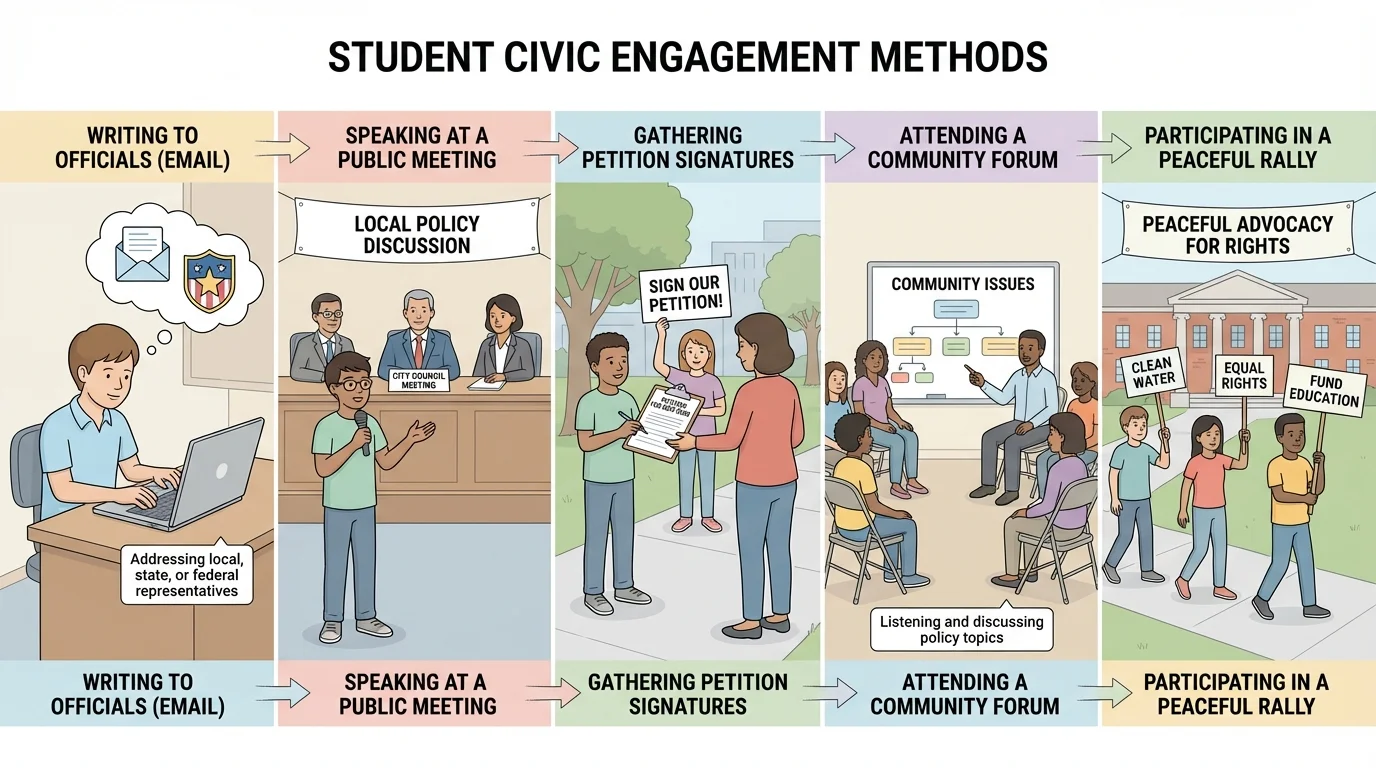
Participation includes many methods beyond voting, and [Figure 3] illustrates several common ways community members connect with decision-makers. Different issues call for different approaches. Some methods are private and direct, such as sending a letter to a representative. Others are public, such as speaking at a school board meeting or joining a peaceful rally.
One common method is contacting elected officials. Effective messages are brief, respectful, and specific. They identify the issue, explain why it matters, provide evidence, and request a particular action. A message that says, "Please support extending library hours because students in our district rely on after-school internet access," is far more effective than a message that only says, "Do better."
Public comment is another powerful tool. City councils, school boards, state agencies, and tribal bodies often allow citizens to speak at meetings or submit written comments. This gives people a formal opportunity to enter their views into the public record. A student who has researched a proposal can use public comment to explain likely effects, cite data, and suggest changes.
Petitions can demonstrate that an issue affects many people, but numbers alone are not enough. A petition works best when paired with evidence and a clear demand. Community forums, youth advisory boards, and organized meetings with officials can also create dialogue. Peaceful protest has a long history in democratic life, especially when institutions ignore urgent problems. However, protest is strongest when participants understand the legal boundaries, goals, and message discipline of the action.
Students who are not yet eligible to vote still have meaningful influence. They can attend meetings, submit testimony, write op-eds, organize informational campaigns, interview officials, join student government, and work through community organizations. When they become eligible, voting becomes one additional tool, not the only one.
Case study: changing a school district policy
A group of students believes their district should add more mental health counselors.
Step 1: Define the problem clearly.
They identify long wait times for counseling appointments and collect anonymous student concerns through a school-approved survey.
Step 2: Gather evidence.
They review district staffing data, compare counselor-to-student ratios, and examine budget reports and board meeting minutes.
Step 3: Identify decision-makers.
They learn that the school board approves staffing priorities and the superintendent recommends budget allocations.
Step 4: Present a position.
They speak at a board meeting, submit written testimony, and propose a phased increase in counseling staff.
Step 5: Follow up.
They continue attending meetings, meet with administrators, and update the community on progress.
This example shows that civic participation is usually a process, not a single moment.
Several methods can work together. A well-researched email can lead to a meeting. A meeting can lead to testimony. Testimony can lead to media coverage. Media coverage can lead to broader public support. Engagement is often most effective when it combines communication, organization, and persistence.
Some civic action focuses on broad policy questions, while other action centers on specific rights. An individual right may involve one person seeking equal access or fair treatment. A group right may involve a community defending language, land, voting access, cultural practices, or equal protection under the law. Often these two levels overlap.
Consider disability access. A student using a wheelchair might face a school entrance that is technically legal under older design standards but still difficult to use in practice. That student can raise an individual concern, but the issue may reveal a broader pattern affecting many people. Advocacy can then move from one complaint to a wider policy review of accessibility, maintenance, signage, transportation, and inclusive design.
Voting rights provide another example. Changes in voter identification rules, polling place locations, registration systems, or language access can affect different communities unequally. Citizens and organizations may research the impact, challenge unlawful barriers, testify before lawmakers, educate voters, or file court cases when necessary.
Issues involving sovereignty are especially important when working with tribal governments. Sovereignty means the authority of a people or government to govern itself. Tribal nations may advocate for control over resources, education, child welfare, cultural protection, or legal jurisdiction. Effective civic participation in these cases requires respect for tribal authority, historical knowledge, and an understanding that tribal rights are rooted in nationhood, not simply in local preference.
Case study: protecting a community resource
A community learns that a development project may affect water quality near tribal land and nearby neighborhoods.
Step 1: Research who has authority.
Residents identify the local planning board, the state environmental agency, and the tribal government as key actors.
Step 2: Gather evidence.
They review environmental impact statements, public records, maps, and testimony from scientists and residents.
Step 3: Organize advocacy.
Different groups coordinate comments, attend hearings, and ask officials to delay approval until stronger protections are adopted.
Step 4: Protect rights and interests.
Advocates frame the issue around health, environmental justice, and respect for tribal authority and community well-being.
This kind of advocacy shows how rights, policy, and multiple levels of government can intersect.
Advocating for rights does not always mean total agreement within a community. People may disagree about methods, timing, or priorities. What matters is that engagement remains lawful, evidence-based, and focused on dignity and justice.
Civic participation faces obstacles. Some people lack transportation, free time, internet access, language support, or confidence in public speaking. Others feel excluded because institutions have ignored them before. Recognizing these barriers matters because an open democracy should not depend only on who has the most resources.
There are also ethical challenges. Misinformation can spread quickly. Edited videos, false quotes, and misleading statistics can turn public debate into confusion. Responsible citizens verify before sharing. They also avoid doxxing, harassment, threats, and personal attacks, even when they strongly disagree. Freedom of speech protects many forms of expression, but it does not excuse abuse or erase the need for judgment.
Persuasive argument writing and source evaluation from earlier coursework remain essential here. Civic participation depends on the same habits: identifying claims, checking evidence, and distinguishing reliable sources from weak ones.
Digital tools can expand participation, but they can also create the illusion that posting is the same as organizing. Online awareness matters, yet policy change usually requires more: documents, meetings, testimony, coalition-building, follow-up, and public accountability. Clicking "share" is easy. Sustained civic work is harder but more effective.
Major changes in rights and policy often begin with local action. A small group notices a problem, documents it, and demands a response. Over time, their efforts may influence school policy, city ordinances, state legislation, tribal governance, or federal court decisions. Change is rarely immediate. It usually comes through repeated participation, coalition-building, and careful strategy.
Youth have often played crucial roles in public life. Students have organized for safer schools, civil rights, environmental protection, and fair treatment in their communities. Their influence does not come from age alone. It comes from preparation, credibility, and the ability to connect lived experience with evidence and action.
The most effective active community members understand that democracy is not a spectator activity. They study issues, listen to others, identify the correct level of government, defend rights, and participate in ways that strengthen civil society. Public life is not only about what government does to people. It is also about what people, together, require government to do.
