Here is a paradox that has shaped human history: people create government because they fear chaos, but they also fear the government they create. That tension is one of the most important ideas in civics. A society without rules can become violent and unstable, yet a government with too much power can become oppressive. Understanding government means understanding both sides of that problem: why human communities need political authority and why that authority must never be unlimited.
At its most basic level, government exists because human beings live together in groups and groups create conflict as well as cooperation. People compete for resources, disagree about rules, defend themselves against outside threats, and need systems for making collective decisions. A family can settle many issues informally. A nation of millions cannot. Government develops as an organized way to make and enforce decisions for a political community.
A state is a political unit with territory, population, government, and sovereignty. Sovereignty means the authority to govern itself and make laws within its borders. Not every society throughout history has looked the same, but nearly all large, settled societies have created some form of governing system to keep order, settle disputes, raise resources, and defend the community.
Government is also tied to human needs that no individual can fully meet alone. Roads, courts, public safety systems, and national defense are examples of things that require organized cooperation. Economists often call these public goods, meaning benefits that many people use and that are difficult to provide efficiently through individual action alone. Even people who want a limited government usually accept that some shared institutions are necessary.
Government is the institution through which a society makes and enforces public policies.
Authority is the recognized right to rule or make decisions.
Legitimacy is the belief that a government has a rightful claim to govern.
Legitimacy matters because people obey government not only from fear of punishment but also because they believe its rules are rightful or necessary. A government that loses legitimacy may still have weapons and police, but it becomes less stable. History shows that governments survive best when citizens believe the system is justified, even when they disagree with specific laws or leaders.
Political thinkers and historians have proposed several explanations for how governments begin, and [Figure 1] compares the main theories that students most often study. These theories are not all equally accepted today, but each reveals something important about the relationship between power, belief, and human society.
One older theory is the divine right theory, which held that rulers received authority from God. This idea was especially important in parts of Europe, where monarchs claimed that challenging the king was almost the same as challenging divine will. The theory gave rulers strong legitimacy, but it also made criticism of authority more difficult.
Another explanation is the force theory, which argues that governments begin when one person or group dominates others through power. In this view, political authority first grows out of conquest or coercion. This theory helps explain some empires and kingdoms, especially where military victory created rule over large populations.
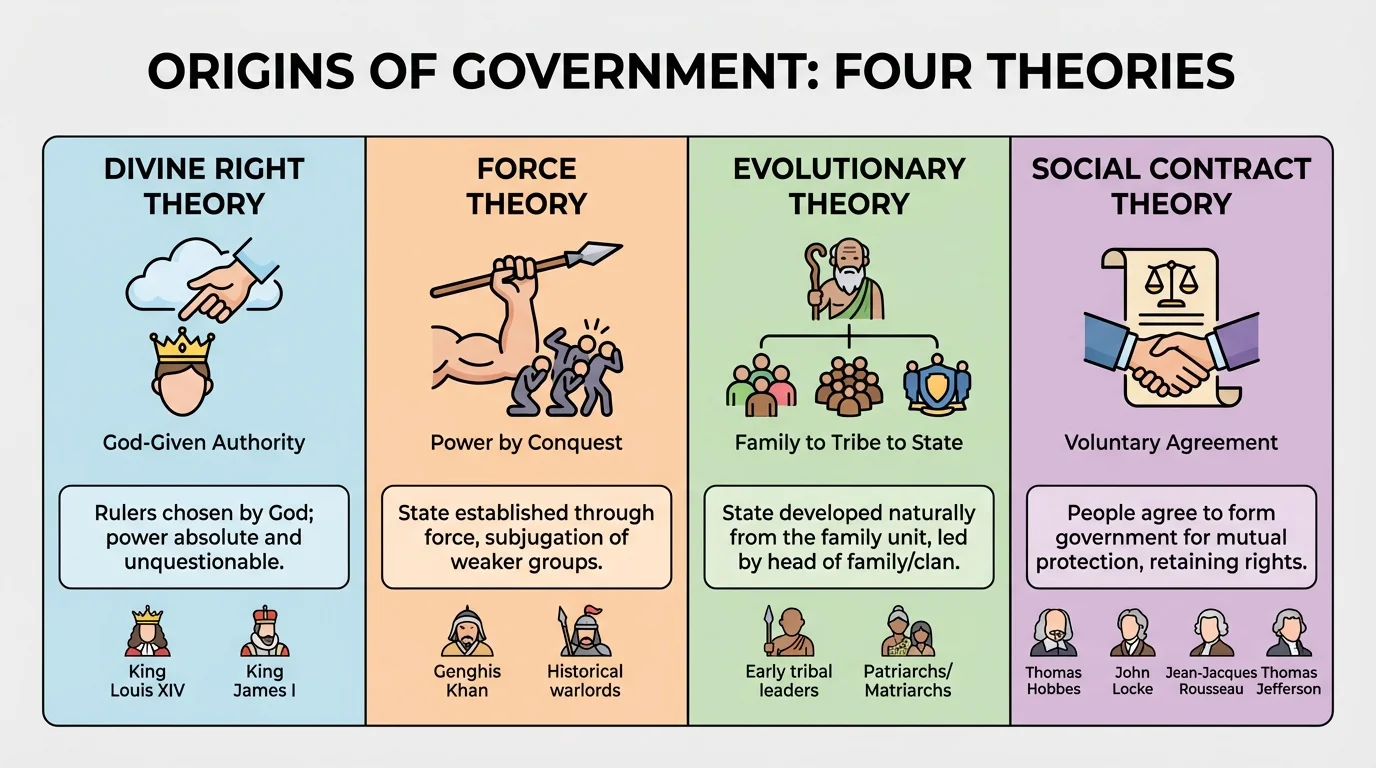
A third explanation is the evolutionary theory, which suggests that government developed gradually out of family, clan, tribe, and village structures. As communities grew larger and more complex, informal leadership became formal authority. This theory emphasizes slow development rather than a single dramatic beginning.
Perhaps the most influential modern explanation is the social contract. According to this idea, people agree—explicitly or implicitly—to give some power to a government in exchange for protection, order, and the security of rights. The social contract does not mean everyone signed an actual document. It is a philosophical model for understanding political obligation. Later, as shown in [Figure 1], different thinkers interpreted that contract very differently, especially when deciding how much power government should have.
Governments exist for many purposes, but several core functions appear again and again across time and place. One major purpose is to maintain rule of law, meaning that society is governed by known laws rather than the personal wishes of rulers. Under the rule of law, leaders are supposed to be bound by law just as citizens are. Without that principle, power easily becomes arbitrary.
A second purpose is to protect rights and provide justice. Courts hear disputes, determine guilt or innocence, and interpret laws. In democratic systems, governments are also expected to protect civil liberties such as speech, religion, due process, and equal treatment. This does not mean governments always succeed. In fact, much of history involves people demanding that governments live up to their stated ideals.
A third purpose is to provide security. This includes policing, emergency response, border protection, and national defense. Citizens expect government to reduce violence and respond to threats, whether those threats come from crime, invasion, terrorism, or natural disaster. During crises, debates often intensify over how much power government should use to keep people safe.
A fourth purpose is to provide public services and infrastructure. Schools, roads, public health systems, sanitation, water systems, and disaster relief all depend heavily on organized public action. Even when private companies help deliver these services, the government often regulates, funds, or coordinates them.
A fifth purpose is to promote the common good. That phrase does not mean everyone always agrees. It means government should aim at the welfare of the community as a whole rather than serving only a ruler, party, or wealthy elite. This purpose can include economic regulation, environmental protection, and efforts to expand opportunity.
The central tension of government is that people want two things at once: effective power and limited power. A weak government may fail to protect rights or maintain order. A strong government may threaten liberty. Constitutional systems try to solve this tension by giving government enough authority to act, while placing legal and institutional limits on that authority.
In the United States, these purposes are reflected in the Preamble to the Constitution: to form a more perfect union, establish justice, insure domestic tranquility, provide for the common defense, promote the general welfare, and secure the blessings of liberty. Those goals still shape political debates today. Arguments over taxes, health care, policing, immigration, and education often come down to different views about which governmental purposes should receive the greatest emphasis.
History offers a clear warning: power tends to expand unless it is restrained. Leaders may claim emergency powers, suppress critics, imprison opponents, or rewrite laws for their own benefit. The danger is not only dictatorship. Even governments with elections can violate rights if there are no strong limits, independent courts, free media, and active citizens.
One reason for limiting government is the protection of individual liberty. Freedom of speech, religion, press, assembly, and petition allow citizens to criticize leaders and advocate change. These liberties do not merely benefit individuals; they protect the entire political system by making abuse easier to expose.
Another reason is to prevent tyranny, which means cruel or oppressive rule. Tyranny can come from a king, a military ruler, a political party, or even a majority that ignores minority rights. Democratic government is not just majority rule. It also requires constitutional protections that keep majorities from using power unjustly.
Limited government depends on written constitutions, independent courts, free elections, checks among institutions, and civic culture. If laws exist only on paper but are ignored in practice, liberty remains fragile. A constitution is powerful not simply because it is written, but because people and institutions are committed to enforcing it.
Some of the strongest constitutional protections in history were written after people experienced the opposite. The English Bill of Rights, the U.S. Bill of Rights, and many postwar constitutions emerged from periods when people had seen abuses of power firsthand.
Citizens also limit government through participation. Voting, jury service, peaceful protest, journalism, petitions, and community organizing all help hold leaders accountable. In that sense, the limitation of government is not only a legal design problem. It is also a citizenship problem.
Many modern ideas about government come from political philosophy, and [Figure 2] lays out how several major thinkers answered the same basic question in different ways: what should government do, and why should anyone obey it? Their disagreements still echo in present-day arguments over authority, liberty, and equality.
Thomas Hobbes, writing during the English Civil War, believed that without government human life would be insecure and violent. In his view, the "state of nature" would be full of fear because there would be no common authority to stop conflict. Hobbes argued that people therefore surrender significant power to a sovereign who can maintain order. He valued security over liberty more than most later democratic thinkers did.
John Locke responded very differently. He argued that people possess natural rights—especially life, liberty, and property—even before government exists. For Locke, government is created to protect those rights, not to grant them. If a government violates them consistently, the people have a right to alter or abolish it. This idea had enormous influence on American revolutionary thought.
Baron de Montesquieu focused on the structure of power. He argued that liberty is safer when governmental power is divided among different branches. Rather than trusting any one ruler or institution, he believed systems should be designed so that power checks power. That idea deeply influenced constitutional design in the United States.
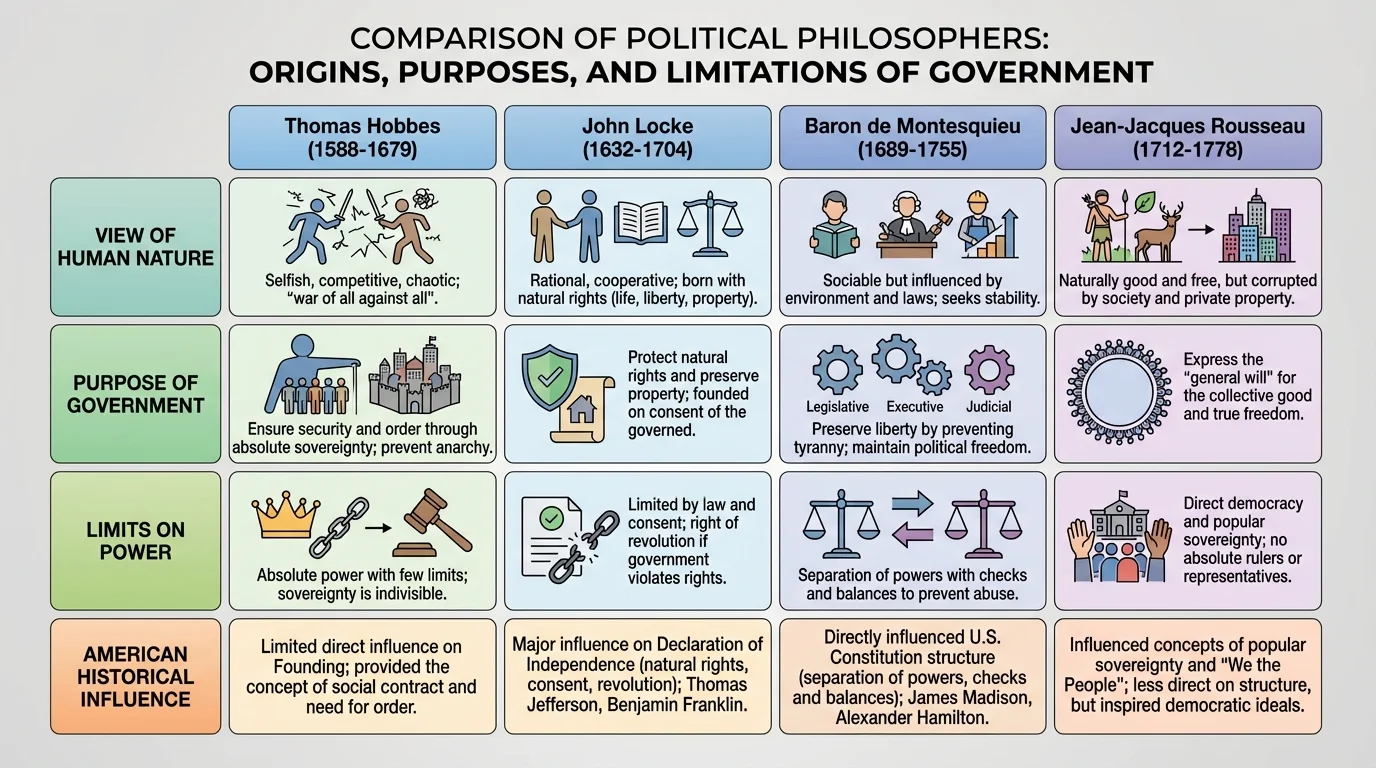
Jean-Jacques Rousseau emphasized popular sovereignty, the idea that legitimate authority comes from the people. He believed government should reflect the general will of the community rather than private interests. Rousseau inspired democratic and revolutionary movements, though later critics pointed out that appeals to the "general will" can become dangerous if leaders claim to speak for the people while suppressing dissent.
Together, these thinkers reveal that political philosophy is not abstract in a useless way. It shapes real institutions. Locke's natural rights appear in declarations of independence. Montesquieu's theories shape constitutional design. Hobbes helps explain why societies accept strong states in dangerous times. Rousseau informs arguments about democracy and citizenship. Their differences, summarized in [Figure 2], also show why modern democracies continually debate how much freedom, equality, order, and authority should be balanced against one another.
"That to secure these rights, Governments are instituted among Men, deriving their just powers from the consent of the governed."
— Declaration of Independence
This famous line reflects Locke's influence very clearly. It also introduces a central democratic principle: legitimate government rests on consent. In practice, consent may be expressed through elections, representation, civic participation, and the opportunity to challenge laws through lawful means.
American government did not emerge from one mind. It was shaped by intense debate among leaders who agreed on independence but often disagreed on power. George Washington represented the importance of leadership restrained by example. He stepped down after two terms, helping establish the peaceful transfer of power as a norm rather than clinging to office.
James Madison is often called the "Father of the Constitution" because of his major role in designing the system of checks and balances. Madison believed that because human beings are not angels, government must control itself as well as society. That idea led to structures meant to prevent concentration of power.
Thomas Jefferson powerfully expressed natural-rights philosophy in the Declaration of Independence. He favored limited government and agricultural republicanism, though his legacy is deeply complicated by the fact that he enslaved human beings while writing about liberty. Studying Jefferson honestly means recognizing both his influence and his contradictions.
Alexander Hamilton argued for a stronger national government capable of promoting stability, credit, and economic development. His disagreements with Jefferson reflected an enduring American question: how strong should the national government be compared with state governments and individual citizens?
| Figure | Major contribution | Key concern |
|---|---|---|
| George Washington | Modeled restrained executive leadership | National unity and legitimacy |
| James Madison | Designed constitutional checks | Preventing concentrated power |
| Thomas Jefferson | Expressed natural-rights ideals | Liberty and limited government |
| Alexander Hamilton | Defended energetic national government | Stability and national strength |
Table 1. Major founding-era figures and the main governmental concerns associated with their contributions.
These founders created a framework, but they did not fully apply liberty and equality to all people. Women could not vote. Enslaved Africans and their descendants were denied basic human rights. Native nations were pushed aside or attacked. Property requirements restricted participation in many places. The founding matters enormously, but so do the struggles that followed to expand the meaning of citizenship.
American history is not only the story of officeholders and constitutional framers. It is also the story of people who challenged the government to become more just. Their contributions help explain both the purpose and the limitations of government in real life.
Abigail Adams urged her husband John Adams to "remember the ladies" when creating new laws. Her words highlighted a major contradiction in early American politics: a government built on liberty that still excluded women from equal political rights. She reminds us that from the beginning, some Americans saw the limits of the new republic.
Frederick Douglass, a formerly enslaved abolitionist, exposed the hypocrisy of a nation celebrating freedom while allowing slavery. Through speeches such as What to the Slave Is the Fourth of July?, he argued that government must protect universal human rights, not only the rights of the powerful. Douglass pressed the nation to connect constitutional ideals with actual justice.
Sojourner Truth connected race and gender in her demands for equality. She challenged assumptions about who counted as fully human and fully political in American life. Her activism shows that rights debates are often intersectional, even before that term existed.
Ida B. Wells investigated lynching and demanded that government enforce equal protection under the law. Her work revealed a brutal limitation of government: sometimes authorities fail not because they are weak, but because they are unwilling to protect everyone equally. Wells used journalism and activism to expose that failure.
Zitkála-Šá, a Yankton Dakota writer and activist, criticized U.S. treatment of Native peoples and defended Indigenous rights, culture, and self-determination. Her work challenges the idea that American government always expanded freedom. For many Native communities, federal policy often meant forced assimilation, land loss, and broken treaties.
César Chávez and Dolores Huerta organized farmworkers to demand labor rights, better wages, and safer working conditions. Their activism showed another purpose of government: creating and enforcing fair rules in the economy, not merely protecting property. At the same time, their struggle showed the limits of government when political power is unequally distributed.
Shirley Chisholm, the first Black woman elected to Congress, challenged barriers in political representation. Her career demonstrated that government is not only something citizens obey; it is also something they reshape by participating in it. Representation matters because the people making laws influence whose experiences and needs are recognized.
Case study: Equal protection and government responsibility
Consider the problem of racial violence in the late nineteenth and early twentieth centuries.
Step 1: Identify the purpose of government.
Government is supposed to provide security and equal justice under the law.
Step 2: Identify the limitation.
In many communities, local and state authorities failed to protect Black citizens from mob violence.
Step 3: Evaluate the response.
Ida B. Wells used reporting, evidence, and public advocacy to pressure government institutions and public opinion.
This example shows that governments may declare rights but still fail to enforce them equally. Civic action often pushes institutions toward their own stated principles.
These figures broaden the meaning of American government. They show that civics is not only about how power is structured. It is also about who is protected, who is heard, and who must struggle to make institutions live up to their promises.
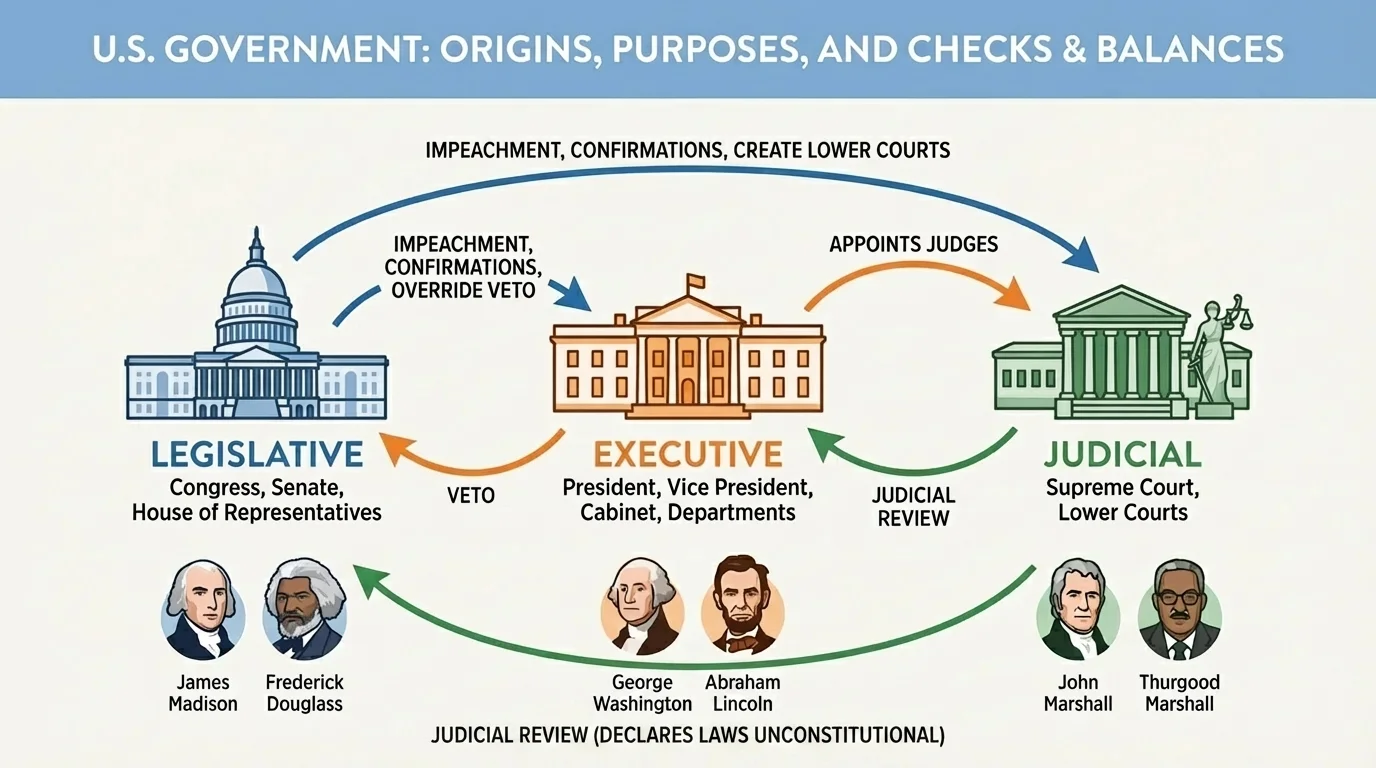
In the United States, the constitutional system divides power in multiple ways, and [Figure 3] shows the basic structure of the three branches. The legislative branch makes laws, the executive branch enforces laws, and the judicial branch interprets laws. This arrangement is called separation of powers.
The branches do not operate independently of one another. They are linked through checks and balances. For example, Congress passes laws, but the president can veto them. Courts can review whether laws are constitutional. The Senate confirms many executive and judicial appointments. The point is not efficiency above all else. The point is to prevent any branch from becoming too powerful.
Another limit on government is federalism, the division of power between national and state governments. Federalism allows local variation while keeping a national union. It can protect liberty by preventing overcentralization, but it can also create conflict when states and the national government disagree about rights and authority.
Civil liberties and civil rights are additional constraints and responsibilities. Civil liberties protect individuals from unjust government interference. Civil rights ensure fair treatment and equal access under the law. When students debate school speech, privacy, religious freedom, voting laws, or equal protection, they are debating the boundaries of legitimate government action.
As the branch structure in [Figure 3] makes clear, limitation is built into the design of American government. But design alone is not enough. Institutions depend on norms such as accepting election results, respecting judicial decisions, allowing dissent, and rejecting political violence. When those norms weaken, constitutional limits become harder to maintain.
Majority rule is a democratic principle, but constitutional democracy also protects minority rights. A decision supported by most voters is not automatically just if it violates equal protection, due process, or basic liberties.
Citizens therefore play a dual role. They authorize government through participation, and they restrain government through oversight. This is why civic education matters. A free society requires more than leaders with titles; it requires people who understand institutions well enough to defend them and criticize them intelligently.
The origins, purposes, and limits of government are not just historical topics. They appear in current debates every day. How much surveillance is acceptable to prevent violence? How much regulation is necessary to protect workers and the environment? When should courts strike down laws passed by elected majorities? How should governments balance free expression with public safety online?
These debates often involve competing values rather than simple right-or-wrong answers. Liberty and security can conflict. Equality and individual choice can conflict. National power and local control can conflict. The challenge of constitutional government is not to eliminate these tensions but to manage them through laws, institutions, and democratic participation.
A mature understanding of civics recognizes that government is neither automatically the problem nor automatically the solution. Government is a human institution: necessary, powerful, imperfect, and always in need of accountability. The best political systems try to channel power toward justice while preventing that same power from becoming dangerous.
