A pothole gets fixed by one level of government, your driver's license comes from another, and a Supreme Court ruling can affect students in every state. Government is not one giant machine with one leader at the top. It is a layered system, built to divide power, assign responsibilities, and prevent any one person or office from controlling everything. To understand public life, you need to know not just who is in office, but what each office is actually designed to do.
When people talk about "the government," they often speak as if it were a single actor. In reality, government in the United States is divided into levels and branches. The levels are local, state, and national. At each level, authority is organized into institutions that make laws, carry out laws, and interpret laws.
This structure matters because different problems belong to different jurisdictions. A city council can decide zoning rules in a town, but it cannot declare war. Congress can pass national tax laws, but it does not decide where every neighborhood stop sign goes. Understanding this division helps students recognize where political power is located and how citizens can influence it.
Branch of government means a major division of government authority with a particular function. Legislative bodies make laws, executive officials enforce and administer laws, and judicial institutions interpret laws and resolve disputes. Jurisdiction is the official area of authority of a court, office, or government body.
Government structure also exists to limit power. The people who wrote the United States Constitution were deeply concerned about tyranny. They believed power should be divided so that ambition checks ambition. That same basic idea influences many state constitutions and local charters today.
The purpose of government is not only to exercise authority. It also exists to provide order, protect rights, deliver services, and represent the public. Roads, schools, police protection, courts, sanitation systems, public records, business regulation, military defense, and elections all depend on government institutions.
In a constitutional democracy, government has both powers and limits. It can tax, regulate, and punish unlawful behavior, but it must also respect civil liberties, due process, and equal protection. This tension is one of the central questions of civics: how can a government be strong enough to govern, but limited enough to remain free?
Government as both power and restraint
Government is designed to do things individuals cannot easily do alone, such as maintain armed forces, run court systems, or organize large public works. At the same time, constitutions, elections, and laws restrain public officials so that government does not become arbitrary. The structure of government reflects this balance between effective action and limited authority.
That is why studying offices and officials is not just about memorizing names. It is about understanding what powers belong to each office, what duties that office has, and what legal boundaries apply to it.
At the national level, the United States uses a three-branch system, as [Figure 1] shows, to divide authority among lawmaking, law enforcement, and legal interpretation. This structure aims to prevent concentration of power in one institution or one person.
The legislative branch is Congress, which consists of two chambers: the House of Representatives and the Senate. Congress writes bills, debates policy, passes federal laws, approves budgets, and has oversight power over the executive branch. The House is based on population, while each state has two senators in the Senate. Current members of Congress include the representatives and senators elected from each state and district. To identify them, a citizen must know the state, congressional district, and official title.
The executive branch is headed by the President. The President enforces federal laws, serves as commander in chief of the armed forces, signs or vetoes legislation, negotiates treaties, and appoints many federal officials and judges. The Vice President, Cabinet secretaries, and leaders of executive departments and agencies are also part of this branch. Departments such as Justice, State, Defense, Education, and Homeland Security carry out specific parts of federal policy.
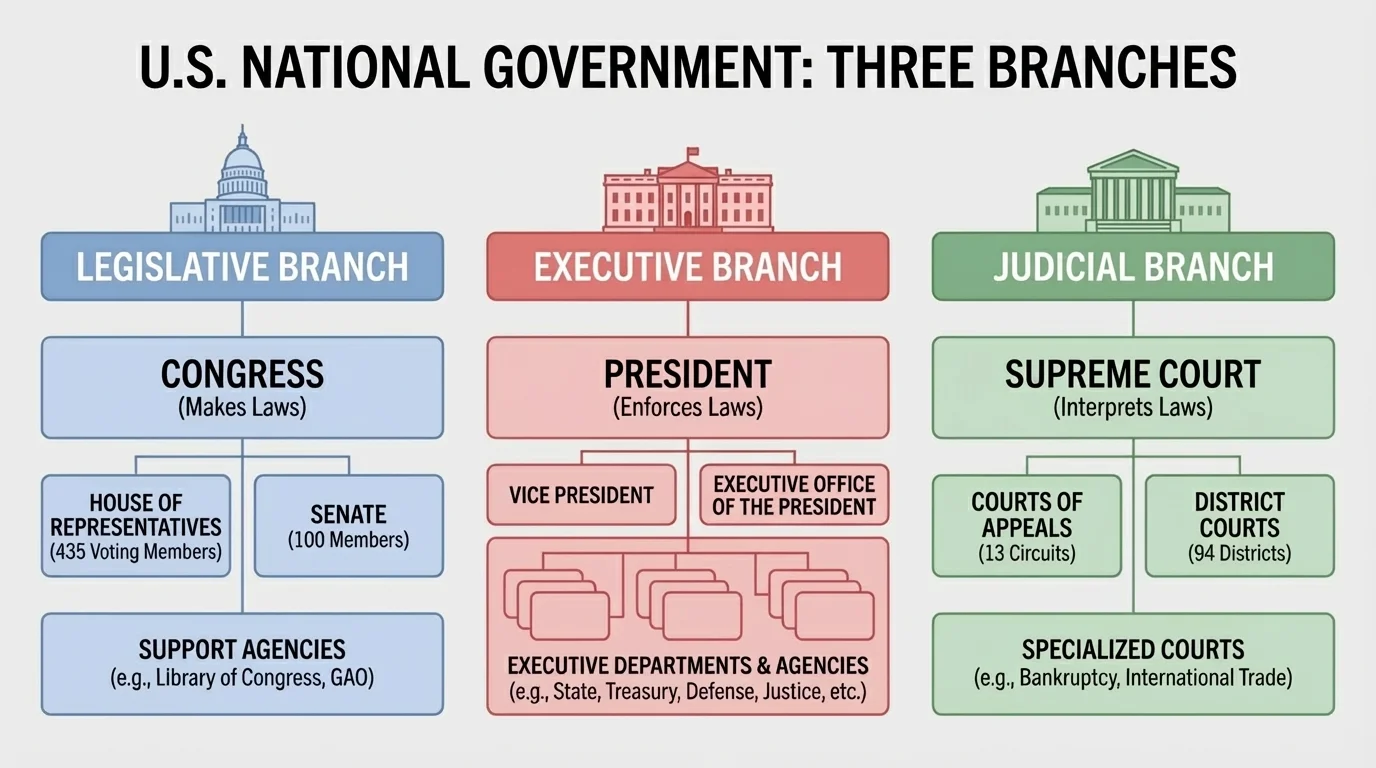
The judicial branch includes the Supreme Court and lower federal courts. Its role is to interpret laws, decide whether government actions follow the Constitution, and resolve legal disputes. Federal judges are nominated by the President and confirmed by the Senate. The Supreme Court is especially important because its decisions can shape national policy for decades.
These branches do not operate independently from one another. Congress can pass laws, but the President can veto them. The courts can review those laws. The Senate confirms judges and many executive appointments. Congress can investigate executive officials, and in serious cases, the House can impeach while the Senate holds a trial. As a result, structure is directly tied to accountability.
When identifying current national officials, it is useful to ask three questions: What office is this? What level of government is it in? What powers belong to that office? For example, a U.S. senator represents an entire state in the national legislature, while a Cabinet secretary helps administer a federal department in the executive branch. Those are very different roles, even though both are powerful positions.
The Constitution does not list every executive agency that exists today. Many departments and agencies were created later by laws passed by Congress as the needs of the country changed.
The same three-part pattern appears again in state governments, but with important differences in powers and responsibilities. Seeing the federal structure makes it easier to notice both the similarities and the limits when power shifts to the states.
Every state has its own constitution and its own government, and in most cases the structure resembles the national model, as [Figure 2] illustrates. States usually have legislative, executive, and judicial branches, but the exact details vary from state to state.
The state legislative branch is often called the state legislature. In most states it is bicameral, with two chambers, commonly a senate and a house of representatives or assembly. Nebraska is a well-known exception because it has a unicameral legislature with one chamber. State legislatures make state laws, set budgets, approve taxes, and shape major policies involving education, transportation, health, criminal law, and business regulation.
The state executive branch is led by the governor. Governors sign or veto state bills, direct state agencies, propose budgets, and respond to emergencies. Other state executive officials may include the lieutenant governor, attorney general, secretary of state, treasurer, auditor, and commissioner-level officials. Some are appointed, while others are elected independently, depending on the state.
The state judicial branch includes trial courts, appellate courts, and usually a state supreme court. These courts interpret state constitutions and state laws, hear civil and criminal cases, and review legal disputes arising within the state. State court systems are especially important because most legal cases in the United States are handled at the state, not federal, level.
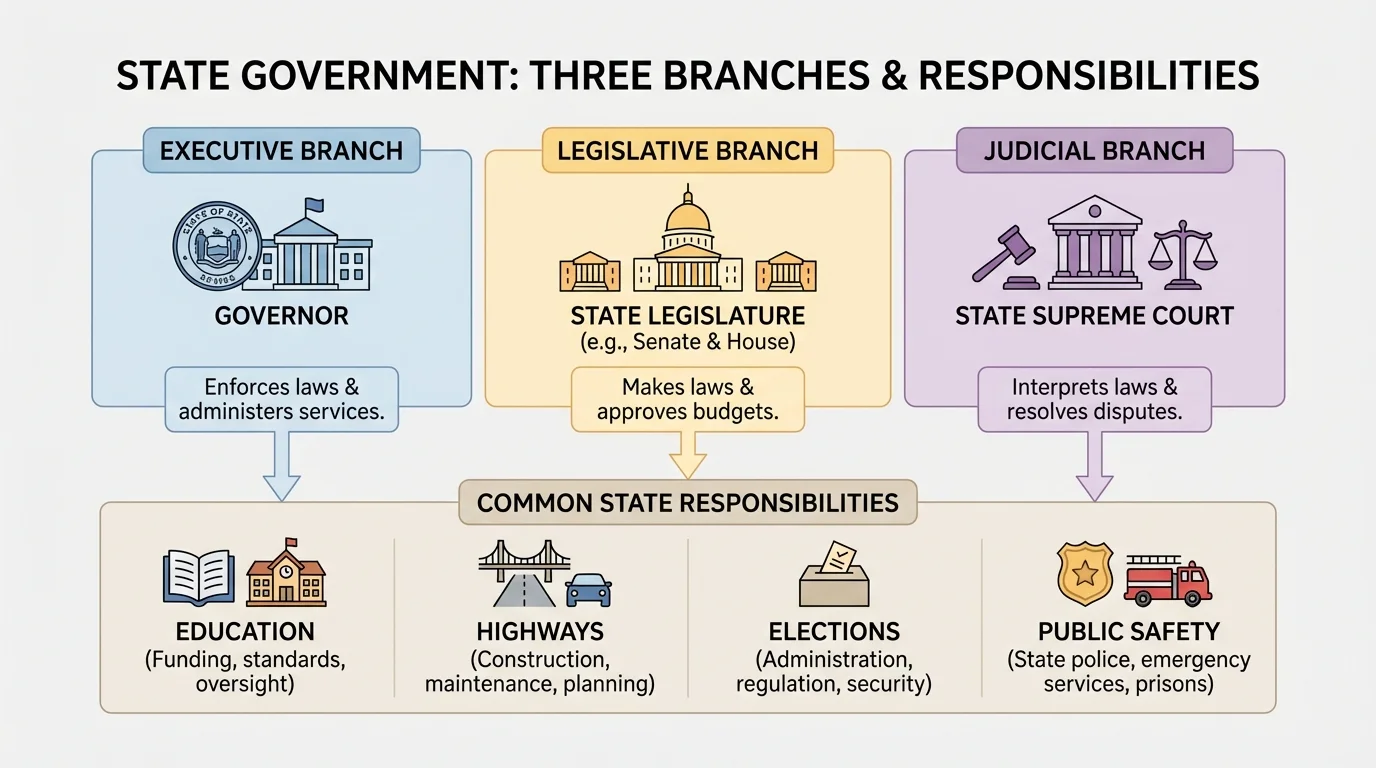
States have powers that the federal government does not directly control. Under the principle of federalism, states retain many powers over public education, professional licensing, elections administration, public health, and criminal law. That is why school requirements, voting procedures, and traffic laws can differ across states.
To identify current state officials, a student should know the state and office title. For example, each state has one governor, but many state legislators. A state senator serves in a state legislature, not in the U.S. Senate. This distinction matters because their jurisdictions are entirely different. State attorneys general also differ from the U.S. attorney general: one works at the state level, the other at the national level.
Case study: A state education policy decision
Suppose a state wants to change graduation requirements.
Step 1: The proposal is introduced in the state legislature.
Legislators debate the change, hold hearings, and vote on the bill.
Step 2: The governor acts on the bill.
If the bill passes both chambers, the governor may sign it into law or veto it.
Step 3: State agencies implement the change.
The state department of education creates rules and guidance for school districts.
Step 4: Courts review disputes if needed.
If someone argues the new law violates the state constitution, state courts may decide the issue.
This example shows how all three branches interact in a state government process.
State governments often seem less visible than the national government in news coverage, but they shape daily life in major ways. In many areas, state policy has a more immediate effect on schools, roads, courts, and elections than federal policy does.
Local government affects the most ordinary parts of life, as [Figure 3] demonstrates through offices that students are likely to recognize from their own communities. Water systems, garbage collection, local policing, fire departments, school board decisions, local parks, and building permits are usually handled close to home.
Unlike national and state governments, local governments vary widely in structure. Some communities have a mayor-council system, where an elected mayor leads the executive side and a city council acts as the legislative body. Others use a council-manager system, where the council sets policy and hires a professional manager to run daily operations. Counties may be led by boards of commissioners or supervisors. Townships, villages, boroughs, and special districts add even more variation.
Local legislative bodies often include city councils, county commissions, town boards, or school boards. These bodies pass ordinances, approve local budgets, set tax rates within legal limits, and make policy decisions on land use, public facilities, and local services. Local executive roles may include mayors, city managers, county executives, sheriffs, clerks, and superintendents.
Local judicial institutions may include municipal courts, county courts, or other lower courts, depending on the state. These courts often hear traffic cases, misdemeanor offenses, and local ordinance violations. Their authority is limited compared with state supreme courts or federal courts, but they are important because they are where many citizens encounter the legal system directly.
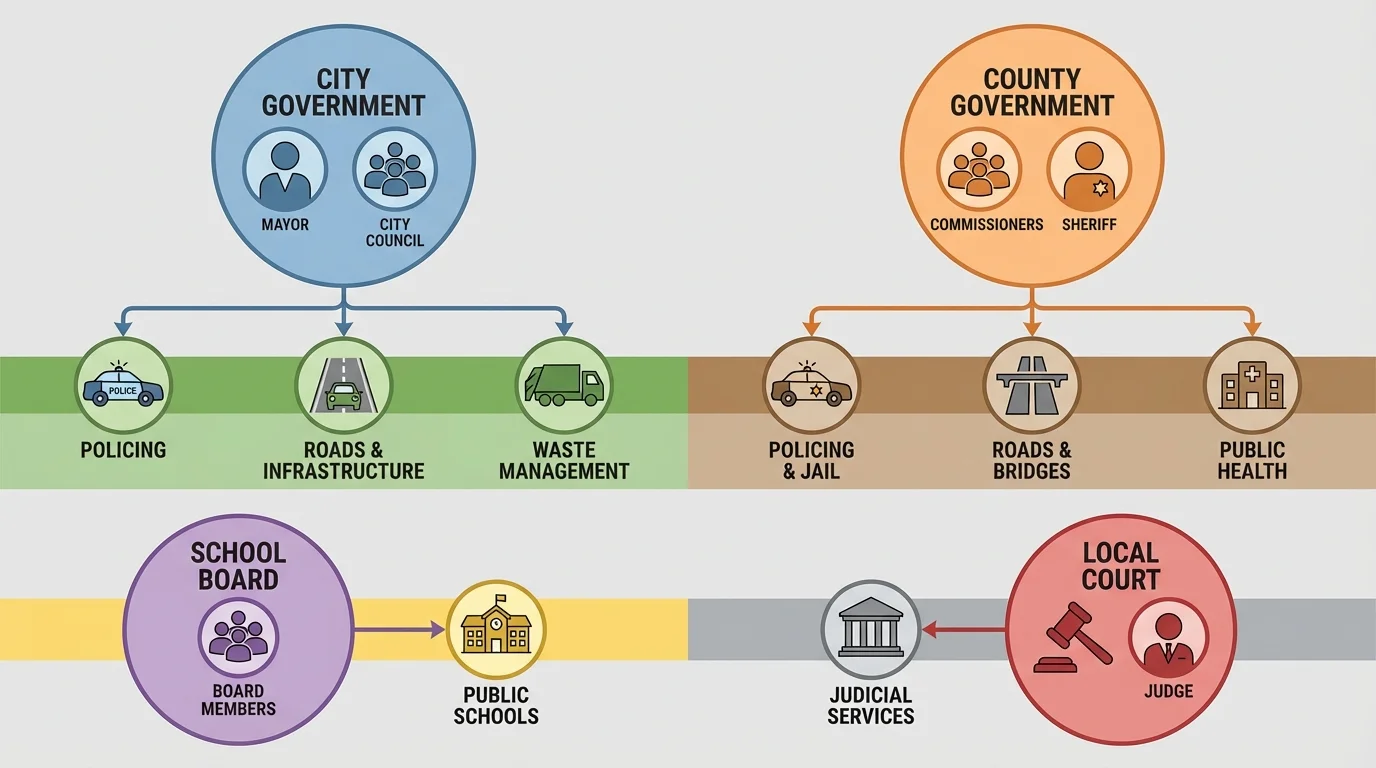
To identify current local officials, students need to know the exact municipality or county. A mayor governs a particular city, not an entire state. A county sheriff's power is usually limited to that county. A school board member serves within a school district. The title alone is not enough; the jurisdiction completes the picture.
Local governments are often where citizens have the most direct access. It is usually easier to attend a school board meeting than to speak before Congress. This makes local government especially important for civic participation. These offices are not symbolic; they make decisions that directly shape neighborhoods, school calendars, transportation routes, and public safety priorities.
Remember that not every level of government has exactly the same titles or structures. The three broad functions of lawmaking, law enforcement, and legal interpretation are common, but the names of offices and the way officials are selected can differ from place to place.
Because local government varies so much, one of the most important civic skills is reading an official local government website or charter to determine who serves in which role and what authority that role actually has.
No level of government exists in isolation. Under federalism, powers are divided and shared among local, state, and national institutions, and [Figure 4] helps clarify how one issue can involve several layers at once. This arrangement can create cooperation, tension, and negotiation.
Consider public education. A local school board may manage district-level decisions, a state government may set graduation rules and teacher licensing requirements, and the national government may influence policy through civil rights law and grant funding. In a natural disaster, local first responders act immediately, state authorities coordinate broader emergency resources, and the federal government may provide aid through national agencies.
Transportation offers another example. A city handles neighborhood streets, a state manages highways, and the national government may support large interstate systems and infrastructure funding. Public health works similarly: county health departments, state health agencies, and federal organizations may all play roles during a disease outbreak.
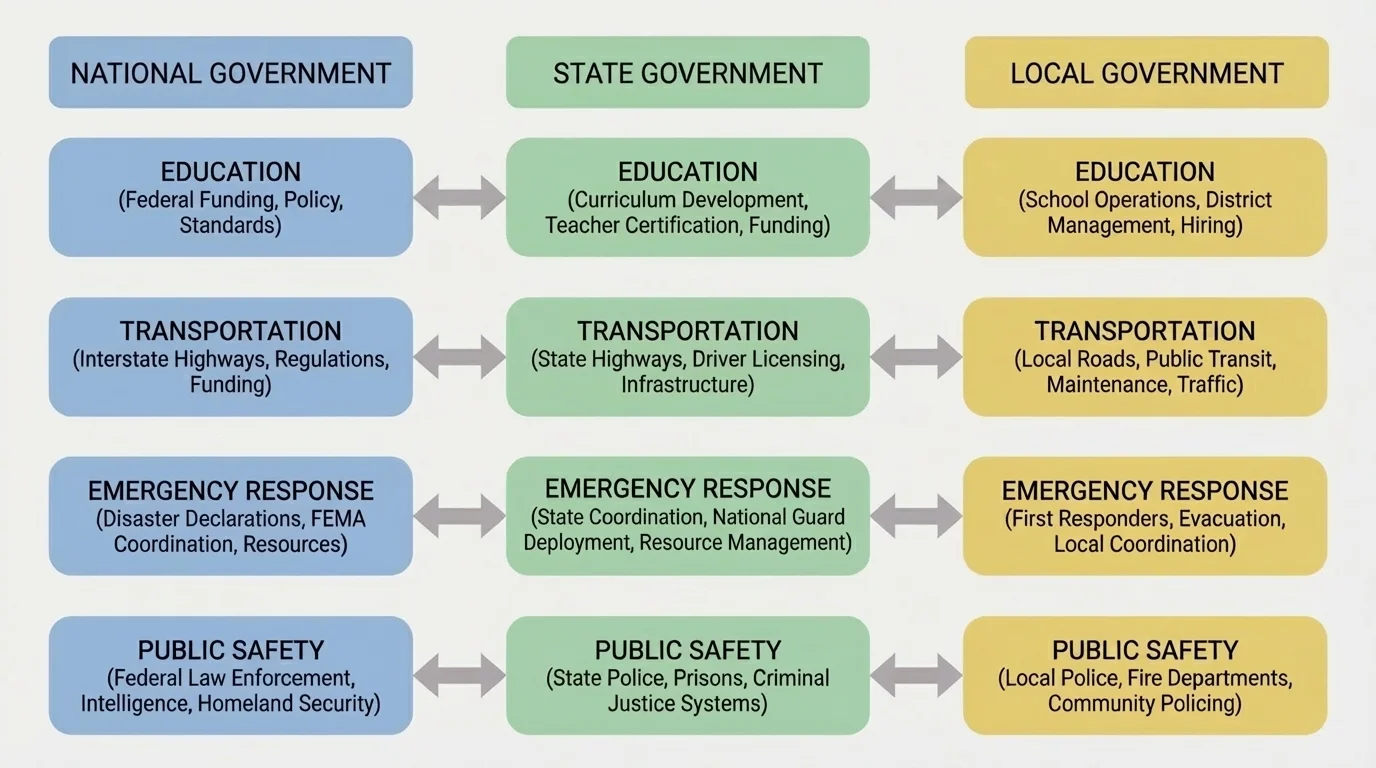
This overlap can be confusing, but it reflects the idea that problems exist at different scales. A broken traffic light is local. A statewide election law is state-level. Immigration policy is national. Some issues, however, cross boundaries and require several governments to coordinate at once.
Conflicts can arise when one level believes another has gone too far. State officials may challenge federal policies in court. Cities may disagree with state laws. Courts then become essential because they help determine whether a government has acted within its lawful authority. This shared structure shows why understanding jurisdiction is central to understanding power.
In civics, the phrase "current members" refers to the people presently serving in public offices. Since officeholders change through elections, resignations, appointments, and confirmations, the most accurate way to identify current officials is by using up-to-date official sources. Reliable sources include congressional websites, state legislature pages, governors' offices, secretary of state websites, county pages, city websites, and court directories.
When identifying a public official, start with level, branch, office, and jurisdiction. For example, if someone asks, "Who represents me?" the answer could mean a city council member, a state representative, a state senator, a U.S. representative, or a U.S. senator. The question only becomes answerable when the level and district are clear.
It is also important to distinguish elected and appointed officials. Presidents, governors, mayors, legislators, and many local officials are elected. Cabinet secretaries, many agency heads, and many judges are appointed, though methods differ across states. Some state judges are elected, while federal judges are appointed. This affects both accountability and how vacancies are filled.
Titles can sound similar, but authority can be very different
A senator in a state legislature and a U.S. senator do not serve in the same government. A state attorney general and the U.S. attorney general have different jurisdictions. A local judge, a state supreme court justice, and a Supreme Court justice all work in the judicial system, but at very different levels with very different powers.
One strong habit is to read the title exactly. Small words matter. "United States Senator" is not the same as "state senator." "Secretary of State" usually refers to a state election and records official at the state level, but at the national level it is the head of foreign affairs. In civics, precision is power.
The three branches are not simply different categories; they are part of a system of checks and balances. Each branch has tools to influence or restrain the others. This system operates most clearly at the national level, but versions of it appear in state governments and, in a looser way, in local governments as well.
Legislatures control lawmaking and budgets. Executives can veto legislation and direct administration. Courts can review whether laws or actions violate constitutions. Elections allow voters to remove many officials from office. Term limits exist in some offices. Public records laws, ethics rules, and open meetings requirements can also limit abuse of power.
Another major limit is the Constitution itself. At the national level, the U.S. Constitution defines federal powers and protects individual rights. At the state level, state constitutions organize government and often include additional protections. Local governments usually operate under state law and local charters, which means they generally cannot exercise powers beyond what state law permits.
"The accumulation of all powers, legislative, executive, and judiciary, in the same hands... may justly be pronounced the very definition of tyranny."
— James Madison
This warning remains relevant. If a legislature could enforce its own laws without review, or if an executive could create law alone, freedom would be much weaker. The structure of government is therefore not just an organizational chart; it is a safeguard against unchecked authority.
Knowing government structure changes how a citizen responds to public issues. If a student is concerned about lunch policy at school, the most relevant officials may be local school board members or district administrators. If the issue is voting access across a state, attention may turn to the state legislature, governor, or secretary of state. If the issue is a constitutional right applied nationwide, federal courts or Congress may be central.
Civic participation becomes more effective when people know where decisions are made. Voting, contacting representatives, attending hearings, speaking at public meetings, following court decisions, and reading budgets all become more meaningful when citizens understand who has the power to act.
That knowledge also improves how people interpret current events. News about a Supreme Court ruling, a governor's executive order, or a city council vote makes much more sense when students understand the office involved, the branch it belongs to, and the legal boundaries around it. Government is not just about personalities. It is about institutions, roles, structures, and lawful authority.
