A constitution is supposed to be a society's basic rulebook, but here is the paradox: if it can never change, it becomes outdated; if it changes too easily, it stops being a stable foundation. That tension is at the center of American government. Both the United States and Colorado have constitutions, both protect rights, and both can be amended. But they are amended in very different ways, and those differences reveal a lot about how power, rights, and democracy work.
In civics, amendment rules matter because constitutions do more than organize government. They also limit government, protect individual liberty, and express what a political community considers fundamental. When people debate issues such as voting rights, taxation, criminal justice, privacy, or education, they are often arguing not just about policy but about whether a constitution should lock in a principle for the long term.
A constitution is higher law. Ordinary laws can usually be passed, repealed, or revised by a legislature through the normal lawmaking process. Constitutional rules are harder to change because they set the framework for all other laws. If a simple temporary majority could rewrite a constitution whenever it wanted, the rights of minorities and the stability of institutions would be at risk.
Amendment means an official change to a constitution. A Bill of Rights is a section of a constitution that lists and protects important rights and liberties. Ratification is the formal approval required to make a proposed constitutional change take effect.
At the same time, a constitution cannot stay frozen forever. New technologies, social movements, changing ideas about equality, and practical problems in government all create pressure for change. The history of constitutional amendments shows a balancing act: preserve core principles, but allow correction and growth.
This balance helps explain why the United States Constitution has been amended relatively few times, while the Colorado Constitution has been amended much more often. The federal system values stability and broad national agreement. Colorado's system allows more direct public access, especially through ballot initiatives, so change can happen more frequently.
The U.S. Constitution contains its own amendment procedure in Article V, and the process, as [Figure 1] shows, is deliberately difficult. An amendment must first be proposed, and then it must be ratified. This two-stage design prevents sudden constitutional shifts based on a short-term political mood.
There are two ways to propose an amendment. First, Congress can propose one if two-thirds of both the House of Representatives and the Senate agree. Second, two-thirds of the state legislatures can call for a national constitutional convention to propose amendments. That second method exists in the Constitution, but no amendment has ever been proposed through such a convention.
There are also two possible methods of ratification. Congress decides which method will be used for a particular amendment. One method is approval by three-fourths of the state legislatures. The other is approval by conventions in three-fourths of the states. Nearly all amendments have been ratified by state legislatures; the Twenty-First Amendment, which ended Prohibition, was ratified by state conventions.
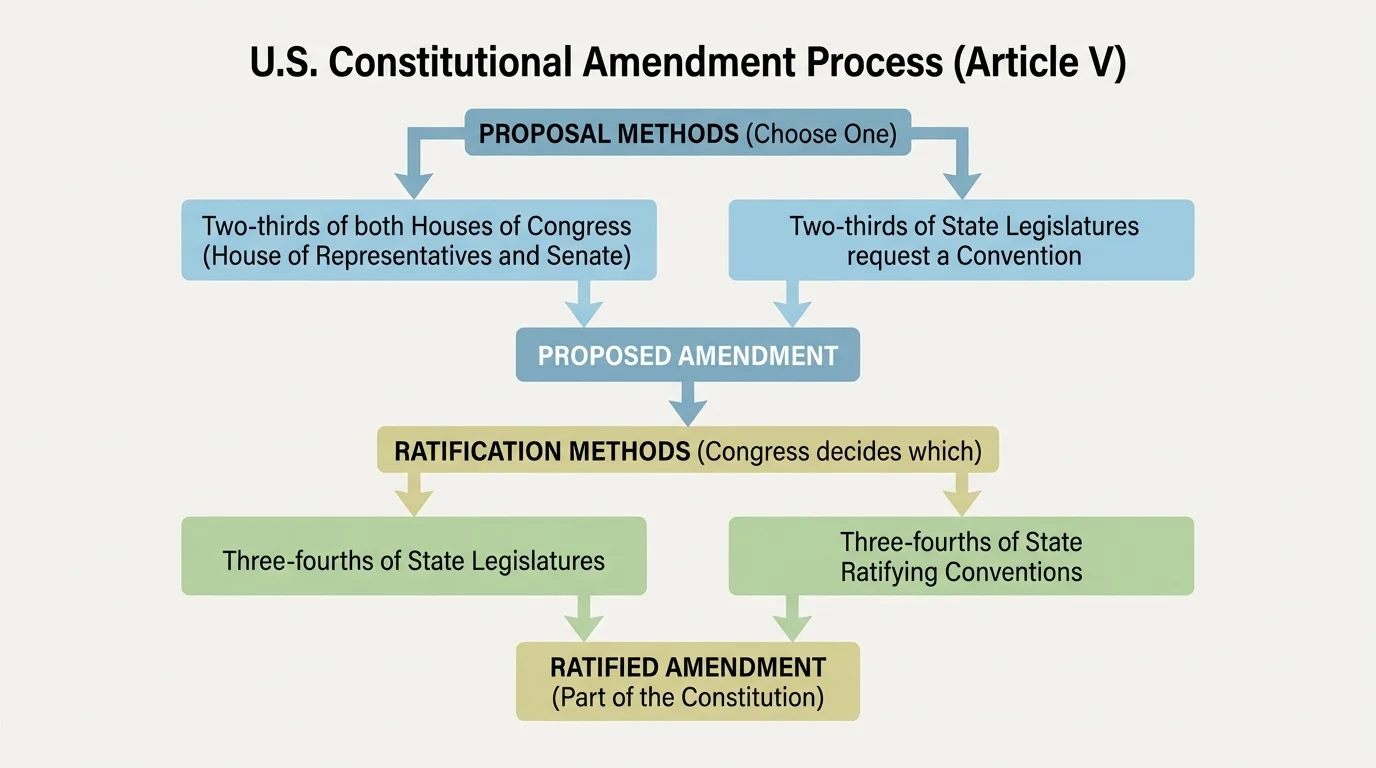
This means a successful federal amendment needs support far beyond one political party or one region. Even if a proposal is popular nationally, it can still fail if it cannot gain enough support across the states. That is one reason only 27 amendments have been added since the Constitution was written in 1787.
Some constitutional changes are nearly impossible under Article V. For example, the Constitution specifically protects equal representation of states in the Senate unless a state agrees to lose that equality. This shows that the framers considered some structural features so central that they should be especially difficult to alter.
Why Article V is so strict
The amendment process is designed to slow change until there is broad and durable agreement. This protects the system from sudden swings, but it also means needed reforms can take decades. In practice, many political changes happen through laws, court decisions, and shifting interpretations rather than formal amendments.
That strictness has major consequences. As seen earlier in [Figure 1], every amendment must move through several veto points, so organized opposition can stop change even when many people support it. This is one reason debates over constitutional interpretation are so important in the United States: if formal amendment is hard, meaning often evolves through the courts and political practice.
The most important changes to the U.S. Constitution came in historical waves, as [Figure 2] illustrates. Some amendments were responses to the struggle over ratification, some to the Civil War, and others to long campaigns for broader democracy. Looking at the amendments this way helps reveal that constitutions change most dramatically when the nation faces crisis or sustained public pressure.
The first ten amendments, known as the Bill of Rights, were ratified in 1791. They were added partly because many Americans feared that the new national government might become too powerful. These amendments protect freedoms such as religion, speech, press, assembly, petition, bearing arms, due process, jury trial, and protection from unreasonable searches and cruel and unusual punishment.
These rights were originally aimed mainly at limiting the federal government. Over time, especially through the Fourteenth Amendment and later court decisions, many of these protections came to apply to state governments as well. That development greatly expanded the practical reach of the national Bill of Rights.
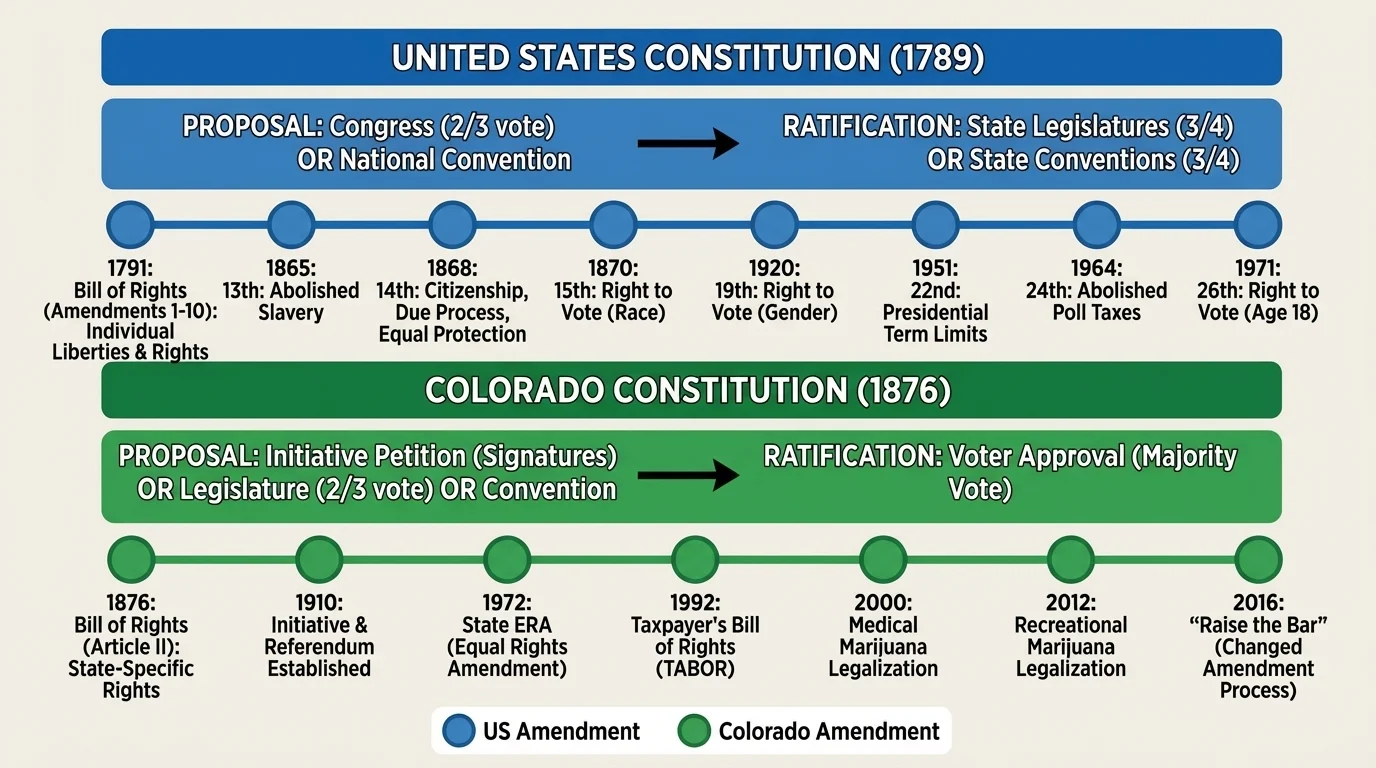
The Civil War Amendments transformed the Constitution. The Thirteenth Amendment abolished slavery. The Fourteenth Amendment established birthright citizenship, required due process and equal protection of the laws, and became one of the most important foundations for later civil rights rulings. The Fifteenth Amendment prohibited denying the right to vote based on race.
Later amendments expanded democratic participation. The Seventeenth Amendment provided for the direct election of senators. The Nineteenth Amendment recognized women's suffrage. The Twenty-Fourth Amendment banned poll taxes in federal elections. The Twenty-Sixth Amendment lowered the voting age to 18, reflecting the argument that if people were old enough to be drafted for war, they were old enough to vote.
Other amendments changed governmental structure or corrected earlier policies. The Eighteenth Amendment created Prohibition by banning the manufacture, sale, and transportation of alcoholic beverages. The Twenty-First repealed it, making it the only amendment that directly undid another. The Twenty-Second limited presidents to two elected terms after Franklin D. Roosevelt served more than two terms.
Historical case study: The Fourteenth Amendment
Step 1: Identify the problem it addressed.
After the Civil War, the United States had abolished slavery, but formerly enslaved people still faced discrimination, violence, and legal inequality.
Step 2: Identify the constitutional response.
The Fourteenth Amendment required states to provide due process and equal protection, creating a stronger national guarantee of civil rights.
Step 3: Trace its long-term impact.
Later cases involving school segregation, criminal procedure, same-sex marriage, and freedom of expression relied heavily on the Fourteenth Amendment.
This amendment shows how one constitutional change can reshape law for generations.
The amendments on the timeline in [Figure 2] show that constitutional change often follows conflict. Rights that seem basic today were not always protected equally in practice. Amendments can mark major turning points, but they usually come after years of activism, legal struggle, and political resistance.
Colorado has its own state constitution, and its amendment system, as [Figure 3] shows, is more accessible than the federal process. State constitutions often contain more detail than the U.S. Constitution, so they are amended more often. Colorado's constitution can be changed through legislative referral and through citizen initiative, which gives voters a more direct role.
One route begins in the General Assembly, Colorado's state legislature. Lawmakers may refer a proposed constitutional amendment to the voters. If the required legislative support is reached, the proposal appears on the statewide ballot. Voters then decide whether to approve it.
The second route is the initiative process. Citizens may draft a proposed amendment, gather the required number of petition signatures, and place the measure on the ballot if they meet legal requirements. This process is a form of direct democracy. It allows the public to bypass the legislature, but it also means constitutional text can be influenced by campaign funding, advertising, and short-term political pressure.
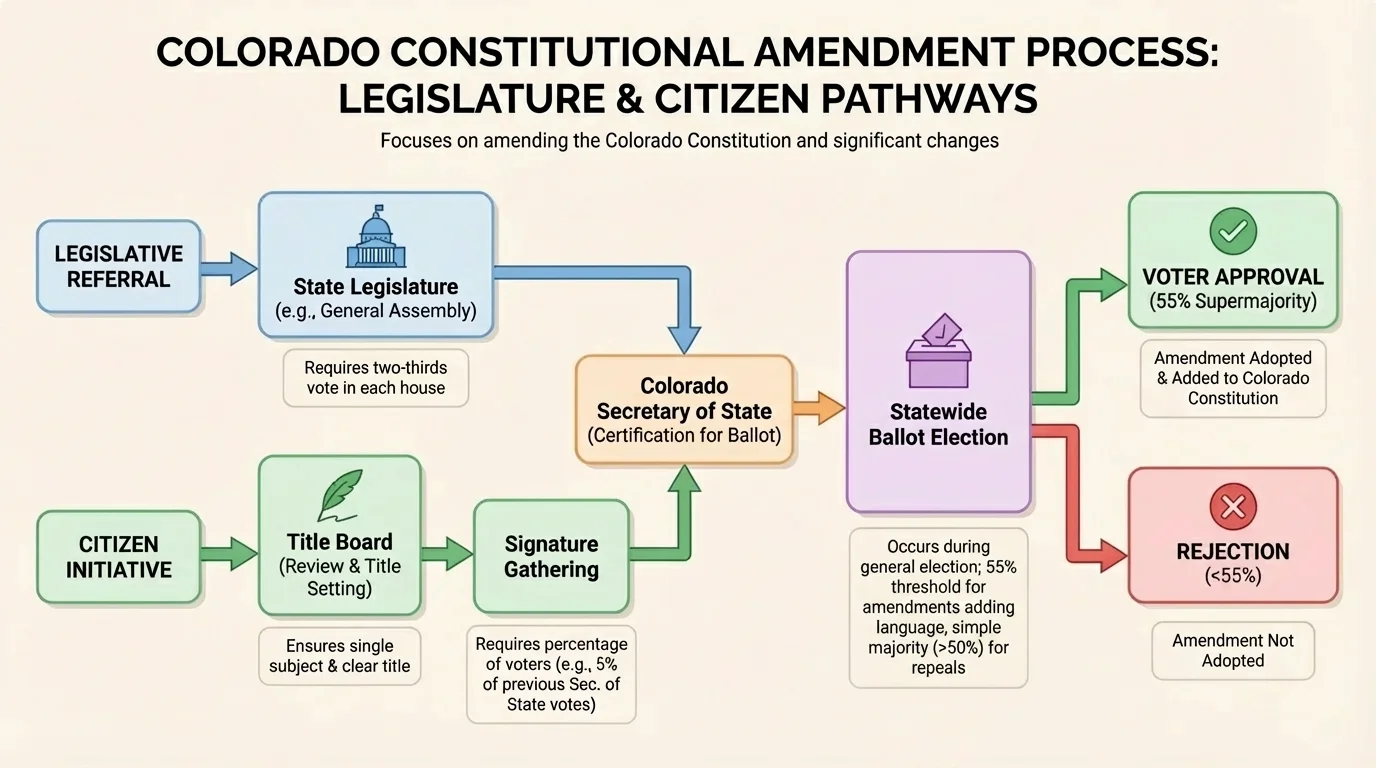
Colorado also uses voter approval thresholds for constitutional changes. In recent years, the state has required more than a simple majority for many constitutional amendments, making permanent changes harder than ordinary ballot choices. This reflects concern that a constitution should not be revised too casually.
In addition to amendment, some state constitutions provide for broader constitutional revision through commissions or conventions, though such methods are less common in everyday politics. This matters because a state constitution may need not only isolated amendments but also larger structural reconsideration over time.
Colorado's constitution is much longer and more frequently amended than the U.S. Constitution. That is common among state constitutions because they often include detailed policy rules that the federal Constitution leaves to ordinary law.
The process in [Figure 3] highlights a key difference between state and federal systems. At the federal level, constitutional change depends heavily on representative institutions. In Colorado, direct voter participation plays a much larger role. That can make the state constitution more responsive, but also more crowded and sometimes less coherent.
The Colorado Constitution has changed many times because it regulates both rights and detailed policy matters. Important amendments have affected government structure, local control, finances, elections, and individual rights. Studying these changes helps explain why state constitutions are often more active political documents than the national Constitution.
One major area of change involves home rule. Home rule gives certain cities and local governments greater authority to manage local affairs without waiting for the state legislature to make every decision. This reflects the idea that communities often understand their own needs best, although conflicts can arise when state and local authority overlap.
Another significant area involves taxation and fiscal rules. Colorado is well known for constitutional limits on government revenue and spending, especially through the Taxpayer's Bill of Rights, commonly called TABOR. Because these fiscal rules are constitutional rather than statutory, changing them is difficult. That gives voters direct control over some tax questions, but critics argue it can make budgeting for schools, transportation, and other services more rigid.
Colorado's constitution has also evolved in how it addresses elections, criminal justice, and rights of victims. For example, amendments have expanded protections and participation in some areas while also increasing the complexity of the constitutional text. This raises an important civics question: should constitutions contain broad principles only, or should they also include detailed policy choices?
Case study: Fiscal rules in a constitution
Step 1: Recognize the constitutional choice.
Colorado places some tax and spending limits directly in its constitution instead of leaving them to ordinary legislation.
Step 2: Consider the advantage.
Voters gain stronger control over government growth and major tax changes.
Step 3: Consider the drawback.
When economic conditions change quickly, it may be harder for government to respond because constitutional rules are slower to revise than ordinary statutes.
This example shows that amendment rules shape not just political theory, but daily budgeting decisions.
Colorado's amendment history shows a recurring pattern: when people distrust lawmakers, they may prefer to write more policy directly into the constitution. But the more detailed a constitution becomes, the more often it may need revision. That creates a cycle of additional amendments.
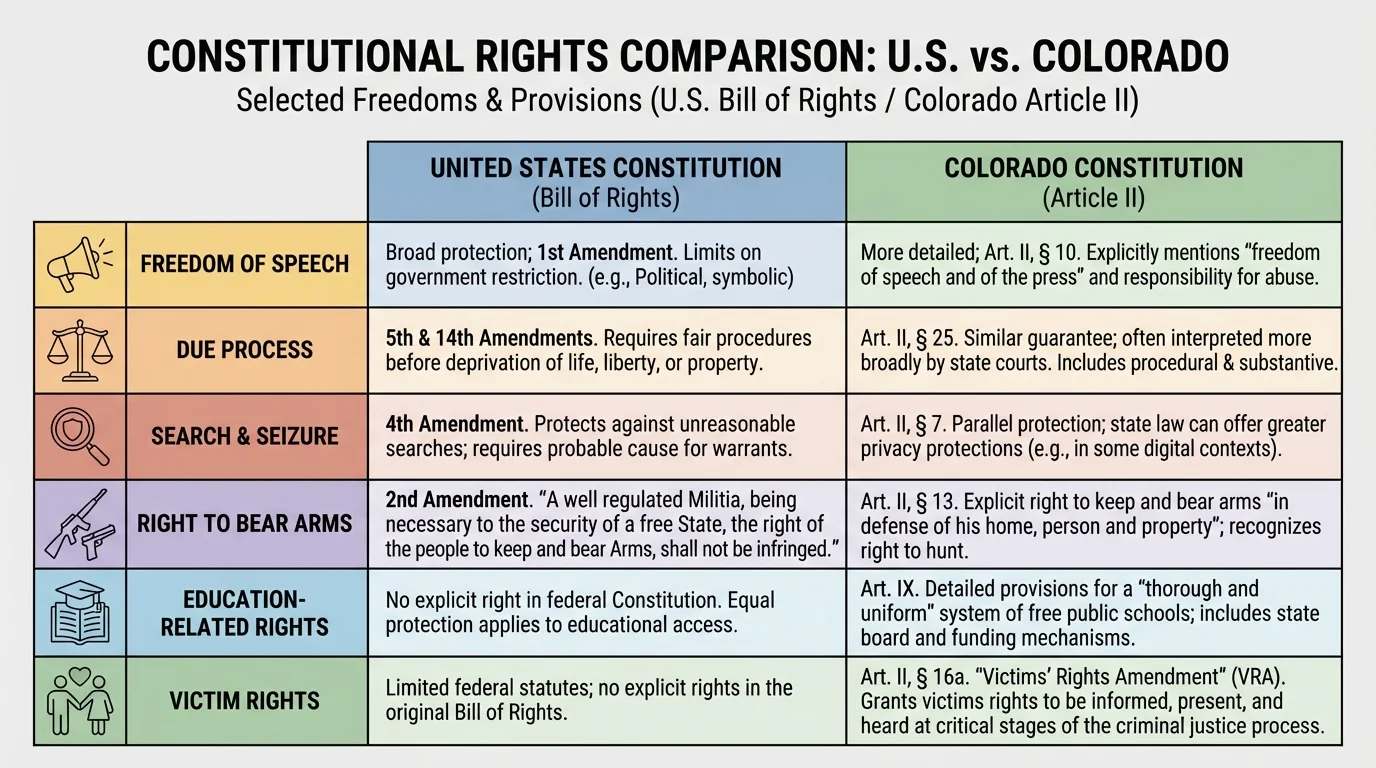
The national and state protections of liberty are closely connected, and [Figure 4] helps compare them side by side. The United States Bill of Rights is the first ten amendments to the U.S. Constitution. Colorado's Bill of Rights appears mainly in Article II of the state constitution. Both protect core liberties, but a state constitution may sometimes provide broader protections than the federal minimum.
The U.S. Bill of Rights includes famous protections: freedom of religion, speech, press, assembly, and petition; the right to keep and bear arms; protections for accused persons; and restrictions on excessive bail and cruel and unusual punishments. These rights limit government power and help define what freedom means in a constitutional democracy.
Colorado's Bill of Rights includes many similar guarantees, including freedom of worship, speech, due process, and protections against unreasonable searches and seizures. But state constitutions can include additional language or stronger wording. In some legal disputes, a state court may interpret the Colorado Constitution to protect a right more broadly than the federal Constitution does, as long as it does not violate federal law.
This relationship is an example of federalism, the sharing of power between national and state governments. The U.S. Constitution sets a floor for rights protection, not always a ceiling. States cannot provide less protection than the federal Constitution requires, but they may provide more in some areas under their own constitutions and laws.
| Topic | United States Bill of Rights | Colorado Bill of Rights |
|---|---|---|
| Speech and press | Strong protection against federal and, through later interpretation, state interference | Also strongly protected; state courts may interpret state text independently |
| Religion | Protects free exercise and limits establishment of religion | Protects worship and conscience in state constitutional language |
| Search and seizure | Fourth Amendment protections | Parallel state protections that may be interpreted more broadly in some cases |
| Criminal procedure | Rights to counsel, jury trial, due process, and protection against self-incrimination | Comparable protections in state constitutional text |
| Additional state-specific rights | Less detailed on many state-level issues | May include provisions tied to state governance and public policy |
Table 1. Comparison of major themes in the United States and Colorado Bills of Rights.
The chart in [Figure 4] shows why state constitutions matter. Many people assume the U.S. Constitution is the only rights document that affects them, but in everyday life state constitutional law can be just as important, especially in criminal cases, education disputes, local governance, and voting issues.
Amendment procedures shape which ideas become permanent constitutional rules and which remain ordinary laws. If a policy is written into a constitution, it becomes harder to change later. That can protect rights from political attacks, but it can also freeze controversial policy choices that future voters might want to revisit.
Consider voting rights. At the federal level, constitutional amendments were necessary to prohibit certain forms of discrimination and expand political participation. At the state level, constitutional provisions may influence election administration, districting rules, or citizen initiatives. In both systems, changing the constitution is ultimately about deciding which values are so important that they should stand above ordinary politics.
Remember that the Constitution does not operate alone. Statutes, court decisions, executive actions, and political customs all affect how government works. Formal amendment is only one path of constitutional change, but it is the most explicit and permanent one.
Rights debates also show why amendment procedures matter. If people believe a right is fundamental, they may try to place it in constitutional text rather than rely on a statute that a future legislature could repeal. At the same time, every addition makes a constitution longer and potentially more difficult to interpret.
No amendment process is perfect. A very difficult process can protect stability but block needed reform. A more open process can encourage democratic participation but make constitutional text unstable or overloaded with detailed policy. The United States and Colorado illustrate these tradeoffs clearly.
The federal system has produced a short constitution with relatively few amendments. That gives the document prestige and continuity, but it can also force major social change to occur through judicial interpretation instead of formal amendment. Colorado's more flexible process allows broader direct participation, but it can lead to a constitution that contains issues some people think should be handled through ordinary legislation instead.
Historical patterns matter too. Many successful amendments followed war, economic conflict, social protest, or large-scale demands for fairness. Constitutions do not usually change because one leader has a clever idea. They change when enough people, across enough institutions, become convinced that the old rules no longer match the nation's principles or needs.
"The Constitution is not a machine that would go of itself."
— John Adams
That statement is a reminder that constitutional government depends on citizens, lawmakers, judges, and voters. Written words matter, but so do the people who interpret and amend them. Understanding amendment processes helps explain how government balances continuity with reform, authority with liberty, and majority rule with protection of rights.
