If the government could arrest someone without evidence, search a home without limits, or take land without a fair process, freedom would become fragile very quickly. That is why courts matter. The judicial branch is not the most visible part of government in everyday life, but it often becomes the place where the most important questions are settled: Can the police do that? Does a student still have rights at school? Can the state punish a person unfairly? Can the government take private property for public use? These are not abstract questions. They affect real people, real families, and real communities.
In the United States, the judicial system plays a central role in protecting life, liberty, and property. Those three ideas come from a long tradition in political thought and are woven into the Constitution and later amendments. Courts help make those protections real by interpreting laws, reviewing government actions, settling disputes, and applying constitutional rights even when doing so is unpopular. At the same time, courts are not perfect, and they cannot solve every injustice on their own. To evaluate their role honestly, we must look at both what they do well and where their power has limits.
The judicial system includes local, state, and federal courts. Its basic job is to resolve disputes and apply the law, but in a constitutional democracy that job is larger than simply deciding who wins a case. Courts also guard the rule of law. The rule of law means that no one, including public officials, is above the law. A police officer, a governor, a school district, and even the president can be challenged in court.
Courts matter especially when the majority supports actions that may violate individual rights. Legislatures respond to voters. Executives carry out policy. Judges are expected to decide cases based on law and evidence, not popularity. That independence can help protect people who are politically weak, socially unpopular, or unable to defend themselves against the power of the state.
Judicial system refers to the network of courts that interprets and applies the law. Life means protection from unjust killing or dangerous abuse by the government. Liberty means freedom under law, including civil rights and civil liberties. Property means ownership and lawful control of possessions, land, money, and other economic interests.
Still, courts do not automatically produce justice. Laws may be unfair, judges may disagree, and access to legal help may depend heavily on money and time. Evaluating the judicial system means asking not only whether courts have the authority to protect rights, but also whether people can realistically reach those protections.
The Constitution creates a government of separated powers. Congress makes laws, the president enforces them, and the courts interpret them. This arrangement reduces the risk that one branch will become too powerful. Within that structure, the judiciary reviews disputes and determines whether government action follows the Constitution.
[Figure 1] The United States has both state and federal court systems because it is a federal system. State courts handle most criminal cases, family law, probate, contracts, and property disputes under state law. Federal courts hear cases involving the U.S. Constitution, federal laws, treaties, disputes between states, and certain cases involving citizens of different states. Most cases begin in trial courts, where facts are examined and evidence is presented. Appeals courts review whether legal errors occurred. At the top are state supreme courts and the U.S. Supreme Court.
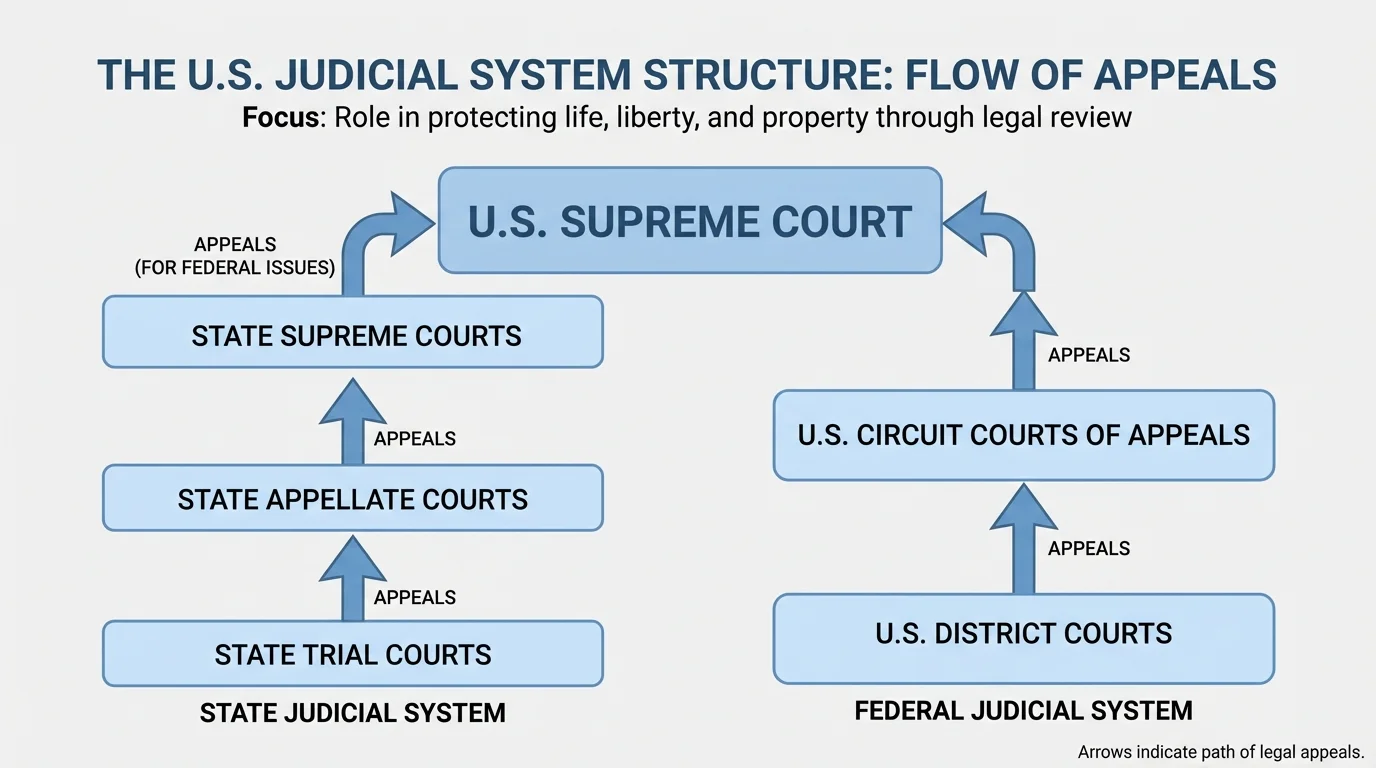
The design of multiple court levels is important. It gives people opportunities to challenge decisions and to argue that a lower court misapplied the law. This does not guarantee a correct outcome every time, but it reduces the chance that one mistaken judgment will be final. Later, when we examine the limits of the system, [Figure 1] also helps explain why appeals can protect rights but can also make justice slower and more expensive.
Judicial independence is another key part of the framework. Federal judges are appointed rather than elected, and they serve during good behavior, which usually means for life. This system is meant to shield them from immediate political pressure. Many state judges, however, are elected or retained through retention elections, which can make them more responsive to public opinion but may also make complete independence harder to maintain.
When Americans talk about protecting life, liberty, and property, they are talking about more than physical survival or ownership of things. These ideas refer to core rights that government must respect. The Fifth and Fourteenth Amendments are especially important because they say no person shall be deprived of life, liberty, or property without due process of law. That phrase means government must follow fair procedures and, in some situations, must also respect certain fundamental rights.
The phrase for all persons matters greatly. The Constitution does not protect only citizens in every circumstance. Many constitutional protections apply to persons, which includes noncitizens in the United States as well. Courts have often had to decide who counts, which rights apply, and whether the government is treating people equally. Those decisions shape the actual reach of freedom.
Why the phrase "for all persons" matters
One of the most important roles of courts is to decide whether rights apply broadly or narrowly. Across American history, the answer has changed over time. Judicial decisions have expanded protections to formerly excluded groups, but courts have also sometimes failed to protect those groups. That mixed record is central to evaluating the judiciary.
Protection can be procedural, meaning the government must use fair methods, or substantive, meaning some rights are so important that government cannot violate them without an extremely strong reason. Courts often have to decide where that line should be drawn.
Protecting life begins with placing limits on the government's power to accuse, imprison, and punish. In criminal cases, courts help ensure that the state cannot take away a person's life or physical safety arbitrarily. Judges oversee warrants, evidence, bail hearings, trials, sentencing, and appeals. If police obtain evidence illegally, a court may exclude it. If a confession was forced, a court may reject it. If a trial is unfair, a court may order a new one.
This role matters because criminal prosecution is one of the strongest powers government has. The state can arrest a person, hold them, and in some cases seek the death penalty. Because of that, courts insist on constitutional protections such as notice of charges, assistance of counsel, an impartial jury, and proof beyond a reasonable doubt. These rules reduce the chance that an innocent person will lose freedom or life.
Courts also address conditions of confinement. People in jail or prison do not lose all constitutional protection. Cases involving medical care, overcrowding, unsafe facilities, and abuse by officials show that courts can intervene when the state fails to meet minimum standards. Protecting life therefore includes not only preventing wrongful conviction but also preventing cruel treatment after conviction.
Case study: judicial protection in a criminal case
A person is arrested after police search a house without a valid warrant or a recognized exception.
Step 1: The defense challenges the search in court.
The judge examines whether the search followed constitutional rules.
Step 2: The court decides whether the evidence is admissible.
If the search violated the Constitution, the evidence may be excluded.
Step 3: The ruling affects the prosecution.
Without illegally obtained evidence, the government may have to reduce charges or dismiss the case.
This example shows how courts protect life and liberty by limiting the government's power to punish without lawful process.
Courts also face difficult questions about public safety. A judge must balance individual rights with the need to protect communities from violence. In emergency situations, fear can push governments toward overreach. The judiciary becomes especially important in those moments because rights are easiest to ignore when people are afraid.
Civil liberties are freedoms that protect individuals from excessive government control. Courts defend liberty by enforcing rights such as freedom of speech, freedom of religion, freedom of the press, the right to assemble, and protections against unreasonable searches and self-incrimination. These rights are not always easy to protect because they often involve unpopular speakers, controversial beliefs, or tense political moments.
For example, courts have repeatedly held that the First Amendment protects speech that many people dislike or disagree with, as long as it does not fall into a narrow unprotected category such as true threats or certain forms of incitement. This is one of the judiciary's most important functions: protecting liberty not only when it is convenient, but when it is difficult.
Liberty also includes fair treatment in schools, workplaces, and public spaces. Students do not lose all constitutional rights at the schoolhouse gate, although those rights can be limited more than adult rights in some settings. Religious liberty cases ask whether government is improperly favoring one religion, burdening belief, or restricting free exercise. Privacy-related cases ask how much authority the government has over deeply personal decisions.
Another major protection of liberty is the right to counsel. A fair trial is impossible if a person does not understand the law and cannot defend themselves against trained prosecutors. Courts have recognized that justice should not depend entirely on wealth. That principle does not erase inequality, but it is one of the clearest examples of the judiciary trying to make liberty meaningful for ordinary people rather than only for those who can afford expensive legal teams.
Property rights are sometimes overlooked because they sound less dramatic than free speech or criminal justice, but they are vital to personal security and economic stability. If government could seize homes, freeze money, or rewrite contracts at will, people would have little confidence in the legal system or the economy. Courts protect property by enforcing contracts, resolving ownership disputes, reviewing taxes and regulations, and examining whether the government has followed the Constitution when taking or restricting property.
One key issue is eminent domain, the power of government to take private property for public use if it provides just compensation. Courts do not eliminate this power, but they review whether the taking is lawful and whether compensation is fair. This can involve roads, schools, pipelines, redevelopment plans, or other projects said to serve the public.
Courts also protect property through procedural fairness. Before the government takes a business license, seizes assets, removes someone from public housing, or forecloses on property, it usually must provide notice and an opportunity to be heard. These requirements may seem technical, but they are essential. Property is often tied to shelter, income, transportation, or family survival.
Property cases often affect liberty as well. Losing a home, car, or business can reduce a person's ability to work, travel, support family members, or participate fully in society.
At the same time, courts must balance property rights with the public interest. Environmental rules, zoning laws, safety codes, and anti-discrimination laws may limit how property is used. The judiciary must decide when regulation is a valid exercise of government power and when it goes so far that it effectively becomes an unconstitutional taking.
To protect rights, judges rely on several core legal tools. These include due process, equal protection, judicial review, precedent, and habeas corpus. Each tool gives courts a different way to test whether government action is lawful.
[Figure 2] Due process requires fairness. Procedural due process asks whether the government used fair methods. Substantive due process asks whether the government has infringed on certain fundamental rights. Equal protection, found in the Fourteenth Amendment, requires states to treat people equally under the law unless there is a constitutionally valid reason for different treatment.
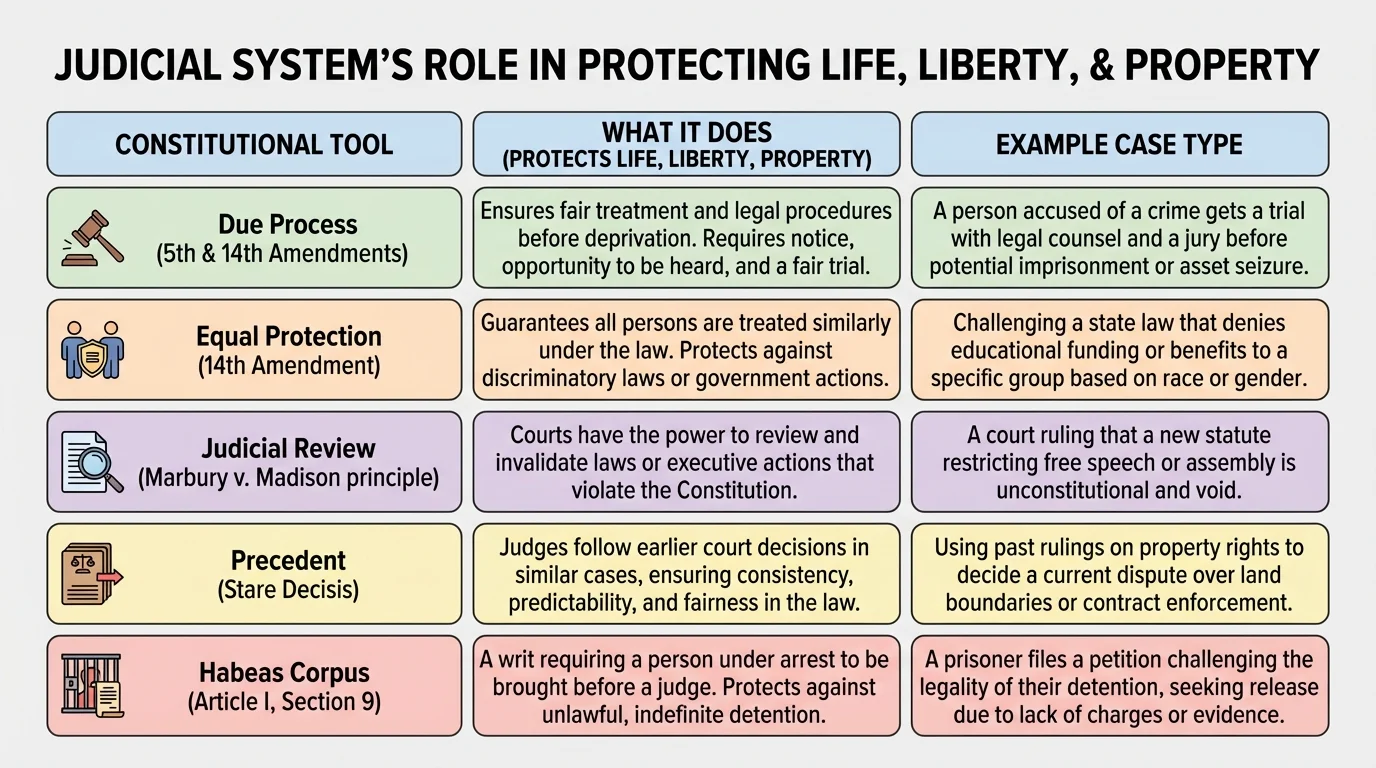
Judicial review is the power of courts to declare government actions unconstitutional. This power is not stated in one short sentence in the Constitution, but it became a foundational principle through early Supreme Court interpretation. It allows courts to invalidate laws, executive actions, or policies that violate constitutional rights.
Precedent means that past judicial decisions guide later cases. This promotes consistency and predictability. If similar cases were decided differently every week, the law would become unstable. However, courts can overturn precedent when they conclude an earlier decision was seriously wrong or unworkable.
Habeas corpus protects against unlawful detention. A person held by the government can challenge the legality of that detention in court. This principle is one of the oldest safeguards of liberty in Anglo-American law. In periods of war, emergency, or fear, its importance becomes especially clear.
When courts use these tools well, they can prevent major abuses of power. The comparison in [Figure 2] also shows that no single doctrine does all the work. Rights are protected through a combination of procedures, principles, and case-by-case judgment.
The protection of rights in the United States did not emerge all at once. It developed over time through conflicts, lawsuits, and changing interpretations through major cases across American history. Some decisions expanded freedom. Others failed badly, reminding us that courts can protect rights but can also deny them.
[Figure 3] In Marbury v. Madison (1803), the Supreme Court established judicial review. In Dred Scott v. Sandford (1857), the Court denied citizenship and rights to Black Americans of African descent, one of the most damaging failures in judicial history. After the Civil War, the Fourteenth Amendment created new constitutional foundations for equal protection and due process, but courts did not always enforce them strongly.
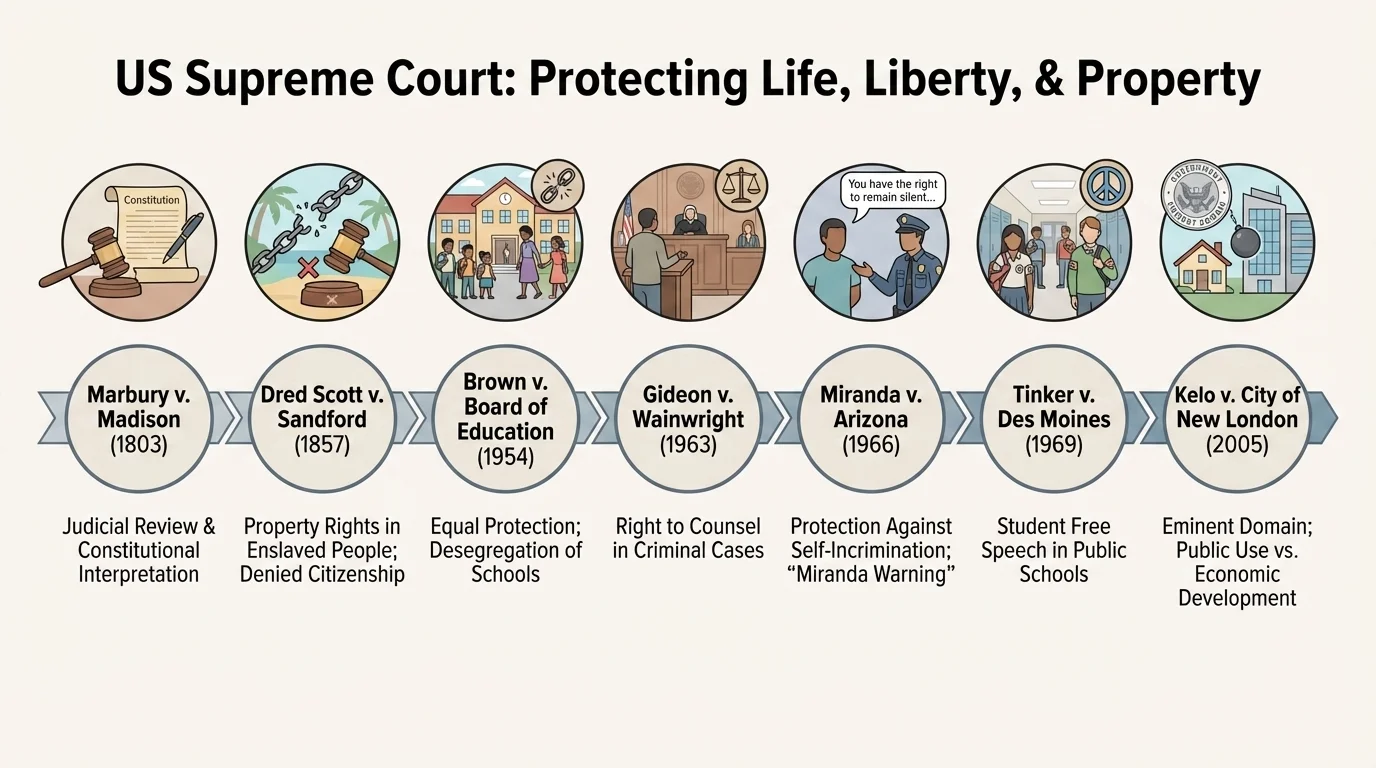
In Brown v. Board of Education (1954), the Court ruled that racial segregation in public schools was unconstitutional, rejecting the idea that "separate but equal" was truly equal. In Gideon v. Wainwright (1963), the Court recognized the right to counsel for defendants in serious criminal cases who could not afford an attorney. In Miranda v. Arizona (1966), the Court required that suspects be informed of key rights before custodial interrogation.
Other cases protected student expression and limits on school authority, such as Tinker v. Des Moines (1969). Property rights debates appear in cases such as Kelo v. City of New London (2005), where the Court upheld a broad use of eminent domain for economic development, sparking intense public debate about whether property was being adequately protected. Looking back at [Figure 3], it becomes clear that the judiciary's role is not fixed. It changes as judges interpret the Constitution in new contexts.
These cases show why evaluation matters. The courts have sometimes been engines of justice and sometimes obstacles to it. A strong civic understanding of the judiciary requires both respect for its protective role and honesty about its failures.
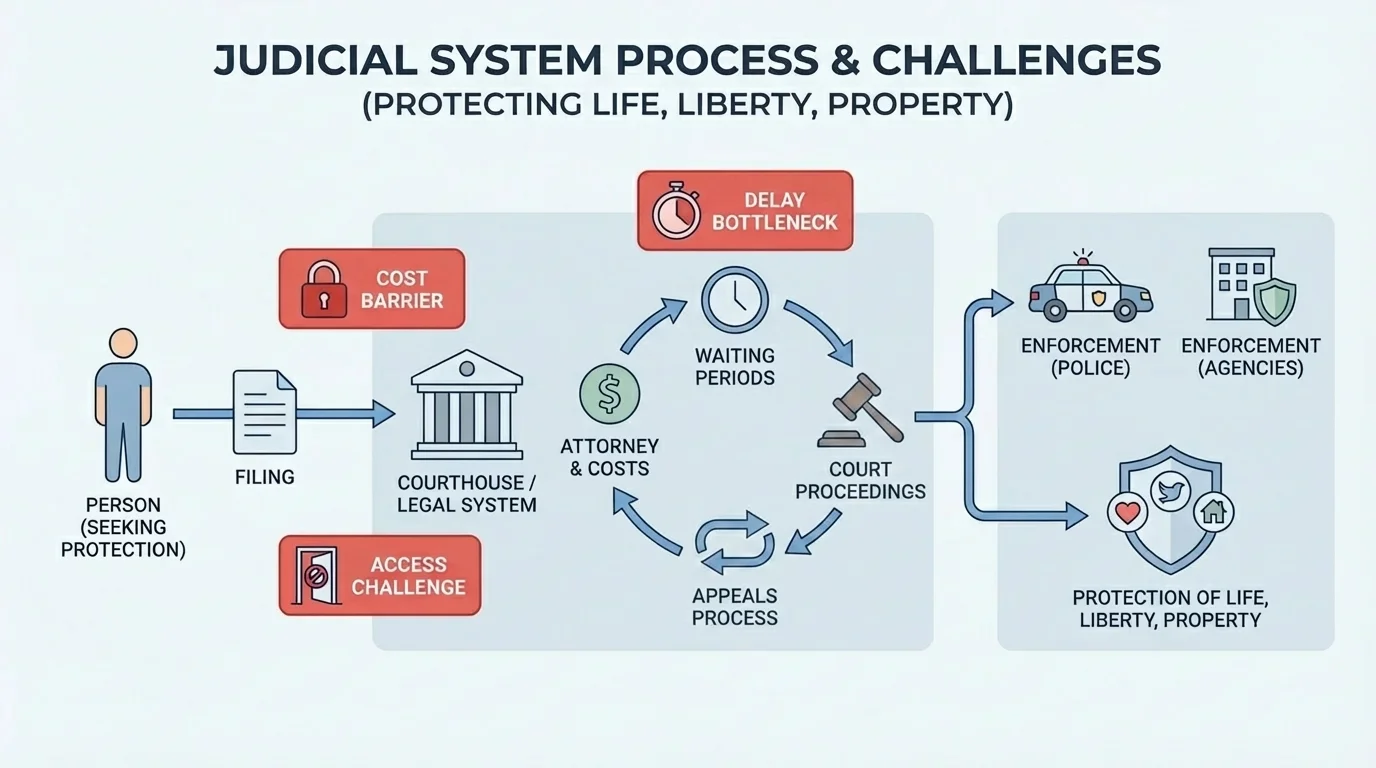
Courts are powerful, but they are not all-powerful. The obstacles they face show that legal rights on paper do not always become real protections in daily life. A person usually needs standing, meaning a direct stake in the case, and the court must have jurisdiction, meaning authority to hear it. Courts also rely on the executive branch to enforce decisions and on legislatures to fund courts and, in many cases, to revise laws.
[Figure 4] Cost is a major limit. Lawyers, filing fees, expert witnesses, transportation, and time away from work can make justice hard to reach. Public defenders often carry heavy caseloads. Civil litigants usually do not receive free lawyers, even when housing, debt, or child custody is at stake. This means wealth can affect how well rights are defended.
Delay is another problem. Cases can take months or years. Appeals add protection, but they also add time and expense. For someone wrongly jailed, evicted, or deprived of benefits, a delayed victory may still come after serious harm has already occurred.
Courts also work through cases one dispute at a time. They are not designed to redesign society all at once. If a discriminatory system harms thousands of people but only a few can bring cases, change may be slow. And although judges are expected to be neutral, they are still human beings shaped by their experiences, legal philosophies, and historical moment.
History shows that courts can fail badly. They have upheld slavery, segregation, internment, and other injustices at different points. That record is not a reason to ignore the judiciary; it is a reason to evaluate it carefully. The same institution that protects rights in one era may neglect them in another. As [Figure 4] makes clear, access and enforcement problems can weaken even strong legal principles.
A fair evaluation of the judicial system must be balanced. On the positive side, courts provide peaceful methods for resolving disputes, checking government power, enforcing constitutional rights, and giving individuals a way to challenge officials and institutions. They help protect life by requiring fair criminal procedures, protect liberty by defending constitutional freedoms, and protect property by demanding lawful process and just compensation where required.
Courts are especially important for minority rights. In a democracy, majority rule matters, but it is not supposed to be unlimited. The judiciary can stop the majority from violating the constitutional rights of a smaller group. That is one of the main reasons constitutional democracy includes an independent judicial branch instead of relying only on elections.
"Equal justice under law."
— Inscription on the U.S. Supreme Court building
But the phrase on the building is also a challenge. If justice is expensive, delayed, inconsistent, or shaped by unequal access to representation, then protection is not equally real for everyone. The words for all persons require more than formal rights. They require meaningful access to courts, fair procedures, honest judging, and enforcement that reaches rich and poor alike.
In the strongest sense, the judicial system protects life, liberty, and property when it does three things well: it limits arbitrary power, it treats people fairly, and it applies constitutional principles even when doing so is politically difficult. Its greatest weakness appears when rights exist mainly on paper or when some groups can use the legal system far more effectively than others.
For students studying civics, the most important insight is that courts are neither magic nor meaningless. They are essential institutions in a constitutional republic. They can preserve freedom, correct injustice, and restrain abuse. Yet they depend on public trust, access to legal representation, enforcement by other branches, and a continuing commitment to the idea that every person deserves the protection of law.
