A single court decision can change what students may say in school, whether a state may add qualifications for Congress, how local taxes are enforced, or how governments treat minority groups. Courts do not command armies or write budgets, yet they can stop laws, limit presidents and governors, and redefine the relationship between citizens and government. That is why understanding the judicial system is essential to understanding power itself in American government.
The judicial branch exists to interpret laws, resolve disputes, and protect constitutional limits. In a constitutional democracy, government power is not supposed to be unlimited. Courts help enforce that principle by deciding whether actions taken by officials and lawmakers follow the Constitution and other laws.
One of the most important ideas in American government is checks and balances. Each branch has powers that can limit the others. Congress writes laws, the president enforces them, and courts interpret them. But courts are not all-powerful. Judges depend on the executive branch to enforce decisions, and legislatures can respond to court rulings by changing laws, proposing constitutional amendments, or altering court structure within constitutional limits.
Judicial review is the power of a court to examine a law or government action and decide whether it violates the Constitution. This power makes courts a central part of checks and balances because it allows judges to limit the legislative and executive branches.
Courts also matter because rights often become real only when courts enforce them. A right written on paper means little if there is no institution capable of protecting it. When people challenge censorship, discrimination, unlawful searches, election rules, or government overreach, courts often become the place where those conflicts are settled.
The federal judiciary is organized in levels, and understanding that hierarchy helps explain how a case moves through the system. As [Figure 1] shows, most federal cases begin in trial courts, where facts are presented and evidence is examined, and some then move upward through appeals. This structure is designed to allow review without retrying every case from the beginning.
At the lowest federal level are U.S. District Courts, which are trial courts. These hear criminal cases involving federal law, civil disputes involving federal questions, and cases involving parties from different states under certain conditions. Witnesses testify, evidence is introduced, and juries may decide facts.
Above them are the appellate courts, usually called the U.S. Courts of Appeals. These courts do not usually hold full new trials. Instead, they review whether the trial court applied the law correctly. They may affirm, reverse, or send a case back for further proceedings.
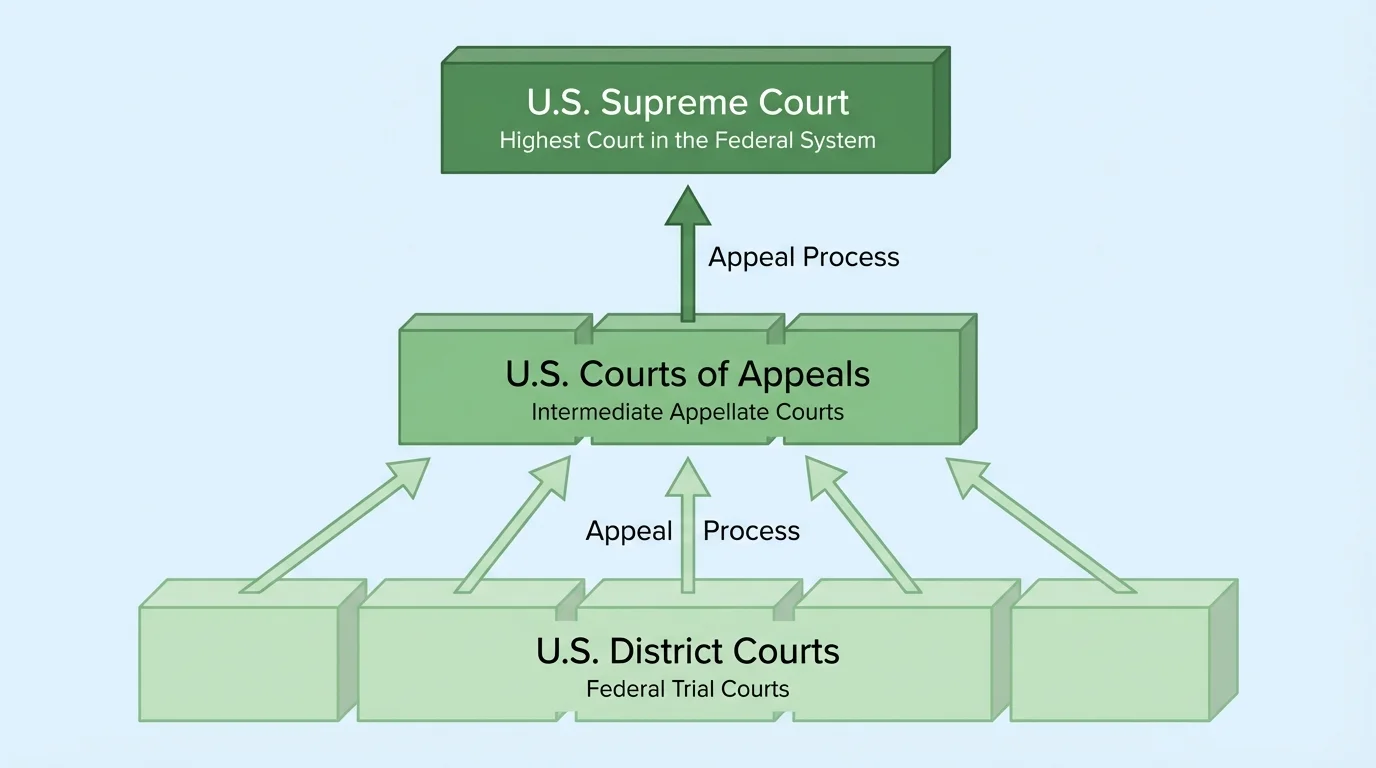
At the top is the U.S. Supreme Court, the highest court in the nation. It chooses only a small number of cases to hear, usually those involving major constitutional questions, conflicts among lower courts, or issues of national importance. Because it hears so few cases, when the Supreme Court acts, its rulings often have enormous impact.
This federal structure shapes checks and balances in a practical way. A president may sign a law, Congress may pass it, and agencies may enforce it, but federal courts can still decide that the law or the way it is enforced violates the Constitution. Later in the lesson, cases such as Korematsu v. United States and Tinker v. Des Moines show how these judicial powers can either protect liberty or, at times, fail to do so.
Colorado has its own court system, and students are more likely to encounter parts of it in daily life than the federal courts. As [Figure 2] illustrates, Colorado courts are layered, with different courts handling different kinds of disputes, from local ordinance violations to major appeals involving the state constitution.
Municipal courts handle violations of city ordinances, such as certain traffic or code issues within a city. County courts hear misdemeanors, traffic matters, civil cases involving limited amounts of money, and preliminary matters in felony cases. District courts are Colorado's main trial courts of general jurisdiction, hearing major civil cases, felonies, family law matters, juvenile cases, probate matters, and more.
Above the district courts is the Colorado Court of Appeals, which reviews many appeals from district courts. At the top is the Colorado Supreme Court, which is the highest court in the state and has the final word on questions of Colorado law unless a federal constitutional issue allows review by the U.S. Supreme Court.
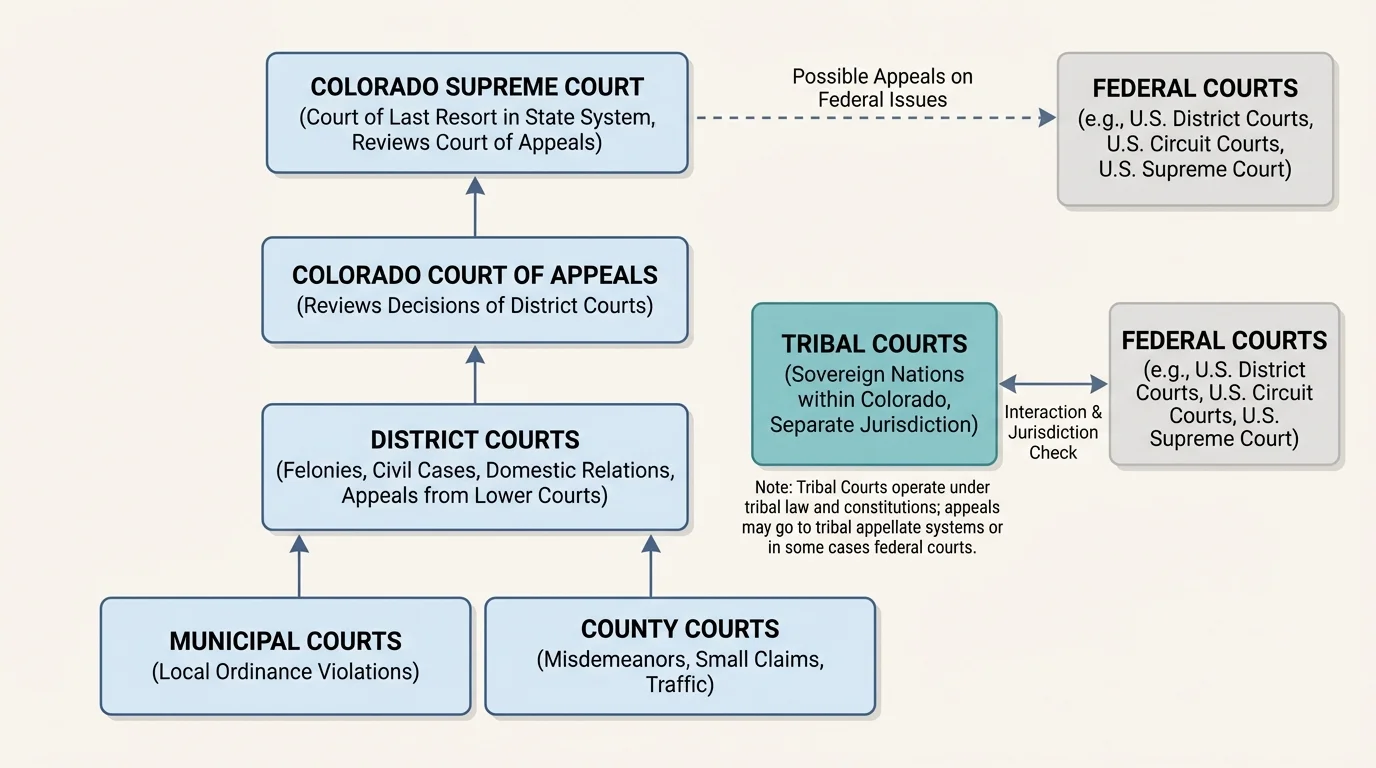
Colorado's legal landscape is more complex than a simple ladder. Some legal issues may involve jurisdiction, meaning the authority of a court to hear a case, and disputes can move between state and federal systems depending on the law involved. In addition, tribal courts operate as part of tribal sovereignty rather than as a branch of Colorado state government.
Why court structure matters
Court systems are organized by subject matter, location, and level of review so that legal questions are handled by the institution best suited to them. Trial courts focus on facts and evidence. Appellate courts focus more on legal interpretation. High courts focus on major legal questions and consistency across the system.
This layered design helps avoid concentrating too much power in one place. A local court can make a decision, but a higher court can review it. A state supreme court can interpret state law, but the U.S. Supreme Court may step in when federal constitutional issues are involved. That is part of the balance between state and national power in American federalism.
How judges get their jobs affects public trust, independence, and accountability. As [Figure 3] shows, in the federal system judges are selected through a political process, while in Colorado many judges are chosen through a merit-based appointment system followed by voter review.
At the federal level, the president nominates judges, including Supreme Court justices, and the Senate must confirm them. Federal judges usually serve during good behavior, which in practice means life tenure unless they resign, retire, or are removed through impeachment. Supporters argue that life tenure protects judicial independence because judges do not need to worry about reelection. Critics argue that it gives unelected officials long-lasting influence.
Colorado uses a merit selection system for many judges. A judicial nominating commission reviews applicants and sends names to the governor, who appoints a judge. Later, voters decide in a retention election whether that judge should remain in office. Voters are not choosing between competing candidates; they are deciding yes or no on keeping the judge.
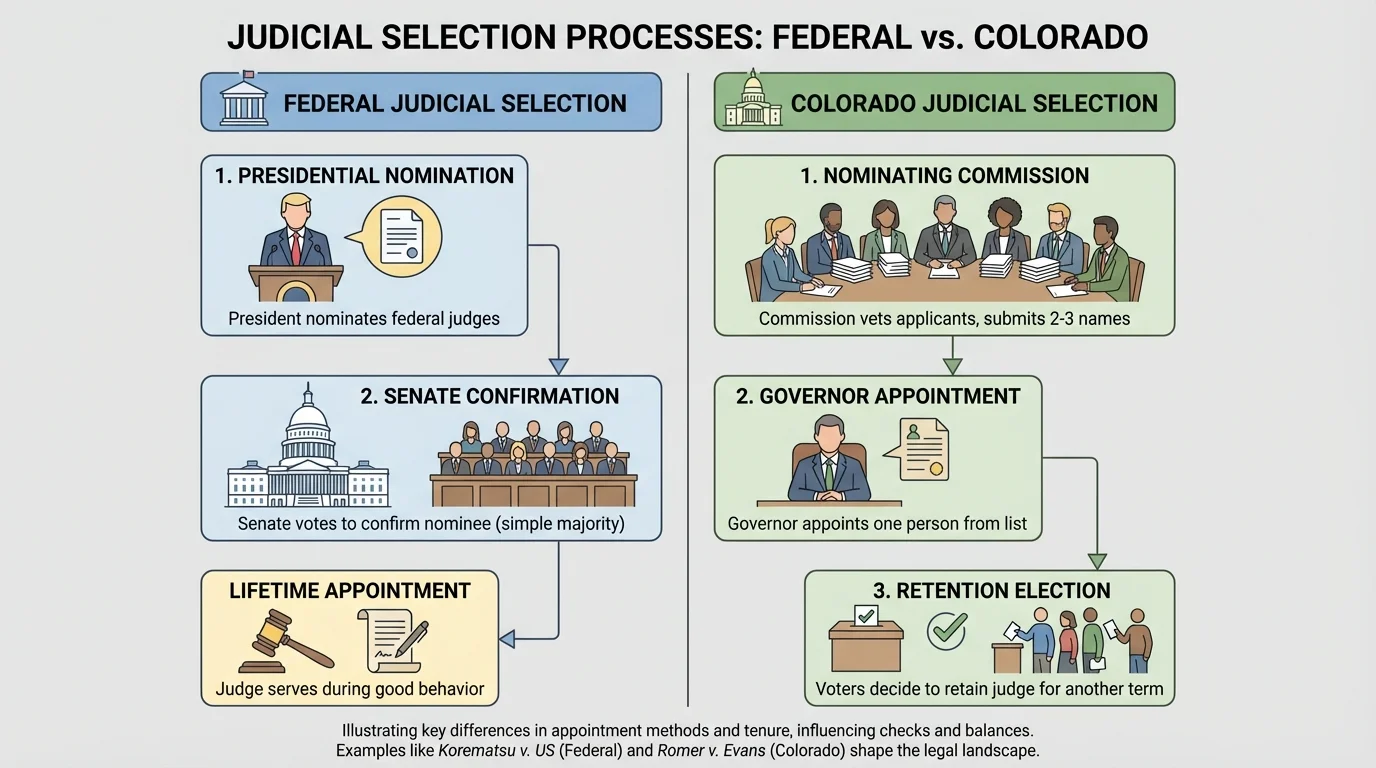
These systems reflect a tension at the heart of democracy: judges should be independent enough to make unpopular constitutional decisions, but also connected enough to the public to maintain legitimacy. Colorado's system attempts to blend expertise, executive appointment, and public oversight. The federal system emphasizes separation of powers by requiring both the executive and legislative branches to participate.
Even after judges are selected, other branches still influence courts. Legislatures create lower courts, set many rules of procedure, and approve budgets. Executives appoint judges in many systems. Courts are independent, but they do not stand outside government. They are one part of a larger constitutional structure.
Courts are often described as guardians of the Constitution, but they are also participants in political conflict. When a court strikes down a law, it is not simply expressing an opinion; it is checking another branch. When courts uphold government action, they may strengthen executive or legislative power.
At the same time, courts face limits. Judges cannot begin most cases on their own. They must wait for actual disputes. They rely on lawyers to bring arguments, on evidence presented by the parties, and on other branches to carry rulings into effect. If the public or political leaders strongly resist a ruling, enforcement can become difficult.
The Supreme Court has no army, police force, or budget-writing power of its own. Its influence depends heavily on the legitimacy of its reasoning and on the willingness of other institutions to comply with its judgments.
That limitation is important. The judiciary is powerful because its interpretations carry legal authority, but it is limited because it cannot directly govern in the way legislatures and executives do. In other words, courts check power while also being checked by constitutional structure, public debate, and the possibility of later legal change.
Colorado court decisions have shaped questions of civil rights, taxation, election law, and the meaning of constitutional protections. These cases show that state-level decisions can have national significance.
Francisco Maestas et al. v. George H. Shone (1914) involved Mexican American children in Colorado who had been excluded from a public school attended by white children. The court ruled against the school district's attempt to separate the students solely because they were of Mexican descent. This case is significant because it challenged school segregation decades before the more widely known federal rulings of the mid-twentieth century. It showed that equal access to public education was already a contested issue in Colorado and that state courts could push back against discriminatory local practices.
U.S. Term Limits, Inc. v. Thornton (1995) began with an Arkansas measure, but Colorado and other states had supported similar term-limit efforts for members of Congress. The U.S. Supreme Court ruled that states cannot add qualifications for members of Congress beyond those listed in the U.S. Constitution. The case matters in Colorado because it demonstrated a major limit on state power: even if voters in one state support a rule, that rule cannot alter national constitutional requirements for federal office. This is a clear example of federal constitutional supremacy over state action.
Romer v. Evans (1996) began in Colorado and became one of the most important civil rights decisions in modern constitutional law. Colorado voters had approved Amendment 2, which prevented state and local governments from protecting people against discrimination based on sexual orientation. The U.S. Supreme Court struck down the amendment, ruling that it violated the Equal Protection Clause of the Fourteenth Amendment. The Court found that the amendment singled out one group and denied it ordinary political protection. This case is a strong example of courts checking majority power when that majority acts in a way that violates constitutional equality.
Case study: Why Romer v. Evans matters for checks and balances
Step 1: Colorado voters approved a state constitutional amendment.
Step 2: Individuals challenged the amendment in court, arguing that it violated the federal Constitution.
Step 3: The judicial branch reviewed the amendment and invalidated it under the Equal Protection Clause.
The result shows that even a measure approved by voters can be unconstitutional. Democracy in the United States is majority rule within constitutional limits, not unlimited majority power.
Colorado Union of Taxpayers Foundation v. City of Aspen (2018) dealt with the Taxpayer's Bill of Rights, often called TABOR, and whether certain government charges counted as taxes requiring voter approval. The Colorado Supreme Court ruled that Aspen's charge on disposable bags was a fee rather than a tax. That distinction mattered because taxes and fees are treated differently under Colorado law. The case shows how judicial interpretation affects local government authority, public finance, and citizen oversight. A single word in law, such as tax or fee, can determine whether a city may act on its own or must first go to voters.
These Colorado cases reveal several recurring themes: local decisions can raise constitutional questions; state courts and federal courts may both play roles; and rights disputes are often tied to practical issues such as schools, elections, and local revenue.
Some Supreme Court decisions become famous because they define the country's understanding of liberty and power. Others become famous because they show how badly courts can fail during moments of fear or crisis.
Korematsu v. United States (1944) is one of the clearest warnings in American legal history. During World War II, the federal government ordered the forced relocation and internment of Japanese Americans. Fred Korematsu challenged the policy. The Supreme Court upheld the government's action. Although the decision was later widely condemned, it demonstrated how courts sometimes defer too much to executive claims of military necessity. The case matters because it exposes a limitation of checks and balances: institutions designed to protect rights do not always succeed, especially during national emergencies.
"The Constitution of the United States is a law for rulers and people, equally in war and in peace."
— Ex parte Milligan (1866)
Tinker v. Des Moines Independent Community School District (1969) involved students who wore black armbands to protest the Vietnam War. School officials suspended them. The Supreme Court ruled in favor of the students, declaring that students do not "shed their constitutional rights to freedom of speech or expression at the schoolhouse gate." This case is especially important for high school students because it directly addresses student expression. Schools may regulate speech that substantially disrupts learning, but they may not silence student expression simply because officials dislike the viewpoint.
Together, these two cases reveal a striking contrast. Korematsu shows judicial failure in protecting civil liberties under pressure. Tinker shows judicial willingness to protect unpopular speech. In both situations, the Court shaped the relationship between citizens and government power.
The Bill of Rights and the Fourteenth Amendment are central to many court cases. Rights such as free speech, due process, and equal protection often become meaningful through judicial interpretation rather than through simple reading of constitutional text alone.
The lesson from landmark decisions is not that courts always protect freedom. It is that courts are one of the main arenas where the meaning of freedom is contested. That is why studying decisions matters as much as studying constitutional structure.
American government is not one single legal system stacked neatly from bottom to top. As [Figure 4] shows, it is a network of overlapping authorities. Local, state, tribal, and federal governments may each have their own powers, and courts often decide where one authority ends and another begins. That makes the judicial system essential to federalism as well as to separation of powers.
tribal sovereignty means that federally recognized tribes possess a measure of inherent self-government. Tribal courts are not subdivisions of Colorado or of local counties. They are part of the governing authority of tribal nations. However, the exact boundaries of tribal, state, and federal authority can be complex and depend on the subject, location, and people involved.
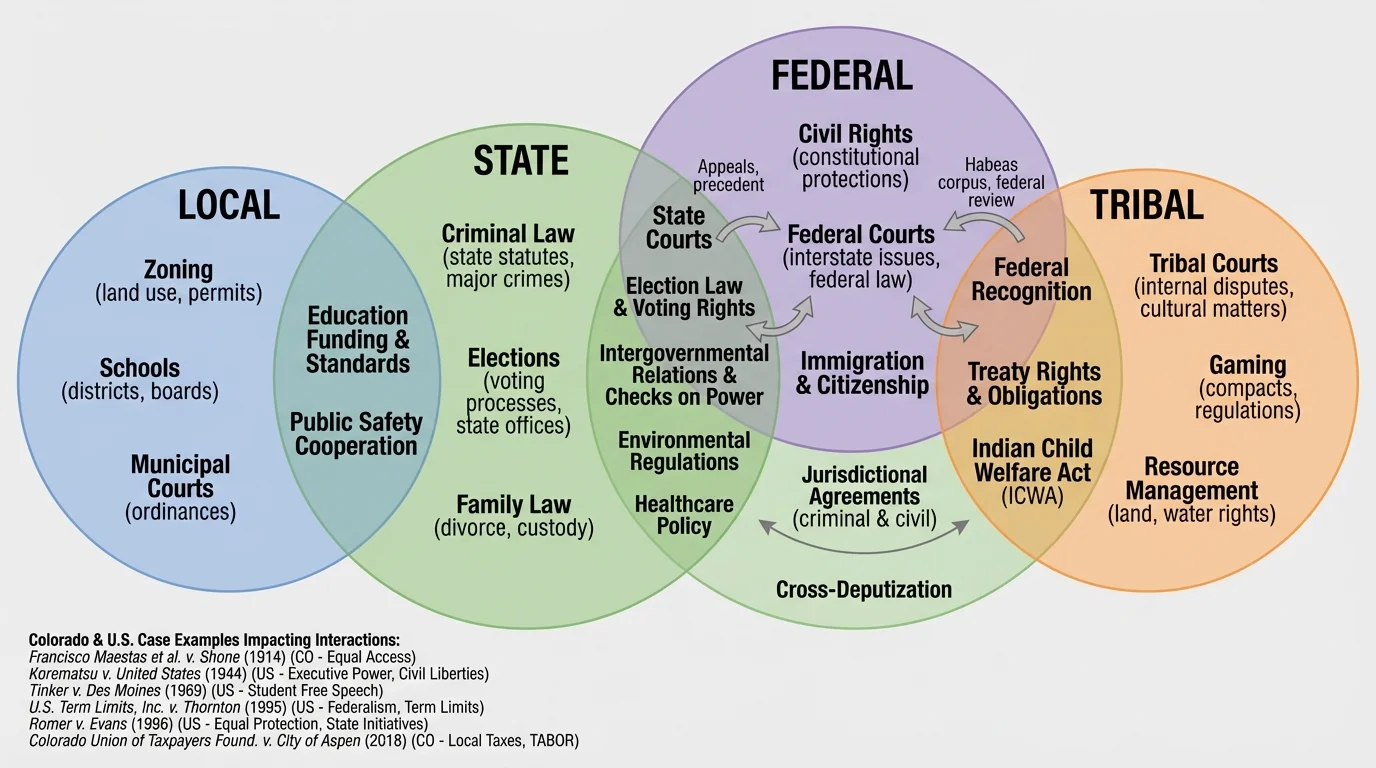
For example, a local city may enforce an ordinance, but that ordinance must still comply with the Colorado Constitution and the U.S. Constitution. A state law may govern elections or education, but federal courts may review it if it conflicts with federal constitutional rights. A tribal court may decide matters involving tribal law and tribal members, while some issues can move into federal court because of federal statutes or constitutional questions.
This interaction matters in real life. Consider policing, land use, environmental regulation, taxation, and voting. One issue may involve a local government action, a state statute, tribal rights, and federal constitutional claims all at once. Courts sort through these conflicts by asking which government has authority and which law controls.
We can also connect this back to [Figure 2], which displays Colorado's court layers, and to [Figure 3], which shows how judges are chosen. A court's place in the system and the method used to select its judges can influence how legal conflicts are understood by the public, even though judges are expected to apply law rather than political preference.
The judicial system is not remote from student life. Tinker affects student speech. State court decisions affect school rules, local taxes, transportation, safety, and public services. Election cases affect who may appear on ballots and under what rules. Civil rights cases affect whether minority groups receive equal treatment under law.
When you hear that a court "interpreted" a law, that may sound passive. In reality, interpretation can shape daily life just as strongly as legislation does. If a city's charge is labeled a fee instead of a tax, public policy changes. If a state amendment violates equal protection, it cannot stand. If a school punishes peaceful symbolic protest, courts may intervene.
The judiciary therefore serves multiple purposes at once: resolving conflict, protecting rights, enforcing constitutional limits, and clarifying the boundaries between different levels of government. But it also has limitations: judges are unelected in the federal system, legal processes can be slow, courts depend on actual cases, and decisions may reflect the pressures and assumptions of their times.
A mature understanding of civics requires holding both truths together. Courts are neither flawless guardians nor mere political actors. They are institutions built to reason through conflict under law. Their greatest strength is the ability to say that power must justify itself. Their greatest danger appears when they fail to do so.
