Governments do not run only on people, elections, or buildings. They run on ideas written down and argued over for generations. A constitution, declaration, or charter can outlast presidents, governors, wars, and political parties. In the United States and in Colorado, founding documents are not just old papers in museums. They still shape who has power, what government may do, what it may not do, and how ordinary people can defend their rights.
To understand modern American and Colorado government, it helps to see founding documents as part of a long conversation about order, liberty, representation, and justice. Some of that conversation began before the United States existed. Some of it happened in the struggle for independence. Some of it took shape when Colorado entered the Union in 1876. And some of it is still happening today in courtrooms, legislatures, ballot measures, and public debate.
A founding document is a basic text that establishes political principles, structures of government, or core rights. Founding documents often answer a few essential questions: Who has authority? Where does that authority come from? What are the limits of government? How can laws be made or changed? What rights belong to the people?
These texts matter because they create both power and limits. A government needs enough power to keep order, provide security, and solve public problems. But if power has no boundaries, it can become abusive. The central challenge of civics is balancing authority with liberty. The founding documents of the United States and Colorado are major attempts to strike that balance.
Popular sovereignty means that political power ultimately comes from the people. Federalism is the division of power between a national government and state governments. Civil liberties are freedoms protected from government interference, such as freedom of speech or religion.
Another reason these documents matter is that they are not frozen in time. Their words stay important, but their meaning develops through amendments, court decisions, political movements, and public argument. A student posting on social media, a journalist investigating corruption, a voter signing a petition, or a defendant demanding due process all rely on principles rooted in these documents.
Long before the United States declared independence, Indigenous nations on this continent developed sophisticated political systems. One important example is the Great Law of Peace of the Haudenosaunee Confederacy. As [Figure 1] shows, this system joined separate nations under a shared political framework while preserving local identity and authority. That idea of unity without total uniformity is one reason historians and political thinkers often discuss the Great Law of Peace when studying early American political development.
The Haudenosaunee Confederacy brought together several nations, including the Mohawk, Oneida, Onondaga, Cayuga, Seneca, and later the Tuscarora. Its governing principles emphasized peace, mutual obligation, deliberation, and a council system. Leaders were expected to act with the welfare of future generations in mind, not merely short-term advantage.
The Great Law of Peace is significant because it demonstrates that complex constitutional thought existed in North America before the creation of the United States. It included ideas about representation, distributed authority, and collective decision-making. Some scholars argue that Haudenosaunee political practices influenced colonial and early American thinkers, especially in discussions of union and confederation. Historians debate the extent of that influence, but there is broad agreement that Indigenous governance deserves serious attention as part of American political history.
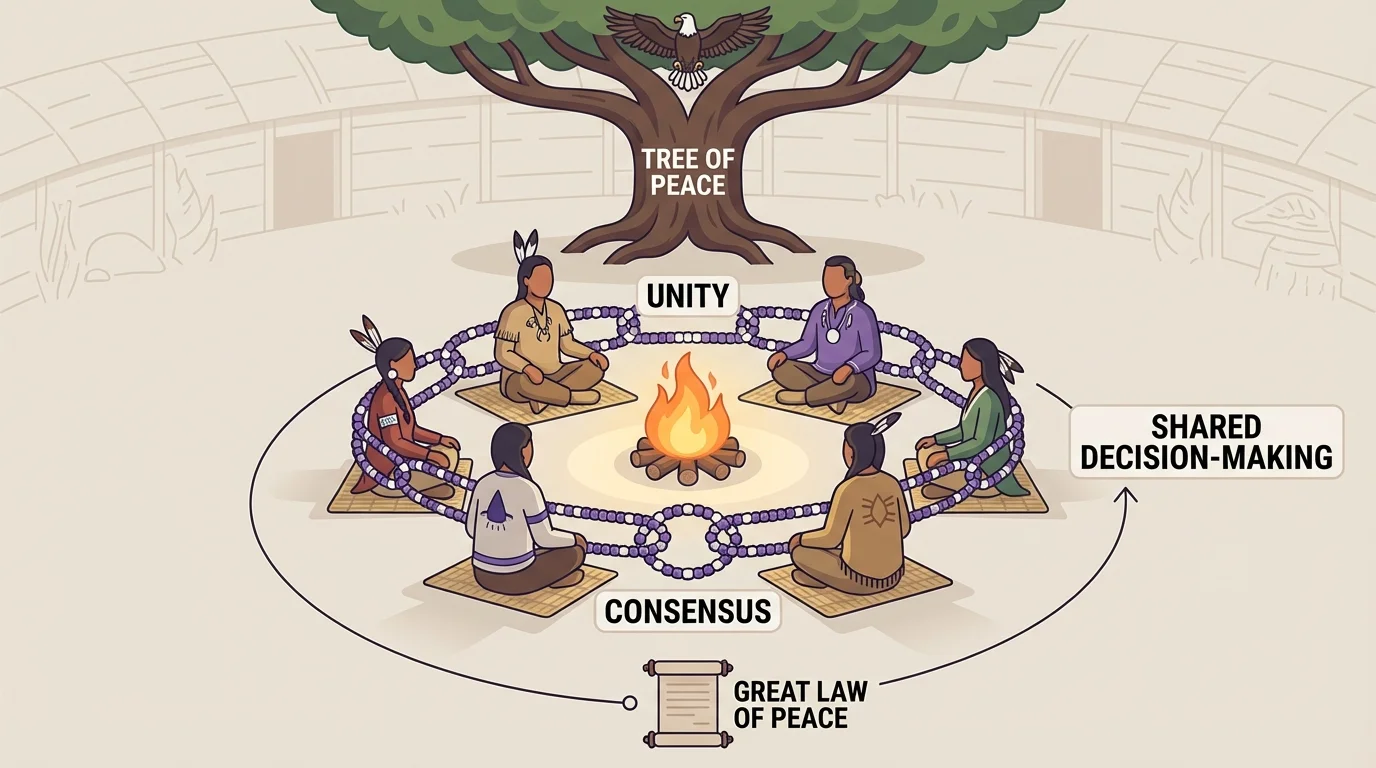
The Great Law of Peace also reminds us that founding documents are not just legal rules. They express values. In this case, those values included peace among nations, respect for process, and responsibility across generations. When modern Americans discuss constitutional principles, they are part of a much larger history of governance on this continent.
The idea of considering the welfare of future generations in political decision-making is often associated with Haudenosaunee traditions. That long-range way of thinking still influences modern discussions about environmental policy and public responsibility.
That broader perspective matters when evaluating government structures. A successful system must not only organize power for the present; it must also preserve stability and justice over time. The Great Law of Peace, like later constitutions, aimed to reduce conflict by making rules of decision-making clear.
By the mid-1700s, Britain's North American colonies were in growing conflict with imperial authority. The path toward independence, outlined in [Figure 2], was driven by arguments over taxation, representation, trade, military occupation, and self-government. Colonists increasingly believed that Parliament and the king were violating rights they considered fundamental.
Documents such as the Stamp Act Congress resolutions, colonial pamphlets, and statements from the Continental Congress helped define these grievances. Enlightenment thinkers, especially John Locke, shaped colonial arguments by promoting the ideas of natural rights and government by consent. Colonists claimed that legitimate government existed to protect life, liberty, and property. If it failed to do so, they argued, people had the right to resist.
The most famous result of this debate was the Declaration of Independence, adopted on July 4, 1776. Written primarily by Thomas Jefferson, with input from others including John Adams and Benjamin Franklin, it did several things at once. It announced separation from Britain, listed grievances against King George III, and stated universal political principles.
The Declaration begins with a powerful claim that all people are created equal and are endowed with unalienable rights, including life, liberty, and the pursuit of happiness. It argues that governments derive "their just powers from the consent of the governed." This is one of the clearest statements of popular sovereignty in political history.
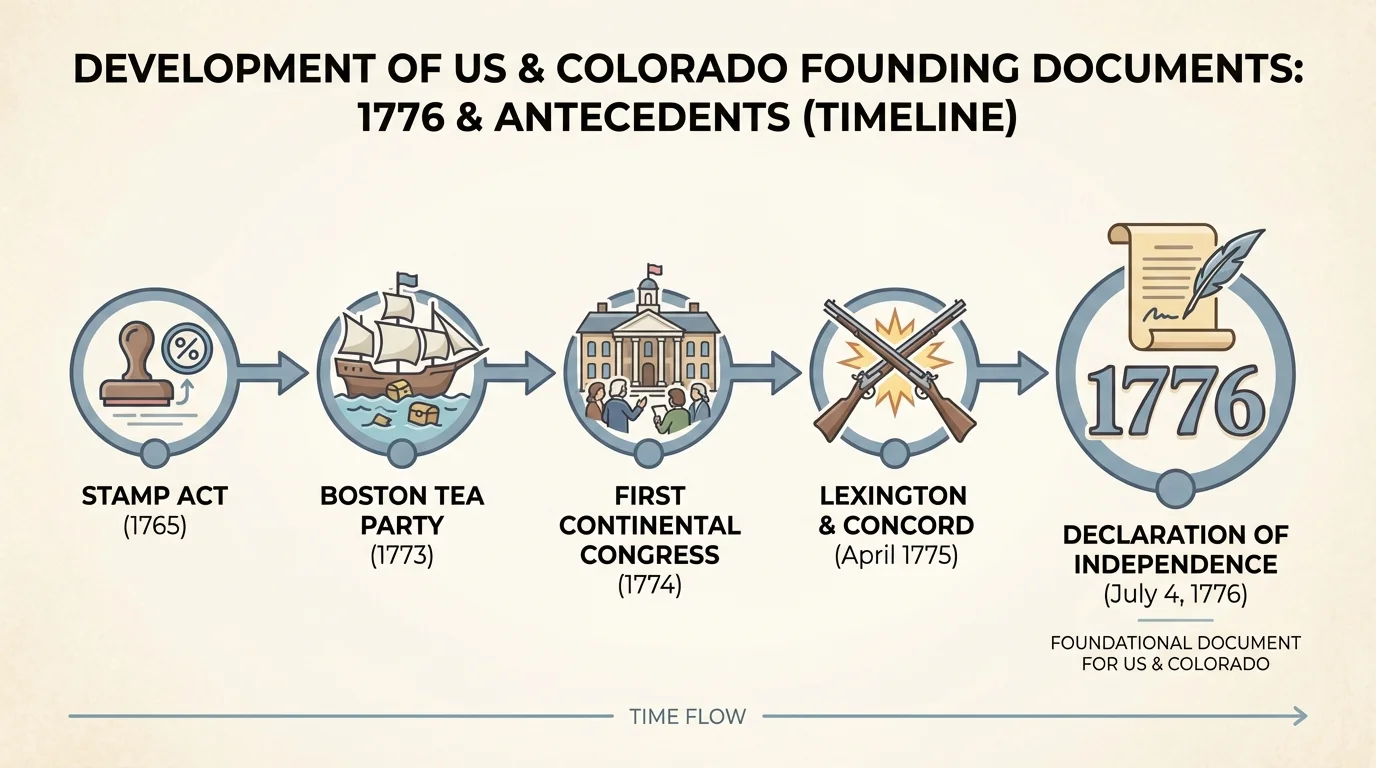
Yet the Declaration also reveals a major contradiction. It proclaimed equality while slavery continued, women lacked political rights, and Indigenous peoples were excluded from its promise. This gap between ideals and reality is one of the central themes of United States history. Over time, reformers, abolitionists, suffragists, civil rights activists, and others used the Declaration's own language to demand a more equal society.
"We hold these truths to be self-evident, that all men are created equal..."
— Declaration of Independence
Because of that contradiction, the Declaration is both inspiring and incomplete. It established ideals that continue to challenge the nation. When later generations fought for emancipation, voting rights, equal protection, and marriage equality, they often appealed to the Declaration's promises, even when those promises had not been fully honored at the start.
Winning independence did not solve the problem of how to govern. After the Revolution, the United States first operated under the Articles of Confederation, which created a weak national government. There was no strong executive, no national judiciary, and Congress lacked effective power to tax or regulate commerce. As [Figure 3] illustrates, the later Constitution created a much more structured system by dividing power among branches and between levels of government.
Problems under the Articles became clear quickly. The national government struggled to pay war debts, respond to economic instability, and coordinate the states. Events such as Shays' Rebellion in 1786–1787 convinced many leaders that reform was necessary.
At the Constitutional Convention in Philadelphia in 1787, delegates drafted the Constitution of the United States. This document remains the supreme law of the land. Its brilliance lies partly in its design: it gives government enough authority to function while trying to prevent tyranny.
The Constitution created three branches of government. The legislative branch makes laws, the executive branch enforces them, and the judicial branch interprets them. This system of checks and balances means that each branch can limit the others. Congress can pass laws, but the president can veto them. Courts can review laws for constitutionality. The Senate confirms many presidential appointments. Impeachment gives Congress power to remove federal officials in serious cases.
The Constitution also created federalism, which divides power between the national government and the states. National powers include coining money, conducting foreign policy, and regulating interstate commerce. States retain broad authority over matters such as education, local government, and many criminal laws. This division is not always neat, which is why conflicts over state and federal power continue today.
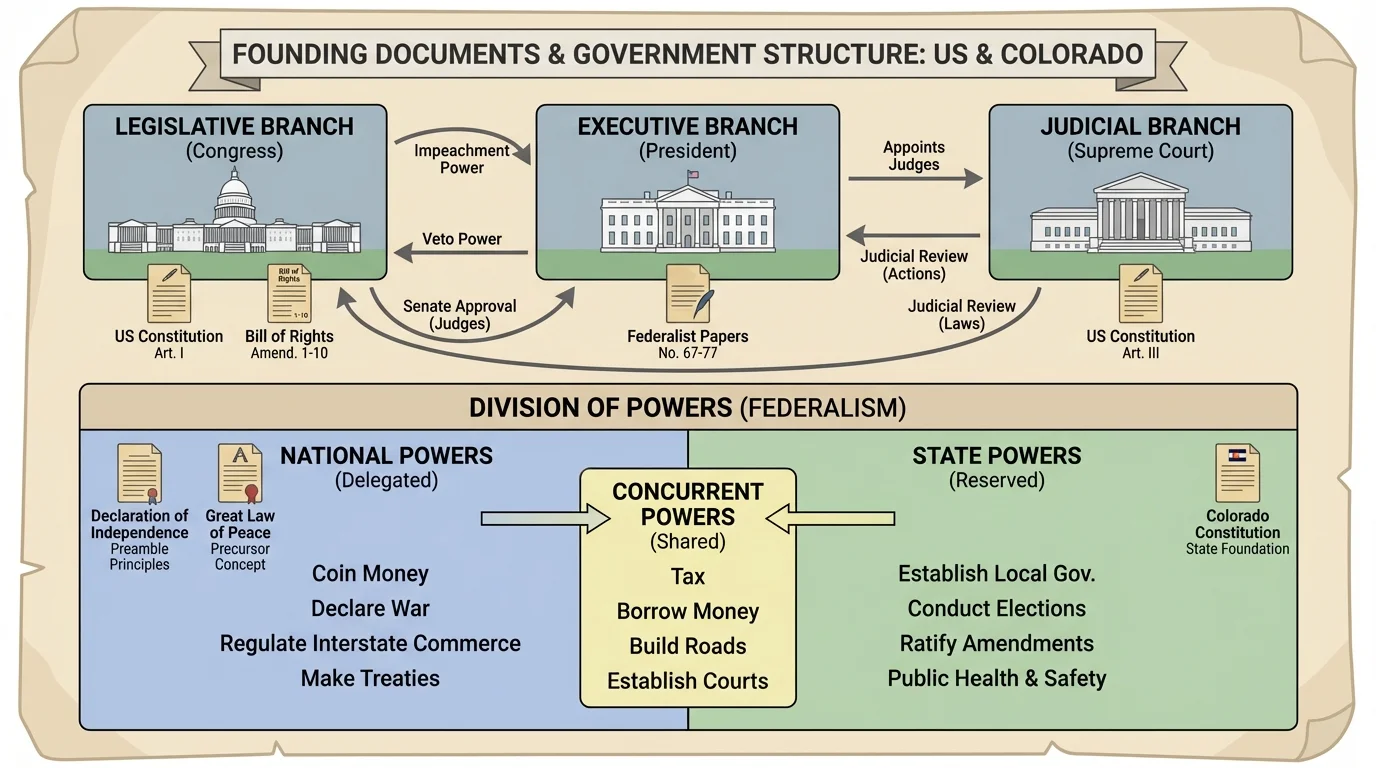
Another key feature is the amendment process. The Constitution is difficult, but not impossible, to change. That difficulty protects stability. At the same time, the ability to amend the Constitution allows growth. The document has endured because it combines permanence with flexibility.
Why the Constitution lasts
The Constitution survives not because it answers every question in exact detail, but because it establishes broad principles and structures. Phrases like "due process," "equal protection," and "freedom of speech" are general enough to apply to new circumstances, from radio to the internet, from paper searches to cell-phone data.
The Constitution's limitations are important too. It did not originally define every right clearly enough to satisfy its critics, and it tolerated slavery through several clauses and compromises. Its creation was a major achievement, but not a final answer to justice.
The Constitution did not become law automatically. It had to be ratified by the states, and that sparked a major public debate. The Federalist Papers were a series of essays written by Alexander Hamilton, James Madison, and John Jay under the name Publius. Their purpose was to persuade New Yorkers and others to support the Constitution.
These essays are important because they explain how the framers understood the new system. In Federalist No. 10, Madison argued that a large republic could better control factions, or groups driven by interests that might harm the common good. In Federalist No. 51, he explained why separating powers would help prevent tyranny, writing that "ambition must be made to counteract ambition."
Supporters of the Constitution, known as Federalists, believed the new government would be stronger, more stable, and better able to protect the nation. Opponents, known as Anti-Federalists, feared that national power would become too great and that individual liberties were not adequately protected.
The Anti-Federalists lost the ratification battle, but they won an important concession: many states demanded a bill of rights. In that sense, the debate itself strengthened the constitutional system. It forced supporters of the Constitution to address concerns about liberty and government overreach.
Historical case study: Why debate mattered
Ratification shows that founding documents are created through disagreement, not perfect unity.
Step 1: Federalists argued that the Articles of Confederation were too weak to preserve order and national survival.
Step 2: Anti-Federalists argued that the proposed Constitution could produce a distant and powerful central government.
Step 3: The compromise was political, not mathematical: states ratified the Constitution with the expectation that amendments protecting rights would follow.
This debate shaped the final meaning of the Constitution by leading directly to the Bill of Rights.
That pattern still appears in modern politics. Major constitutional questions are often clarified only after intense public disagreement. The founding era was not a moment of complete consensus; it was a contest over how liberty and power should coexist.
In 1791, the first ten amendments to the Constitution were ratified as the Bill of Rights. These amendments limit government and protect individual freedoms. They include freedom of religion, speech, press, assembly, and petition; protections for criminal defendants; and rules against unreasonable searches, cruel and unusual punishment, and deprivation of liberty without due process.
At first, the Bill of Rights applied mainly to the federal government. Over time, especially through the Fourteenth Amendment and Supreme Court decisions, most of these protections were applied to the states as well. This process dramatically expanded the practical reach of constitutional rights.
The Bill of Rights remains central to daily life. Students exercise First Amendment rights when expressing views, though schools may set some limits for safety and order. The Fourth Amendment matters when courts consider phone searches or digital privacy. The Sixth Amendment matters in criminal trials. The Eighth Amendment shapes debates over punishment and prison conditions.
Rights in the United States also developed through later amendments. The Thirteenth Amendment abolished slavery. The Fourteenth Amendment established birthright citizenship and equal protection of the laws. The Fifteenth, Nineteenth, Twenty-Fourth, and Twenty-Sixth Amendments expanded voting rights by race, sex, removal of poll taxes in federal elections, and age for adult citizens at eighteen.
| Document or Amendment | Main Purpose | Long-Term Importance |
|---|---|---|
| Bill of Rights | Protect core liberties and due process | Limits government power and safeguards freedom |
| Thirteenth Amendment | Abolish slavery | Transforms the legal meaning of freedom |
| Fourteenth Amendment | Citizenship and equal protection | Foundation for many modern civil rights rulings |
| Nineteenth Amendment | Voting rights regardless of sex | Expands democratic participation |
Table 1. Major constitutional protections and their lasting significance.
As we saw earlier with the Constitution in [Figure 3], structures of government matter because rights are protected not only by ideals but also by institutions. Courts, legislatures, executives, and voters all help determine whether rights are respected in practice.
Colorado became a state in 1876, the centennial year of American independence, which is why it is nicknamed the "Centennial State." Its Colorado Constitution established the framework for state government and reflected both national principles and state-specific concerns. As [Figure 4] shows, Colorado combines representative government with unusually strong tools of direct democracy.
Like the federal Constitution, Colorado's constitution creates legislative, executive, and judicial branches. It defines offices, powers, elections, taxation rules, education provisions, and local government arrangements. It also contains a declaration of rights that protects liberties within the state system.
One distinctive feature of Colorado government is the strong role of citizens in lawmaking through the initiative and referendum process. An initiative allows citizens to propose laws or constitutional amendments by gathering enough signatures to place measures on the ballot. A referendum allows voters to approve or reject measures. This gives Colorado residents direct influence beyond electing representatives.
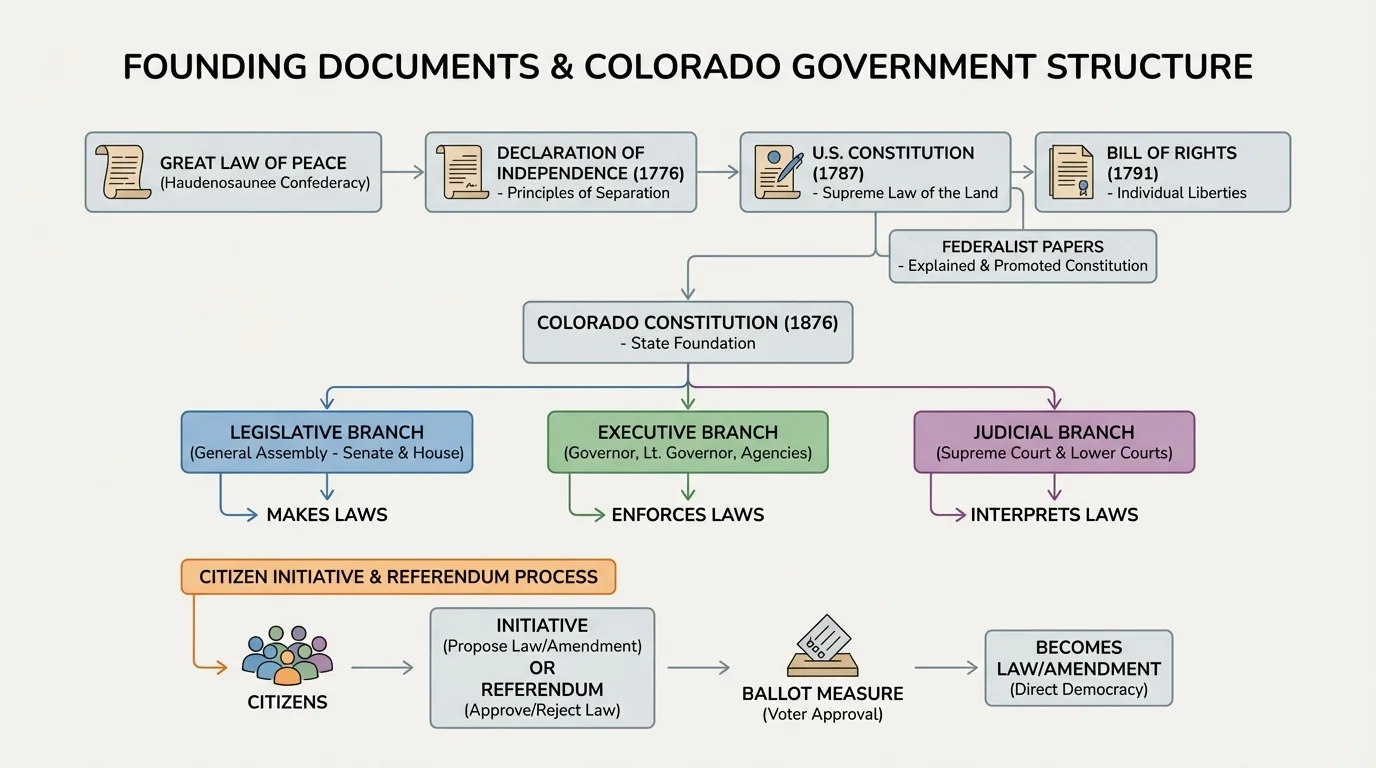
Colorado's constitution has been amended many times, far more often than the U.S. Constitution. That reflects one major difference between state and federal constitutions: state constitutions are usually longer and more detailed, and they are often easier to amend. This can make state government more responsive, but it can also make the document more complicated.
Colorado's constitution has addressed issues especially important to the state, including public lands, water, local control, education, taxation, and home rule for municipalities. In a state with mountains, rivers, mining history, agricultural needs, and rapid population growth, those topics are not abstract. They shape daily life, economic development, and environmental conflict.
State governments are not copies of the national government. They have their own constitutions, their own courts, and broad authority over many issues that affect everyday life, including schools, roads, local policing, and election administration.
The Colorado Constitution also shows the limits of founding documents. Detailed rules can solve immediate problems, but they can also become outdated. That is why amendment and interpretation remain so important. A constitution must provide stability without becoming too rigid to address new realities.
The U.S. Constitution and the Colorado Constitution share core ideas: popular sovereignty, separated powers, rights protections, and the rule of law. But they differ in scope and style. The national Constitution is shorter, older, and harder to amend. Colorado's is longer, more detailed, and more frequently revised.
| Feature | United States Constitution | Colorado Constitution |
|---|---|---|
| Level of government | National | State |
| Year adopted | 1787 | 1876 |
| Length and detail | Brief and general | Longer and more detailed |
| Amendment difficulty | Very difficult | Easier by comparison |
| Direct democracy | Limited | Strong initiative and referendum role |
| Main function | Organizes federal government and national rights | Organizes state government and state policy details |
Table 2. Comparison of the federal and Colorado constitutions.
These differences reflect purpose. A national constitution must hold together a very large and diverse union. A state constitution can address more local matters. That is one reason Colorado includes provisions that would seem too detailed for the federal Constitution.
Still, the two constitutions interact constantly. Colorado laws must comply with the U.S. Constitution because federal law is supreme. If a Colorado policy violates the federal Constitution, courts can strike it down. At the same time, Colorado can provide protections that go beyond the federal minimum in some areas, as long as it does not conflict with national law.
These documents are not relics. They shape modern controversies over free speech, gun regulation, religious liberty, privacy, voting access, immigration, education, campaign finance, and criminal justice. When citizens debate what government should do, they are often also debating how founding documents should be interpreted.
For example, the First Amendment applies to speech on digital platforms in complex ways because private companies and government actors are different under the law. The Fourth Amendment now raises questions about data, surveillance, and cell phones that the founders could never have imagined. Colorado ballot measures can change tax rules, ethics requirements, or social policy in ways that directly affect residents.
The Great Law of Peace also remains relevant as a reminder that democracy in North America has more than one intellectual origin. The Declaration remains a moral statement about equality and consent. The Constitution provides structure. The Federalist Papers provide interpretation. The Bill of Rights protects liberty. The Colorado Constitution adapts those ideas to state government and direct public action.
Living influence, not "living document" confusion
People often say the Constitution is a "living document." That does not mean the text changes by itself. It means its application develops through amendments, judicial interpretation, legislation, and social movements. The words remain, but society keeps testing what they require.
That continuing development is one reason civics matters. A free government depends on citizens who can read, question, and use its founding documents. Rights survive best when people understand both their value and their limits.
A clear timeline helps show how these documents build on one another rather than appearing in isolation. The Great Law of Peace predates the United States and demonstrates constitutional thinking before the republic. The Declaration of Independence announced principles of equality and consent in 1776. The Constitution created a stronger federal system in 1787. The Bill of Rights followed in 1791. Colorado's constitution entered that longer tradition when the state joined the Union in 1876.
Key figures include Haudenosaunee leaders and tradition-bearers connected to the Great Law of Peace; Thomas Jefferson, John Adams, and Benjamin Franklin for the Declaration; James Madison, Alexander Hamilton, and George Washington for the framing and defense of the Constitution; and later reformers such as Frederick Douglass, Susan B. Anthony, Ida B. Wells, Martin Luther King Jr., and many others who pushed the nation to apply its principles more fully.
Primary sources for this topic include the text of the Declaration of Independence, the U.S. Constitution, the Bill of Rights, the Federalist Papers, and the Colorado Constitution. Secondary sources include textbooks, historical essays, legal analysis, and scholarship about Indigenous governance and constitutional development. Studying both kinds of sources helps students separate what a document says from how historians interpret it.
As seen earlier in [Figure 2], founding moments usually emerge from crisis, while systems like those in [Figure 1] and [Figure 4] show that good government also depends on durable structures for participation and decision-making. That combination of ideals, institutions, and public action is the real story of these documents from their beginnings to the present.
