A war thousands of miles away can raise gas prices in the United States by the end of the week. A virus discovered in one country can close American schools, disrupt supply chains, and reshape debates over public health. A cyberattack launched from abroad can threaten hospitals, pipelines, or elections. These examples reveal a central truth of civics: the United States does not make policy in isolation. American government is deeply connected to a world where events cross borders faster than ever.
To understand modern government, students need to do two things at once. First, they need to analyze how world problems influence American decisions about security, trade, immigration, public health, and rights. Second, they need to compare the U.S. system with other systems of government. Different structures of power lead countries to respond in different ways. Some governments encourage public debate and elections. Others concentrate power in one ruler, one party, or a small elite.
[Figure 1] A global issue is a problem or challenge that affects multiple countries and often requires international cooperation. Examples include climate change, armed conflict, terrorism, refugee crises, pandemics, trade disruptions, energy shortages, and cyber threats. These issues matter to the United States because they affect both foreign policy and domestic life.
American policy is shaped by the fact that the U.S. economy, military, technology networks, and alliances are connected to the rest of the world. If major shipping routes are blocked, prices rise in American stores. If a hostile country expands its military power, U.S. defense policy may change. If another government violates human rights, American leaders may debate sanctions, diplomacy, or aid. Government structures exist to make these decisions, but they also place limits on how quickly or how far leaders can go.
Foreign policy is the strategy a country uses in dealing with other countries and international organizations. Domestic policy focuses on issues inside the country, such as education, health, transportation, and law enforcement. In practice, global issues often connect these two areas.
The purpose of government includes providing security, protecting rights, promoting the general welfare, and maintaining order. In a global age, each of those purposes is influenced by international events. That means civics is not only about what happens in Washington, D.C.; it is also about how world events push American institutions to act.
Several major issues shape U.S. choices at the same time. National leaders rarely face only one challenge; instead, they must balance security, economics, public health, and civil liberties all at once.
Armed conflict and security threats often have immediate effects on American policy. Russia's invasion of Ukraine led the United States to provide military and economic aid, strengthen cooperation with allies in the North Atlantic Treaty Organization, and reconsider energy and defense strategy. After the terrorist attacks of September 11, 2001, U.S. policy changed dramatically through new security laws, expanded surveillance, military action abroad, and the creation of the Department of Homeland Security.
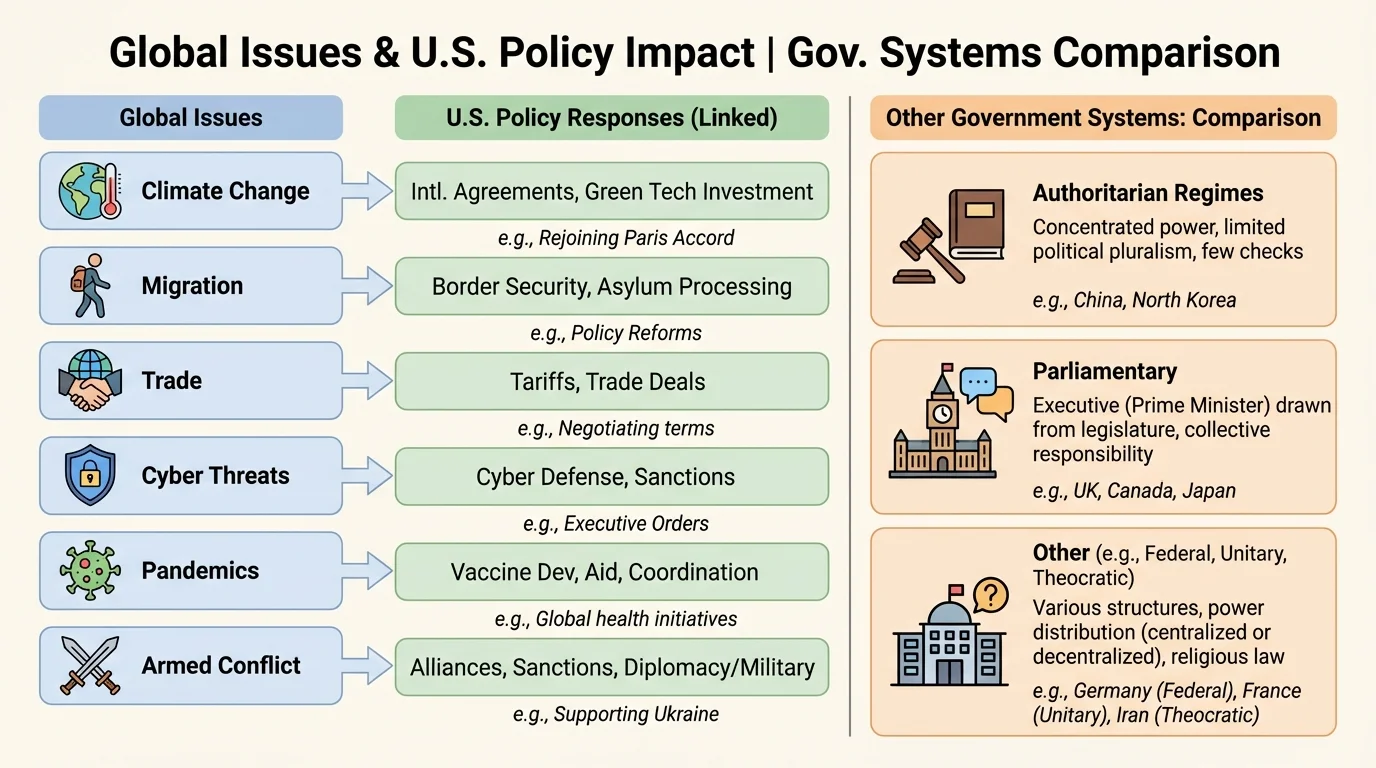
Trade and supply chains also shape policy. The United States depends on global markets for electronics, medicine ingredients, food, and energy. When factories shut down overseas during the COVID-19 pandemic, American businesses and consumers felt the impact. Debates over tariffs on Chinese goods, semiconductor production, and trade agreements show how economic competition abroad can change industrial policy at home.
Migration and refugee crises affect border policy, asylum law, and relations with neighboring countries. Violence, poverty, or political instability in Latin America, the Middle East, or Africa can lead people to flee their homes. American policymakers must decide how to enforce borders, process asylum claims, cooperate with other governments, and balance national security with humanitarian concerns.
Climate change influences energy, disaster planning, transportation, and diplomacy. Stronger storms, droughts, wildfires, and rising sea levels create pressure on federal, state, and local governments. The United States must decide how much to invest in clean energy, how to regulate emissions, and how to work with other countries on environmental agreements. Climate policy also affects jobs, industry, and national security, especially when resource shortages increase international tension.
Pandemics and global health remind citizens that disease does not stop at national borders. COVID-19 affected school systems, hospitals, travel, elections, and the economy. U.S. policy debates included vaccine distribution, emergency powers, federal and state responsibilities, and the balance between public safety and personal freedom. The same issue showed how scientific expertise, public trust, and governmental structure can influence outcomes.
Cybersecurity has become a major policy concern. A cybersecurity threat can target banks, utilities, transportation systems, or election infrastructure. Because private companies control much of the digital system Americans use every day, the federal government must work with business, intelligence agencies, and international partners to respond. This is a clear example of the limits of government: even powerful states cannot simply command every part of a modern networked society.
Human rights concerns also shape American responses. When governments imprison dissidents, restrict religious freedom, or censor the press, U.S. leaders may impose sanctions, issue public condemnations, or support international investigations. But here too, policy has limits. The United States may condemn abuses without being able to stop them quickly.
The same global event can push American policy in opposite directions. A war abroad might increase support for military spending, while also raising concerns about inflation and the cost of aid.
As seen earlier in [Figure 1], one global issue often affects several policy areas at once. A pandemic is not only a health problem; it becomes an economic, educational, and constitutional issue too.
[Figure 2] When the United States responds to a world problem, the decision does not come from one person alone. The process moves through multiple institutions, and each has powers, responsibilities, and limits.
The president plays a major role in foreign affairs. The president directs diplomacy, serves as commander in chief, negotiates with other countries, and can respond quickly in emergencies. Presidents often shape the public narrative around a crisis. However, presidential power is not unlimited. Congress controls funding, can declare war, approves treaties through the Senate, and oversees executive actions.
Congress makes laws, appropriates money, and represents different regions and interests. That means global issues often become domestic political debates. Lawmakers may disagree over military aid, trade rules, immigration policy, or public health funding. Because Congress is large and divided, it can slow action. At the same time, that slowness can protect against hasty decisions.
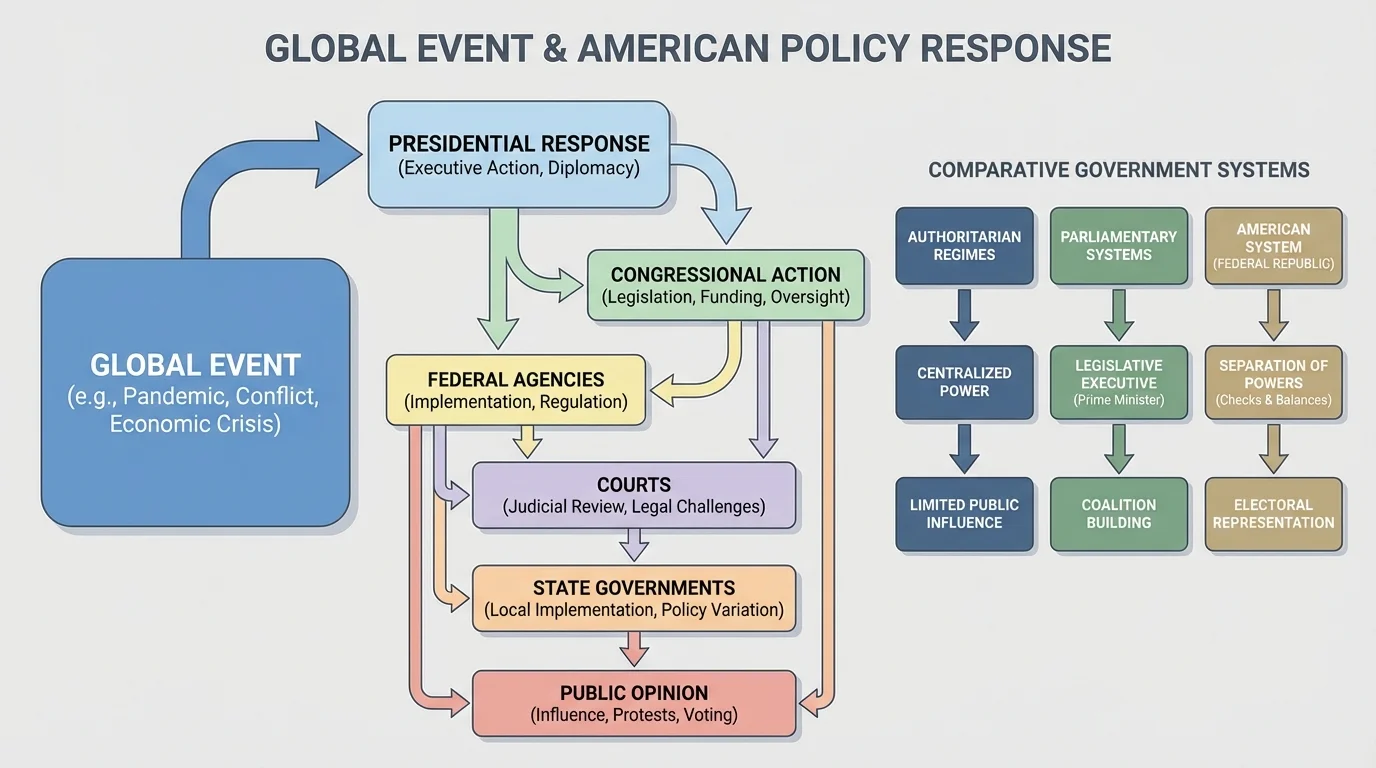
Federal agencies carry out policy. The Department of State handles diplomacy. The Department of Defense manages military operations. The Centers for Disease Control and Prevention provide health guidance. Intelligence agencies gather information about threats. These agencies have expertise, but they are still limited by law, funding, and public trust.
The courts also matter. If a policy appears to violate the Constitution, judges can review it. For example, immigration rules, emergency health measures, and surveillance programs may be challenged in court. This reflects a basic feature of American government: even in a crisis, leaders must still act within legal boundaries.
States and local governments matter as well. The United States is a federal system, meaning power is divided between national and state governments. During COVID-19, state governors made important decisions about school closures, business restrictions, and vaccine rules. During immigration debates, state officials sometimes cooperated with federal authorities and sometimes resisted them. Federalism can make policy more flexible, but it can also create inconsistency.
Public opinion, media coverage, and interest groups influence the process too. Citizens protest, vote, contact representatives, post online, and support advocacy organizations. In a democracy, the government must respond not only to events abroad but also to the beliefs and pressures of people at home.
Structures create both power and limits
American government is designed to avoid concentrating too much power in one place. That can be frustrating during fast-moving crises, but it also protects liberty. A system with checks and balances may act more slowly than an authoritarian government, yet it gives citizens more opportunities to question, challenge, and influence policy.
Looking back at [Figure 2], it becomes clear that a global problem becomes American policy only after passing through many layers of decision-making. This complexity is not accidental; it reflects constitutional design.
[Figure 3] The major systems of government differ most in who holds power, how leaders are selected, and what limits exist on authority. Comparing systems helps students see that government is not just about who is in charge; it is also about the rules that define how power works.
A democracy generally includes free elections, political competition, legal protections, and some degree of public participation. But democracies are not all organized the same way. Some use parliamentary systems. Others, like the United States, use presidential systems. Some are unitary, with power concentrated at the national level. Others are federal, dividing power among levels of government.
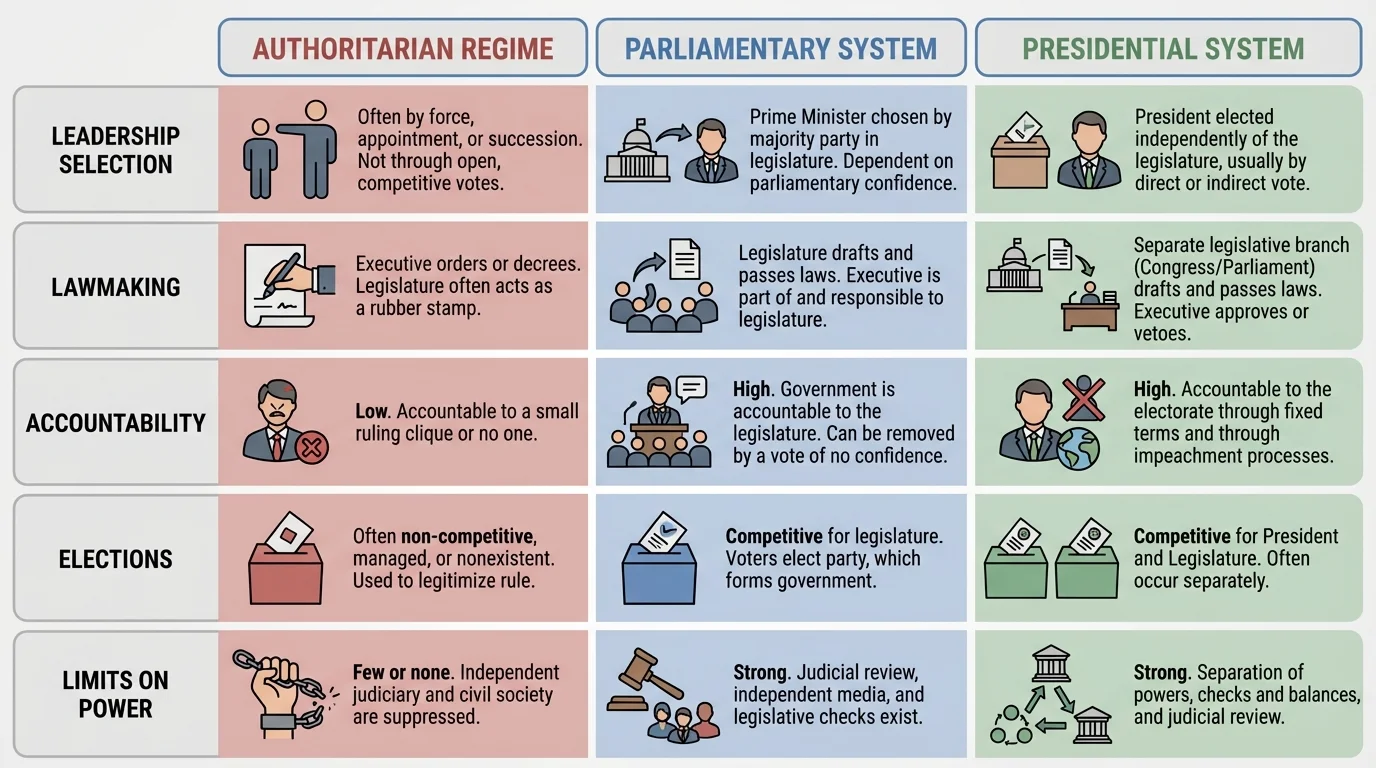
| System | How leaders are chosen | How power is organized | Main strengths | Main risks |
|---|---|---|---|---|
| Authoritarian | Leader or ruling group holds power with limited competition | Power is concentrated | Can act quickly and decisively | Abuse of power, weak rights, little accountability |
| Parliamentary | Voters elect legislature; legislature selects prime minister | Executive and legislative branches are closely linked | Efficient lawmaking, easier to replace failed leaders | Coalition instability, weaker separation of powers |
| Presidential | Voters elect president separately from legislature | Separation of powers | Strong checks and balances, stable fixed terms | Gridlock, slower action |
Table 1. Comparison of three major systems of government and their general characteristics.
No system is perfect. Every structure involves trade-offs between speed and debate, unity and representation, authority and liberty. That is why political scientists compare systems instead of assuming one arrangement solves every problem.
An authoritarian regime is a system in which political power is concentrated in one leader, one party, the military, or a small group, with limited political freedom and weak accountability. Elections, if they occur, may not be free or fair. Opposition parties are often restricted, and the press may be censored.
Authoritarian governments may appear efficient because they can make decisions quickly. They do not have to negotiate openly with a strong legislature, answer to an independent press, or tolerate broad protest. China's one-party system, for example, can mobilize large state resources quickly. Russia under Vladimir Putin has shown how centralized power can shape war policy, media narratives, and elections with limited public challenge.
However, fast action is not the same as good action. Authoritarian systems often suppress criticism, making it harder for leaders to hear accurate information. Without independent courts or free media, corruption and abuse may grow. Citizens may have fewer protections for speech, assembly, religion, or due process. In other words, the same concentration of power that allows speed can also threaten liberty.
Case study: Pandemic response under different systems
During a global health crisis, an authoritarian government may impose lockdowns rapidly and enforce them strictly.
Step 1: The central government identifies a threat and orders nationwide restrictions.
Step 2: Local authorities enforce the policy with little public debate.
Step 3: The policy may reduce spread quickly, but public data, criticism, or local concerns may be hidden or suppressed.
This shows why evaluating a government requires more than asking whether it acts fast. It also matters whether people can question the policy and whether rights are protected.
Authoritarian governments often claim that unity and stability are more important than open disagreement. Democracies generally argue the opposite: disagreement, though messy, is a necessary part of legitimate government.
[Figure 4] In a parliamentary system, voters elect a legislature, and the legislature then chooses the head of government. Parliament is the central institution, linking elections directly to the selection of the prime minister and cabinet.
In this system, the executive and legislative branches are fused rather than sharply separated. The prime minister is usually the leader of the majority party or coalition in parliament. If the government loses the support of parliament, it can be removed without waiting for a fixed presidential term to end. Countries such as the United Kingdom, Canada, Germany, India, and Japan use parliamentary systems, though each has its own variation.
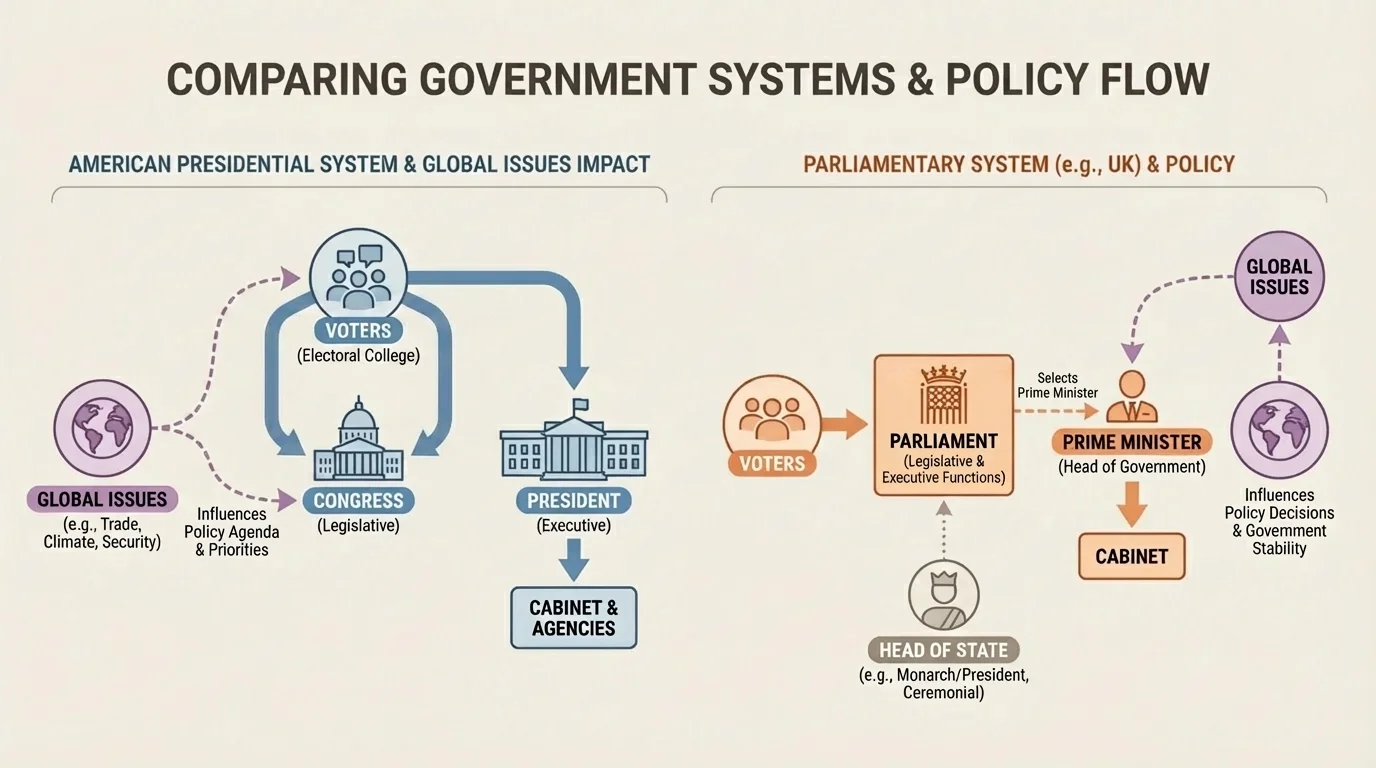
One strength of parliamentary systems is efficiency. If the executive and legislature are controlled by the same majority, laws can pass more quickly than in systems with strong separation of powers. This can help during economic crises or urgent policy debates. Parliamentary systems can also replace unpopular leaders more easily. A prime minister who loses confidence may be removed by a vote and replaced by someone else from the governing majority.
But parliamentary systems can also face instability, especially when no party wins a majority and a coalition government must be formed. Coalitions require compromise among multiple parties. That can broaden representation, but it can also cause fragile alliances and frequent elections. Israel and Italy have both experienced periods of coalition instability.
A parliamentary system may include a ceremonial head of state, such as a monarch or president, while the prime minister serves as the active head of government. This differs from the United States, where the president is both head of state and head of government.
Later comparison with [Figure 4] helps explain why parliamentary governments can often respond to legislative majorities more directly than presidential ones. The structure ties political survival to parliamentary support.
The United States uses a presidential system, in which the president is elected separately from the legislature. This creates a strong separation of powers among the executive, legislative, and judicial branches. The idea is not efficiency alone, but balance.
In the U.S. system, Congress writes laws, the president enforces laws, and courts interpret laws. Each branch checks the others. A president can veto legislation. Congress can override a veto, investigate the executive branch, and impeach officials. Courts can rule actions unconstitutional. This design aims to reduce the chance that one branch dominates the government.
The United States is also federal, meaning national and state governments both have real authority. This differs from a unitary system, where the central government holds most power and local governments mainly carry out national decisions. France is a classic example of a more unitary structure, though even unitary states can decentralize some powers.
The American system can make policymaking slower than in parliamentary or authoritarian systems. If different parties control Congress and the presidency, gridlock may occur. Gridlock means political institutions cannot easily agree on action. Students often notice this in debates over immigration reform, military aid, budgets, climate policy, or emergency spending.
The Constitution intentionally limits government power. Checks and balances, federalism, regular elections, and judicial review all exist to prevent concentrated authority, even when quick action might seem attractive.
Still, slowness can be a strength. Deliberation may prevent extreme decisions, protect minority rights, and force compromise. The challenge is that the same safeguards can frustrate citizens when problems feel urgent.
When global crises occur, different systems often respond in noticeably different ways. An authoritarian regime may act rapidly but hide information. A parliamentary government may pass policy efficiently if a majority supports it. A presidential system may move more slowly because of checks and balances, divided government, or court review.
Consider war policy. In authoritarian systems, military decisions may be made by a narrow elite with little public oversight. In parliamentary systems, support from the legislature is closely tied to support for the government itself. In the United States, the president may act quickly at first, but long-term military action usually depends on congressional funding and public support.
Consider economic crises. Parliamentary governments may pass emergency budgets quickly. Presidential systems may require negotiation across branches. Authoritarian systems may impose top-down controls, but citizens may have fewer ways to challenge unfair outcomes.
Consider rights and dissent. Democracies generally allow protest, criticism, and opposition organizing. Authoritarian governments often restrict those activities. This difference matters because citizens are not only subjects of policy; in democracies, they are participants in it.
"The accumulation of all powers, legislative, executive, and judiciary, in the same hands... may justly be pronounced the very definition of tyranny."
— James Madison
That warning helps explain why many democratic systems value limits on power, even though those limits can slow decision-making. Government must be able to act, but it must also be restrained.
Comparing systems of government is not just an academic exercise. It helps citizens judge how power works, how rights are protected, and how leaders should be held accountable. If students know the difference between a parliamentary vote of no confidence and an American impeachment process, or between a federal and unitary structure, they can understand news more clearly and evaluate claims more carefully.
Global issues will continue to test governments. Climate pressures may increase migration. Artificial intelligence may create new security and labor concerns. Competition between major powers may shape trade, technology, and military policy. As those issues develop, Americans will debate what government should do and what limits it must respect.
The most important civic question is not simply, "Can a government act?" It is also, "Who decides, under what rules, with what accountability, and with what effect on freedom?" That question connects current global issues to the deeper purposes, roles, and limitations of government itself.
