If you are pulled over on a highway, attend a public school, use a hospital, or work for a business, you usually assume one government is in charge. In parts of the United States, that assumption breaks down. In some places, three governments may all matter at once: a tribal government, a state government, and the federal government. Understanding how those governments relate to each other is one of the most important and most misunderstood parts of American civics.
Tribal governments are not clubs, charities, or local branches of state government. They are governments of Native nations with political authority over their people and territory. That fact changes how laws are made, how services are delivered, and how power is divided in the United States. For students studying civics, tribal governments reveal something essential: government in the United States is not only about the federal government and the states. It also includes Native nations whose authority existed before the United States itself.
When people talk about federalism, they usually focus on the division of power between the national government and the states. But the real picture is more complex. Tribal nations have a unique legal and political status. Their relationship with the United States is often described as nation-to-nation relationship, meaning tribes and the federal government deal with one another as political entities, not merely as private groups.
Tribal sovereignty means that tribal nations have the inherent right to govern themselves. Inherent means this authority does not come from a state government giving it to them; it exists because tribes were self-governing peoples before the United States was formed.
Jurisdiction means the legal authority to make, apply, and enforce laws in a particular place or over particular people.
This topic also matters because the past is still active in the present. Treaties signed generations ago, Supreme Court decisions, acts of Congress, and present-day agreements all influence who has authority over land, natural resources, policing, taxes, schools, and business development today.
A tribal nation is a Native people recognized as a political community with its own government. Tribal sovereignty, as shown in [Figure 1], exists within the larger constitutional system of the United States. That means tribes are not foreign countries in the ordinary international sense, but they are also not just another level of state or local government.
This is why the legal status of tribes can seem unusual at first. A tribe has powers of self-government, but those powers have been shaped and limited over time by federal law. States generally do not have automatic authority over tribal nations. Instead, the federal government usually has the primary outside relationship with tribes. This makes tribal governments a separate part of the American system.
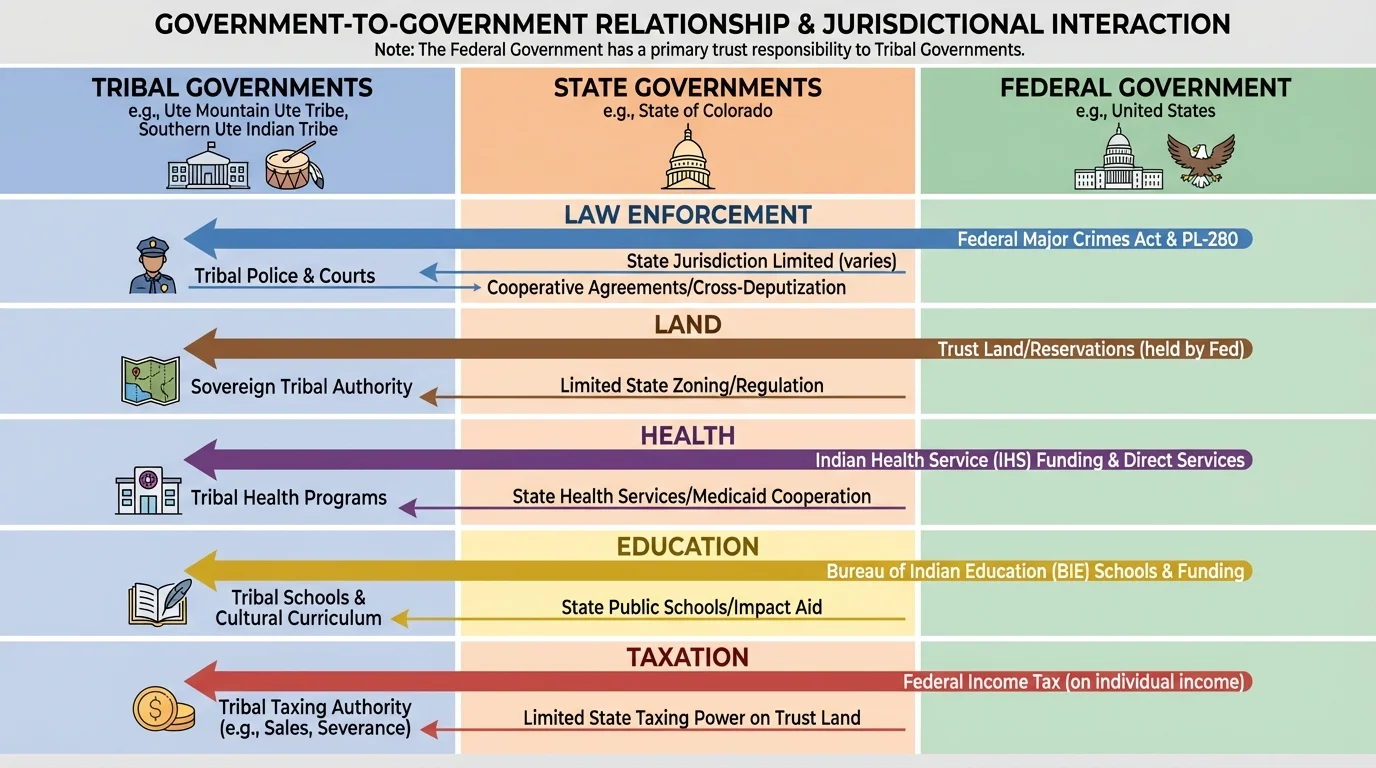
Tribal governments exercise authority in ways that may include passing laws, running courts, operating police departments, regulating businesses, managing housing, providing health and social services, preserving language and culture, and negotiating with other governments. Like state and federal governments, tribal governments balance public safety, economic development, and the rights of citizens.
Tribal sovereignty is sometimes misunderstood as meaning total independence from the United States. That is not correct. Tribes are often described by courts as "domestic dependent nations." This phrase reflects a paradox: tribes have real governmental authority, but that authority operates under a constitutional system in which Congress and the federal courts have claimed major power over Indian affairs.
Why sovereignty matters in practice
Sovereignty is not just a legal label. It affects who can arrest a suspect, who can issue a business permit, who can regulate hunting or water use, and who receives revenue from economic activity on tribal lands. Without understanding sovereignty, it is impossible to understand why tribal-state-federal disputes occur.
Even with limits, the central point remains: tribal governments are governments. They exist to protect the welfare of their citizens and to exercise self-rule over matters that belong to the tribe.
Tribal governments are not all organized in exactly the same way. Some have constitutions modeled partly on the United States system, while others incorporate traditional leadership practices alongside modern institutions. Many tribes have an elected tribal council, a chairperson or president, administrative departments, and tribal courts.
Like any government, a tribal government has structures and functions. It may make laws, enforce laws, interpret laws, and deliver services. It may oversee schools, environmental programs, health departments, housing authorities, and cultural preservation offices. Some tribes operate enterprises such as tourism businesses, energy projects, or agriculture. Revenue from these activities can help support tribal independence and public services.
As we saw earlier in [Figure 1], tribal powers overlap with state and federal concerns in some areas, but the source of tribal authority is different. A county government has powers delegated by a state. A tribal government's authority is tied to its status as a sovereign Native nation.
| Government | Main Source of Authority | Examples of Powers | Major Limits |
|---|---|---|---|
| Tribal government | Inherent sovereignty, treaties, federal recognition | Membership rules, tribal law, courts, services, land management | Federal law, court decisions, limits imposed by Congress |
| State government | State constitution and U.S. Constitution | Education policy, state roads, licensing, criminal law, taxation | U.S. Constitution, federal law, limits on authority in Indian Country |
| Federal government | U.S. Constitution and acts of Congress | Treaty obligations, Indian affairs, interstate issues, federal crimes | Constitutional limits, treaty commitments, political accountability |
Table 1. Comparison of the sources of authority, powers, and limits of tribal, state, and federal governments.
The relationship between tribal nations and the United States developed across changing historical periods, as [Figure 2] illustrates. In the early republic, the federal government often dealt with tribes through treaties. These treaties recognized tribes as political entities and often involved land cessions, promises of peace, and guarantees about territory or resources.
Over time, federal policy shifted. At different moments, the federal government tried to remove tribes from their lands, force assimilation, break up tribal landholdings, or reduce tribal authority. In the twentieth century, federal policy moved more strongly toward tribal self-government and self-determination, though not without contradictions.
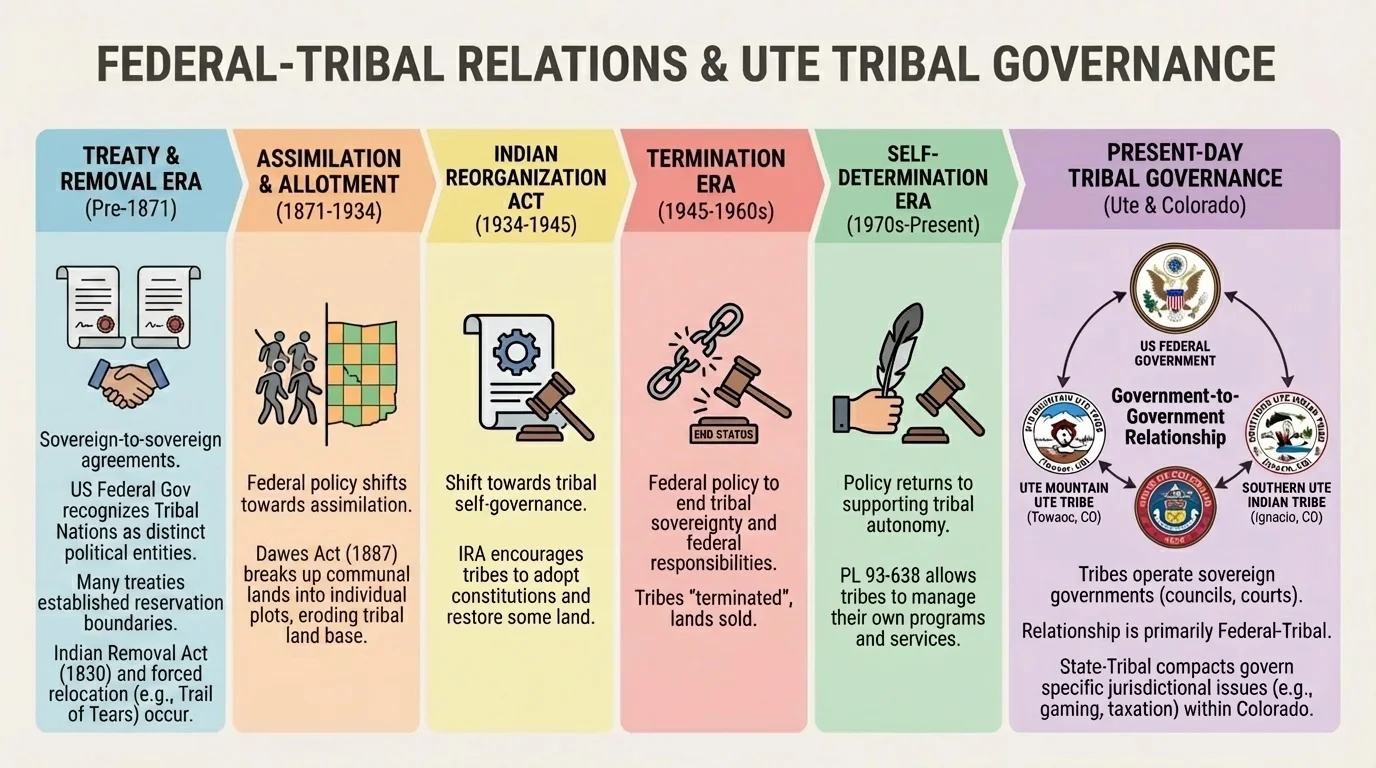
One key idea is the federal trust responsibility. This is the legal and moral obligation of the federal government to protect tribal lands, treaty rights, resources, and self-government. The trust responsibility is not always fulfilled well, and tribes have often had to fight in court or through politics to enforce it.
Congress plays a major role in Indian affairs. The Supreme Court has also shaped tribal powers through decisions about criminal jurisdiction, civil authority, taxation, and land status. Federal agencies, especially the Bureau of Indian Affairs, the Indian Health Service, and the Environmental Protection Agency, often interact directly with tribal governments.
The federal government's role is therefore both supportive and limiting. It may provide funding, recognize treaty rights, and support tribal programs, but it has also historically imposed rules and structures on Native nations. That tension is one of the defining features of tribal-federal relations.
Some major principles of federal Indian law come from Supreme Court cases decided in the early nineteenth century, and those rulings still affect governance today. That means legal ideas formed nearly 200 years ago continue to shape present-day questions about sovereignty and jurisdiction.
When students evaluate the purposes and limits of government, this relationship is a powerful example. The federal government is meant to honor obligations and provide a framework for tribal self-rule, yet it also has the power to interfere. That makes tribal-federal relations both protective and unequal at the same time.
State governments do not stand in the same legal position as the federal government when dealing with tribes. In general, states have less authority in Indian Country than they do elsewhere. This is because tribal sovereignty and federal supremacy in Indian affairs limit state power.
Still, states and tribes interact constantly. Roads cross reservation lands. Water systems connect communities. Students may attend schools off-reservation or on-reservation. Businesses serve both Native and non-Native customers. Police investigations may involve people from different jurisdictions. Because of this, tribes and states often sign agreements to coordinate policy.
Areas of interaction may include public safety, environmental protection, taxation, transportation, child welfare, emergency response, wildlife management, and economic regulation. Sometimes these relationships are cooperative. Sometimes they become legal disputes over who has authority.
Case study: why authority can be complicated
Suppose a business operates near reservation land and serves both tribal citizens and non-citizens.
Step 1: Officials ask where the activity takes place.
If it occurs on tribal land, tribal and federal law may be especially important.
Step 2: Officials ask who is involved.
The answer may differ if the people are tribal citizens, non-citizens, or a mix of both.
Step 3: Officials ask what kind of issue it is.
Taxation, environmental regulation, family law, and criminal law do not always follow the same jurisdictional rules.
That is why one event can involve more than one government, even though not all of them have equal power over the matter.
Many modern tribal-state relationships work best through negotiation rather than assumption. A state cannot simply act as if a reservation were ordinary state territory. Likewise, tribes and states often benefit from formal compacts and memoranda of understanding that clarify responsibilities.
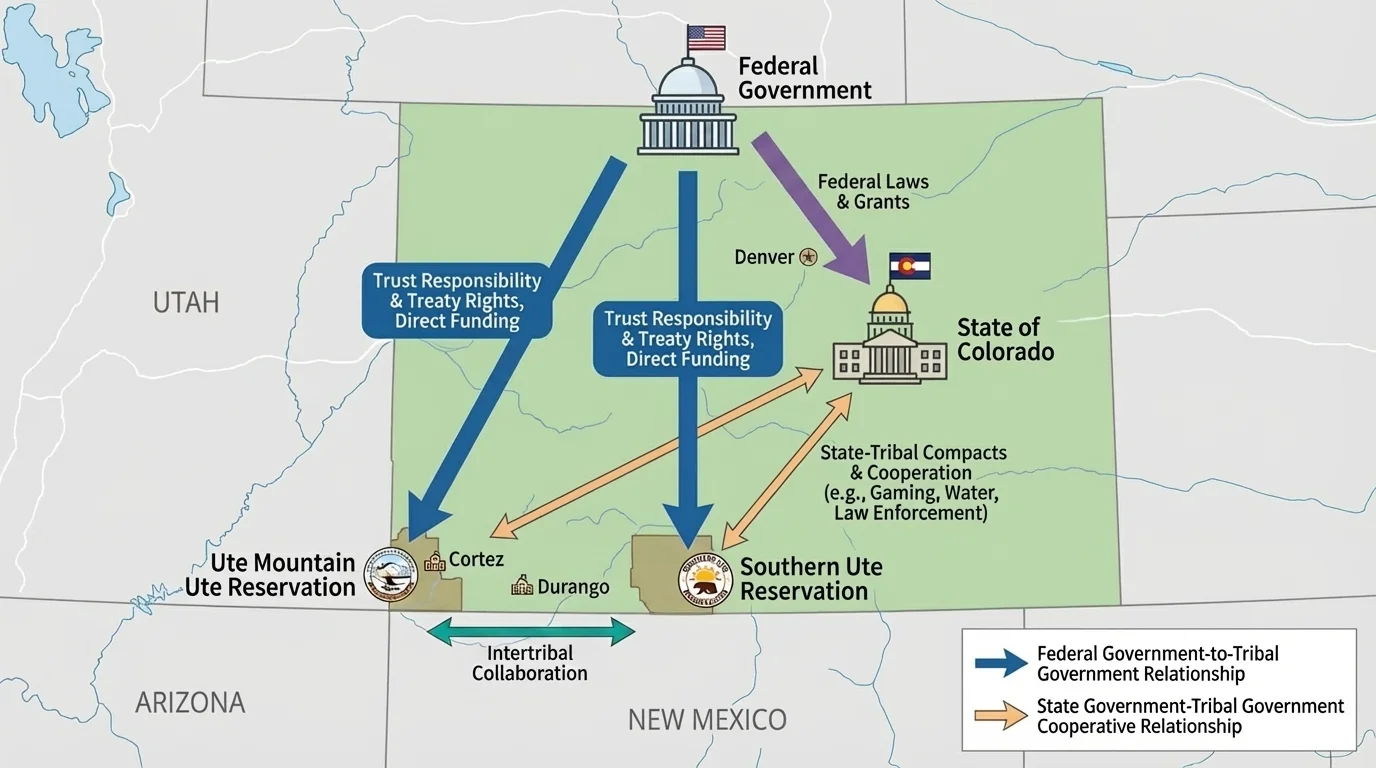
Colorado provides an important example because it is home to two federally recognized Ute tribes: the Ute Mountain Ute Tribe and the Southern Ute Indian Tribe. The geographic setting, shown in [Figure 3], matters because both tribes are located in southwestern Colorado, where tribal lands, county governments, state agencies, and federal lands all exist near one another.
The reservation of the Ute Mountain Ute Tribe includes land in Colorado, New Mexico, and Utah. That multi-state geography itself shows why tribal governance cannot be reduced to a single state relationship. The tribe governs its own affairs, but it must also interact with more than one state government and with the federal government.
The Ute Mountain Ute tribal government exercises authority over matters such as public services, land use, cultural preservation, and economic activity on tribal land. As with other tribes, federal recognition confirms the tribe's status in dealings with the United States, while state power remains limited by tribal sovereignty and federal law.
Colorado and the Ute Mountain Ute Tribe may cooperate on transportation, emergency services, environmental issues, and public safety. For example, road maintenance or law enforcement coordination may require tribal, county, state, and federal officials to share information. That does not erase sovereignty; instead, it shows how sovereign governments can cooperate.
The Ute Mountain Ute case also reminds students that tribal government is tied to community survival. Governance is not only about courts and permits. It is also about protecting language, traditions, sacred sites, and access to resources that support the tribe's future.
The Southern Ute Indian Tribe is also a sovereign government with its own institutions, laws, and programs. The tribe is well known for strong economic development, especially in energy and related business operations. This is a major civic point: economic power can strengthen political self-determination because it gives a government more resources to provide services and make independent decisions.
The Southern Ute tribal government interacts with the State of Colorado in many practical areas, including transportation, taxation agreements, environmental management, education, and policing. It also works directly with the federal government on land, energy, natural resource regulation, and trust-related issues.
Because natural resources are often involved, the Southern Ute case highlights how sovereignty connects to economics. Questions about drilling, pipelines, leases, or environmental standards are not just business questions. They are questions about which government has authority, how revenue is shared, and how the tribe protects its land and long-term interests.
"The power to govern includes the power to decide a community's future."
The Southern Ute Indian Tribe demonstrates that tribal governments are modern governments dealing with contemporary issues such as corporate management, environmental oversight, intergovernmental agreements, and infrastructure planning. This challenges the stereotype that tribal nations belong only to the past.
Looking back to [Figure 3], location helps explain why state and tribal cooperation in Colorado is so important. Shared roads, nearby towns, and overlapping economic activity make regular coordination necessary, even though the governments remain distinct.
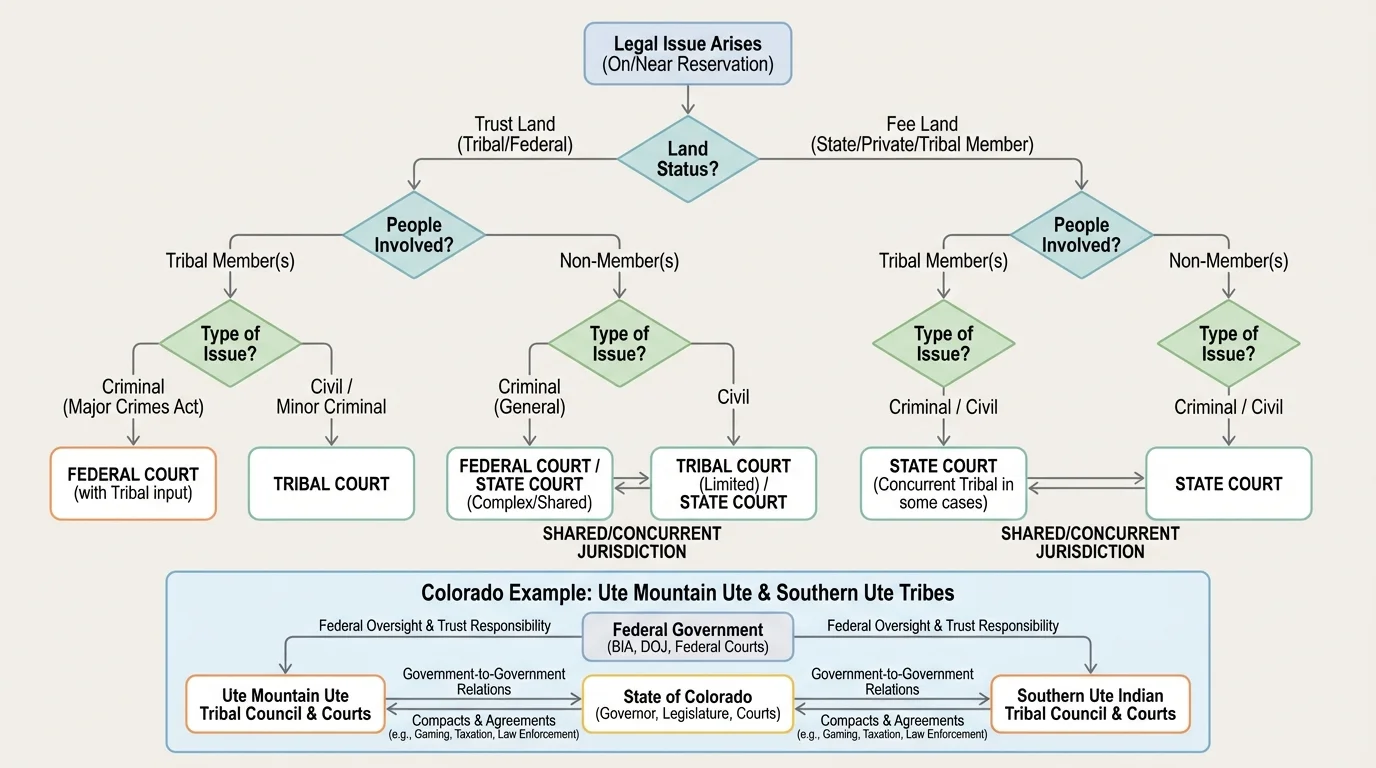
One of the hardest parts of this topic is jurisdiction, and the decision path in [Figure 4] shows why. A single incident may raise several questions at once: Where did it happen? Who was involved? Is the issue civil or criminal? Does federal law apply? These questions determine whether tribal, state, or federal authorities take the lead.
Criminal law is especially complex. In some situations, tribal police, county sheriffs, state police, and federal agents may all have roles, but not the same roles. The answer depends on the status of the land, the nature of the alleged crime, and the identities of the people involved. This complexity is one reason cross-deputization agreements and intergovernmental cooperation can be so important.
Taxation can also create disputes. A state may want to tax certain sales or activities, while a tribe may argue that taxation on tribal land interferes with self-government. Water rights and natural resource management are similarly important in the West, where access to land and water is tied to agriculture, energy, ecosystems, and cultural survival.
Education and health care show another side of the relationship. Tribal governments may run their own educational or health programs, but federal funding and state coordination can still matter. During emergencies such as wildfires, drought, or disease outbreaks, tribal, state, and federal governments often have to respond together.
Earlier civics study may have emphasized separation of powers and federalism. This topic adds another layer: not all governmental authority in the United States fits neatly into only federal, state, and local categories.
Cooperation does not mean equality of power in every situation. The federal government often has the strongest legal position in Indian affairs, while states may be excluded from areas where they would normally act elsewhere. Tribes therefore must defend sovereignty while also negotiating practical solutions with neighboring governments.
That complexity is clearer when you return to [Figure 4]. The flow of decisions is not confusing because the system is broken in every case; it is confusing because multiple governments with different legal foundations share the same civic space.
Studying tribal governments helps students evaluate the purposes, roles, and limits of government structures. A government exists to make rules, protect rights, deliver services, maintain order, and represent a political community. Tribal governments do all of these things. Their existence shows that sovereignty can be layered and historically grounded.
The topic also teaches an important lesson about limits. State governments are powerful, but their power is not unlimited. Federal power is broad in Indian affairs, but it is shaped by treaties, trust duties, and political accountability. Tribal governments have real authority, but they also face constraints created by history and federal law.
In a healthy civic system, governments should not simply compete for power. They should also cooperate where possible while respecting legal boundaries. The relationships among tribal, state, and federal governments therefore test whether a democracy can recognize distinct political communities without erasing them.
Today, debates continue over voting access, environmental regulation, public safety, energy development, land status, missing and murdered Indigenous persons, and the protection of sacred places. In each of these issues, the relationship among tribal, state, and federal governments affects real people's lives.
For Colorado, the Ute Mountain Ute and Southern Ute tribal governments are not distant examples from a textbook. They are active governments in the state's civic landscape. Their relationships with Colorado and the federal government shape policy, law, economics, and community life in the region.
When students understand these relationships accurately, they move beyond a simplified picture of American government. They see that the United States includes sovereign tribal nations whose rights, responsibilities, and governmental powers remain central to the country's constitutional and civic reality.
