One of the most important realities in American history is that some of the biggest changes in government policy did not begin inside government buildings. They began when ordinary people organized, marched, boycotted, testified, filed lawsuits, wrote letters, and refused to accept injustice as normal. Voting matters, but it is not the only way citizens influence government. In a democracy, people also shape public life through organized pressure, public persuasion, and collective action.
Civic participation includes the many ways people try to improve their communities and influence government decisions. Some forms are familiar, such as voting, contacting elected officials, or attending school board meetings. Other forms are more organized and more public, such as joining a professional association, supporting a civil rights campaign, participating in a protest, or working with a movement that seeks social change. These efforts can affect political institutions, public opinion, and public policy.
Governments do not act in isolation. Legislators, judges, agency officials, governors, mayors, and presidents respond to pressure from many directions. They hear from voters, business leaders, activists, unions, religious organizations, advocacy groups, and the media. When citizens organize effectively, they can place issues on the public agenda, expose injustice, and force institutions to respond.
Think about how trends spread today. A single video, speech, or testimony can quickly shape national debate. But lasting change usually requires more than attention. It requires organization, persistence, strategy, and a clear understanding of how government works. Civic participation becomes most effective when people know not only what they want to change, but also which institution has the power to make that change.
Interest group is an organized group that tries to influence government policy on behalf of a specific cause, industry, profession, or shared interest.
Social movement is a broader, often less formal effort by many people working together to create social or political change.
Public policy refers to the laws, regulations, decisions, and government actions used to address public issues.
Although interest groups and social movements are different, they often interact. A social movement may create public pressure, while interest groups translate that pressure into court cases, lobbying campaigns, or legislative proposals. In many cases, one without the other is less effective.
[Figure 1] compares interest groups and social movements. An interest group usually has a defined membership, leadership structure, funding base, and specific policy goals. It may represent workers, businesses, consumers, veterans, environmental advocates, or civil liberties supporters. Because it is organized, it often works directly with institutions: meeting lawmakers, monitoring legislation, submitting expert testimony, or filing legal briefs. Interest groups are often more formal and policy-focused than broader movements.
A social movement, by contrast, may include many organizations and individuals united by a common demand for change. It might not have one leader or one membership list. Instead, it builds energy through public action, shared identity, and moral arguments. Social movements often change what society considers acceptable, urgent, or just. They can influence culture and public opinion before laws change.
For example, a civil rights organization that challenges discriminatory laws in court acts like an interest group. A mass campaign against racial segregation that includes marches, churches, students, and local leaders acts like a social movement. The two can overlap strongly: one mobilizes people in the streets, while the other works inside institutions.
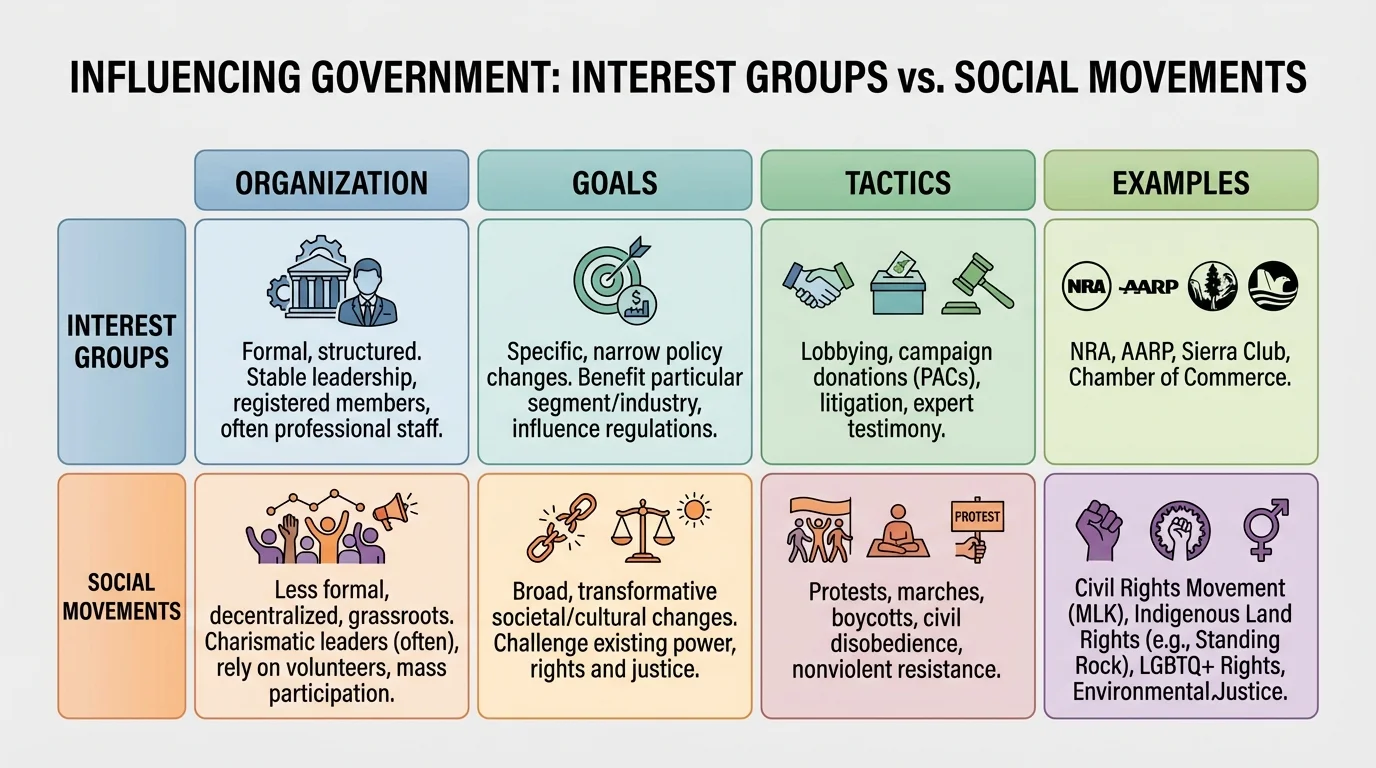
Both forms of participation matter because government is shaped by both expertise and pressure. Officials may respond to carefully researched policy proposals, but they may also respond to widespread protest, moral urgency, and public attention. In practice, successful change often combines both.
[Figure 2] Citizens have many opportunities to influence government through organized action. Some are direct and institutional. Others are public and persuasive. The choice of method depends on the issue, the political context, and the resources available.
One major tactic is lobbying, which means attempting to influence lawmakers or officials on specific policies. Lobbying can involve meetings, policy papers, testimony, and research. While wealthy groups often have an advantage here, lobbying is not limited to corporations. Civil rights groups, student groups, and nonprofit organizations also lobby.
Another tactic is litigation, or using the courts to challenge laws or government actions. Court cases can protect constitutional rights, clarify legal standards, and sometimes force governments to change policy. This strategy is especially important when elected officials refuse to act.
People also use petitions, public comment, media campaigns, protests, marches, strikes, boycotts, and voter registration drives. A boycott pressures businesses or public systems by refusing to buy or use services. A strike pressures employers by withholding labor. A march can dramatize injustice and attract national attention. Public testimony can persuade local officials in school boards, city councils, and state legislatures.
Coalition-building is another important opportunity. A single group may be ignored, but alliances among students, faith leaders, lawyers, workers, local communities, and national organizations can make a cause harder to dismiss. Coalitions expand resources, credibility, and public visibility.
Example: Different tactics for one issue
Suppose a community wants cleaner drinking water and stronger regulation of industrial pollution.
Step 1: Residents gather evidence
They document contamination, collect testimony, and consult scientists and lawyers.
Step 2: They use institutional channels
They attend hearings, submit public comments, and lobby state lawmakers for stricter regulations.
Step 3: They build public pressure
They organize rallies, contact journalists, and spread information through social media.
Step 4: They use the courts if necessary
If officials fail to enforce the law, they may support a lawsuit.
This example shows that effective civic participation often combines inside strategies and outside pressure.
Not every tactic works equally well in every situation. A highly technical policy may be influenced most by expert testimony and legal arguments. A deeply rooted injustice may require public protest to break through indifference. The central point is that people have multiple avenues for participation beyond casting a ballot.
Political institutions rarely change because of one action alone. Change often moves through several stages: citizens raise an issue, organizations amplify it, media attention expands it, and government bodies decide whether to legislate, regulate, negotiate, or resist. Understanding this process helps explain why some movements succeed gradually rather than instantly.
Legislatures can pass laws, hold hearings, investigate problems, and allocate funding. Executive officials can enforce laws, issue regulations, or use federal authority to protect rights. Courts can strike down unconstitutional laws or require fairer treatment. Local governments can adopt policies that later influence state or national action.
Public opinion matters because elected officials care about support, opposition, and reputation. Media coverage can make a local issue national. At the same time, institutions can be slow, divided, or resistant. A movement may win public sympathy long before it wins legal reform.
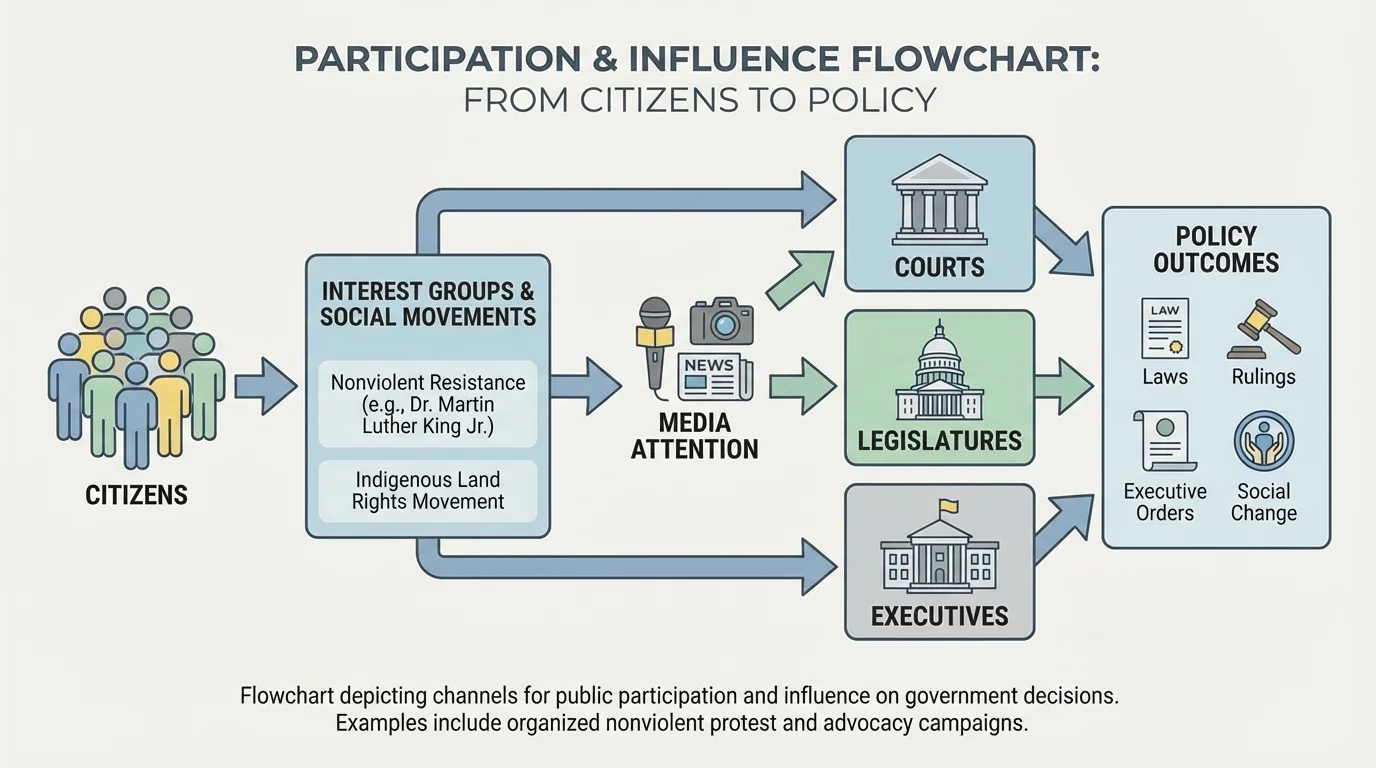
This is why strategic planning matters. A group may ask: Should we pressure Congress, challenge a law in court, push a city council, or appeal directly to the public? The answer depends on where power is located and what kind of change is possible.
[Figure 3] The struggle against segregation under the Jim Crow laws provides one of the clearest examples of how people can influence government through social movements and organized civic action. Jim Crow laws and customs enforced racial segregation and inequality, especially in the South, limiting access to education, transportation, housing, voting, and equal treatment under law.
Dr. Martin Luther King Jr. became one of the most important leaders of the civil rights movement by championing nonviolent resistance, a strategy that rejected physical violence while actively confronting injustice. The sequence of major campaigns and policy responses shows that nonviolent action was not passive. It was disciplined, organized, and designed to create moral and political pressure.
King drew on Christian ethics, democratic ideals, and the example of Mohandas Gandhi. He argued that unjust laws should be challenged through civil disobedience, peaceful protest, and public sacrifice. The goal was not simply to protest unfair treatment. It was to reveal injustice so clearly that the broader public and the federal government could no longer ignore it.
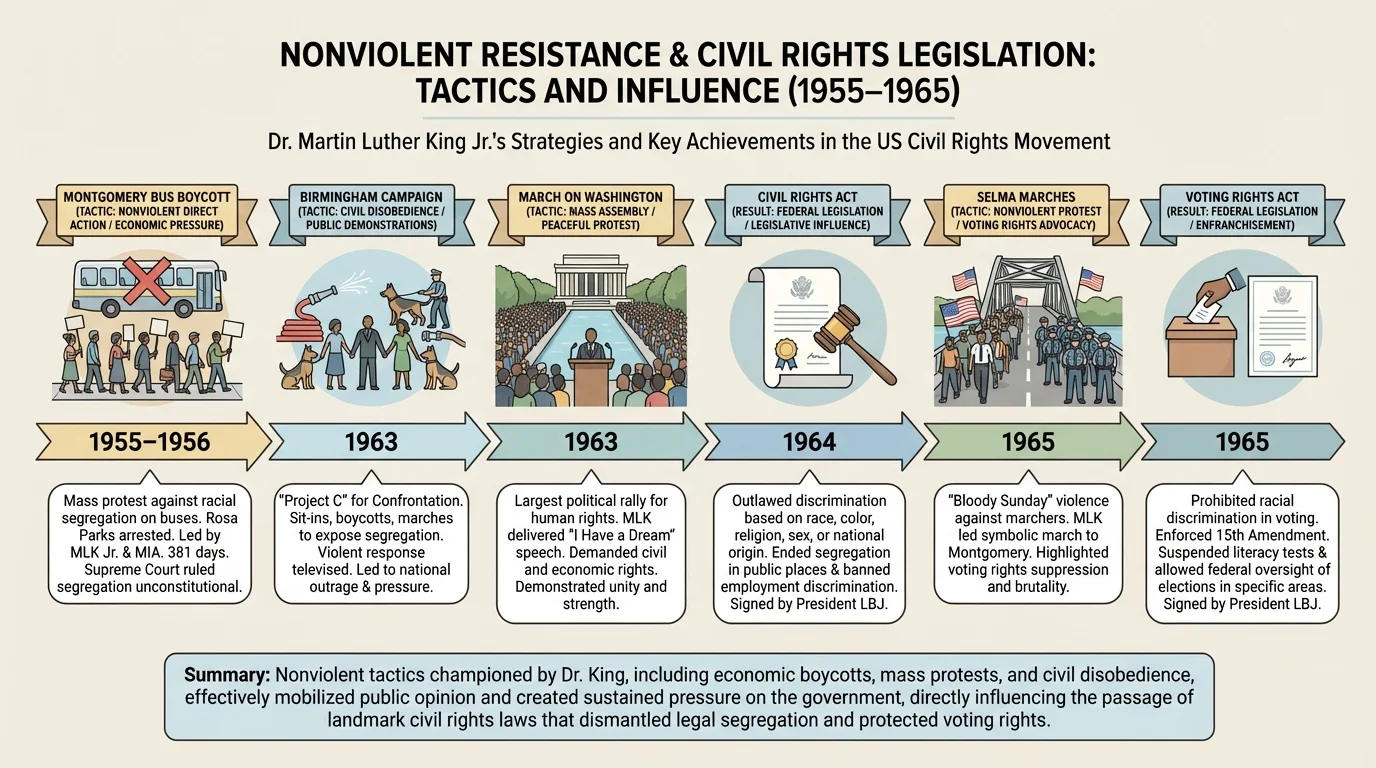
A classic example is the Montgomery Bus Boycott of 1955–1956. After Rosa Parks was arrested for refusing to surrender her bus seat to a white passenger, Black citizens in Montgomery organized a boycott of the city bus system. This was economically powerful because the system depended on their ridership. It was also politically powerful because it showed discipline, solidarity, and endurance. The boycott lasted more than a year and ended after the Supreme Court ruled bus segregation unconstitutional.
Another major example is the Birmingham Campaign in 1963. Activists used marches, sit-ins, and boycotts to confront one of the most segregated cities in America. Violent responses from local authorities, including police dogs and fire hoses, were seen on television across the nation. That mattered enormously. Nonviolent protesters exposed the brutality of segregationists, shifting public opinion and increasing pressure on national leaders.
The March on Washington in 1963 combined symbolism, coalition-building, and moral appeal. It brought together civil rights organizations, labor groups, faith communities, and ordinary citizens. King's "I Have a Dream" speech became famous, but the march also had concrete political goals, including support for civil rights legislation.
"Injustice anywhere is a threat to justice everywhere."
— Dr. Martin Luther King Jr., Letter from Birmingham Jail
King's Letter from Birmingham Jail defended civil disobedience against critics who urged patience. He argued that waiting often meant accepting injustice indefinitely. This is a key insight in the study of civic participation: institutions do not always correct injustice on their own. Sometimes citizens must force moral and constitutional questions into the open.
The Selma to Montgomery marches in 1965 focused on voting rights. Peaceful demonstrators demanding equal access to the ballot were attacked, and the violence shocked the nation. As the pattern shown earlier in [Figure 2] illustrates, public action, media coverage, and institutional response interacted. The marches helped build support for the Voting Rights Act of 1965.
These campaigns reveal several strengths of nonviolent resistance. It can attract broad support, expose unjust repression, claim the moral high ground, and make violent opposition politically costly. It can also encourage participation by people who might not join an armed struggle. However, nonviolence requires training, discipline, organization, and willingness to endure arrest, intimidation, and violence without retaliation.
Primary sources from the era, such as King's speeches, letters, photographs, television footage, court opinions, and newspaper coverage, show how movement strategy and public reaction developed over time. Secondary sources by historians help explain why these actions affected federal policy when many earlier appeals had failed.
Indigenous land rights movements show another powerful way people participate in and influence government. These movements seek recognition of treaty rights, protection of sacred places, return of land, environmental justice, and respect for Indigenous sovereignty. Because land is tied to culture, identity, law, and survival, these movements are both political and deeply personal. Their connection to particular places is clear when activism is linked to geography and treaty history.
[Figure 4] In the United States, many Indigenous land claims are connected to treaties made with the federal government. Tribal nations have often argued that the government violated those treaties, seized land unfairly, or approved development without proper consent. Activists therefore use multiple strategies: court cases, negotiations, direct action, public education, alliances with environmental groups, and appeals to international law.
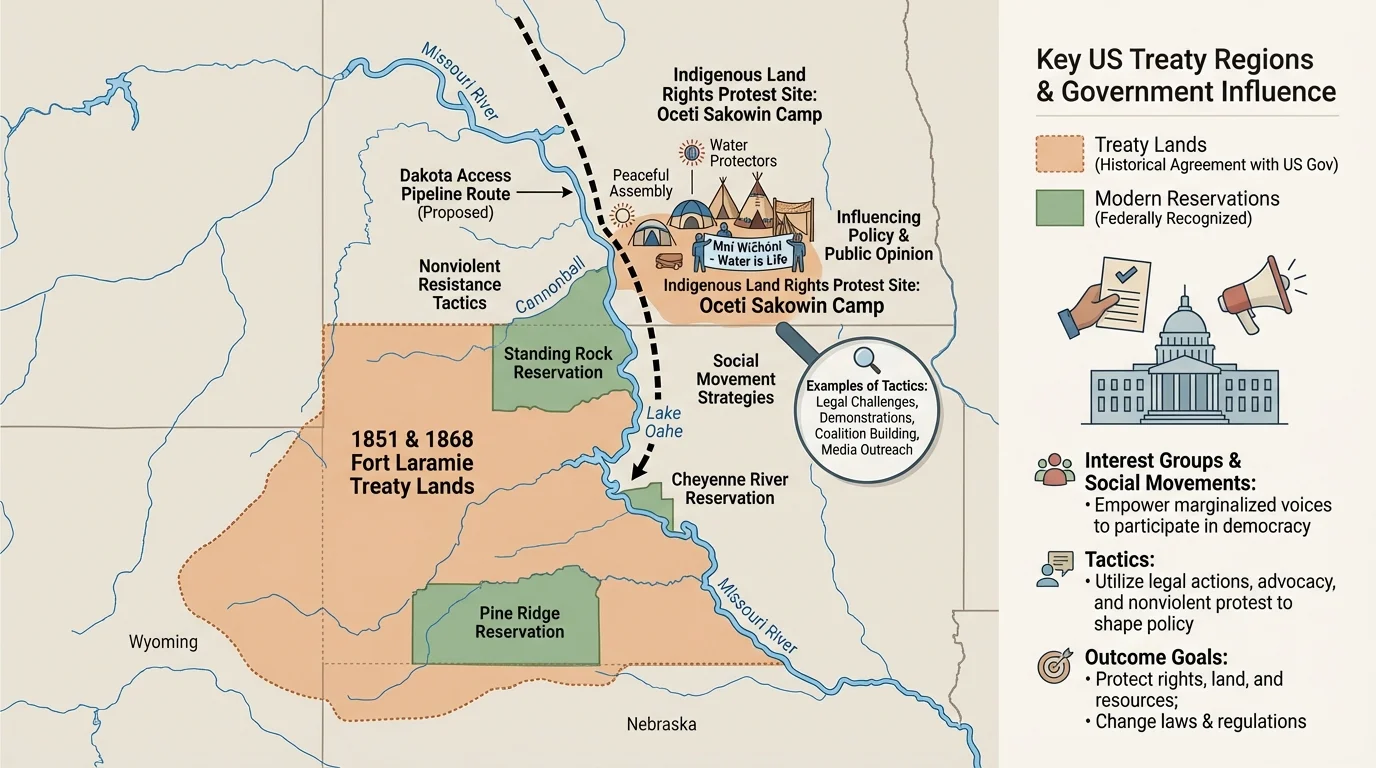
One widely known example is the movement at Standing Rock in 2016, where the Standing Rock Sioux Tribe and supporters opposed the Dakota Access Pipeline. Protesters argued that the pipeline threatened water sources and sacred lands and that consultation with the tribe had been inadequate. The movement used camps, legal challenges, media outreach, and coalition-building. Thousands of supporters, including many non-Indigenous allies, brought national and international attention to the issue.
Another important area of Indigenous activism involves legal cases over fishing rights, land use, and treaty enforcement. In the Pacific Northwest, for example, tribal nations fought for recognition of treaty-protected fishing rights. Court victories helped confirm that treaty promises had continuing legal force. This shows how litigation can become a form of civic participation that protects both rights and cultural survival.
Indigenous land rights movements also appear beyond the United States. In countries such as Canada, Australia, and New Zealand, Indigenous communities have pressed governments to recognize ancestral land, provide restitution, and respect self-determination. While legal systems differ, a common pattern appears: organized communities combine moral arguments, historical evidence, legal claims, and public action to influence institutions.
Why land rights movements are distinctive
Many social movements ask government to create new protections. Indigenous land rights movements often also ask governments to honor older promises that were ignored or broken. That means these movements are not only about change in the future; they are also about justice for the past and legal obligations in the present.
These movements can be effective because they connect local experience to larger constitutional and human rights principles. They also face serious barriers, including limited media attention, economic pressure from powerful industries, and long legal battles. Even when a movement does not win every demand immediately, it can still influence public debate, delay harmful actions, and build long-term political power.
It is important to evaluate opportunities for participation realistically. Civic action can produce major change, but it does not guarantee success. Some groups have more money, media access, legal support, and political influence than others. Marginalized communities may face surveillance, intimidation, discrimination, or violence.
Interest groups can be effective because they are organized, informed, and persistent. But they can also reflect unequal access to power. A wealthy industry group may hire professional lobbyists and lawyers more easily than a low-income community can. Social movements can energize public participation and challenge injustice, but they may struggle with coordination, internal disagreements, or repression.
Backlash is another reality. A movement may gain attention but also provoke resistance from opponents who feel threatened by change. During the civil rights movement, nonviolent protesters faced arrest, beatings, bombings, and political obstruction. Indigenous activists have also faced forceful responses and efforts to discredit their claims. Evaluating civic participation means recognizing both courage and cost.
Television played a major role in the civil rights era because it brought scenes of segregation and violence into living rooms across the country. Public opinion shifted not only because people heard arguments, but because they saw injustice unfold in real time.
Still, history shows that organized participation matters even when progress is slow. Laws can change, court doctrines can evolve, and public expectations can be transformed. The civil rights movement reshaped federal policy. Indigenous land rights activism has expanded public understanding of treaties, sovereignty, and environmental justice. In both cases, persistent participation affected institutions that once seemed unmovable.
For students, the most important lesson is that government is not influenced only by elected officials. It is also influenced by organized people. Effective participation begins with knowledge: understanding the issue, identifying the relevant institution, gathering evidence, and choosing strategies that match the goal.
Responsible civic action should also be ethical. It should respect constitutional principles, seek accurate information, and distinguish peaceful protest from intimidation or misinformation. In democratic life, persuasion is strongest when it combines moral clarity with factual credibility.
When we look back at the campaigns led by King, or at Indigenous communities defending land and treaty rights, we see that civic participation is not a side activity. It is one of the main ways democracy corrects itself. The contrast introduced earlier in [Figure 1] still matters here: some people influence government through formal organizations, while others do so through broad popular movements. The most powerful moments often occur when both work together.
That is why studying civic participation is ultimately about power, responsibility, and citizenship. People who understand how to organize, persuade, and persist are better able to defend rights, challenge injustice, and help shape public policy.
