Two people can both be called citizens and still live in political worlds that feel completely different. One may criticize leaders online, join a protest, vote in competitive elections, and organize a community campaign without fear. Another may be expected to obey the state, join approved organizations, and express loyalty publicly, while criticism brings censorship, arrest, or worse. Studying civic life across systems of government reveals a powerful truth: citizenship is not just a legal label. It is shaped by the rules, institutions, and freedoms of the political system people live under.
Every government claims some level of authority over the people who live under it, but governments do not all distribute power in the same way. In some systems, the people are treated as the main source of political authority. In others, power is concentrated in a ruling party, a monarch, military leaders, or a small elite. Because of that difference, the ways people exercise rights and carry out responsibilities can vary widely.
In general, civic rights include protections and freedoms that allow people to take part in public life. These may include voting, free speech, freedom of religion, freedom of assembly, access to courts, and the right to organize with others. Civic responsibilities are duties that help a society function, such as obeying laws, paying taxes, serving on juries where required, staying informed, respecting others' rights, or contributing to community problem-solving.
Civic rights are the political and civil freedoms that allow people to participate in public life and protect themselves from government abuse.
Civic responsibilities are the duties citizens are expected to fulfill in order to support their community and government.
Political institutions are the formal structures of government, such as legislatures, executives, courts, parties, and bureaucracies, through which power is exercised.
Even when the same words are used across countries, their meaning may differ. A constitution may promise freedom of speech, but independent courts and a free press are often needed to protect that promise. A government may hold elections, but if opposition candidates are harassed or the media is controlled, voting does not function in the same way it does in a more open system.
To understand how people participate, it helps to see the connection between citizens and institutions. Political institutions turn public demands into rules, policies, and decisions. Legislatures pass laws. Executives enforce them. Courts interpret them. Local governments manage services. Political parties organize support and competition. When people participate, they try to influence these institutions directly or indirectly.
This influence can take different forms. Citizens may choose leaders through elections, pressure lawmakers through petitions, challenge government actions in court, expose corruption through journalism, or organize campaigns through civil society groups. In restrictive systems, citizens may still seek influence, but often through quieter methods: informal networks, coded online speech, community-based problem solving, or negotiation with local officials instead of open protest.
Participation and public policy
Civic participation matters because institutions respond differently depending on how power is distributed. In open systems, broad participation can change laws, budgets, and leadership. In more restrictive systems, participation may shape policy only when it does not threaten the ruling group, or when leaders believe reform is necessary to maintain stability. This means the same action, such as signing a petition, can be routine in one country and risky in another.
That is why civic participation should not be measured only by whether people vote. A society may have high voter turnout but little real competition. Another may have lower turnout but stronger protections for criticism, organizing, and legal challenge. Looking at the full set of rights and responsibilities gives a more accurate picture, as [Figure 1] suggests.
In a democracy, citizens usually have several routes to influence government. These commonly include voting in competitive elections, speaking freely, joining organizations, contacting representatives, attending public meetings, serving in local government, using independent media, and protesting peacefully.
These rights are usually paired with responsibilities. Democratic citizenship is not only about claiming freedoms; it also involves staying informed, evaluating evidence, respecting election results while preserving the right to criticize, and participating in ways that strengthen the rule of law. In many democracies, people also pay taxes, follow court orders, and may be called for jury service or other legal duties.
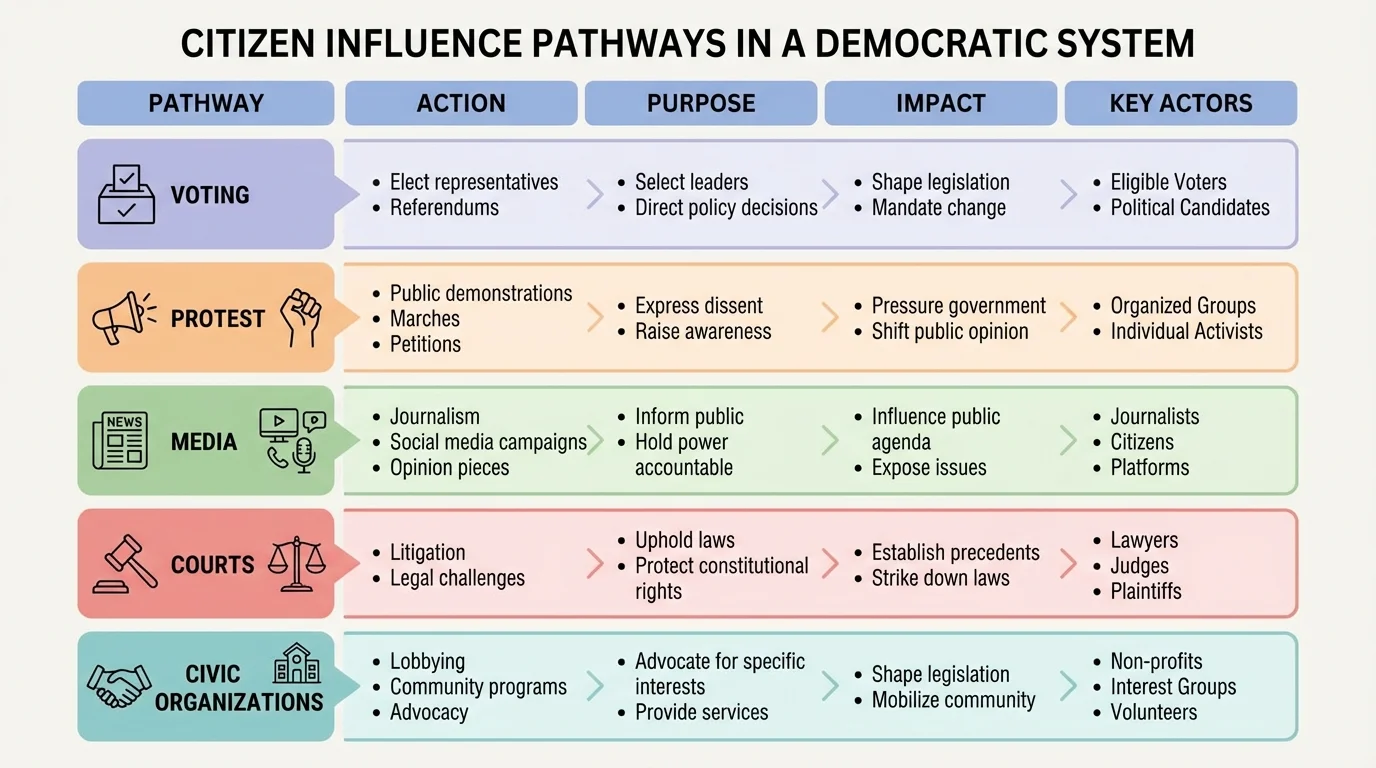
Consider India, the world's largest democracy. Indian citizens vote in massive national elections, participate in regional politics, join social movements, and use the courts to challenge government actions. At the same time, India's size, diversity, and social inequalities make participation uneven. People may have formal rights but still face barriers based on language, class, religion, gender, or geography. This shows that legal rights and practical access are not always identical.
South Africa offers another important example. During apartheid, the political system denied full civic rights to most of the population. Mass organizing, international pressure, labor activism, and community resistance helped transform institutions. After democratization, voting rights expanded, but new responsibilities emerged as well: building trust in institutions, addressing inequality, and holding leaders accountable in a constitutional system.
In democracies, civil society plays a major role. Civil society includes groups outside government, such as unions, charities, advocacy organizations, religious communities, and local associations. These groups help people organize around shared concerns. They train citizens in leadership, gather information, amplify voices, and often shape policy debates long before a law is passed.
Some of the most influential policy changes in democracies began far from national capitals. Local school board meetings, labor strikes, neighborhood associations, and court cases have often pushed issues onto the national agenda before major lawmakers acted.
Media also matters. In democracies, independent journalism can uncover abuse, corruption, or policy failure. Citizens then use that information to pressure officials. When a free press works well, it creates a feedback loop between the public and institutions. When misinformation spreads widely, however, democratic participation can become less informed and more polarized. [Figure 2]
Not all democracies are organized the same way. In many countries with parliamentary systems, elections determine the composition of parliament, and the government is usually formed by the majority party or coalition. The path from voters to national leadership differs from a presidential model.
In constitutional monarchies such as the United Kingdom, Canada, Japan, and Sweden, a monarch serves as head of state, but elected officials govern. Citizens exercise civic rights by voting for representatives, joining parties, campaigning, contacting members of parliament, and participating in public debate. The monarch's role is largely ceremonial, while policy is made by elected institutions.
One important feature of parliamentary government is accountability. If a prime minister loses support in parliament, the government may fall and a new election may be called. This can make civic participation feel more directly tied to the survival of a government. Citizens influence not only who represents them, but also which coalition can govern.
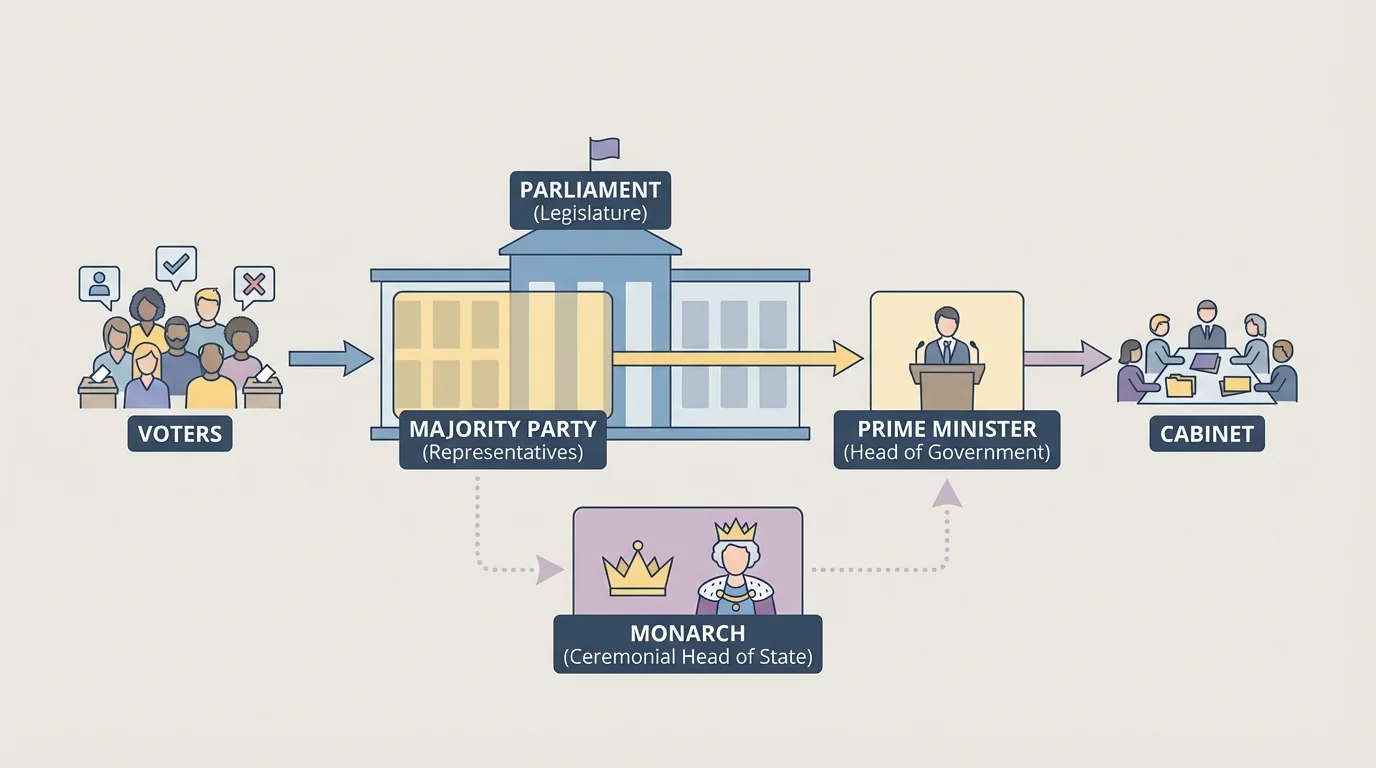
For example, in the United Kingdom, people vote for members of Parliament from local constituencies. The party that wins a majority, or forms a workable coalition, selects the prime minister. Citizens can also sign petitions that trigger parliamentary debate, join issue-based campaigns, and use the courts to challenge executive decisions. As seen earlier in [Figure 2], the public does not directly vote for the prime minister in the same way some presidential systems elect a president, but their votes still determine who leads the government.
Japan shows another variation. Citizens vote in a parliamentary system under a constitutional monarchy, but long periods of one-party dominance have raised questions about how competitive political life feels in practice. Even so, voters, media, local governments, and civil society organizations continue to shape public discussion on issues such as aging, defense policy, and energy. [Figure 3]
In an authoritarianism-based system, the government limits political competition and restricts civil liberties. People may still participate in public life, but participation is often filtered through state-controlled institutions. Elections, if they exist, may not be fully competitive. Media may be censored. Courts may lack independence. Public criticism can bring surveillance, job loss, detention, or violence.
In a single-party state, one ruling party controls political power and usually does not allow real competition for national leadership. Citizens may be encouraged to join party-linked organizations, attend public meetings, volunteer in state campaigns, or report local problems. These activities can create a form of participation, but they usually do not permit citizens to remove ruling elites through open electoral competition.
This does not mean people in authoritarian systems are passive. They may adapt creatively. Some use coded language online to criticize policy without directly naming leaders. Others rely on local complaint systems, religious networks, labor unrest, or carefully framed public grievances. In some cases, governments allow limited feedback on local issues like pollution, housing, or wages because solving such problems helps maintain legitimacy.
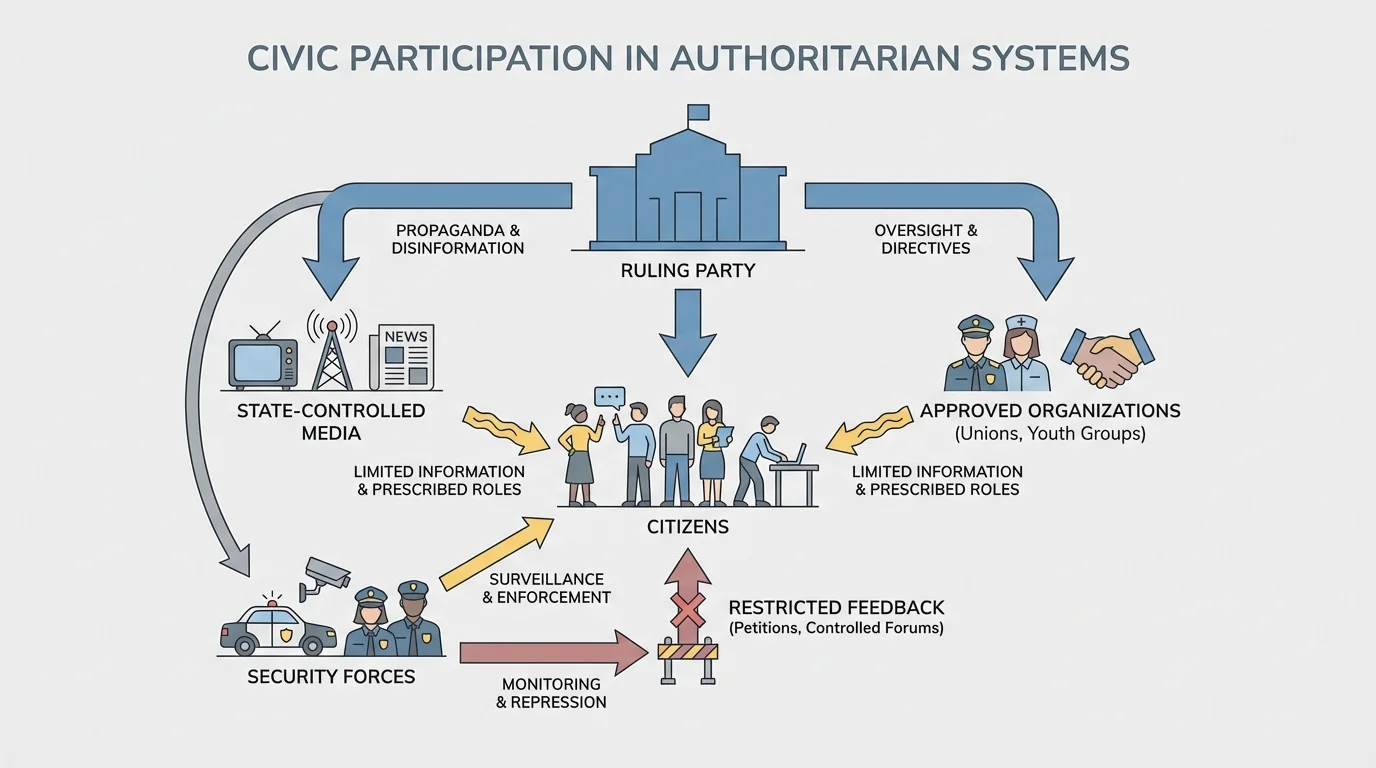
China is an important example. The Chinese government allows some consultation, especially on local administration and economic management, but the Communist Party maintains control over national politics, media, and organized opposition. Citizens may use digital platforms to complain about local corruption or poor services, yet open calls for systemic political change face strong repression. This means civic action exists, but within boundaries set by the state.
Iran also demonstrates mixed patterns within a restrictive system. Citizens vote in elections, and political debate exists, but unelected institutions and religious authorities hold major power. Candidates can be disqualified before elections, and protest movements may be met with force. Even so, citizens continue to use elections, activism, cultural expression, and social networks to push for change.
Case study: exercising civic responsibility under restriction
Suppose residents in a restrictive system face dangerous pollution from a factory.
Step 1: They may avoid direct criticism of the national government and instead document local health problems.
Step 2: They might submit complaints through approved channels, contact local officials, or use carefully worded social media posts.
Step 3: If the issue attracts attention without becoming a broader political challenge, the government may act to preserve order and legitimacy.
This example shows that civic participation can exist even when rights are limited, but the range of acceptable action is much narrower than in open democracies.
Responsibilities in authoritarian systems are often framed differently. Governments may emphasize obedience, unity, military service, ideological loyalty, or social order more than criticism or independent activism. In such systems, the state often defines "good citizenship" as cooperation with official goals rather than monitoring and challenging those in power.
Some governments fall between clear democracy and clear authoritarianism. These are often called hybrid regimes or semi-authoritarian systems. They may hold elections and maintain constitutions, but opposition parties, journalists, judges, or activists face significant pressure. Citizens have some room to participate, but the playing field is uneven.
Russia in the early twenty-first century provides a strong example of managed participation. Elections occur, parties exist, and public institutions function, but the state has heavily constrained independent media, opposition movements, and civil liberties. People can still participate in local concerns or state-approved organizations, yet challenging top leadership carries serious risks.
Hungary and Turkey have also sparked debate among scholars about democratic backsliding. In such cases, the question is not simply whether elections occur, but whether institutions remain independent enough for citizens to use rights meaningfully. If courts weaken, media becomes less free, and opponents face pressure, civic rights may exist on paper while shrinking in practice.
"The ballot is stronger than the bullet."
— Often attributed to Abraham Lincoln
This idea is powerful, but it depends on institutions that make ballots meaningful. If votes are manipulated, opponents silenced, or information controlled, the ballot loses much of its strength. That is why studying institutions is essential when comparing civic participation across systems.
Voting is important, but it is only one part of civic life. People also exercise rights and responsibilities through petitions, public-interest lawsuits, labor organizing, journalism, school boards, community associations, and digital activism. In many countries, youth activism has become especially important on climate policy, education, and policing.
Poland's Solidarity movement in the 1980s shows how labor organizing can reshape political institutions. What began as a workers' movement grew into a broader challenge to communist rule. Over time, civic pressure helped open political space and contributed to democratic transition. This example reminds us that institutions are not fixed forever; sustained participation can transform them.
Tunisia after the Arab Spring shows both the promise and fragility of civic action. Protests helped remove an authoritarian ruler, and civil society groups played a major role in constitutional negotiation. Yet democratic gains later faced serious strain. Civic participation can open political change, but maintaining democratic institutions requires long-term commitment, compromise, and protection of rights.
Rights are most meaningful when institutions enforce them. A constitution, election, or law by itself does not guarantee freedom. Courts, media, parties, and public norms help determine whether citizens can actually use their rights.
Digital spaces have changed civic participation everywhere. Social media can spread information quickly, connect activists, and expose wrongdoing. It can also enable surveillance, censorship, propaganda, and harassment. In open and closed systems alike, digital citizenship now includes evaluating sources, protecting privacy, and recognizing how technology shapes political power.
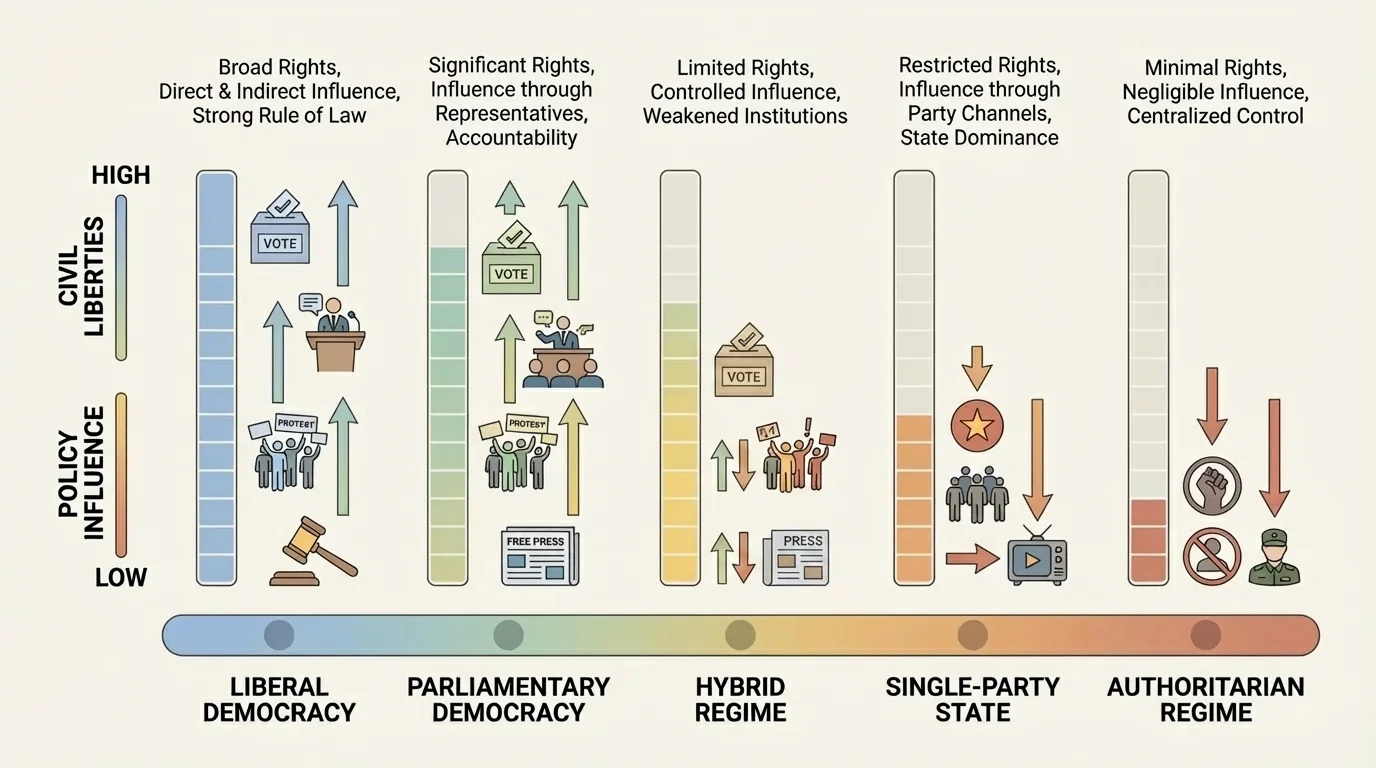
Civic participation exists on a spectrum rather than in two simple categories. The key question is not only whether people participate, but how much real influence they have over leadership, lawmaking, and implementation.
In open democracies, participation often shapes policy through multiple institutional paths, as [Figure 4] illustrates by comparing open and restricted systems. A protest may shift media coverage, pressuring lawmakers and influencing legislation or court action. In more restricted systems, the public may influence only limited policy areas, often local or technical ones, while core political power remains protected from challenge.
| System type | Typical civic rights | Typical civic responsibilities | Impact on institutions and policy |
|---|---|---|---|
| Liberal democracy | Broad voting rights, free speech, protest, independent media, association | Obey laws, pay taxes, stay informed, respect rights, jury or civic service where required | High potential to influence leaders, laws, and public policy |
| Parliamentary democracy | Broad rights similar to other democracies, often with strong party systems | Voting, engagement with representatives, public debate, legal duties | Citizens shape parliament and therefore government formation |
| Hybrid regime | Some elections and legal rights, but uneven protections | Formal duties plus caution in political expression | Influence exists, but major power is often shielded from challenge |
| Single-party state | Limited political competition, controlled expression, approved participation | Loyalty, obedience, participation in state-linked activities | Citizens may affect local issues more than national leadership |
| Authoritarian regime | Restricted speech, assembly, and opposition | Compliance, order, sometimes military or ideological duties | Public influence is narrow and often risky |
Table 1. Comparison of civic rights, responsibilities, and policy influence across major system types.
The contrast in [Figure 4] helps explain why the same action can have different political results. A peaceful march may lead to hearings and reforms in one country, while in another it may lead to arrests. A newspaper investigation may trigger resignation in one system but censorship in another. Institutions decide whether participation becomes policy change, symbolic expression, or suppressed dissent.
Historical change often comes when citizens redefine what their rights and responsibilities should be. In South Africa, anti-apartheid activism transformed a racially exclusive state into a constitutional democracy. In India, civic participation has helped sustain electoral democracy despite enormous social complexity. In Poland, organized labor became a political force. In Tunisia, protest opened a constitutional transition. In China and Iran, citizen action continues under tight constraints.
These examples show that civic participation is not static. It expands, contracts, and changes form depending on law, technology, leadership, economic conditions, and social movements. Rights may be won gradually, lost suddenly, or defended repeatedly across generations.
Many rights that people now consider normal, including broader voting rights, labor protections, and civil liberties, were secured through long campaigns rather than simply granted from above. Institutions often change because citizens keep pressing them to change.
Comparing systems also helps students avoid a common mistake: assuming that elections alone equal democracy or that political silence always means public agreement. Sometimes silence reflects fear. Sometimes participation happens through unofficial channels. Sometimes institutions appear democratic but function unfairly. Careful comparison helps reveal these differences.
Understanding how people in other systems of government exercise civic rights and responsibilities strengthens civic literacy. It helps us ask better questions: Who can speak freely? Who can organize? Who can challenge leaders? Which institutions respond to the public, and which mainly protect those already in power?
These questions matter because public policy affects real life: education, policing, housing, transportation, environmental protection, labor conditions, and digital privacy. When citizens have meaningful rights and use them responsibly, institutions are more likely to face scrutiny and adapt. When rights are restricted, policy may serve rulers more than the public.
Studying other systems does more than teach comparison. It reveals how fragile civic rights can be, how important institutions are, and how deeply participation shapes the relationship between people and power.
