Have you ever looked at a baby picture and said, "That was me?" That picture shows something from long ago. History starts when we wonder about things that already happened. We ask questions so we can learn about people, places, and events from before today.
The past is everything that happened before now. Yesterday is in the past. Your last birthday is in the past. Things that happened before you were born are also in the past. When we talk about history, we are learning about the past.
The past means a time that has already happened. History is learning and talking about people and events from the past.
We can ask questions about our own lives, our family, our school, and people from long ago. Good questions help us notice important details.
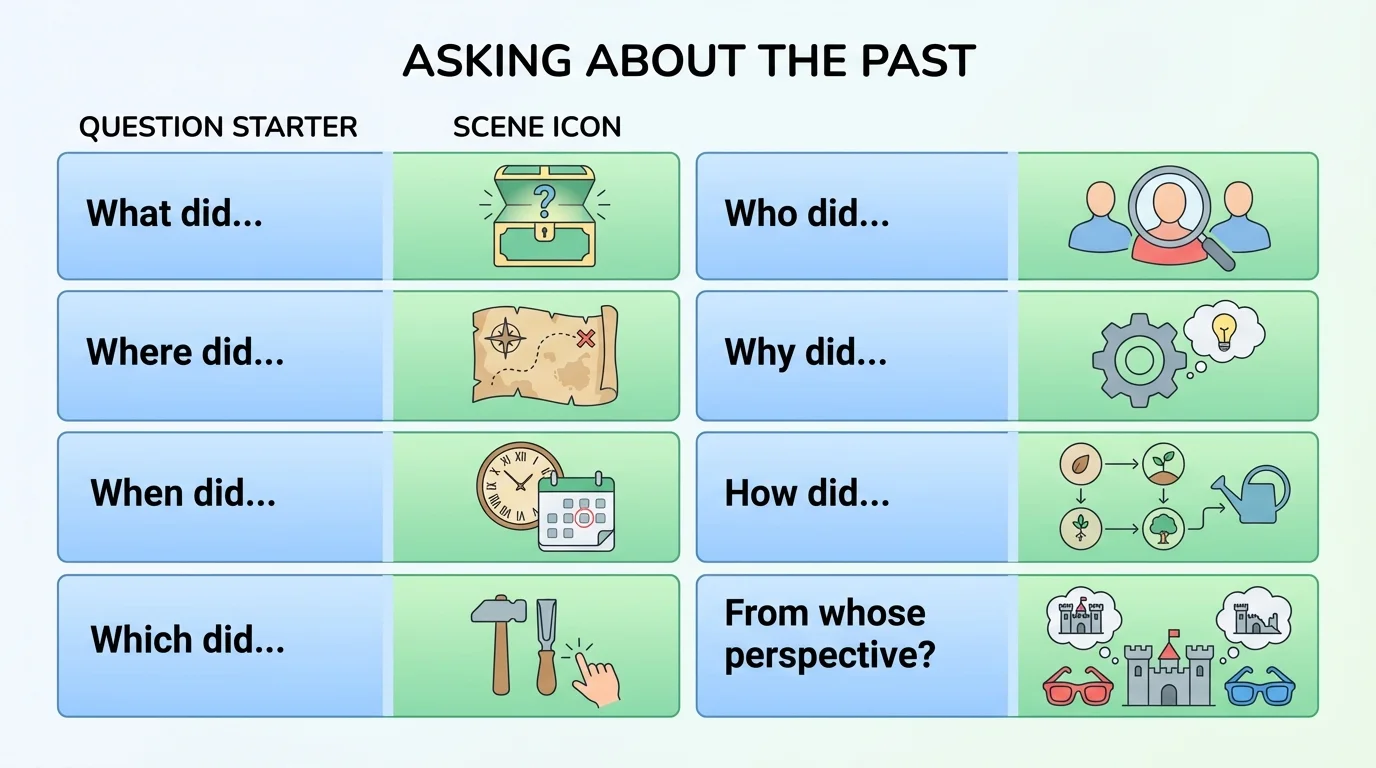
There are many ways to ask about the past, and [Figure 1] shows helpful question starters we can use again and again. Each starter helps us think about a different part of what happened.
What did...? asks about an action. What did the children make at school?
Where did...? asks about a place. Where did the family go?
When did...? asks about time. When did the rain start?
Which did...? helps us choose between things. Which game did they play first?
Who did...? asks about a person or people. Who helped plant the flowers?
Why did...? asks for a reason. Why did the class line up?
How did...? asks about the way something happened. How did they get the ball back?
From whose perspective...? asks whose side or view we are hearing. Is this story told by the teacher, the child, or the parent?
These starters help us talk like young historians. We do not just say, "Tell me about it." We can ask clear questions to learn more.
Let's think about one small event from the past: a class planted a seed in a cup last week. We can ask many questions about that one event.
Example: Asking about a class seed-planting day
Step 1: Ask What did
What did the class plant?
Step 2: Ask Where did
Where did they put the cups?
Step 3: Ask When did
When did they water the seed?
Step 4: Ask Who did
Who poured in the soil?
Step 5: Ask Why did and How did
Why did they put the cup by the window? How did they help the seed grow?
One event can lead to many questions. That is how we learn more about what happened.
We can do the same with a family picnic, a school play, a parade, or a holiday. History is full of questions that help us understand past events more clearly.
A perspective is the way someone sees or tells something. A child, a teacher, and a parent may all talk about the same day, but each one may notice different things, as [Figure 2] illustrates.
Think about recess. A child might say, "I ran fast and played tag." A teacher might say, "The children took turns and stayed safe." A parent might say, "My child came home happy and tired." The event is the same, but the stories sound a little different.
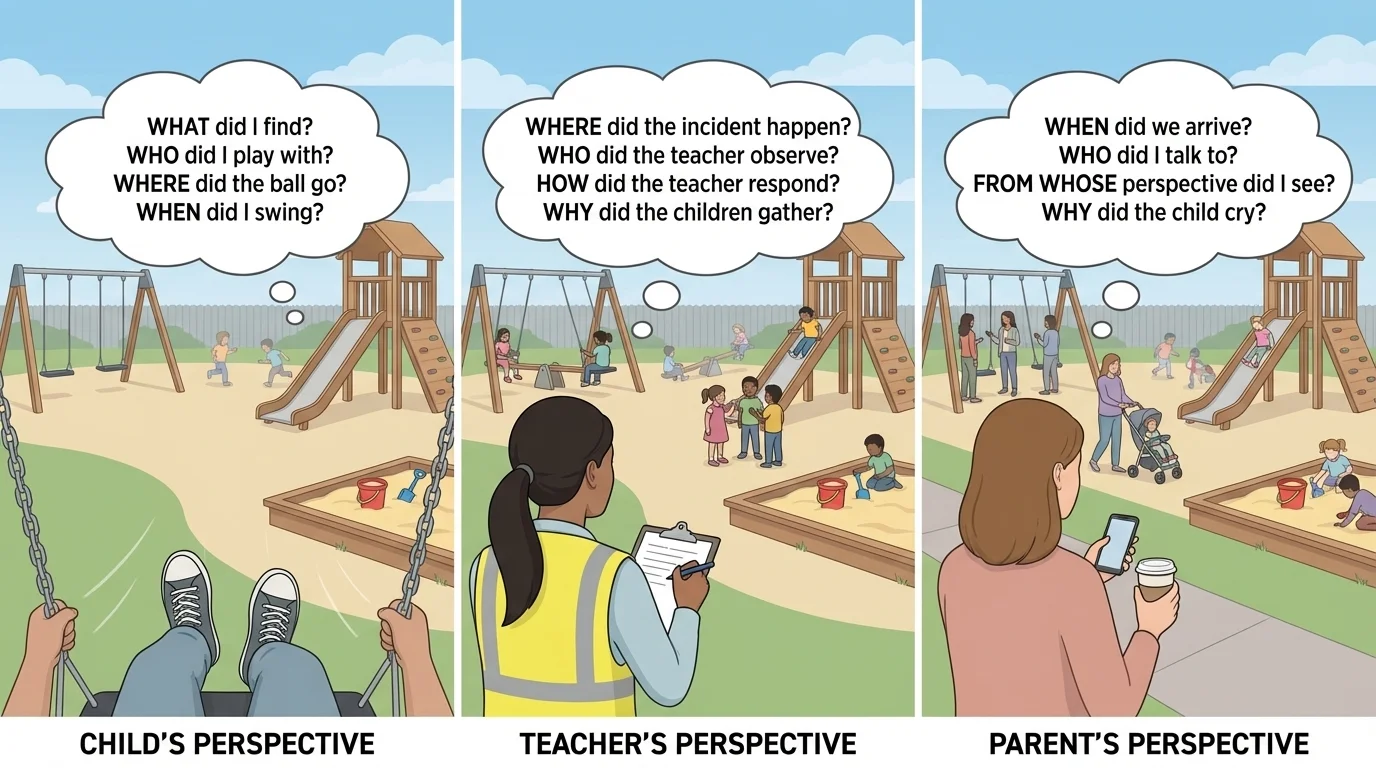
That is why From whose perspective? is an important question. It helps us know who is telling the story.
Why perspective matters
When we hear about the past, we should notice who is speaking. Different people can remember different details. Listening to more than one person can help us understand the event better.
Later, when we hear a family story or look at an old photograph, we can remember that the person telling us the story may have a special point of view. Like the people shown in [Figure 2], each person may notice some parts clearly and miss other parts.
We can learn about the past from sources, and [Figure 3] shows simple examples of clues people use. A source is something that gives us information about what happened before now.
A photograph can show clothes, faces, and places. An old toy can tell us what children liked to play with. A drawing, a letter, or a story from a grandparent can also help us ask questions about the past.
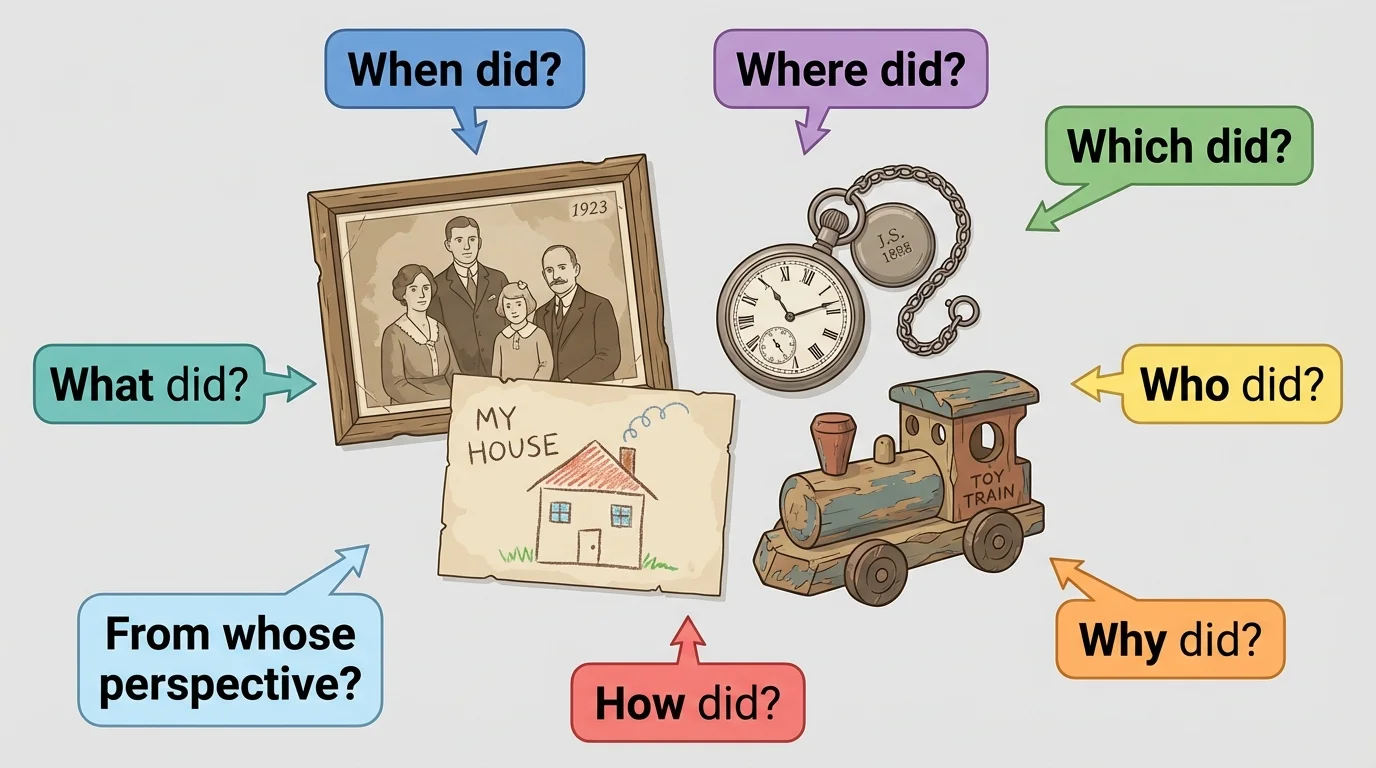
When we look at a clue, we can ask: What did people use this for? Where did it come from? Who had it? Why did they keep it? Questions turn clues into learning.
A tiny object from long ago, like an old button or shoe, can help people learn about how someone lived. Small clues can tell big stories.
Some sources are made at the time something happens. For example, a photo from a birthday party is made during that time. Some sources are made later, like when someone tells a story about the party after it is over. Both can help us learn.
When we ask questions, we should listen carefully to the answers. Sometimes we know the answer. Sometimes we are still wondering. It is okay not to know everything right away.
Good history talk means taking turns, using kind words, and paying attention. We can say, "I wonder who was there," or "I think this photo shows a family meal." We can also ask another question if we need more information.
As we saw with the question chart in [Figure 1], different starters help us learn different kinds of facts. Some questions ask about time, some ask about place, and some ask about reasons. Together, they help us understand the past more clearly.
You already know how to ask questions every day. History uses that same skill, but now the questions are about things that happened before now.
When we ask What did?, Where did?, When did?, Which did?, Who did?, Why did?, How did?, and From whose perspective?, we become careful thinkers. That is an important part of learning about the past.
