A baby becomes a child, and a child grows older each year. That tells us something important: time moves in order. Long ago, children still played, learned, and lived with families, but some parts of life were not the same as they are now. Looking at the past helps us see what changed and what stayed the same.
The past is the time that already happened. The present is now. When we talk about history, the order of events matters, as [Figure 1] shows. A person is a baby first, then a child, and later a grown-up. We tell the story in that order so it makes sense.
Words like before, after, long ago, and today help us describe time. If we say, "Grandma was a little girl before she was a grown-up," we are putting events in the right order.
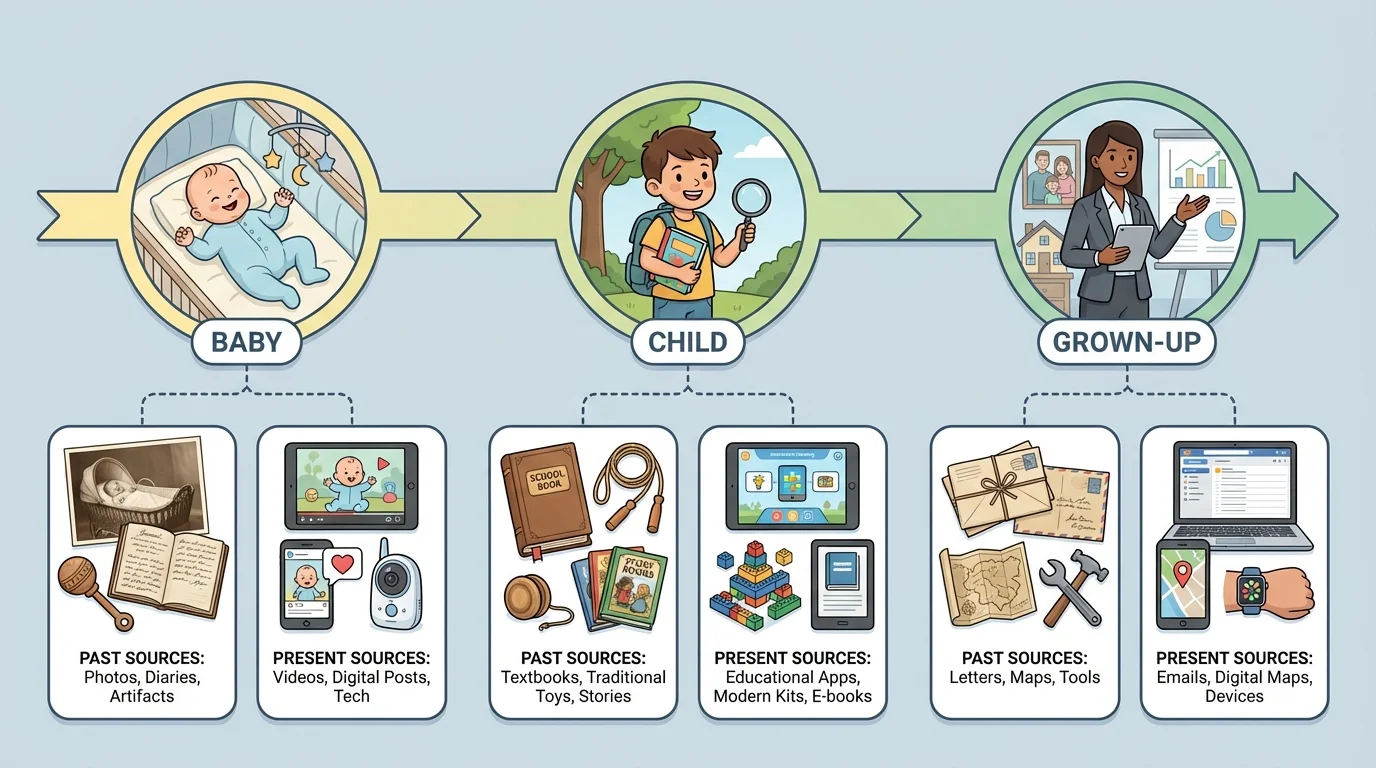
Past means the time before now. Sequence means the order in which things happen. In history, sequence helps us understand what came first and what came next.
People in the past were real people, just like us. They had homes, families, and daily jobs. Some things in their lives were different because they lived at a different time.
We learn about long ago from many kinds of sources, and [Figure 2] shows several of them together. A source is something that gives us clues about the past.
A special object from long ago is called an artifact. An artifact can be a toy, a piece of clothing, a dish, or a tool. Families may also share stories about what life was like when they were young. Old pictures can show clothes, houses, and schools. Books and videos can teach us about families from many places and times.
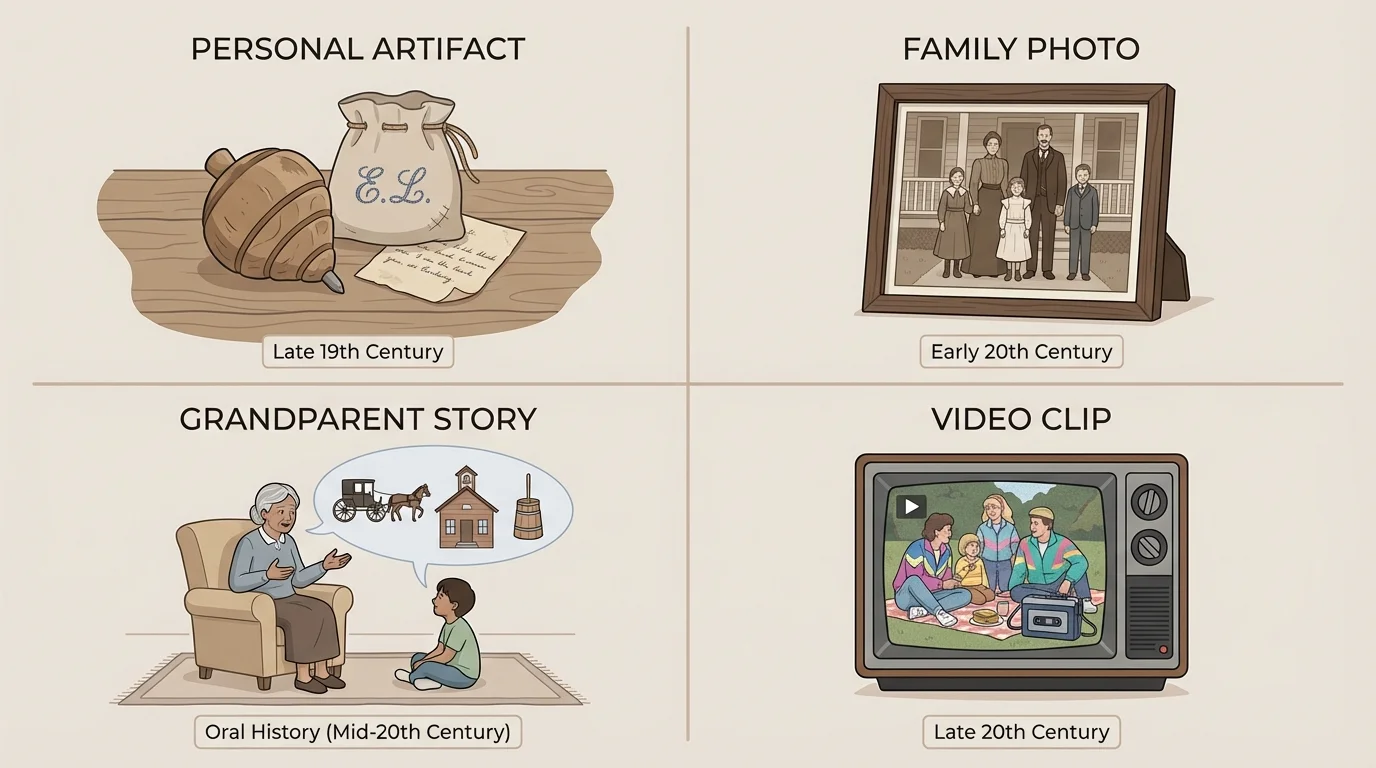
Some sources are made by people who lived at that time. A family photo or a story told by a grandparent is a primary source. Other sources are made later, like a history book for children. Those are secondary sources.
An old teddy bear, a faded photograph, or a letter can teach us about daily life. Small things can tell big stories about the past.
When we use more than one source, we learn more. A picture may show what a classroom looked like, while a story may tell how children felt there.
Families long ago and families today may live in different kinds of homes, eat different foods, or wear different clothes. One family long ago might have cooked over a fire, while many families today use a stove or microwave. Some children long ago helped carry water or gather wood. Today, children may help set the table or put away toys.
Families also have many similarities. Grown-ups care for children. Families eat meals, tell stories, work, and rest. Babies need love and help in every time period. Even when homes or tools look different, families still do many of the same important things.
| Part of Life | Long Ago | Today |
|---|---|---|
| Home | May have had fewer machines | May have more household appliances |
| Cooking | Fire or simple stove | Stove, oven, or microwave |
| Chores | Carrying water, feeding animals | Cleaning room, helping in kitchen |
| Family Time | Stories, songs, games | Stories, songs, games, videos |
Table 1. A simple comparison of family life long ago and today.
Families from different societies can be different too. A family in a city may live differently from a family on a farm. A family in another country may eat different foods or celebrate different holidays. These differences help us learn about the world.
Children's lives can be compared across time, as [Figure 3] shows. Long ago, many children played games outside, helped family members, and learned at home or in school. Today, children still play, help, and learn, but they may use different toys and tools.
For example, a child long ago might have played with a handmade doll, wooden toy, or ball. A child today might play with blocks, puzzles, dolls, balls, or electronic toys. The toys may change, but the joy of play is still there.
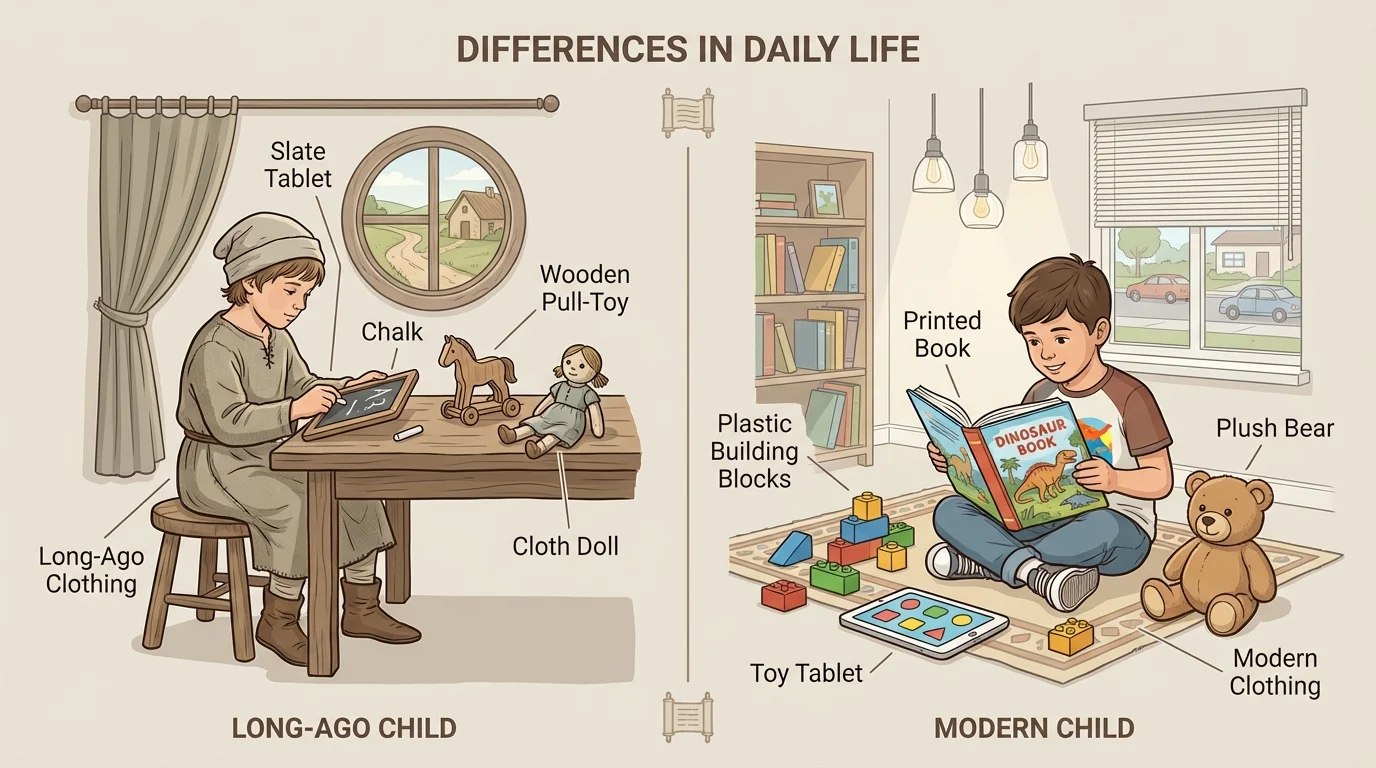
School can be different too. Some children long ago wrote on slates or used one-room schoolhouses. Many children today use paper, books, crayons, and sometimes computers. Even so, children in both times learn to listen, speak, read, count, and share.
Similar and different at the same time
History often shows both change and sameness. Children long ago and children today may have different clothes, schools, and toys, but both need care, learning, and play. Looking for both helps us understand people fairly.
When we look again at [Figure 3], we can notice that children in both scenes are busy learning and playing. That is an important historical idea: people in different times are connected by everyday life.
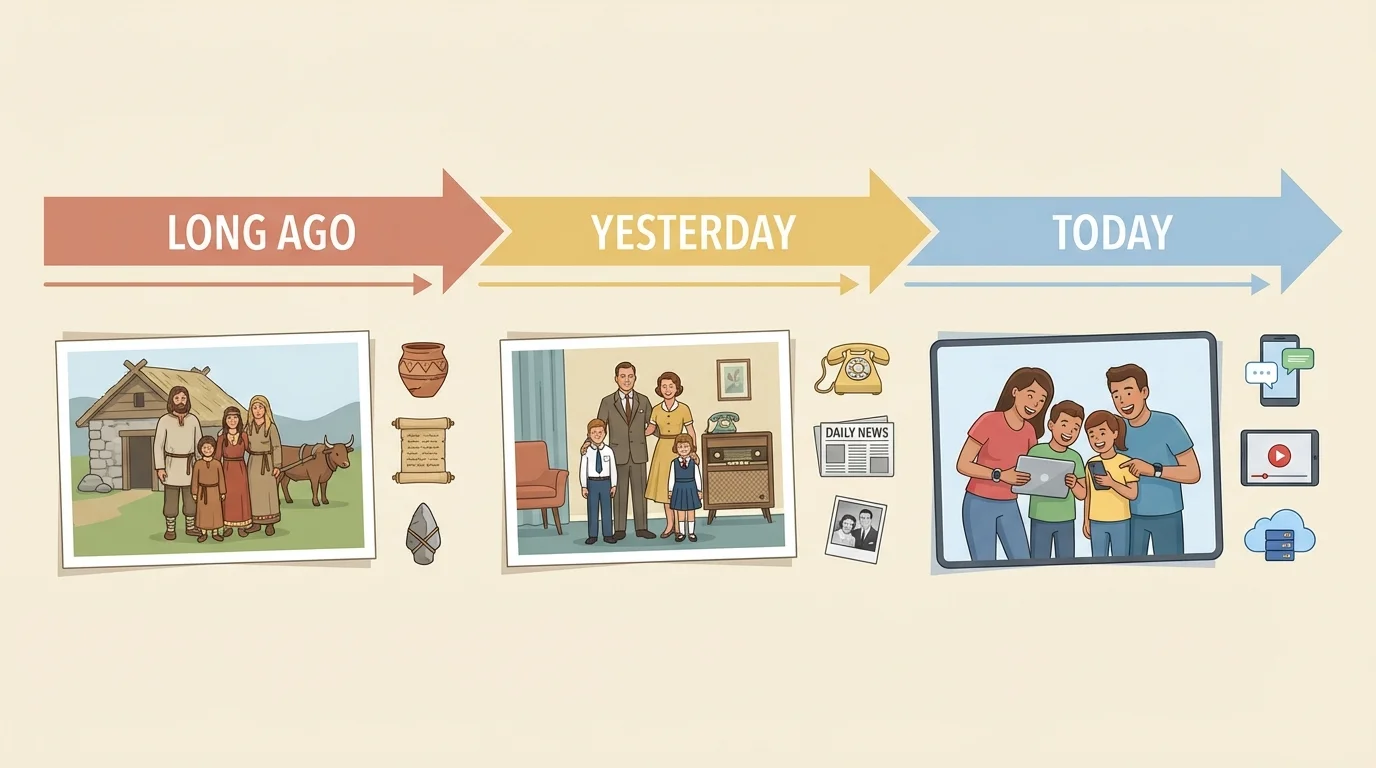
A timeline is a line that helps us place events in order, and [Figure 4] shows how time can move from long ago to today. Timelines help us remember what happened first, next, and last.
Suppose we want to tell the story of a grandparent's life. First, the grandparent was a child. After that, the grandparent became an adult. Later, the grandparent had children, and now there may be grandchildren. If we mix up the order, the story becomes confusing.
Putting a family story in order
Step 1: Start with the earliest event.
"Dad was a little boy."
Step 2: Tell what happened later.
"Dad grew up and went to work."
Step 3: End with what is happening now.
"Now Dad has a family."
This order helps the story make sense.
We can also use words like first, next, and last. These words help us describe history clearly.
Children and families from different time periods and places may look different, live in different homes, or use different tools. But they also share many human needs. People need food, shelter, love, care, and a place to belong.
Stories and pictures help us notice feelings as well as facts. A picture may show a family eating together. A story may tell that a child missed a friend or loved a favorite toy. These details help us understand that children in the past had emotions and experiences just like children today.
When we study the past, we learn to ask good questions. What did this family eat? Where did the child sleep? What games did the children play? What looked different? What felt the same? Looking carefully at sources helps us answer these questions.
As we saw earlier in [Figure 2], different kinds of sources work together. An artifact shows one clue, a picture shows another, and a story adds even more. A timeline like [Figure 4] then helps us place those clues in the right order.
