What if your day started with bedtime, then lunch, then waking up? That would sound very silly. When we talk about things that happened, we need to tell them in the right order so they make sense. This is true for our own lives, and it is also true when we learn about the past.
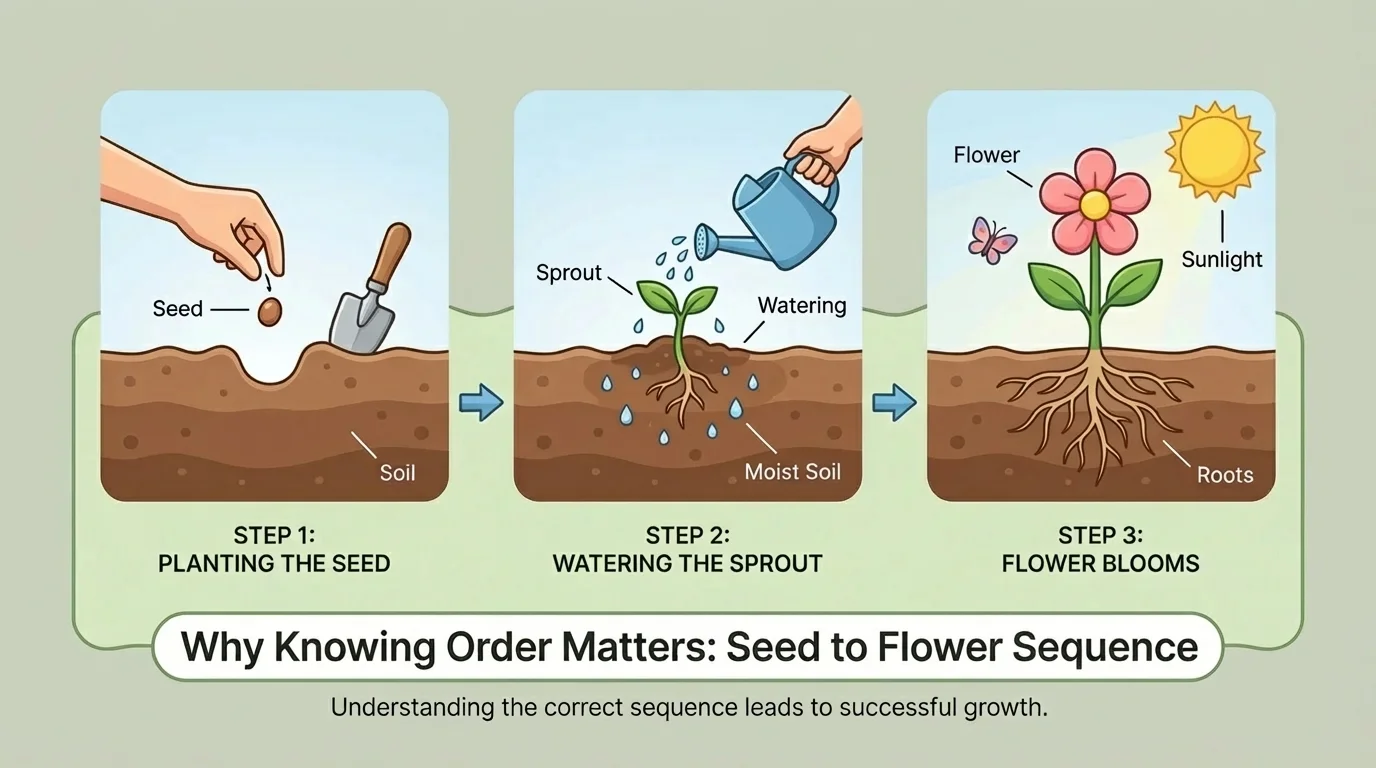
The order of events is the way things happen: first, next, and last. When we put events in order, we can understand the story better. A seed is planted first, then it gets water, and later it grows into a flower, as [Figure 1] shows.
If we mix up the order, the story does not make sense. A flower cannot bloom before the seed is planted. Putting events in order helps our brains follow what happened.
The past is everything that happened before now. When we talk about the past, the right order helps us know what came before and what came after. If someone says, "The town had a school. Then people built the school," that sounds wrong. The school had to be built first.
Order is important because one event can help make another event happen. A family moves to a new home first. After that, the child starts at a new school. If we tell those events backward, we may not understand why the child went to a different school.
Past means the time before now.
Sequence means the order in which things happen.
When we learn history, we listen for words like before, after, earlier, and later. These words help us place events in the right sequence.
We can practice with things we know. First, you wake up. Next, you get dressed. Then, you go to school. Last, you go to bed. These events happen in an order every day.
The same idea works for the past. Long ago, a person was a baby. Later, that person learned to walk. After that, the person learned to talk. We understand growing up because we know the order.
Example: Telling a past event the right way
Look at these events: a chick comes out of an egg, an egg is laid, the chick grows bigger.
Step 1: Find what happens first.
The egg is laid first.
Step 2: Find what happens next.
The chick comes out of the egg next.
Step 3: Find what happens last.
The chick grows bigger last.
Now the story makes sense because the events are in the correct order.
When events are in sequence, we can tell how things change over time. We can see that small things become bigger, new things get built, and people learn and grow.
As [Figure 2] illustrates, a timeline is a line that shows events in order from earlier to later. Timelines help us see what happened long ago, what happened later, and what is happening now.
A simple timeline might show a baby, then a toddler, then a child going to school. This helps us see that growing happens over time. A timeline can also show events in a family, a school, or a town.
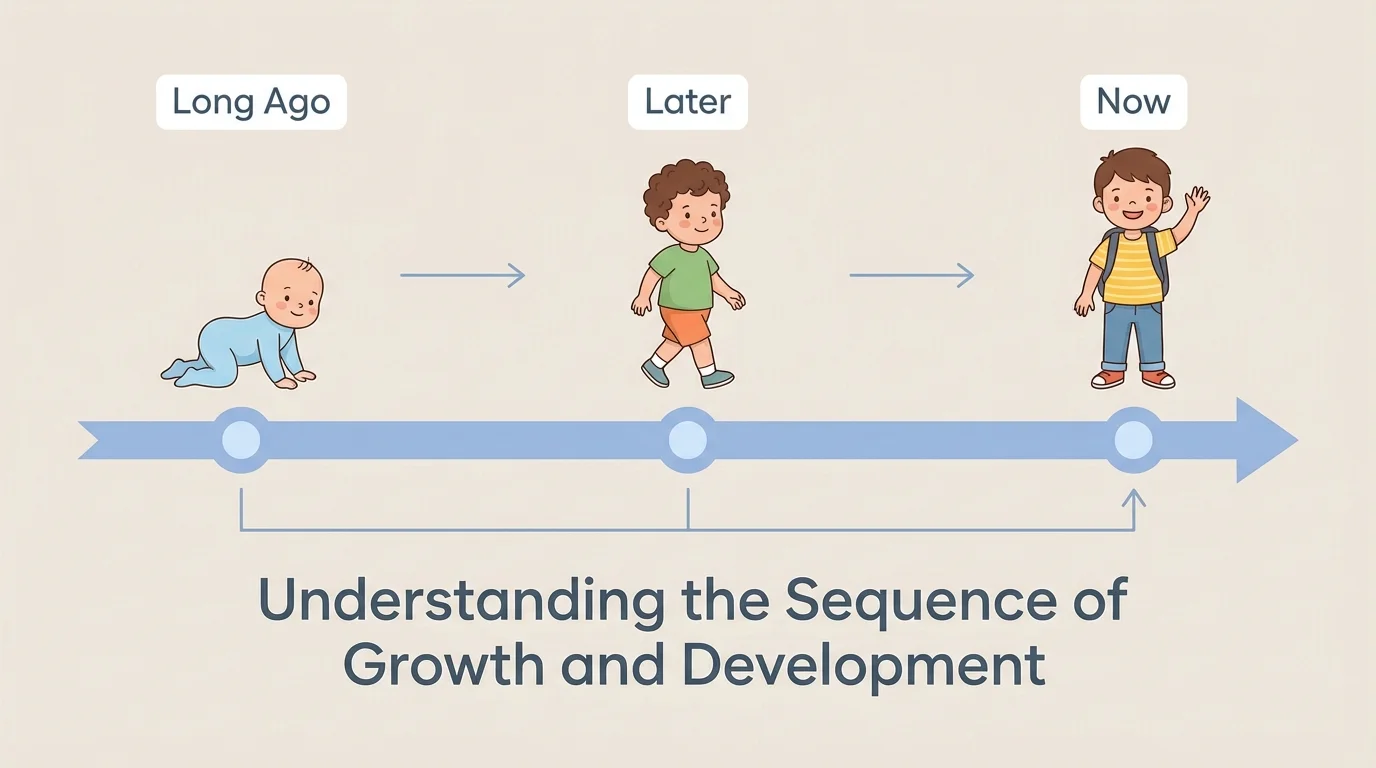
Sometimes people use timelines to show important things from history. For example, first a house is built, later a family moves in, and after many years a new family lives there. The line helps us keep the events in order. Just like the growing child in [Figure 2], a place can change over time too.
Old photographs can help people place events in order because pictures may show someone as a baby, then as a child, and later as an adult.
Words such as yesterday, today, and long ago also help us talk about time in the right order.
As [Figure 3] shows, sometimes we were not there to see what happened in the past, so we use clues. A clue can be a family photo, an old toy, a story from a grandparent, or a book about the past.
These clues are called sources. A source gives us information. A photo can show that a person was younger long ago. An old object can show what people used before. A grandparent's story can tell what happened first and what happened later.
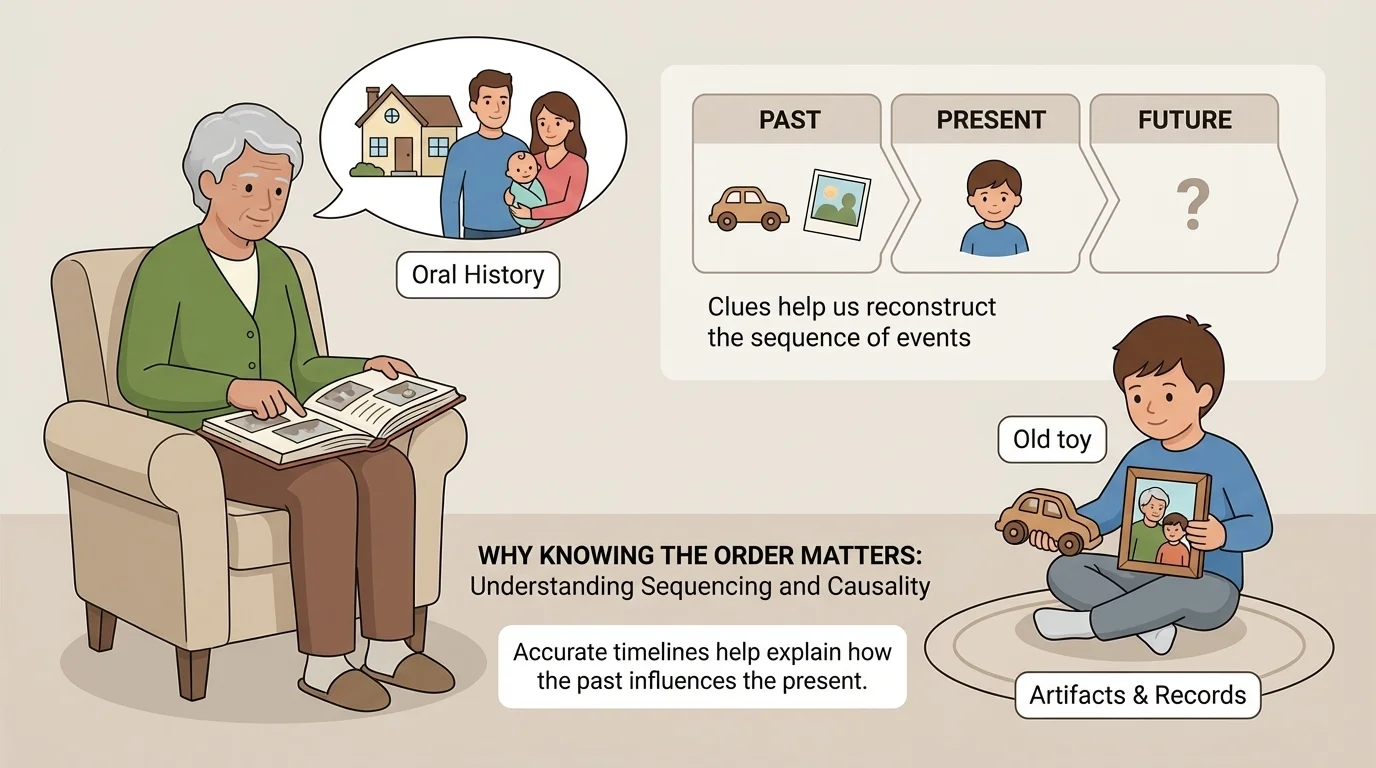
Some sources come directly from people who were there. A person telling what they remember is a firsthand source. Some sources come from books written later. Both kinds can help us learn the sequence of past events.
A historian is a person who studies the past. Historians try to tell what happened in the right order. They do this so the past is clear and true.
If events are mixed up, people may misunderstand what happened. They may think one thing caused another when it did not. But when events are in order, we can better understand change, people's lives, and the story of the past. The clues in [Figure 3] help historians and families put those stories in the right sequence.
"First, next, and last help us tell the past so it makes sense."
Knowing the order of events helps us tell stories correctly, learn from history, and understand how people and places change over time.
