Have you ever seen two children want the very same toy at the same time? That happens a lot. A truck, a crayon, a swing, or a book can be something we really want right now. [Figure 1] Learning how to use another person's things in a kind way helps us make good choices, solve small problems, and be good friends.
At school, at home, and on the playground, people have things that belong to them. Sometimes an item belongs to one person. Sometimes it belongs to the class. When something belongs to someone else, we do not grab it. We stop, look, and ask first.
Asking first shows respect for another person. Respect means we remember that another person's feelings and choices matter. If a classmate is using a stuffed bear or holding a special pencil, that item is not ours to take.
When we ask, we are being polite and safe. We can say, "May I use it?" or "Can I have a turn when you are done?" Asking gives the other person a chance to choose. That choice is important.
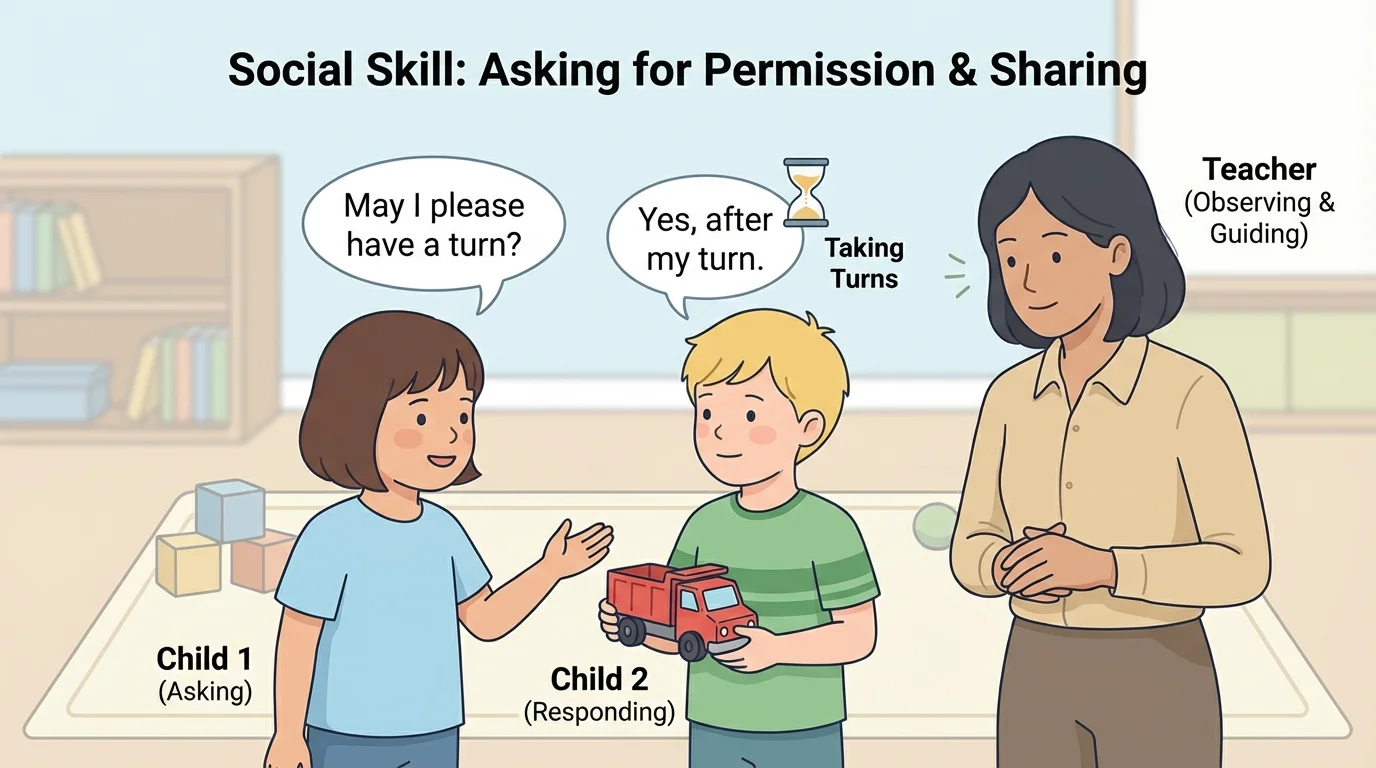
Some things are special because they help us. A child may need a coat, a water bottle, or a lunchbox. Some things are special because we just like them, such as a shiny sticker or a favorite toy car. Both needs and wants matter. People make choices about their own things because those things can be important to them.
Permission means someone says it is okay for you to use or do something. Share means letting another person use something with you or after you. Take turns means one person goes first and another person goes next.
When we understand that people have their own items, we understand why we must not take things just because we want them. Wanting something does not make it ours. Kind choices help everyone feel calm and included.
People make choices every day. In economics, a need is something important for living and doing well, like food, water, or shoes. A want is something we would like to have, like an extra toy or a colorful marker.
A child may say, "No, I need my jacket now," because the jacket helps keep them warm. Another child may say, "Yes, you can use my blocks after snack," because they choose to share at that time. These are choices. Good friends listen to the answer.
If two children both want the same red crayon, they cannot both use it in exactly the same moment. So they choose a solution. One child may use it first, and the other waits. Or they may pick another color for now. Making choices kindly helps a group work better together.
Sharing is not the same as giving something away forever. When you share, you still know whose item it is, and you use it kindly for a short time or together.
Listening to another person's choice teaches fairness. [Figure 2] Fair does not always mean everyone gets the item at the same second. Fair can mean everyone gets a chance in a kind order.
There is a simple borrowing process: take turns, use the item carefully, and return it. This order helps children know what to do.
You can use short, polite words. Try saying, "May I use your blue crayon?" or "Can I have a turn with the ball when you are done?" Then be quiet and listen to the answer. Waiting is part of being kind.
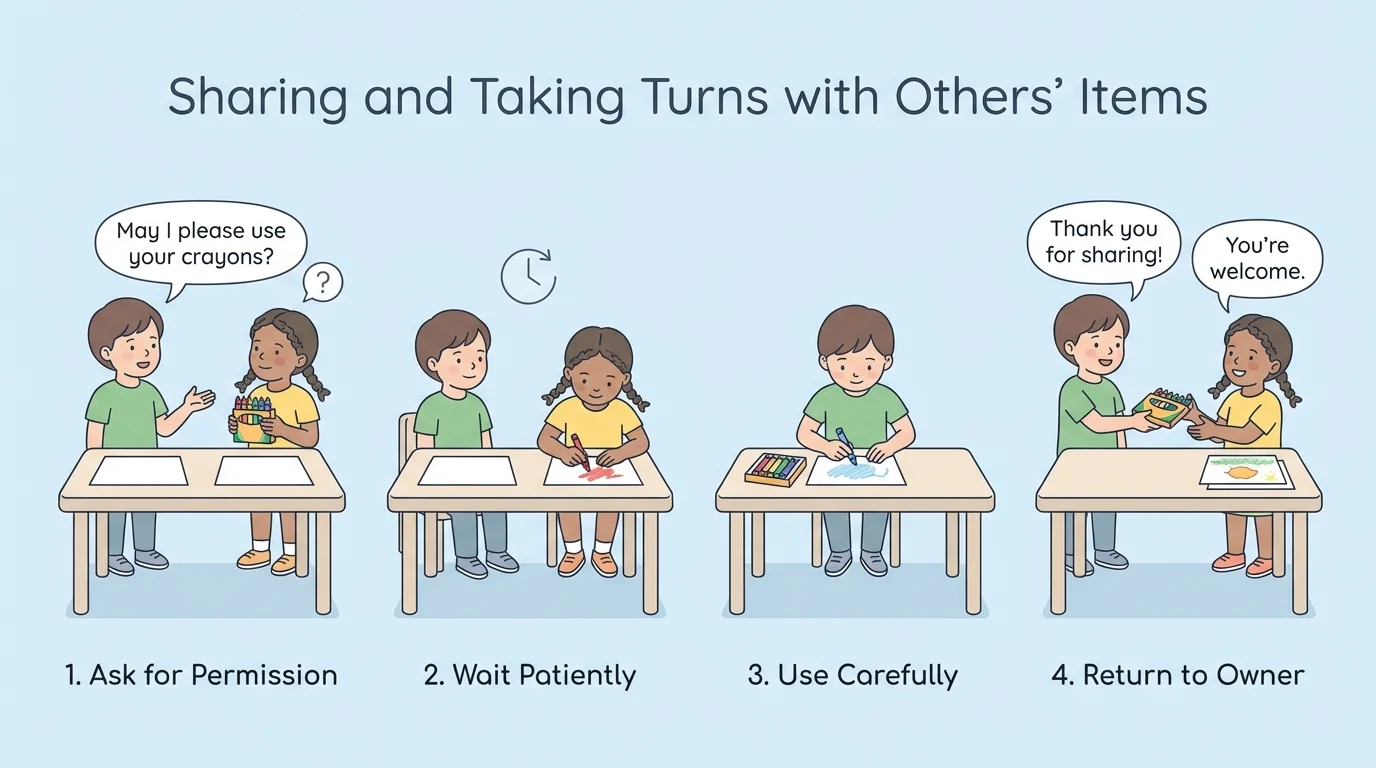
Sometimes waiting can feel hard. You may really want the item right away. But waiting shows self-control. While you wait, you can choose something else to do. You might build with blocks, read a book, or color with a different crayon.
Waiting also helps everyone have a turn. Later, when you have something another child wants, you can remember how waiting worked before. As we see again in [Figure 2], turn-taking has a beginning, a middle, and an end.
Kind borrowing means using another person's item only after asking, listening to the answer, handling the item gently, and giving it back. Borrowing is a way to solve the problem of limited items when many children want to use them.
At school, many children may want the same puzzle, paintbrush, or swing. Taking turns helps a group share limited things peacefully. This is a simple example of making choices when there is not enough for everyone at once.
Sharing can happen in different ways. Two children may build one tower with the same blocks. That is sharing together. One child may finish with scissors and then hand them to another child. That is taking turns.
Here are some examples. If Maya is reading a book, Leo can ask, "Can I read it after you?" If Ben is on the swing, Ana can wait behind the line and have the next turn. If Nora has markers, Eli can ask to share one marker instead of taking the whole box.
Sometimes a teacher helps children decide the order of turns. That helps everyone know what is fair. Children can also solve it with words. They may say, "You go first, then me," or "Let's use it together."
Real-life examples
Step 1: Ask politely.
"May I use your shovel in the sand table?"
Step 2: Listen to the answer.
If the answer is yes, say "Thank you." If the answer is no, stay calm.
Step 3: Use the item gently.
Keep the item safe, clean, and in good condition.
Step 4: Return it.
Give it back when your turn is done.
These small actions build trust. [Figure 3] When people know you will ask, wait, and return things, they are more likely to feel comfortable sharing with you.
Sometimes the answer is no, and that is okay. A calm response matters. You can say, "Okay," or "Maybe later." Then choose something else.
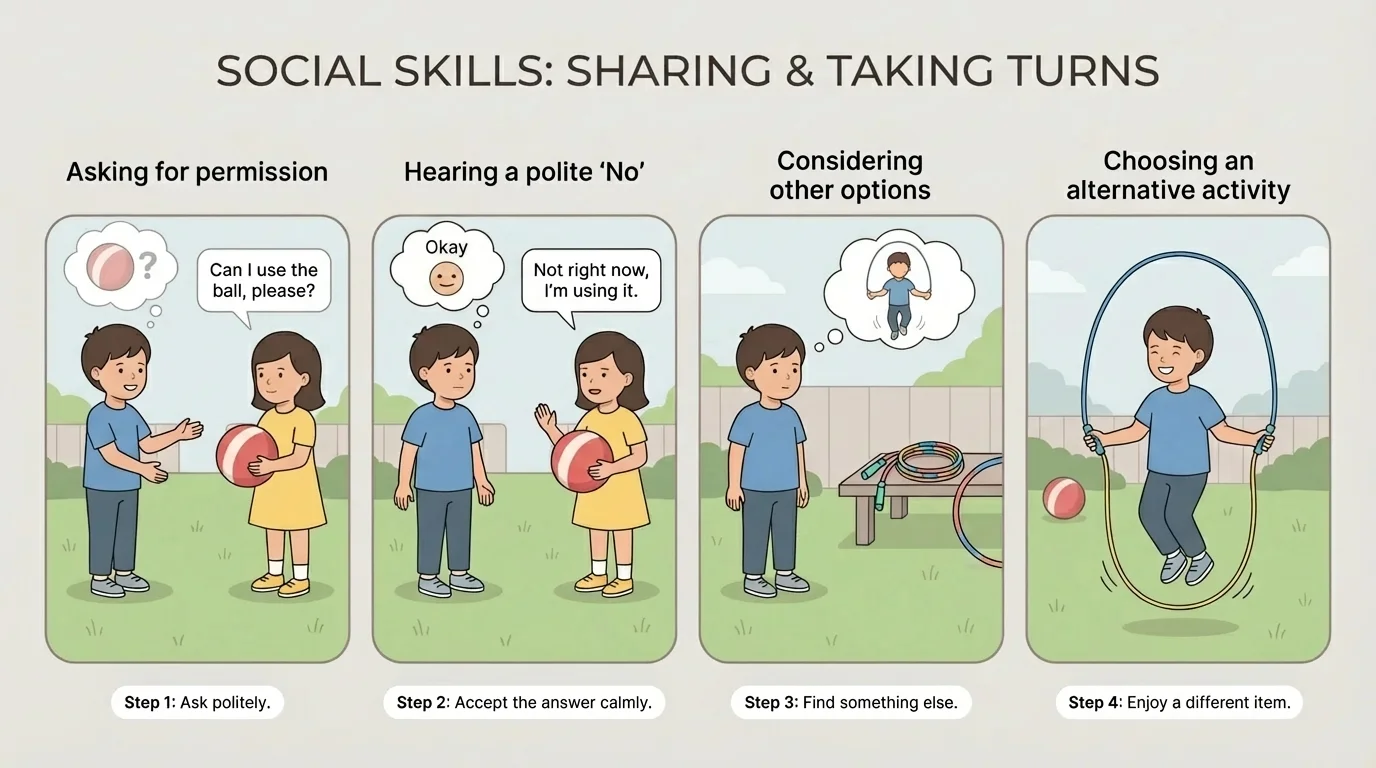
A person may say no for many reasons. They may still be using the item. It may be special. It may be breakable. They may need it right now. Hearing no does not mean they are unkind. It means they are making a choice about their own item.
When someone says no, we do not grab, yell, or pout. We can ask a teacher for help if we feel upset. We can also look for another toy, tool, or game. Like the child in [Figure 3], we can make a new choice and keep playing.
"Ask first. Listen next. Be kind always."
Learning to hear both yes and no helps children solve problems in peaceful ways. [Figure 4] It teaches patience and respect for other people.
When someone lets you borrow something, you have a responsibility to care for it. Responsibility means doing the right thing with what has been trusted to you.
Use borrowed things the right way. Keep crayons on the paper, not on the wall. Carry books with clean hands. Roll a ball where it is safe. Put puzzle pieces back in the box. Then return the item to the person who owns it or to the place where it belongs.
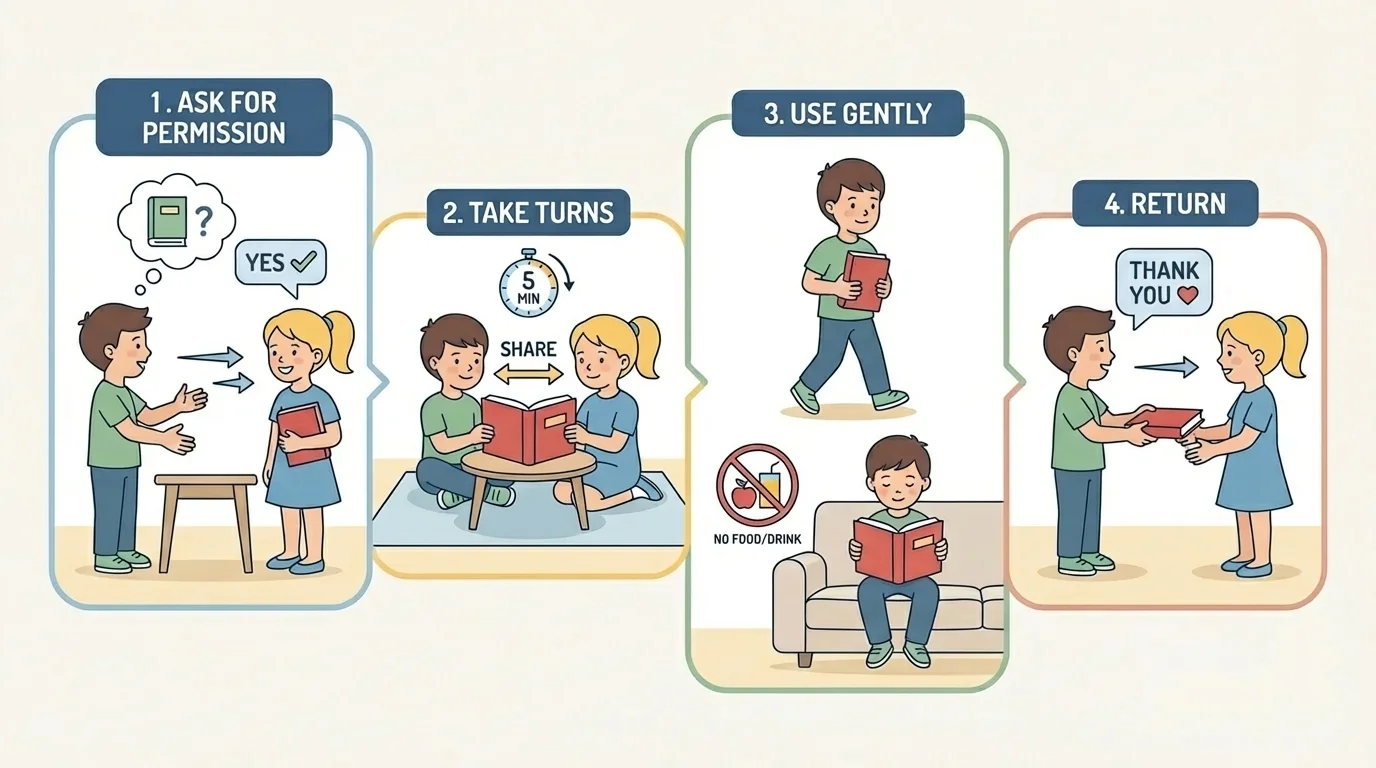
If something breaks or gets lost, tell the truth right away. A grown-up can help. Honest words and careful actions show that you can be trusted.
Returning items matters. If you keep someone else's toy in your cubby or take a class pencil home, the owner may feel worried because they cannot use it. As seen in [Figure 4], borrowed items should come back after use.
Remember that kind classroom behavior includes using gentle hands, listening ears, and polite words. These same skills help with borrowing and sharing.
When children care for items and return them, the whole group has more things ready to use. This helps everyone learn, play, and work together better.
At home, you might ask, "Can I use your puzzle?" before touching a brother's or sister's game. At school, you might ask a classmate before using their eraser. On the playground, you might wait in line for a tricycle or ask for a turn with a bucket.
Some items are for everyone, like many classroom supplies. Even then, children still take turns. A class easel, sink, or favorite center may be shared by a group. Asking, waiting, and kind words still help.
When we use another person's things kindly, we show good manners and good judgment. We understand that people have needs and wants, and they make choices. We can make kind choices too.
