Have you ever built a block tower with a friend and noticed that it works best when everyone is kind, truthful, and ready to share? That is part of being a good citizen. A good citizen helps a group work well together. Even young children can show good citizenship every day.
People belong to many groups. You are part of a family. You may be part of a class, a play group, or a playground group. In each group, people do better when they treat one another with care. Good citizenship means doing your part so everyone can learn, play, and feel welcome.
When we talk about citizenship here, we mean how people act in a group. A group can be small, like two children cleaning up toys, or bigger, like a whole class singing together. A good citizen follows rules, helps others, and thinks about what is good for everyone.
Citizenship means being a helpful and responsible member of a group. Courtesy means using kind manners. Honesty means telling the truth. Fairness means treating people in a just way, such as sharing and taking turns.
Good citizenship is not only for adults. Children show it too. When you wait in line, listen to a classmate, or help pick up books, you are helping your group. These actions make the classroom and other places peaceful and happy.
Courtesy helps a group feel calm and safe. As [Figure 1] shows, children can work well together when they use kind words, listen, and take turns speaking. Courtesy can sound like, "Please," "Thank you," "You go first," or "May I help?"
Courtesy also means using kind actions. You can keep your hands to yourself, look at the person who is talking, and wait for your turn. If everyone grabs, shouts, or interrupts, the group has a hard time working together.
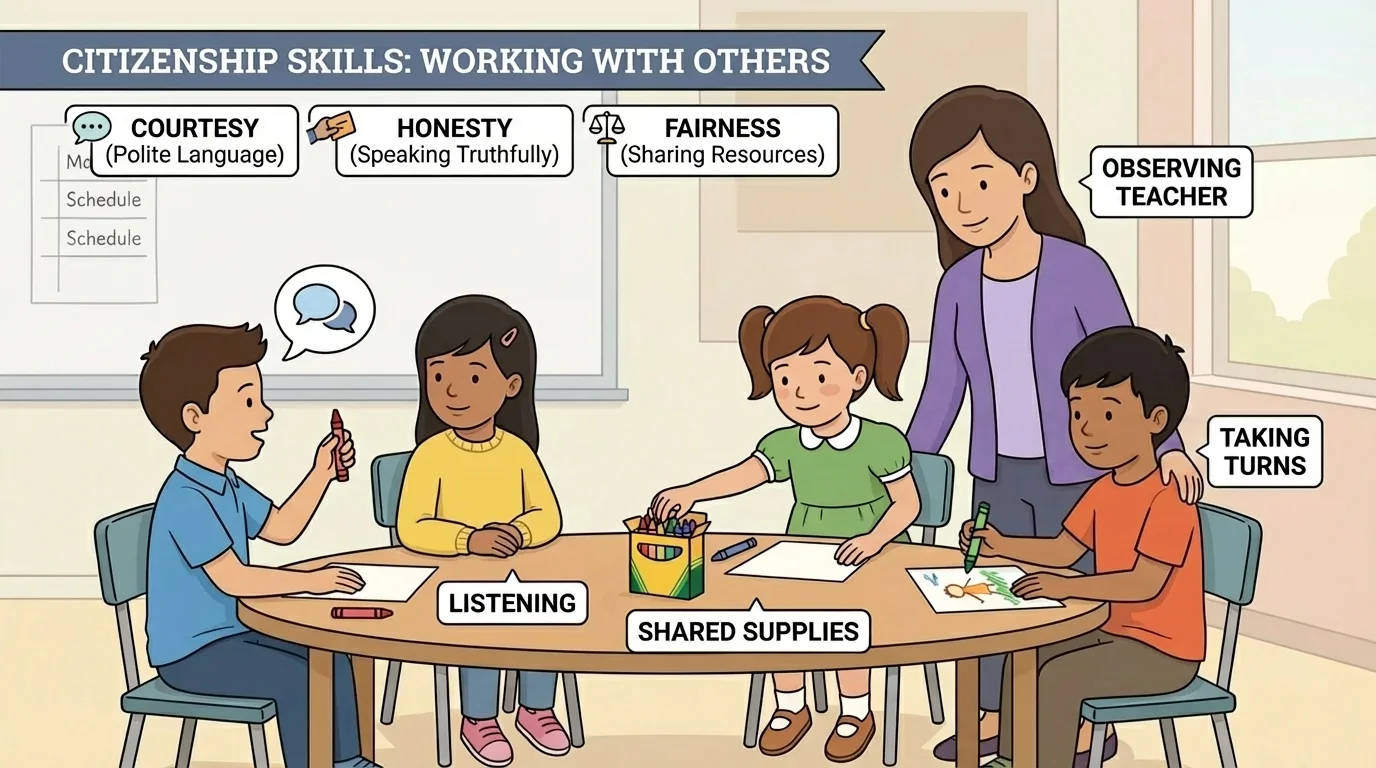
Being courteous does not mean you always get your way. It means you remember that other people matter too. If two children want the same red crayon, a courteous choice is to share it or take turns using it.
Classroom example
A small group is making a picture together.
Step 1: One child asks, "Can I use the blue marker when you are done?"
Step 2: The other child says, "Yes, I will give it to you next."
Step 3: They keep working, and each child gets a turn.
This is courtesy because the children speak kindly and respect each other.
Later, when groups do art, clean-up, or center time, the same polite habits still matter, just like the teamwork in [Figure 1]. Courtesy helps people feel included instead of left out.
Honesty means telling the truth. It also means doing the right thing even when it feels hard. If you spill the paint, honesty means saying, "I spilled it," instead of blaming someone else.
Honesty helps people trust each other. Trust means people believe your words. When a teacher, friend, or family member can trust you, it is easier to solve problems and work together.
Why honesty matters in groups
Groups work best when people know what is true. If someone makes a mistake and tells the truth, the group can fix the problem. If someone hides the truth, the problem may get bigger.
Everyone makes mistakes sometimes. Good citizens do not have to be perfect. They need to be truthful. Saying "I am sorry" and helping fix a mistake is an honest and responsible choice.
Honesty can also mean telling the truth in friendly ways. You can be truthful and kind at the same time. For example, instead of saying something in a mean voice, you can say, "I think this piece goes over here."
Fairness means people are treated in a just way. As [Figure 2] illustrates, fairness often means taking turns so each person gets a chance. In games, on swings, and during class jobs, fairness helps everyone feel respected.
Fairness does not always mean everyone gets the exact same thing at the exact same time. Sometimes fairness means listening to what each person needs. A child who has not had a turn yet should get a turn before someone who already had one.
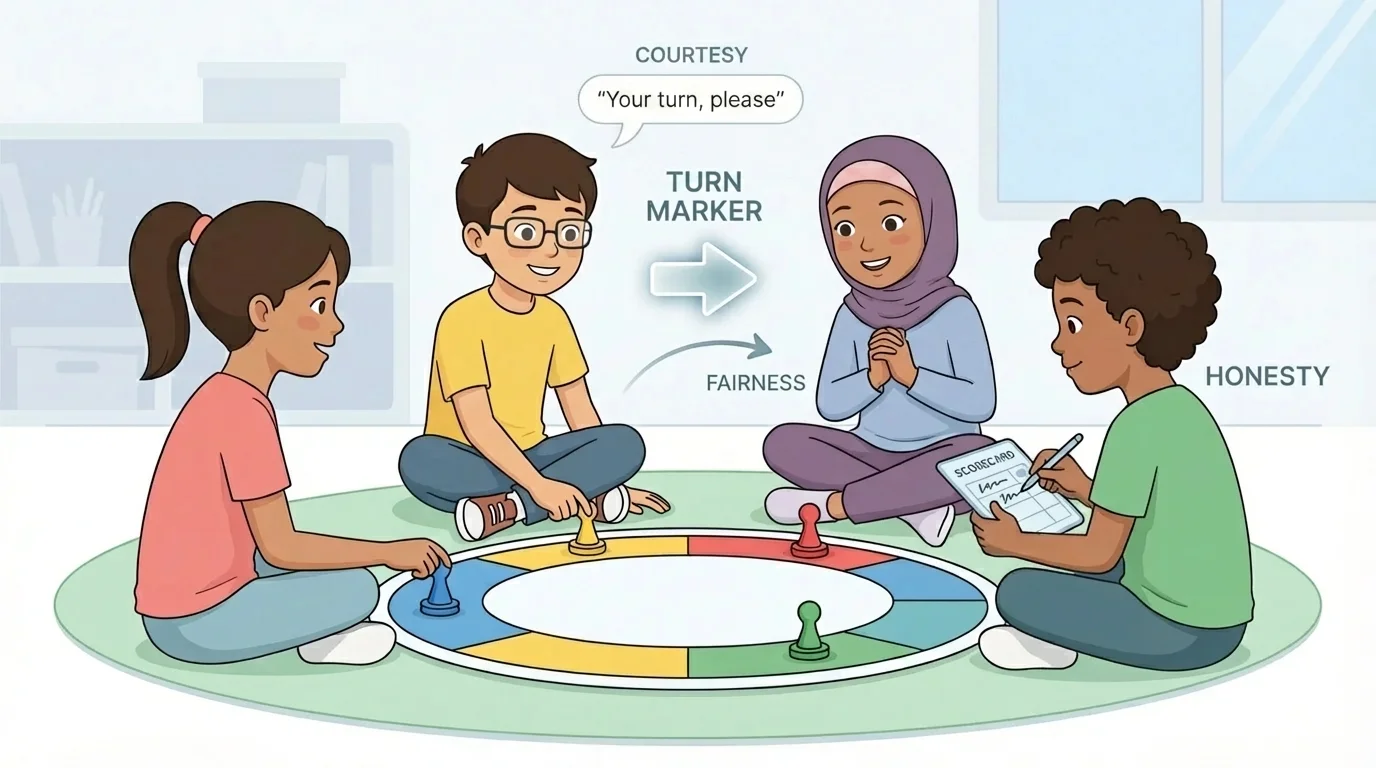
Rules can help groups be fair. A rule like "one at a time" helps everyone know what to do. When people follow the same rule, the game or activity runs more smoothly.
Young children learn fairness early. Even very small children notice when someone keeps all the toys or skips ahead in line.
Think about snack time, recess, or board games. Fairness means no pushing to the front, no taking more than your share, and no changing the rules just to win. The turn-taking in [Figure 2] reminds us that groups stay happier when everyone has a chance to join in.
Good citizenship happens in many groups every day. You may help set the table with your family, raise your hand in class, wait your turn on the playground, or help keep your neighborhood clean. The same skills can travel from one group to another.
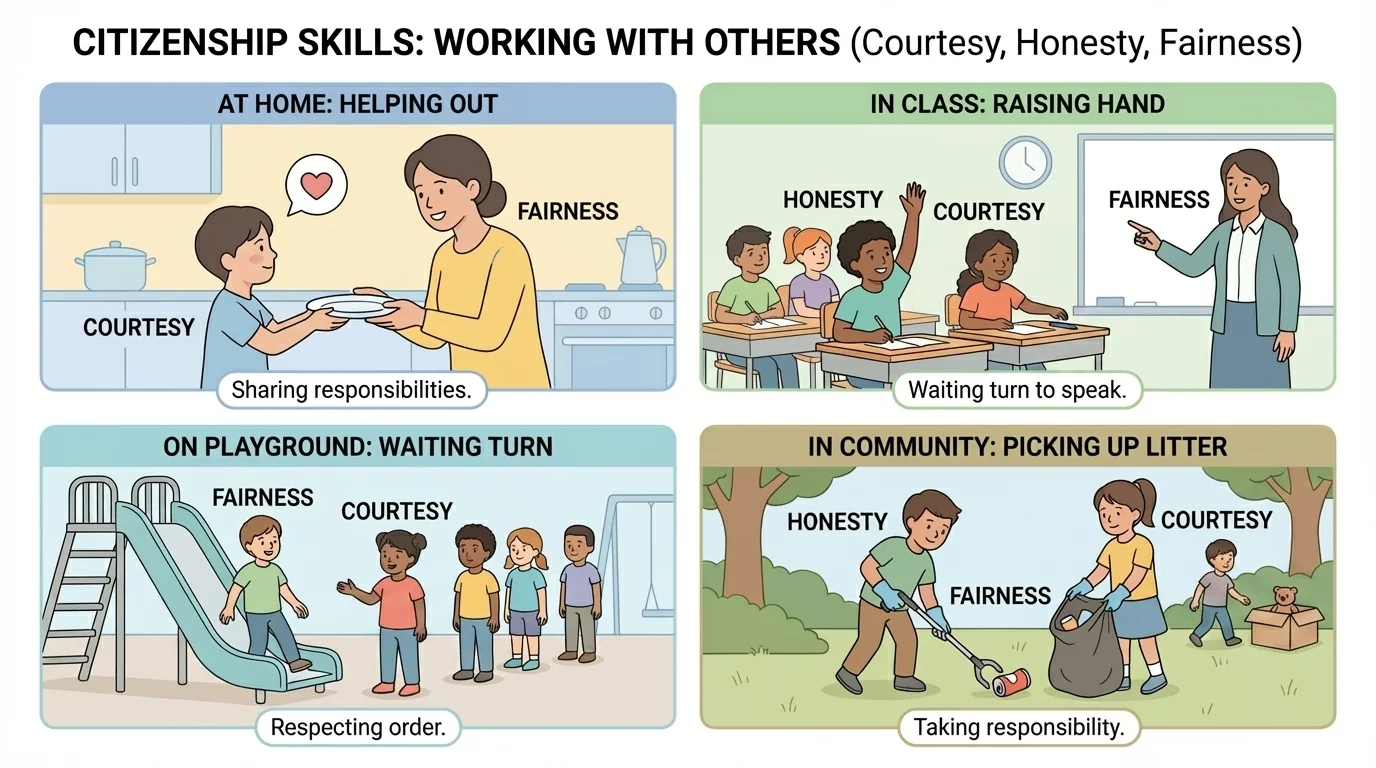
In a family, courtesy may mean speaking politely to a brother, sister, or grown-up. Honesty may mean telling the truth about who broke the cup. Fairness may mean sharing toys or helping with chores.
In a classroom, courtesy may mean listening while another child talks. Honesty may mean saying the true answer about what happened. Fairness may mean taking turns with classroom supplies.
On a team or during play, courtesy may mean cheering kindly. Honesty may mean following the rules. Fairness may mean not leaving someone out. The many scenes in [Figure 3] show that citizenship is not just for one place. It is for many kinds of groups.
Sometimes people disagree. That is normal. Good citizens try to solve small problems in peaceful ways. First, stop and use a calm voice. Next, tell the truth about the problem. Then, look for a fair answer.
Playground example
Two children want the same ball.
Step 1: One child uses courtesy and says, "I would like a turn, please."
Step 2: The other child uses honesty and says, "I just started playing with it."
Step 3: Both children use fairness and agree to take turns.
The problem is solved with kind words, truth, and sharing.
Asking a teacher or trusted adult for help is also a good choice when children cannot fix a problem by themselves. Getting help is not tattling when someone is hurt, unsafe, or being treated unfairly.
When children use courtesy, honesty, and fairness together, they become stronger group members. They help build classrooms, families, and play spaces where people feel safe, heard, and valued.
"Kind words, true words, and fair choices help groups grow strong."
