What if two children look at the same playground and say two different things? One child says, "The slide is blue." Another child says, "The slide is the best part." Both are talking about the slide, but they are not saying the same kind of thing. One is something we can check. The other is a feeling or idea. Learning the difference helps us listen, talk, and make good choices with other people.
A fact is something true that can be checked. We can look, count, ask, or find proof. If someone says, "Our class has one teacher," we can check if that is true. If someone says, "Fire trucks are red," we can look and see many fire trucks are red.
An opinion is what someone thinks or feels. It is not something everyone must agree on. If someone says, "Fire trucks look cool," that is an opinion. Another person might think buses look cooler. Opinions can be different, and that is okay.
Fact means something that is true and can be checked.
Opinion means what a person thinks, feels, or likes.
[Figure 1] Sometimes facts and opinions are about the same topic. For example, "The park has trees" is a fact if the trees are really there. "The park is beautiful" is an opinion because beauty is a feeling. People can agree or disagree about opinions.
We can tell the difference by asking a simple question. Is this something I can check? A fact can be checked. A opinion tells what someone thinks or feels. Facts often use words about things we can see or know. Opinions often use feeling words like best, pretty, yummy, or boring.
If a child says, "The school has a flag," we can look and check. That is a fact. If a child says, "The school flag is pretty," that is an opinion. The word pretty gives us a clue that the sentence tells a feeling.
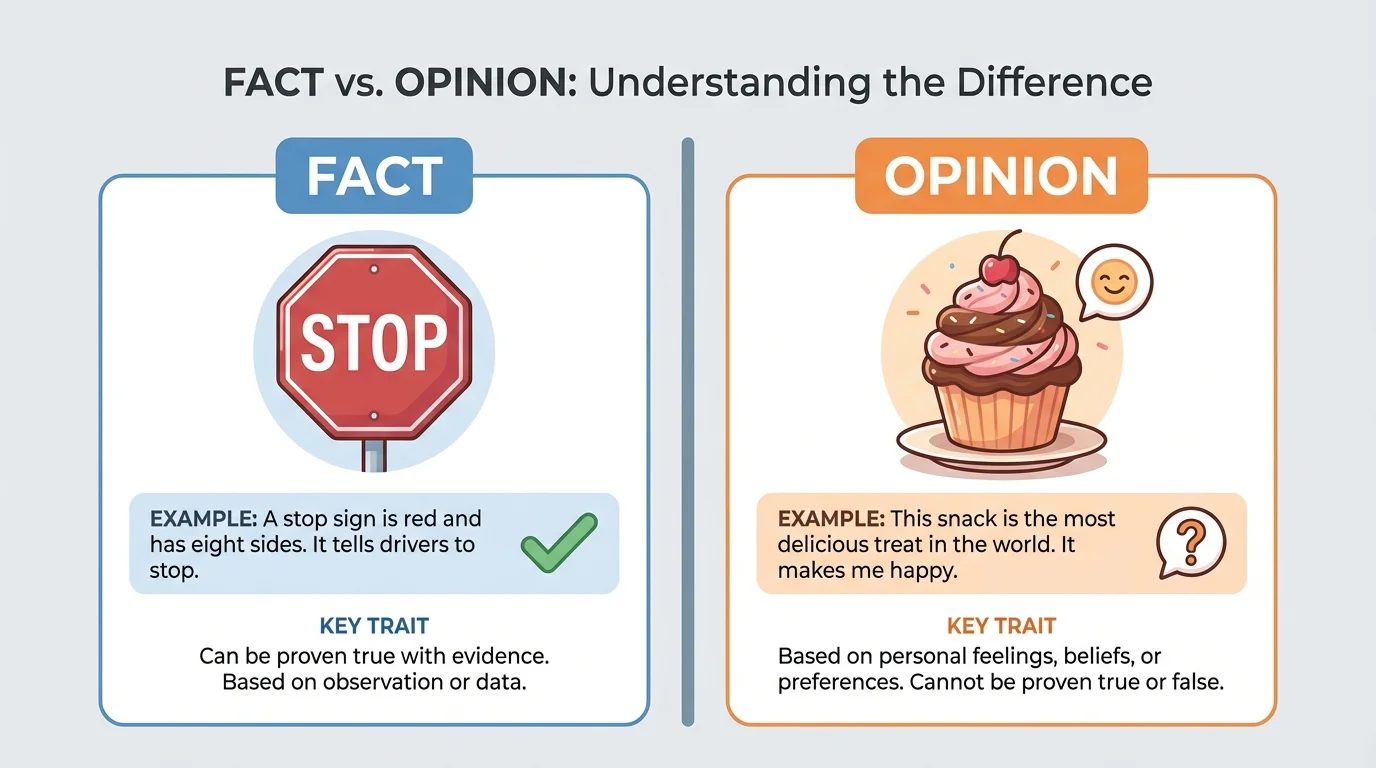
[Figure 2] Here are more clues. Facts stay true even if we do not like them. Opinions can change from person to person. "There are swings on the playground" can be checked. "Swings are more fun than slides" is an opinion because another child may like slides more.
Sometimes a sentence starts with words like "I think," "I like," or "My favorite." Those words often tell us we are hearing an opinion. A sentence with counting or noticing, such as "There are five books on the table," is often a fact because we can count and check it.
People do many things together in a class, a family, and a community. They share ideas, listen, help, and make choices. In a group, facts and opinions both matter. In a class meeting, children may say facts like "We have art on Friday" and opinions like "I want to paint today." When people work together, they need to know which kind of statement they hear.
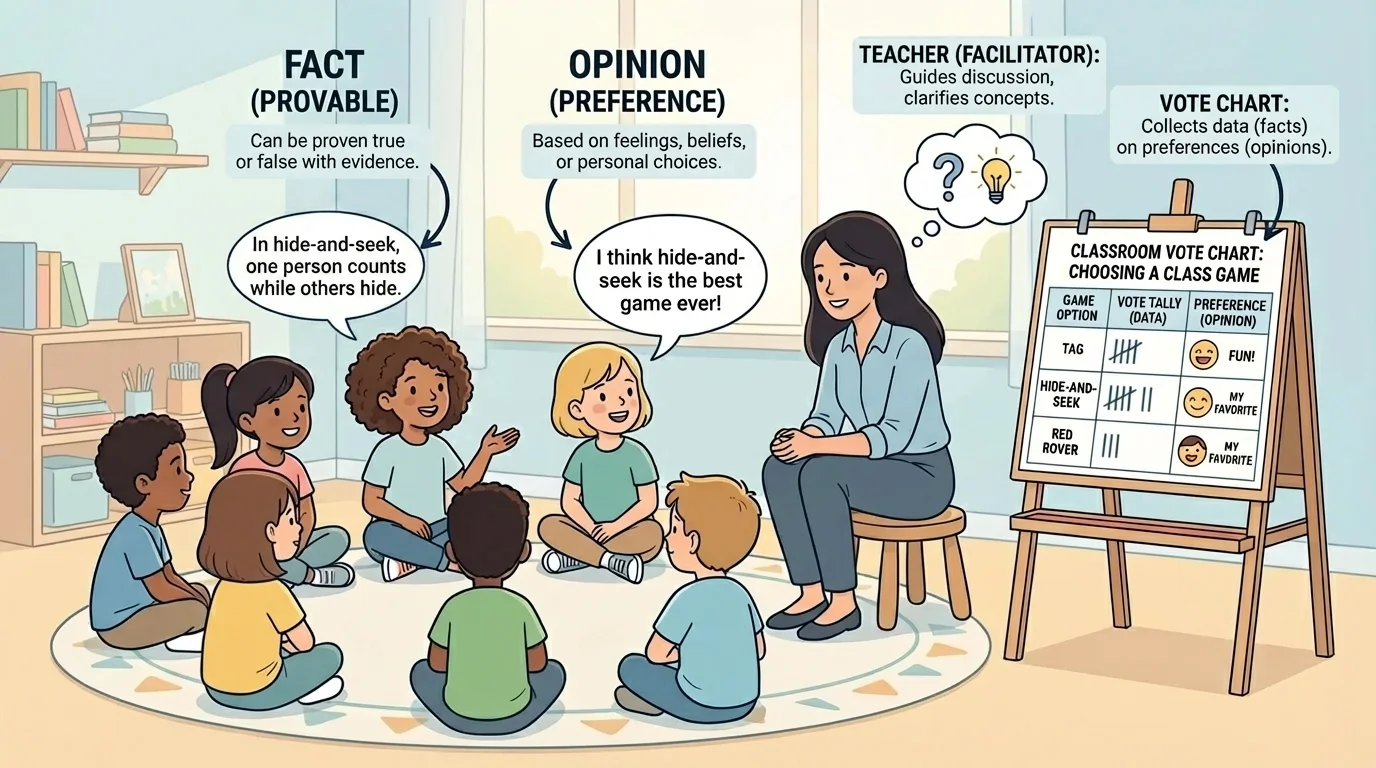
Facts help a group know what is true. Opinions help a group hear what people want or feel. If a class is choosing a game, a fact might be "We have one ball." An opinion might be "Tag is the most fun game." Knowing the difference helps everyone talk fairly and listen kindly.
Families use facts and opinions too. A fact might be "The library closes soon." An opinion might be "Reading outside is nicer than reading inside." Communities use both when people talk about parks, safety, or events. Facts tell what is happening. Opinions tell what people think should happen.
Using facts and opinions together helps groups make choices. Facts give true information. Opinions let people share feelings and ideas. Good listeners can tell the difference and treat both with respect.
When we listen in a group, we do not have to say every opinion is a fact. We can be polite and still notice the difference. That helps us be thoughtful classmates and community members.
Let's look at simple sentences. "The bus is yellow" is a fact because we can see the bus color. "The bus is too noisy" is an opinion because too noisy tells how someone feels.
Example set
Step 1: Sentence: "The stop sign is red."
This is a fact because we can look at the sign and check its color.
Step 2: Sentence: "Red is the best color."
This is an opinion because people can like different colors.
Step 3: Sentence: "Our town has a park."
This is a fact because we can check if the park is there.
Step 4: Sentence: "Our park is the nicest place in town."
This is an opinion because nicest is a feeling word.
We can use the same idea at school. "We eat lunch in the cafeteria" is a fact if that is where lunch happens. "Lunch time is the best part of school" is an opinion. As we saw in [Figure 1], facts can be checked, but opinions depend on what someone thinks.
Here is another pair. "The crossing guard helps children cross the street" is a fact. "The crossing guard is very kind" may be an opinion, even if many people agree. Kindness is something people judge from what they feel and notice.
People can have the same opinion, but it is still an opinion. If many children say apples taste good, that does not turn the opinion into a fact.
Some sentences can even have both together. "The meeting is after lunch, and that is a great time" has a fact and an opinion in one sentence. The first part can be checked. The second part tells a feeling.
Knowing the difference between fact and opinion helps us in everyday life. It helps us understand books, conversations, signs, and announcements. It also helps when we talk in groups, choose a class job, or listen to different ideas.
When someone shares a fact, we can check it. When someone shares an opinion, we can listen respectfully, even if we think something different. In group choices, facts help us know what is possible. Opinions help us learn what people like or want. As shown in [Figure 2], both kinds of statements can be part of a fair class decision.
Being able to tell fact from opinion is part of being a careful listener and a kind speaker. It helps children join conversations, solve problems, and take part in classroom and community life.
