Have you ever seen your shoes right by your feet and the moon high, high up in the sky? They are not in the same place. Some things are close to us, and some things are far away. Learning these words helps us talk about where things are in our room, on the playground, and in the world around us.
Near means something is close. Far means something is not close. A cup on your table may be near. A hill across town may be far. As [Figure 1] shows, we can look at two things and tell which one is close to us and which one is farther away.
If your book is next to you, it is near. If the door is across the room, it is farther away. We use our eyes and our bodies to notice space around us.
Near means close to a person or thing. Far means a longer distance away.
These words help us describe where things are. They are called spatial concepts. This means they help us think and talk about space and place.
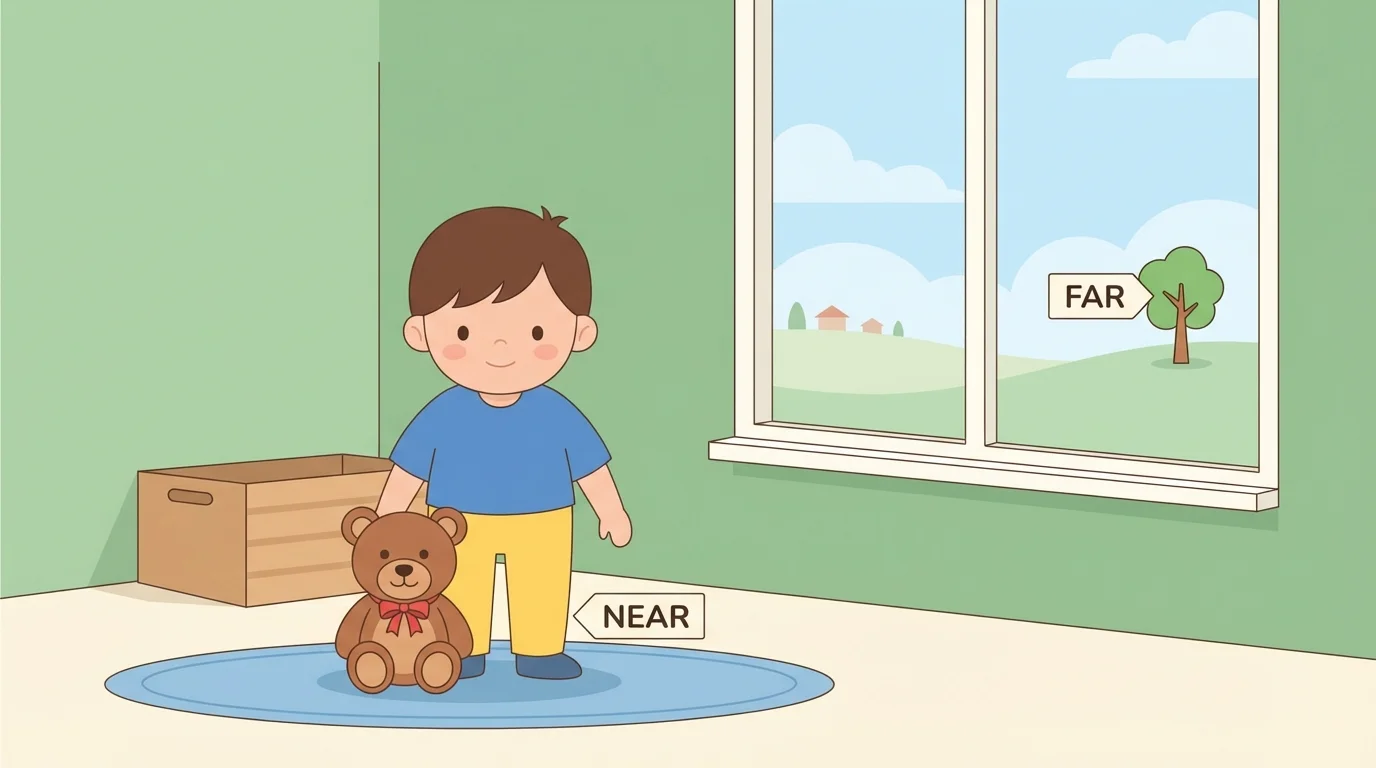
We can compare objects by asking, "What is near me?" and "What is far from me?" Your hands are near your body. The ceiling is farther away. A snack on your plate is near. A bird in the sky is far.
Sometimes we use our own bodies as the starting point. We may say, "The ball is near me," or "The bus is far from me." This helps us understand where things are from where we stand, sit, or walk.
Young children begin to learn about places by using simple words like near, far, in, on, and under. These words are the first steps to understanding maps and directions later on.
Near and far are about distance. Distance means how much space is between one thing and another. For very young learners, we notice distance by looking and moving, not by measuring with numbers.
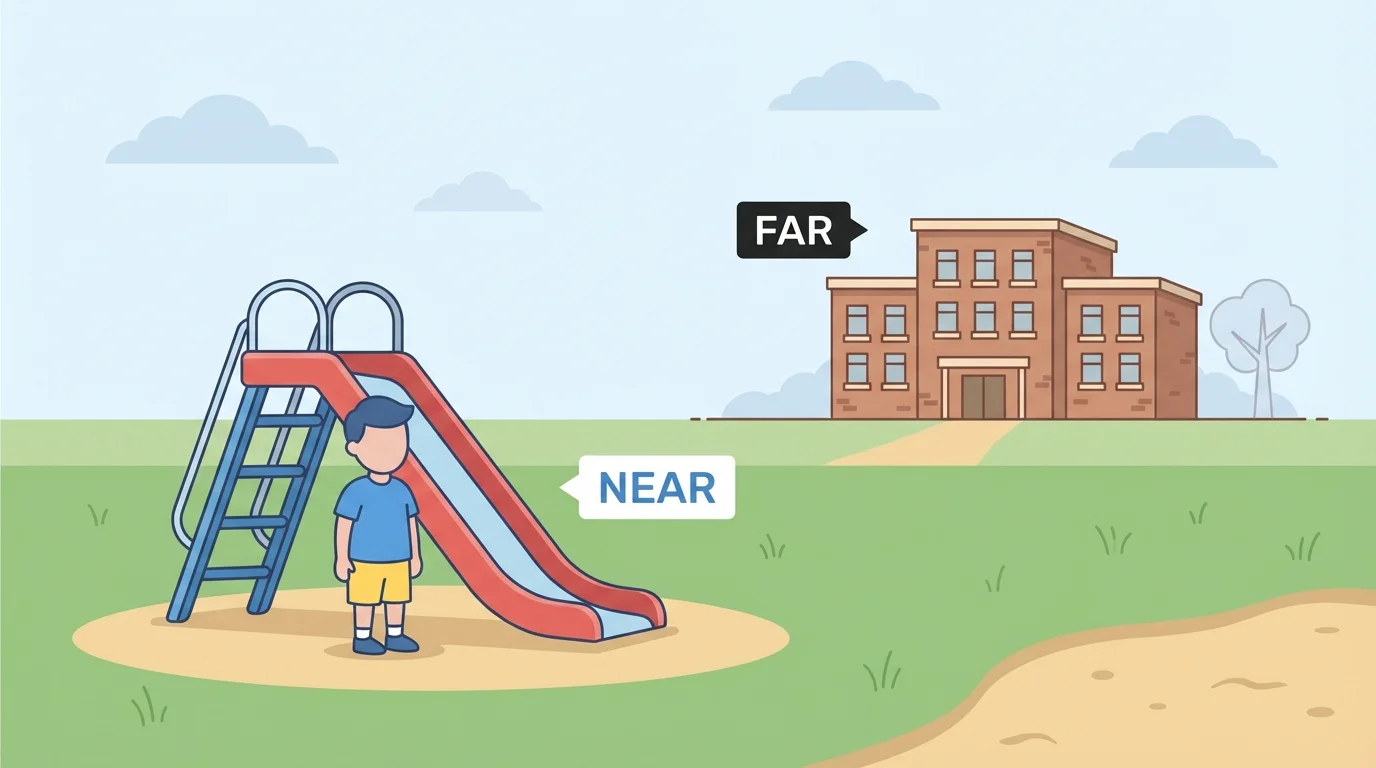
We use near and far in real places every day. At home, your bed may be near your nightlight. The kitchen may be farther from your bedroom. At school, your teacher may be near you at circle time, and the playground may be farther away down the hall. In familiar places, [Figure 2] illustrates how some things are close by while other places are farther away in the same area.
Outside, a flower by the sidewalk may be near. A mountain in the distance may be far. A swing can be near on the playground, while the parking lot may be farther away. These ideas help us understand our place in the world.
Geography helps us think about where things are. Even little children can notice that some places are close to home and some places are farther away. The corner store might be near your house, but the beach or a big city might be far.
Places around us are connected. We live in one place, and other places can be near or far from where we are. Learning this helps us understand our classroom, neighborhood, and bigger world.
Something can be near for one person and far for another person. A ball may be near one child but far from another child standing across the yard. As [Figure 3] shows, where you stand changes what feels near and what feels far.
This is called perspective. Perspective means how something looks or seems from a particular place. If you move closer to the sandbox, the sandbox becomes near. If you walk away, it becomes farther.
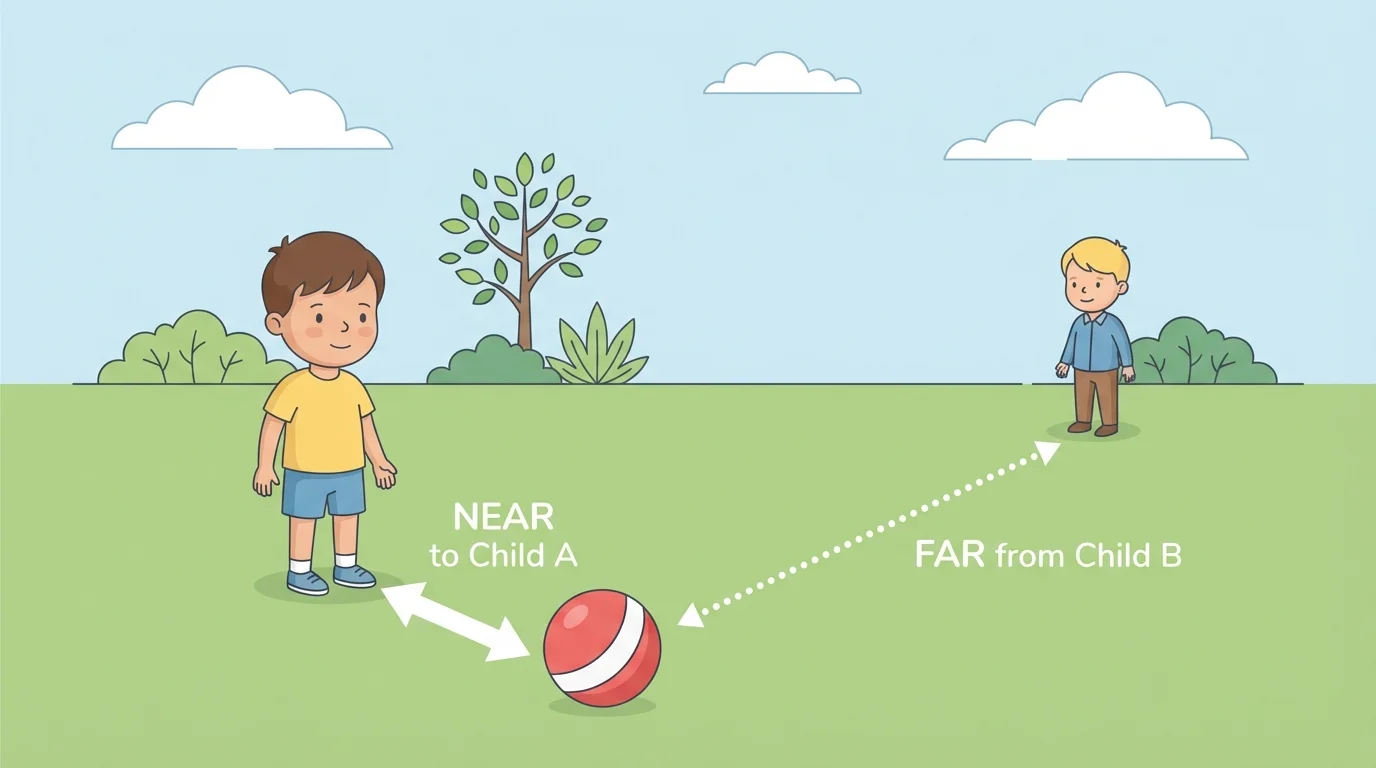
That is why two people can talk about the same object in different ways. One person may say, "The tree is near," while another says, "The tree is far." Both can be right because they are standing in different places.
These words are important for everyday life. Grown-ups may say, "Stay near me," to help keep you safe. We may say, "The bathroom is near," or "Grandma lives far away." Near and far help us talk clearly.
Near and far also help when we look at pictures and maps later on. A map is a drawing of a place. When children begin to learn about maps, they already know some helpful ideas: close places, far places, and where things are around them. The playground example from [Figure 2] connects to this idea because children notice nearby and farther places in one scene.
When we move, our understanding can change. The same object from [Figure 3] reminds us that location matters. We can look, walk, and notice how space around us changes.
Real-life examples of near and far
Step 1: At snack time, your cup is near your hand.
Step 2: The sink across the room is farther away.
Step 3: On a walk outside, the grass by your shoes is near, but the clouds are far.
These examples help us use the words in real places.
When children learn near and far, they are building strong thinking skills. They are learning to notice location, compare spaces, and understand how people connect to places around them.
