Have you ever looked around your classroom and seen many wonderful things at once—different smiles, different voices, different hair, different clothes, and different ideas? A classroom is a place where many people come together. Even when children are not exactly the same, everyone can learn, play, and care for one another.
Each child is part of a family, a classroom, and a community. Belonging means being an important part of a group. Every person matters. Every person should feel safe, welcome, and loved.
In a classroom, some children are quiet and some are talkative. Some run fast and some move slowly. Some know many songs, and some know many stories. All of them still belong. A good classroom makes room for everyone.
Respect means treating people with kindness and care. Difference means a way someone is not exactly the same as someone else. Community is a group of people who live, work, or learn together.
Families can look different too. One child may live with a mother and father. Another may live with a grandparent, aunt, uncle, or foster family. Some families are big, and some are small. What matters most is that families care for the people in them.
Children can look different but still like many of the same things, as [Figure 1] shows. We all need food, rest, love, and care. We all have feelings. We can all feel happy, sad, excited, scared, or proud.
Many children enjoy building, drawing, singing, listening to stories, and playing games. We may not choose the same toys or the same songs, but we all like to learn and have fun. We all want friends who are kind.
People also share important rules. We take turns. We use gentle hands. We listen. We help keep our classroom clean. These shared actions help everyone learn together.
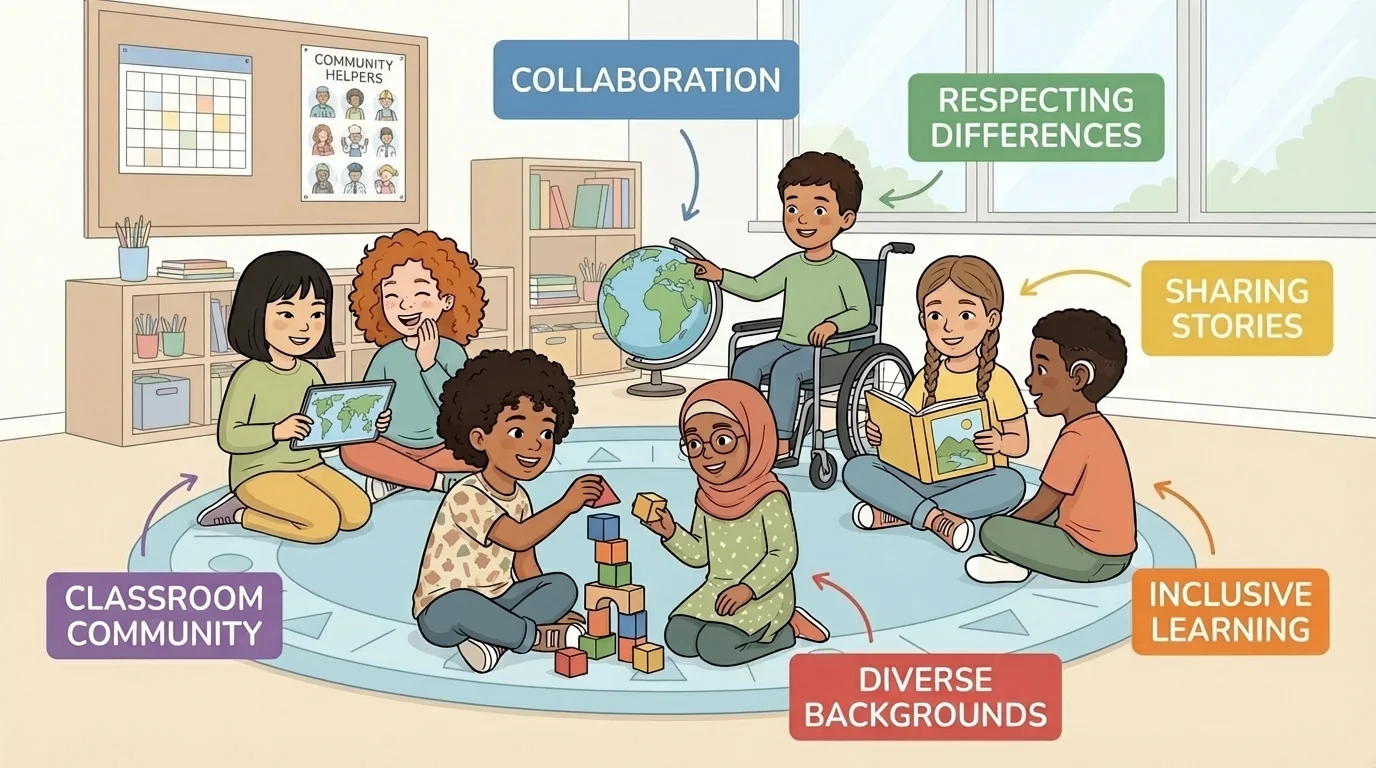
When we notice what we share, it helps us feel connected. A child who speaks a different language at home may still love puzzles. A child with different hair or skin may still enjoy the same storybook you do. Seeing sameness helps us build friendship.
Children around the world laugh, play, learn, and care about their families. Even when homes, foods, and languages are different, many feelings and needs are the same.
That is why a classroom can feel like a team. We are many people, but we learn side by side. As we saw in [Figure 1], children can join the same activity while each child still looks and sounds like themselves.
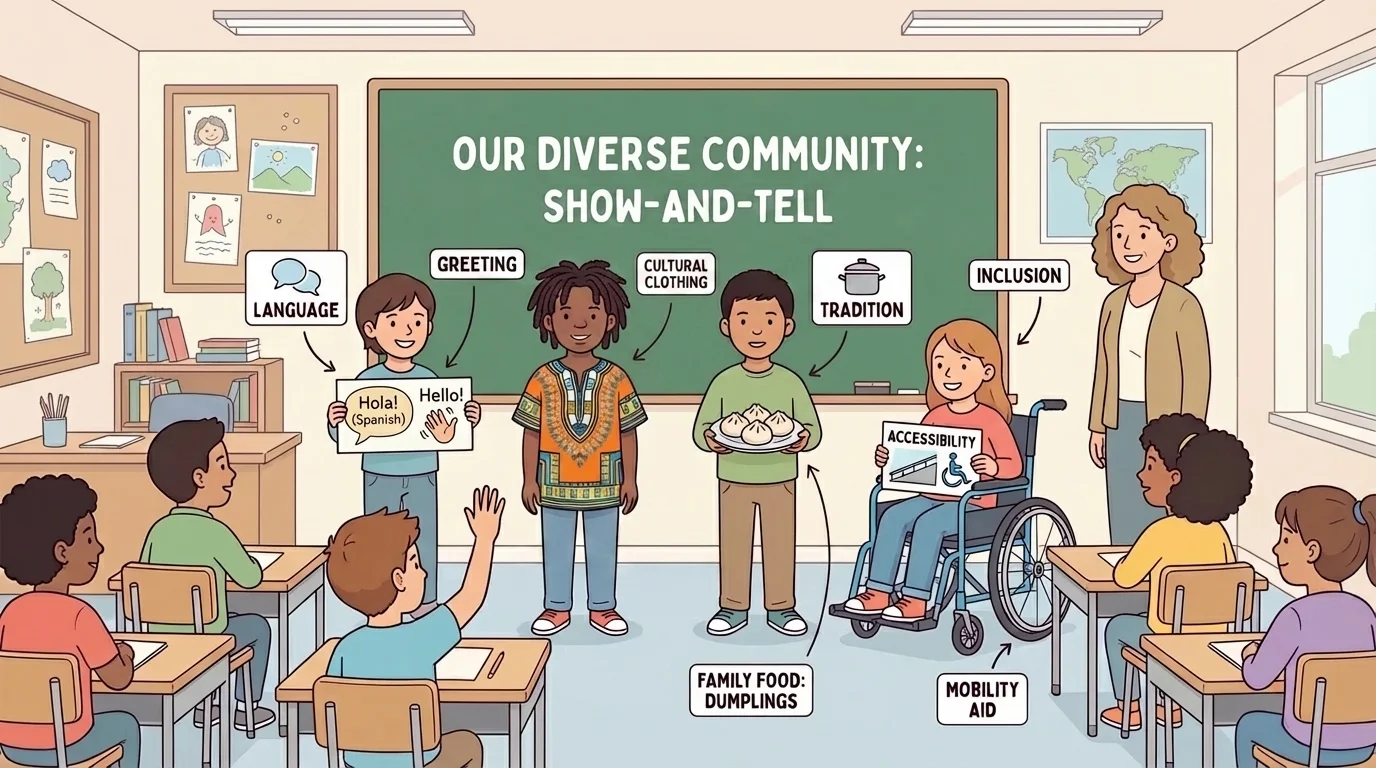
People have many kinds of diversity, and [Figure 2] illustrates some of them. We may have different skin colors, eye colors, hair textures, names, and voices. We may speak different languages or celebrate different holidays. We may eat different foods at home.
Some people move in different ways. A child may wear glasses. A child may use hearing aids. A child may use a wheelchair or another tool to help them move. These tools help people do things in their own way.
Different backgrounds bring new ideas to a group. One family may tell bedtime stories in Spanish. Another may pray before meals. Another may have special music for celebrations. Another may cook rice, soup, noodles, or bread in a favorite family way.
Differences are not problems to fix. They are part of who people are. We do not laugh at differences or say mean things about them. We learn about them with gentle curiosity and respect.
Differences make a group stronger
When people bring different experiences, skills, and traditions, a classroom has more stories, more ideas, and more ways to solve problems. A community becomes richer when people share what makes them unique.
If a class has children who know different songs, everyone can learn new music. If children bring different foods for a celebration, everyone can discover new tastes. The variety shown in [Figure 2] helps us understand that there is not just one right way to live, speak, dress, or celebrate.
Respect is something we do every day, and [Figure 3] shows simple ways to practice it. We use kind words. We listen when someone talks. We wait for our turn. We invite others to play. We speak gently about things that are new to us.
Respect also means noticing what another person needs. If a friend is talking, we listen. If a friend says "no," we stop. If a friend needs space, we give space. If someone needs help, we ask first: "Would you like help?" Asking first is respectful.
We can respect names by trying to say them correctly. We can respect home languages by listening kindly when someone speaks in a different way. We can respect family traditions by understanding that another family may do things differently from ours.
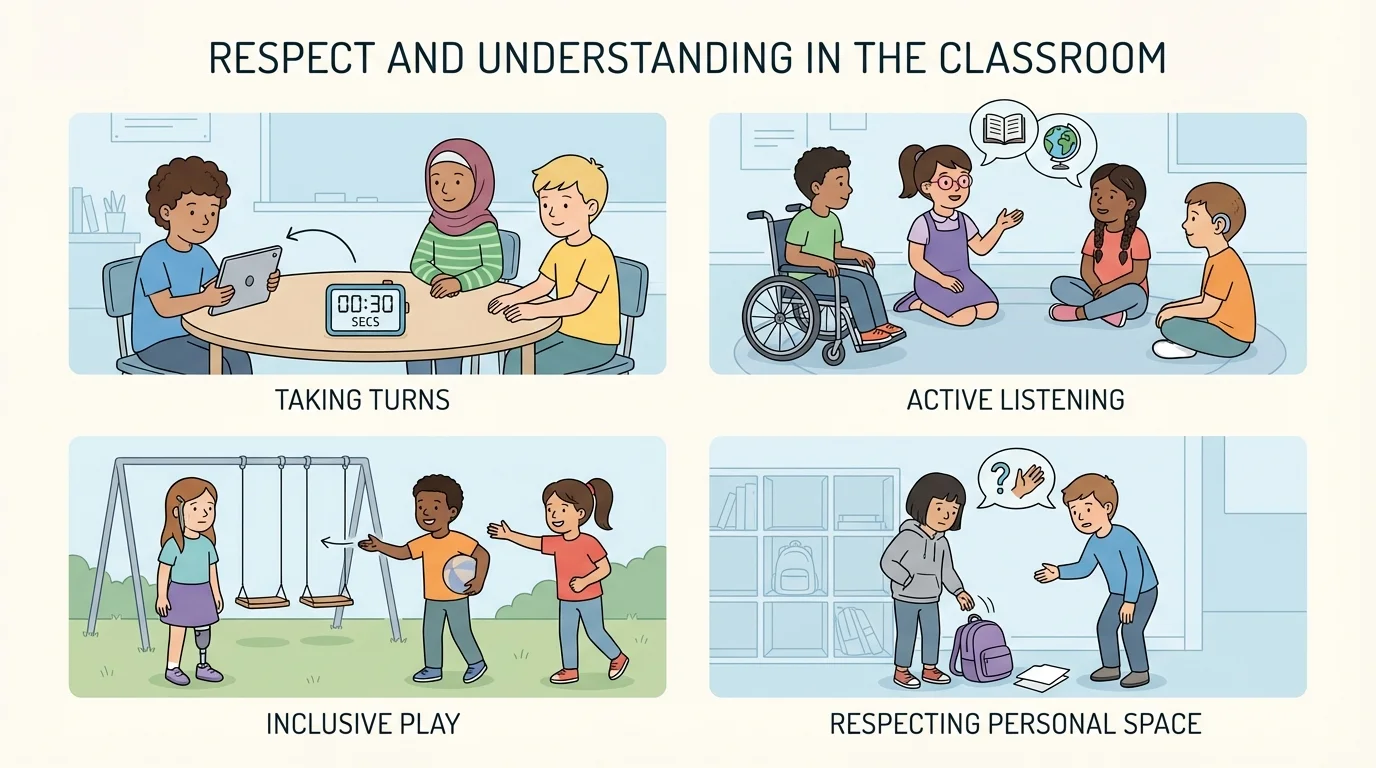
Respect is important during play too. If a game has room for one more, we can say, "You can play with us." If a child cannot do an activity in one way, we can help make another way. Fairness means making sure everyone has a chance to join in.
Everyday examples of respect
Step 1: You hear a friend speak a language you do not know.
You can smile, listen, and say, "That sounds beautiful," or "Can you teach me a word?"
Step 2: You see a classmate eating a food that is new to you.
You can be polite and say, "That looks interesting," instead of making a rude face or laughing.
Step 3: A child uses a wheelchair and wants to join a game.
You can ask, "How can we play together?" and help include everyone.
These actions may seem small, but they make a big difference. As shown in [Figure 3], respectful choices help everyone feel safe and included.
A classroom is one small part of a bigger community. In our neighborhood, we may meet people at parks, stores, libraries, places of worship, and homes. We may meet neighbors, bus drivers, teachers, doctors, firefighters, and other helpers. All kinds of people help a community work.
In a community, respect means being kind not only to close friends but to everyone. We greet people politely. We take care of shared places. We follow rules that keep people safe. We understand that others may celebrate different holidays or have different family customs.
When children learn to respect differences in the classroom, they are practicing how to be good citizens in the community. Listening, sharing, helping, and including are civic habits. They help groups live together peacefully.
You already know how to be kind by sharing, taking turns, and using gentle words. Respecting differences is another way to be kind. It means using those same caring actions with people who may not look, sound, or live exactly like you.
A strong community does not ask everyone to be the same. It welcomes many kinds of people. That is one reason communities can be interesting places to live and learn.
Sometimes a child notices something unfamiliar. Maybe a classmate wears special clothing, speaks another language, brings a different lunch, or uses a tool to move or communicate. It is okay to notice differences. What matters is what we do next.
We can look with friendly eyes, not stare. We can ask polite questions at the right time, not point or laugh. We can remember that every person wants to be treated with care. If we are unsure, we can ask a teacher how to be respectful.
You do not have to be exactly like someone to be their friend. Friendship can grow when we are open, gentle, and willing to learn. Our similarities help us connect, and our differences help us discover new things.
"Kindness is for everyone."
When we respect others, we make our classroom a happier place. When many people do this, the whole community becomes more welcoming.
