What happens when two children want the same toy at the same time? That can feel hard, but it is also a big chance to learn. We can use kind words, calm bodies, and helpful choices to get what we need and want. These actions help us with family members, classmates, friends, and adults. When we treat others with care, people are more ready to help us too.
Social skills are the ways we act and talk with other people. Good social skills help us ask for help, join play, share space, and fix little problems. They also help us show respect, even when someone is different from us or wants something different.
At home, in school, and in the community, people have needs and wants. A need may be help opening a snack or finding an adult. A want may be a turn with a ball or a seat next to a friend. We can try to get these things in peaceful ways instead of grabbing, yelling, or pushing.
Need means something important we must have, like help or safety. Want means something we would like to have, like a toy or a turn. Kind actions are gentle, helpful things we do for others.
When children learn to ask kindly, wait, and notice feelings, they begin to build trust. Trust means other people feel safe and comfortable with them.
[Figure 1] One strong way to get a need or want met is communication. Communication means using words, facial expressions, and body language to share a message. A child can ask for a turn by using a calm voice and kind words. Saying "May I have a turn?" works better than grabbing.
Listening is important too. When we listen, we stop, look, and hear what the other person says. If a friend says, "I am still using it," we can listen and wait instead of getting upset. Listening helps us understand the other person's idea and feeling.
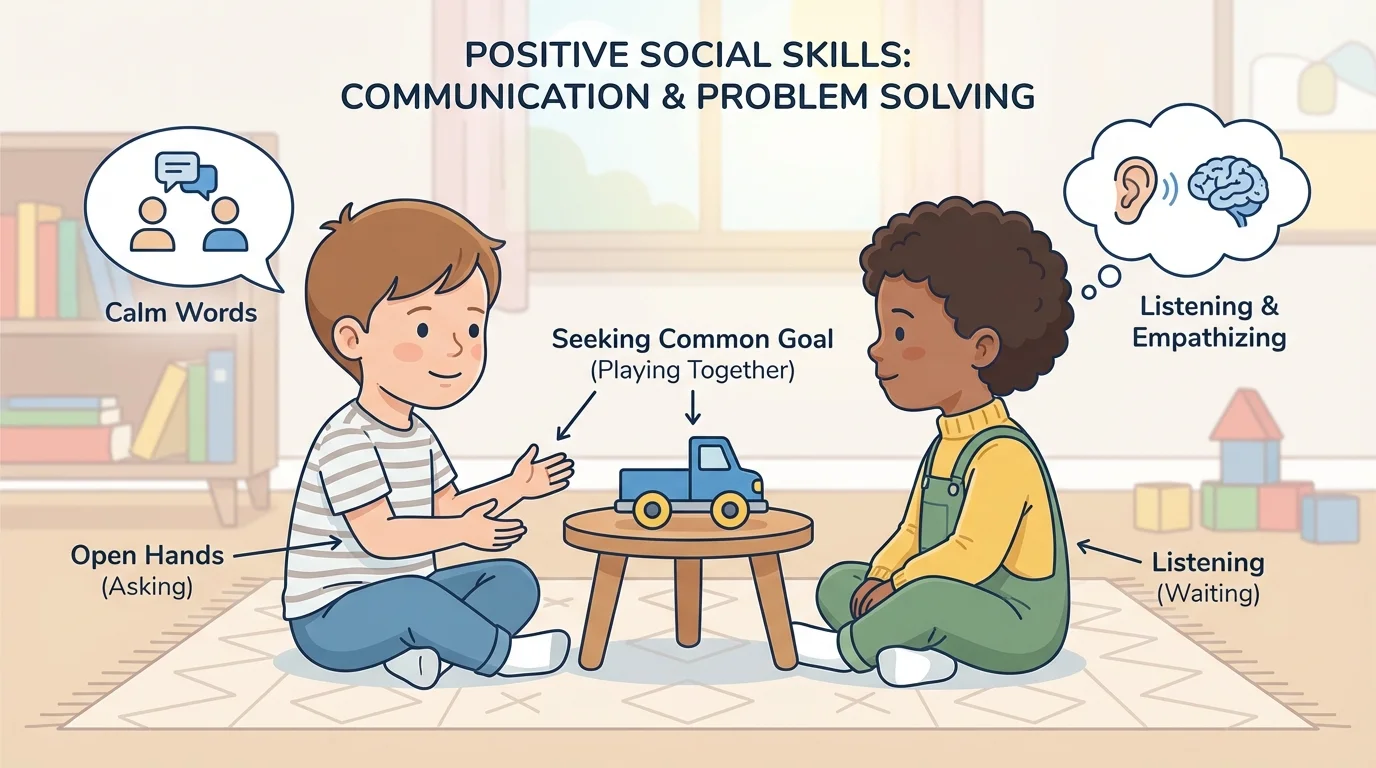
Children can also ask adults for help. A child might say, "Teacher, I need help with my zipper," or "Dad, I want more water, please." Clear words help adults know what is needed. Polite words such as "please" and "thank you" show respect.
Our bodies talk too. A soft face, gentle hands, and a quiet body help the message feel safe. Loud voices, stomping, or hitting make problems bigger.
Example: asking for a turn
Step 1: Stop your body and look at the person.
Step 2: Use kind words: "Can I have a turn when you are done?"
Step 3: Listen to the answer and wait if needed.
This helps both children feel respected.
Later, the same calm asking still matters. Kind communication helps children join play, ask for materials, and get support from adults.
[Figure 2] Sometimes two people want different things at the same time. A trade-off helps both people get something important in a fair way. One child may use the truck now, and the other child uses it next. Or one child chooses the song now, and the other child chooses the song later.
Taking turns is a simple trade-off. Waiting can be hard, especially for young children, but it helps everyone feel included. Sharing space, switching toys, and agreeing on "first you, then me" are peaceful ways to solve small disagreements.
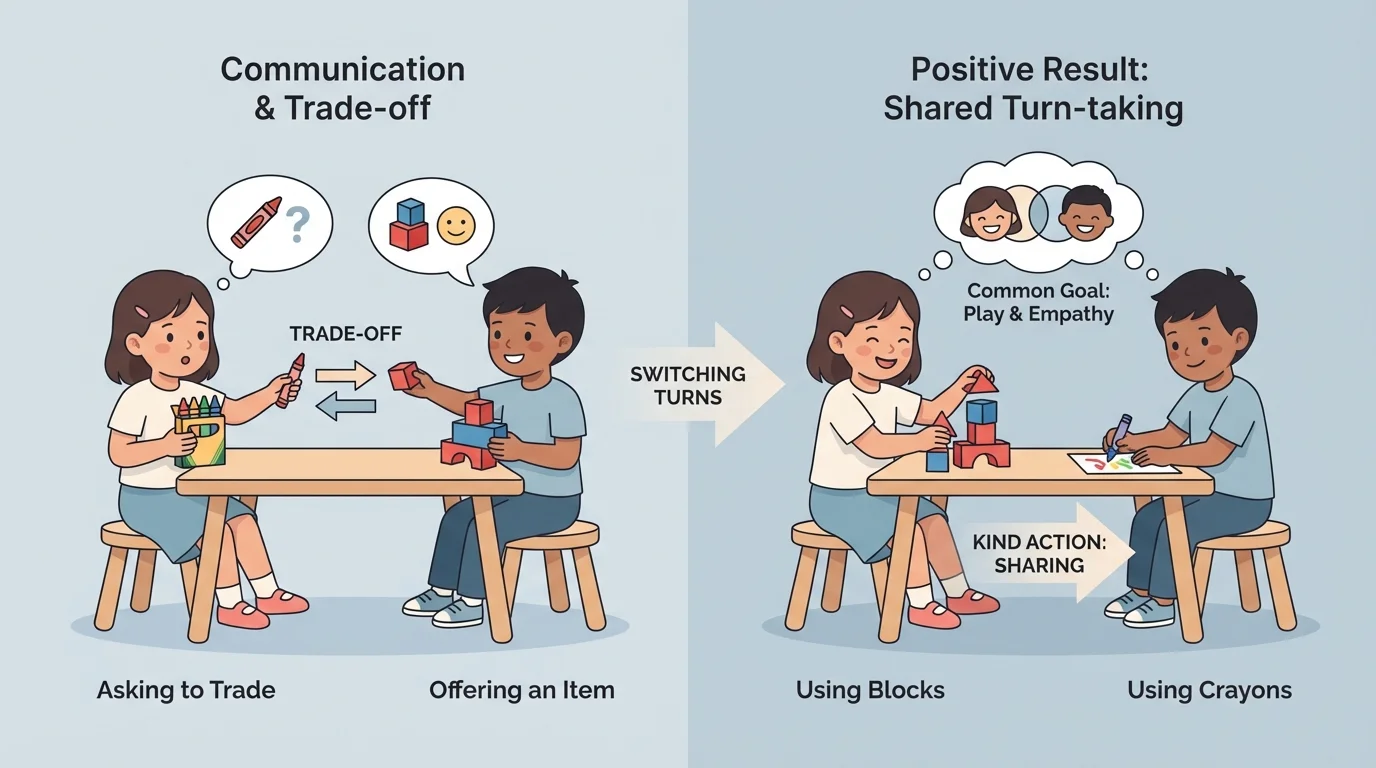
A trade-off does not mean one person gets everything. It means both people matter. Children learn that being fair is more helpful than always trying to win.
If a child wants the red crayon and a classmate has it, the child can say, "Can I use it after you?" If the classmate wants the blue one later, they can switch. This is a fair compromise.
Young children are just beginning to learn waiting and sharing. These skills grow stronger when children hear simple, repeated language like "my turn, your turn" and "first, then."
These fair choices connect to community life too. Families, classrooms, and playgrounds work better when people do not always have the same idea but still find a way for everyone to belong.
[Figure 3] Sometimes the best way to get what we need is to work with others. A common goal is something people want to do together. Children may all want the room clean so they can have snack time or start a new game.
Working together can mean carrying blocks, putting books away, or building one big tower with friends. When children help one another, the job gets done faster and people feel proud together.
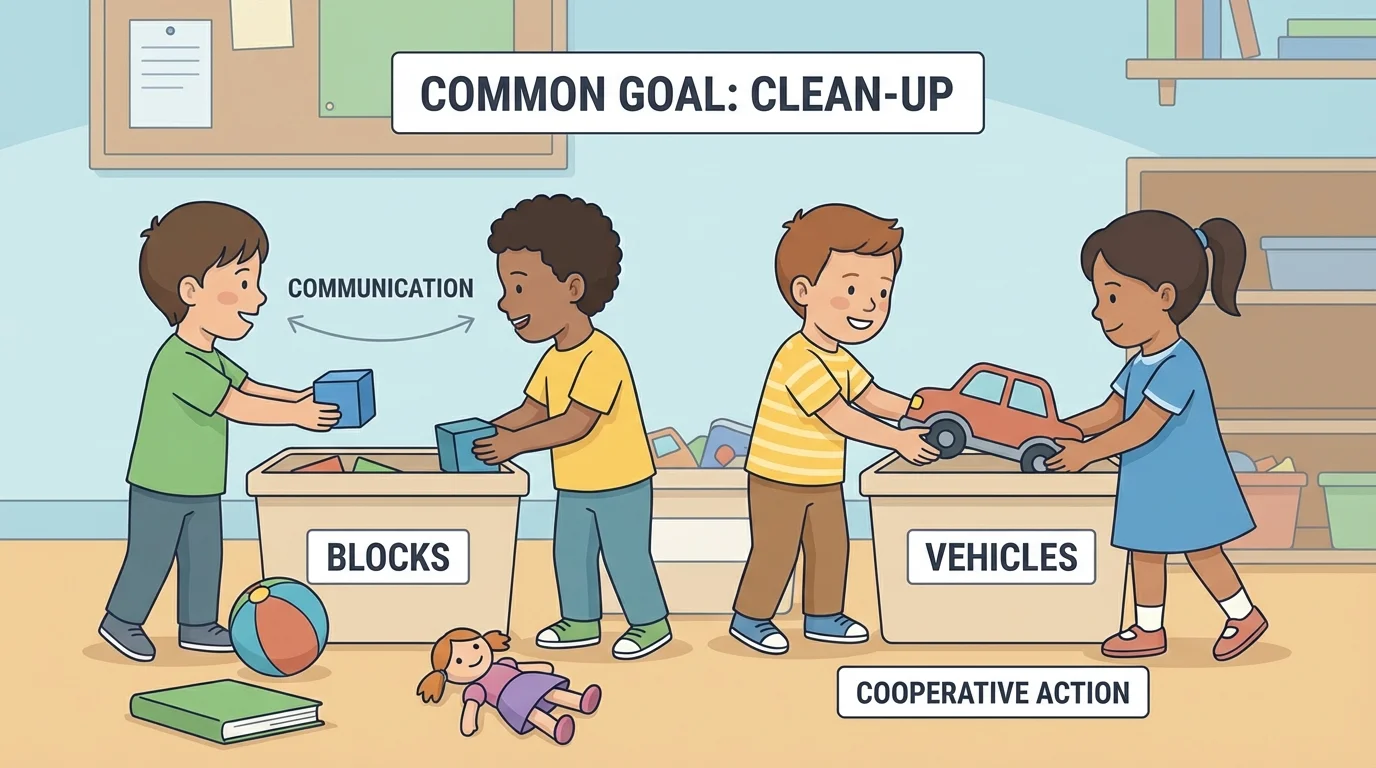
A child might say, "You pick up the cars, and I will pick up the animals." That is teamwork. Another child might say, "Let's build one road for both of us." This helps everyone join in.
In families and communities, people also have common goals. They may want to keep the home safe, make the classroom peaceful, or help a neighbor. Children begin learning that they are part of these groups.
Working together helps solve problems. When children focus on one shared goal instead of only on what one person wants, they learn cooperation. Cooperation means helping, sharing jobs, and making space for others.
When later problems come up, children can remember the teamwork in [Figure 3] and see that many tasks are easier when people help each other.
[Figure 4] Empathy means noticing and caring about how someone else feels. If a friend is sad, a child can look, listen, and respond kindly. This may mean giving space, offering help, or telling a teacher.
Kind actions can be small but powerful. A child may hand someone a dropped pencil, pat a friend gently, or say, "Are you okay?" These caring choices help build friendship and trust.
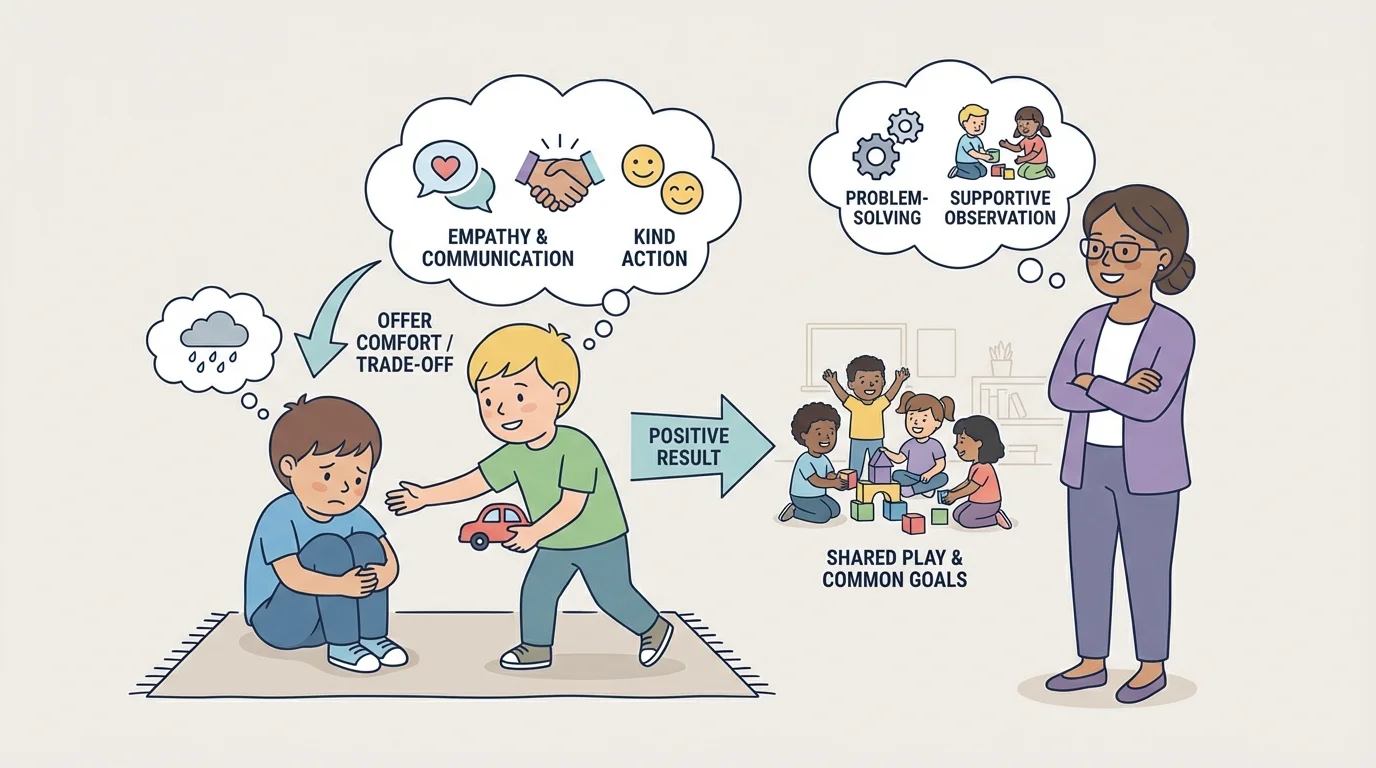
Empathy also helps children understand differences. One child may like loud games, while another likes quiet play. One child may need extra time. One may feel scared in a new place. Respect means understanding that not everyone feels the same way.
If a child bumps someone by mistake, they can say, "I'm sorry." If a classmate is upset, they can say, "You can have a turn next," or "I can help you." Caring words and actions can calm a problem before it grows.
"Kind words can be short and easy to speak, but their echoes are truly endless."
— Mother Teresa
The caring moment in [Figure 4] reminds us that solving problems is not only about getting our own way. It is also about helping other people feel safe, heard, and valued.
Children can begin learning a simple way to solve social problems. First, stop your body. Next, use words. Then listen. After that, think of a fair choice. If the problem is still too hard, ask an adult for help.
For example, if two classmates want the same puzzle, they can talk about taking turns, doing it together, or choosing another puzzle for now. If a child feels hurt or scared, an adult should help right away.
Example: solving a problem with a friend
Step 1: Say the problem: "We both want the ball."
Step 2: Share feelings: "I feel sad when I don't get a turn."
Step 3: Pick a fair plan: "You kick it first, then I kick it."
This gives both children a chance and helps the play continue.
These skills are important with adults too. If a child needs help, they can ask instead of crying or grabbing. If a child wants something that must wait, they can practice patience. Adults help children learn what is safe, fair, and respectful.
Using positive social skills does not mean children always get exactly what they want. It means they learn peaceful ways to ask, listen, care, and solve problems. Those skills help in the family, the classroom, and the whole community.
