What happens when two children both want the red truck at the same time? That is a big moment for learning. In school, at home, and on the playground, children sometimes disagree. These moments are called conflicts. A conflict can feel hard, but it is also a chance to learn how to be calm, kind, and fair.
A conflict is a disagreement or a problem between people. A conflict may happen when children want the same toy, want to stand in the same spot, or feel upset by someone's words or actions. Conflicts are a normal part of being in a group. They do not mean someone is bad. They mean people need help solving a problem.
Conflict is a problem or disagreement between people. Self-regulation means calming your body and feelings so you can make a safe choice. Problem-solving means thinking of ways to fix a problem.
When children learn to solve conflicts, they learn how to live and work with others. This helps a classroom feel safe and happy. It also helps everyone have a turn, be heard, and keep friendships strong.
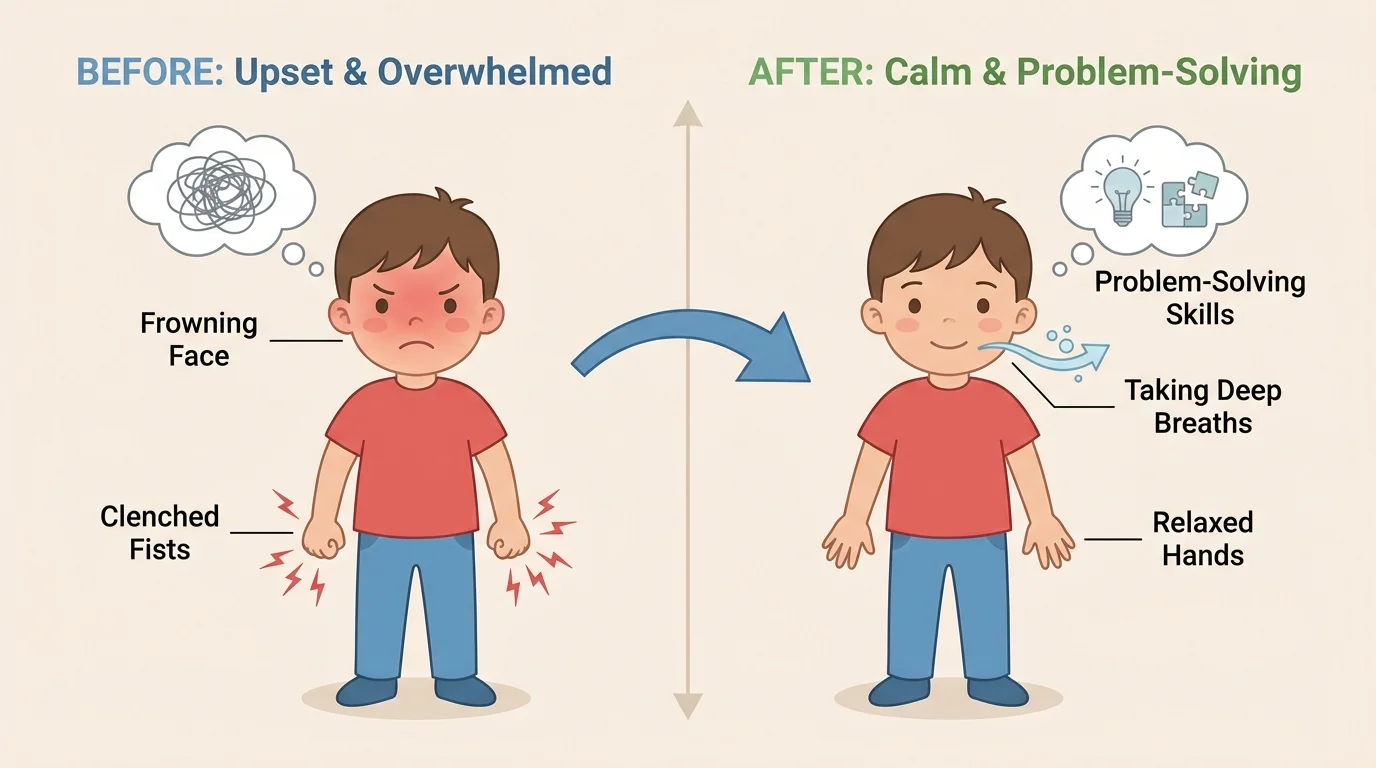
Sometimes a child feels mad, sad, or frustrated before any words come out. A feeling can show up in the body, as [Figure 1] shows. A face may frown. Hands may squeeze tight. A voice may get loud. Feet may stomp. Learning to notice these clues is an important first step.
A child might think, "My body feels hot," or "I want to grab." These signs tell us it is time to slow down. When children notice body clues, they can begin to calm themselves before the problem gets bigger.
Body clues help us make safe choices
When children learn to notice body clues, they can stop before hitting, grabbing, or yelling. Calm bodies help children listen, think, and solve problems. This is what self-regulation looks like in early childhood: safe hands, calm breaths, and words instead of hurting actions.
It is okay to have strong feelings. All feelings are real. But not all actions are okay. Feeling angry is okay. Hitting is not okay. Feeling disappointed is okay. Throwing toys is not okay. Children can learn to match big feelings with safe actions.
Self-regulation means using simple actions to help the body settle. These actions can be taught and practiced again and again. A child does not need to be perfect. A child needs tools.
Helpful calm-down steps include stopping the body, taking a deep breath, using a quiet voice, and keeping hands to themselves. Some children count breaths, hold a stuffed toy, or ask for space. These are all safe ways to calm down.
Calm-down example
Lina wants a puzzle piece that Ben is using. She starts to reach and shout.
Step 1: Lina stops her body.
She keeps her hands safe and does not grab.
Step 2: Lina takes deep breaths.
She breathes in and out slowly.
Step 3: Lina uses words.
She says, "I want a turn when you are done."
Lina is showing self-regulation because she calms down before solving the problem.
Children often need reminders from adults at first. Over time, these calm-down steps become habits. As seen earlier in [Figure 1], the body can move from tight and upset to calm and ready.
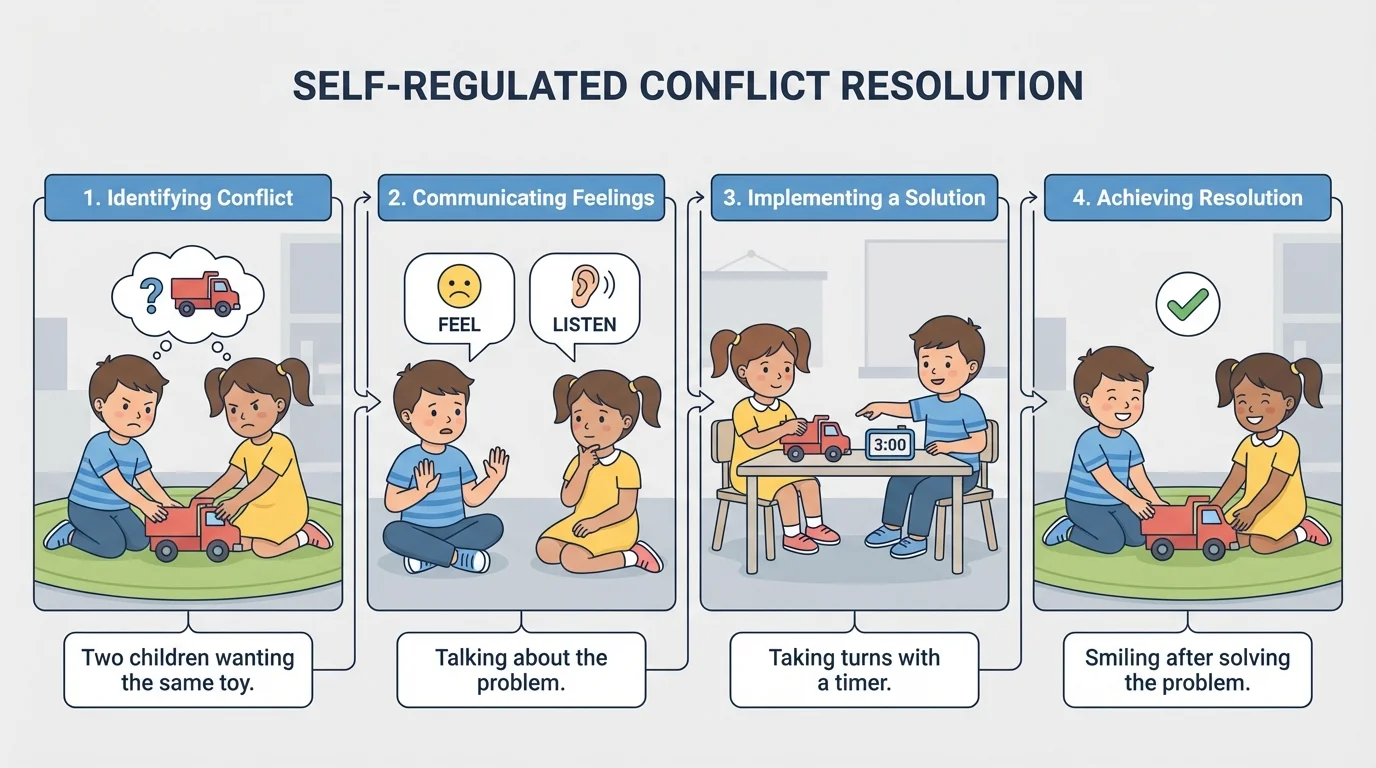
After bodies are calmer, children can begin problem-solving. This means talking about the problem and choosing a fair, safe idea, as [Figure 2] illustrates. Children may need simple choices such as taking turns, sharing, trading, waiting, or playing together.
Good problem-solving often uses easy steps: listen, talk, think, choose, and try. First, each child gets a turn to speak. Next, they say what they need with words like "I feel upset" or "I want a turn." Then they think of a solution. Finally, they try it.
Remember that words are powerful tools. Saying "Stop," "Please give it back," "Can I have a turn?" and "I need help" can solve many problems before they grow.
Children do not always get exactly what they want right away. Solving a conflict does not mean one child wins and the other loses. It means the group finds a safe and fair way to move forward.
Take turns is one useful solution. One child uses the toy first, and then the other child gets a turn. Another solution is to share materials. Two children can build with the blocks together. Sometimes a child can choose a different toy for now and come back later.
Problem-solving example
Two children both want to sit next to the teacher at circle time.
Step 1: They stop and keep bodies calm.
No pushing. No yelling.
Step 2: They say the problem.
Each child says, "I wanted that spot."
Step 3: They choose a solution.
One child sits there today. The other child sits there tomorrow.
This solution is fair because both children get a turn.
[Figure 3] shows how classroom rules can support children as they learn to play and solve problems together.
In a classroom, rules help everyone know what to do. Rules such as "use kind words," "keep hands safe," and "wait your turn" support peaceful problem-solving. Rules are not just about stopping problems. They help groups work, learn, and play together.
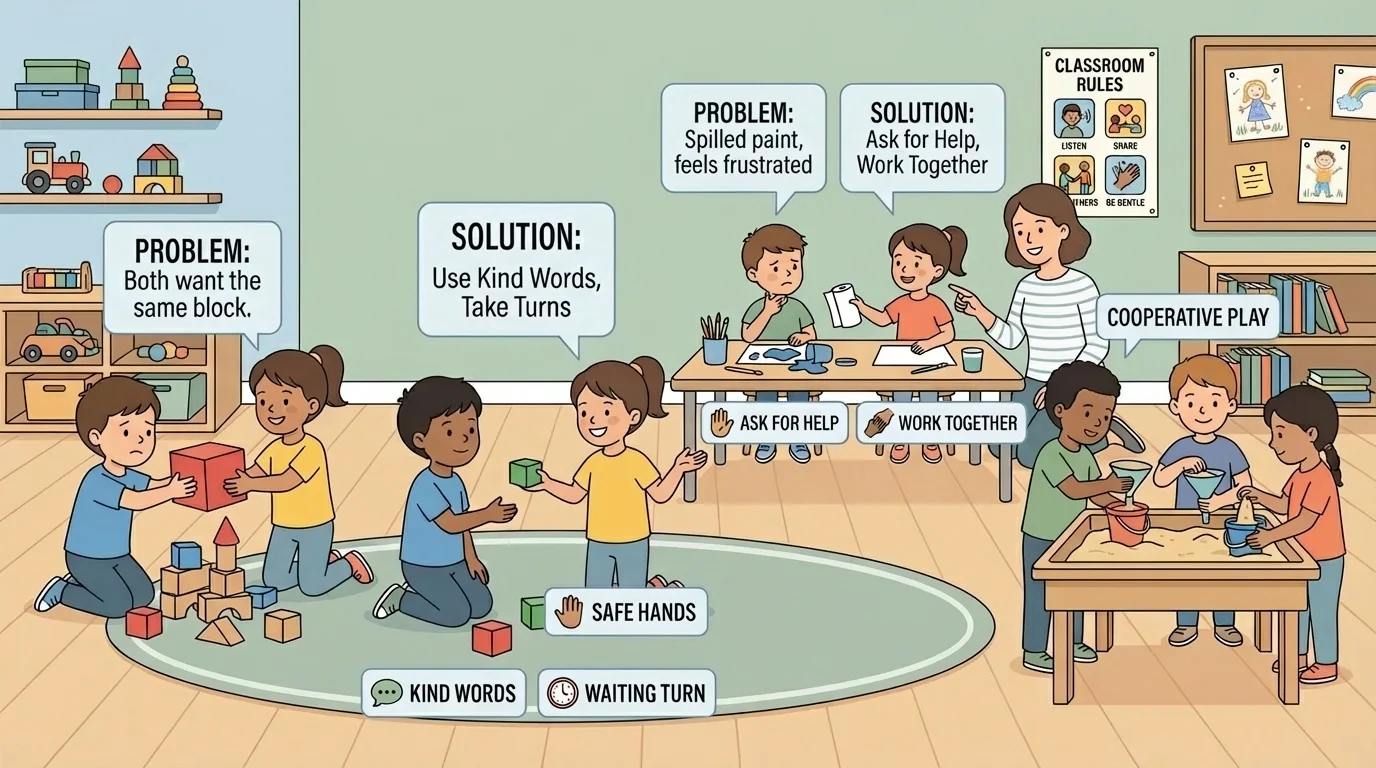
When children follow shared rules, the group works better. There is more safety, more fairness, and more fun. If everyone grabbed toys, shouted, or pushed, play would stop. Rules protect people and help everyone belong.
Very young children can learn fairness in simple ways. Waiting for a turn, using gentle hands, and listening to others are early civics skills because they help people live well in a group.
Rules also make problem-solving faster. If a child already knows, "We use words, not hands," then the child has a clear path during conflict. The rule becomes a helpful guide.
Many conflicts happen during ordinary routines. At snack time, one child may want the blue cup another child picked first. On the playground, two children may want the same swing. During art, someone may feel upset if another child takes a crayon without asking. These are all chances to practice calm choices.
When children use the steps shown in [Figure 2], they learn that problems can be solved. A child can say, "Can I use it after you?" Another can answer, "Yes." Sometimes a timer or teacher reminder helps. The important idea is that children are learning how to pause, think, and act kindly.
Everyday classroom example
Omar is building a tower. Jia bumps it, and part of it falls down.
Step 1: Omar notices his feeling.
He feels angry and wants to yell.
Step 2: Omar calms his body.
He takes breaths and keeps his hands safe.
Step 3: Omar uses words to solve the conflict.
He says, "I did not like that. Please help me fix it."
Now the children can rebuild together or ask for help.
Children can solve many small conflicts with words and calm bodies. But some situations need an adult right away. A child should get help if someone is hurt, if someone is being unsafe, if mean behavior keeps happening, or if the problem feels too big to solve alone.
As children grow, they become more independent. They learn that asking for help is not giving up. It is a smart and safe choice. In fact, using adult help is part of good problem-solving.
Learning to manage conflict takes time. Children practice, make mistakes, and try again. With support, they learn self-control, empathy, fairness, and responsibility. These skills help them in school, at home, and in every group they join.
