Have you ever seen a shiny coin in a hand or a paper bill in a wallet? Money is something people use every day. We use money to get food, clothes, books, and toys. Money helps people trade in a simple way.
Money is something people give when they buy something. If a family wants bread or milk, they can use money at a store. Money has a purpose: it helps us pay for things we need and things we want.
Money is something people use to pay for things. Value means how much something is worth.
Long ago, people traded one thing for another. Now money makes buying and selling easier. A person does not need to trade a toy for an apple. Instead, the person can use money.
[Figure 1] shows different forms of money. A coin is one form of money. Coins are usually round and made of metal. Some money is a bill. A bill is flat and can have different colors, pictures, and numbers on it.
People can also pay without holding coins or bills. Sometimes a grown-up uses a card or a phone to pay. That is also a form of money people use today. Even when money looks different, it still helps people buy things.
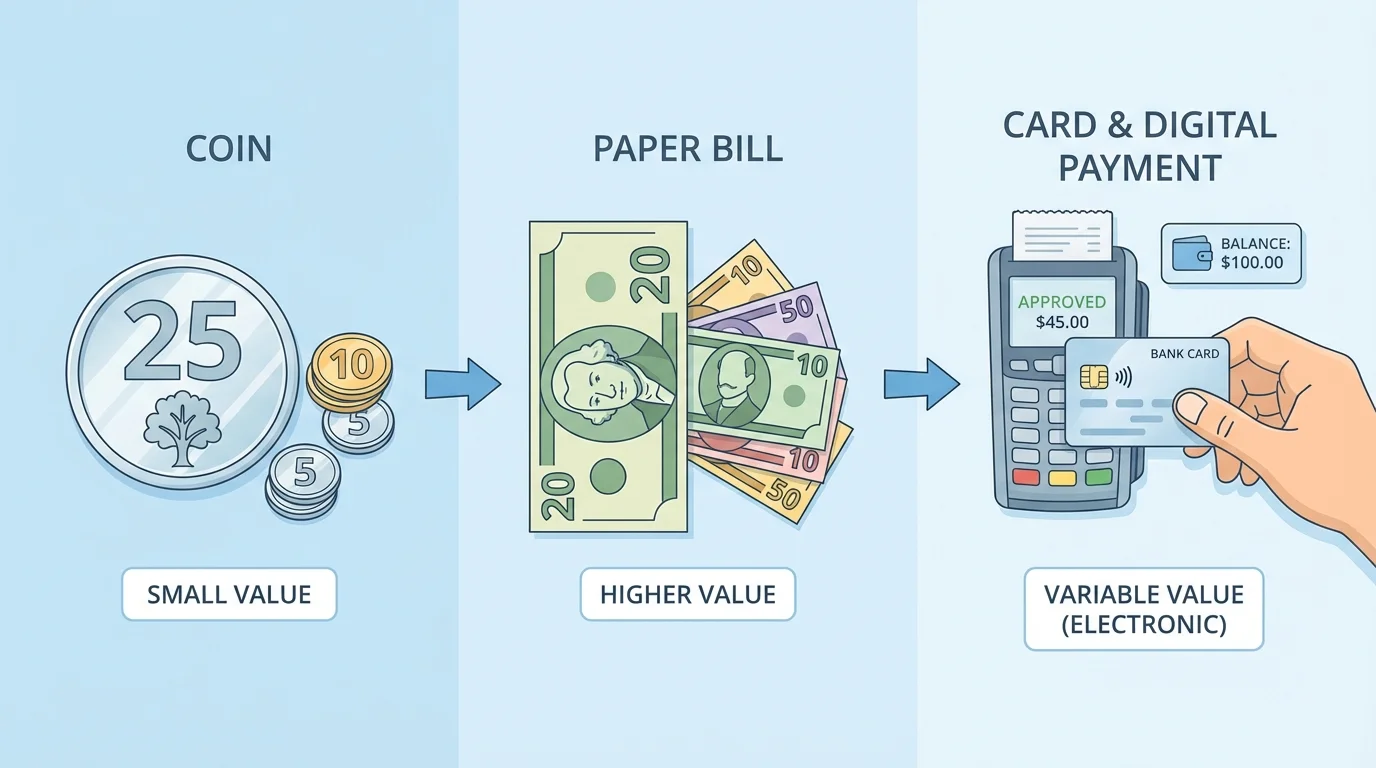
Money can look different from place to place. One coin may be small. Another coin may be bigger. One bill may be one color, and another bill may be a different color. Looking closely helps us know which money we have.
Some coins jingle in a pocket, but a card or phone payment makes no jingling sound at all. Money can feel, look, and work in different ways.
When you look at money, you may notice numbers. A number on money helps tell its value. The number helps people know if the money is worth a little or worth more.
[Figure 2] helps us see that not all money is the same. Some money has a smaller value. Some money has a bigger value. One coin may be worth less than another coin, and one bill may be worth more than one coin.
If you have one coin, that is one piece of money. If you have two coins, you may have more money than with one coin. We can compare amounts with simple ideas like more and less. In math, one is less than two, so we can say \(1 < 2\).
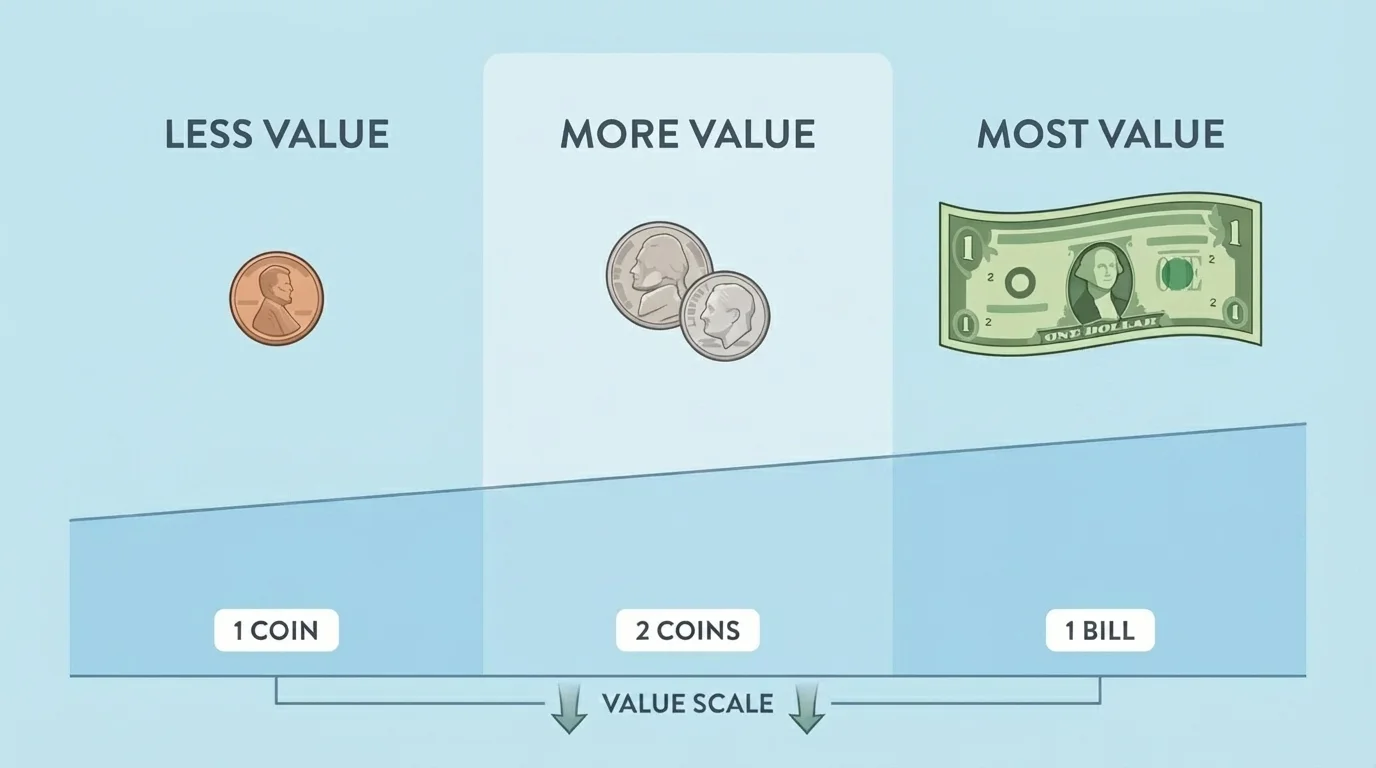
A bigger value can help buy more things. A smaller value may buy fewer things. For example, one small coin may not be enough for an item, but more coins together might be enough. People count money to see if they have the amount they need.
Simple value example
Step 1: Look at one coin.
That is \(1\) coin.
Step 2: Look at two coins.
There are \(2\) coins.
Step 3: Compare them.
Since \(2 > 1\), two coins are more than one coin.
More pieces of money can mean more value.
Later, children learn the names and exact values of coins and bills. Right now, the important idea is that money comes in different kinds, and different kinds can be worth different amounts.
People use money to get things they need, like food, water, and clothes. People also use money to get things they want, like a ball, a puzzle, or a storybook. Money helps families choose what to buy.
At a store, a person gives money and gets an item. That is called paying. A cashier or machine processes the payment. Then the person can take the item home.
Money helps exchange happen. A store gives a good or a service, and a buyer gives money. This makes trade easier because everyone understands that money stands for value.
As we saw earlier in [Figure 1], people do not always pay the same way. Sometimes they use coins. Sometimes they use bills. Sometimes they use a card. The purpose stays the same: to pay for something.
You can tell forms of money apart by looking carefully. A coin may feel hard and smooth. A bill may feel soft and flat. Money may have numbers, pictures, shapes, and colors that help us know what it is.
Looking at details helps us stay organized. A child might notice, "This is a coin," or "This is a bill." A grown-up may look for the number to know its value. In [Figure 2], the different amounts remind us that we can compare money by how much it is worth.
Learning about money is an important first step in personal financial literacy. When children know that money has a purpose and that different forms of money can have different values, they begin to understand how buying works in everyday life.
