A speaker can sound confident, respectful, persuasive, and intelligent in one setting, then careless and unprepared in another, even while talking about the same idea. The difference is often not what the speaker knows, but how the speaker adapts. A class presentation, a scholarship interview, a group discussion, a debate, and a conversation with friends all require different choices in language, tone, and structure. Learning to make those choices well is a powerful communication skill.
Adapting speech means shaping what you say and how you say it so it fits the context, the task, and the people listening. Strong speakers do not use one voice for every situation. They pay attention to audience expectations, the seriousness of the occasion, and the goal of the moment. They know when to sound conversational, when to sound polished, and when formal English is expected.
Audience means the people who hear your message. Purpose means why you are speaking. Context includes the setting, the relationship between speaker and listeners, the topic, and the consequences of the moment. If you are explaining a science project to classmates, your approach may be lively and interactive. If you are presenting that same project to school administrators or judges, your language should become more precise and formal.
The same basic message can be appropriate in one setting and inappropriate in another. For example, saying, "This experiment was kind of cool and stuff, and we got a bunch of results," may sound acceptable in a casual conversation. In a formal presentation, however, that wording sounds vague. A stronger version would be: "This experiment produced clear results that helped us identify the effect of temperature on reaction rate." Both sentences refer to the same experience, but one is much more credible.
Context is the situation in which communication happens, including setting, audience, relationship, and purpose.
Formal English is a more careful and standard style of speaking that uses precise word choice, correct grammar, and an appropriate tone.
Register is the level of formality in language, ranging from casual to highly formal.
Context also affects what listeners need from you. Some audiences need background information. Others already know the basics and want detailed evidence. Some situations value speed and efficiency, while others require explanation and reflection. Effective speaking is not only self-expression; it is also decision-making.
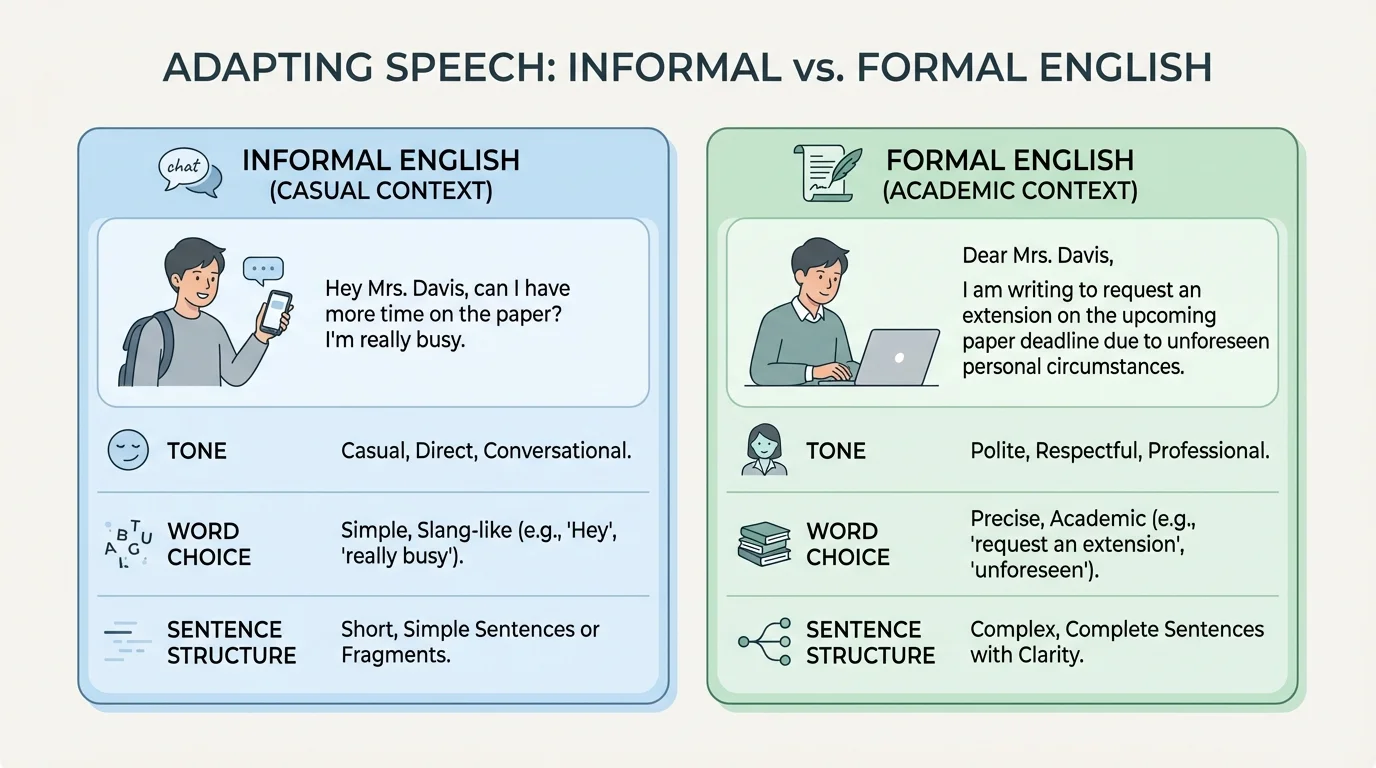
One of the most important speaking decisions involves the difference between informal and formal English. The comparison in [Figure 1] shows that the same request can sound casual, respectful, or professional depending on word choice and sentence structure. Informal English fits relaxed conversations with friends or familiar peers. Formal English fits situations where you need to show respect, clarity, seriousness, or professionalism.
Informal English often includes slang, shortened phrases, incomplete sentences, casual fillers, and inside references. It may sound natural in everyday conversation: "Can you guys check this out real quick?" Formal English avoids slang and uses fuller, clearer sentences: "Could you please review this section and give me feedback?" Formal speech is not stiff or fake. It is controlled, intentional, and suited to the occasion.
Formal English is usually appropriate in academic presentations, speeches, interviews, ceremonies, public meetings, and serious discussions. It is also useful when addressing adults you do not know well, speaking for a group, or presenting information that needs to sound reliable. In contrast, informal English may be appropriate in a brainstorming session with close classmates, a conversation before class, or a casual team check-in.
Choosing formal English does not mean using the biggest words possible. In fact, trying to sound smart by using confusing vocabulary can weaken your message. Strong formal speech favors precise, familiar words used correctly. "The results were inconsistent" is better than "The outcomes were in a state of multifaceted irregularity." Clarity matters more than showing off.
Many strong public speakers sound natural and formal at the same time. They do not remove personality from their speech; they control it so their personality supports the message instead of distracting from it.
Formal English also depends on grammar and pronunciation. Subject-verb agreement, complete sentences, and accurate verb forms all help listeners trust you. Pronouncing words clearly matters too. If your audience has to struggle to identify your meaning, your ideas lose force, even if the content itself is strong.
Before speaking, effective communicators ask several questions. Who is listening? What do they already know? What do they need from me? What is the goal? What tone will fit this situation? These questions help a speaker make smart choices about examples, level of detail, and style.
Suppose you are speaking to ninth-grade classmates about social media privacy. You might use examples from apps students actually use, define key terms simply, and keep your tone direct. If you are speaking to parents at a school event, you might focus more on safety concerns, explain platform features clearly, and avoid assuming shared background knowledge. If you are speaking to a school board, you might emphasize evidence, policy concerns, and a highly professional tone.
The occasion matters too. A debate requires argument and rebuttal. A ceremonial speech may require respect, reflection, and emotional control. A project presentation requires explanation and evidence. A group discussion requires cooperation and responsiveness. Skilled speakers do not prepare one generic talk and force it into every task. They shape the talk to fit the occasion.
Speech adaptation as strategic choice
Adapting speech is not changing your beliefs to please people. It is choosing the clearest and most effective way to communicate your ideas. A serious tone in an interview, a warm tone in a thank-you speech, and a concise tone in a meeting all serve the same goal: helping listeners understand and trust the speaker.
Purpose affects content. If your purpose is to inform, your speech should define terms, explain steps, and present accurate information. If your purpose is to persuade, your speech should include claims, reasons, evidence, and responses to possible objections. If your purpose is to entertain or inspire, your speech still needs structure, but it may use more storytelling or vivid language.
Tone is the speaker's attitude toward the subject and audience. It can be respectful, urgent, enthusiastic, serious, or reflective. Diction means word choice. Tone and diction work together. Saying "You need to listen" creates a different feeling from "I'd like to explain why this matters." Both communicate importance, but one sounds commanding and the other more collaborative.
Style includes sentence length, level of detail, and how conversational or polished the language sounds. In formal settings, speakers often use complete sentences, clear transitions, and carefully chosen evidence. In less formal settings, they may use shorter sentences, quick examples, and more spontaneous phrasing. The goal is not to erase personality but to match style to purpose.
Fillers such as "like," "you know," "um," and "so yeah" can make speech sound less prepared if they appear too often. Everyone uses fillers sometimes, especially when thinking in real time. The problem is not one filler; the problem is patterns that distract listeners. In formal speaking, reducing fillers helps your message sound more focused.
Slang, idioms, and humor also need careful control. If your audience shares your background, an informal phrase may build connection. If not, it may confuse them or make your message sound careless. Humor can help a presentation, but only if it fits the setting and does not weaken credibility. A joke that works with friends may feel inappropriate in a memorial speech or formal debate.
Strong adaptation is not only about wording. It also includes how you organize ideas. A clear structure helps the audience follow your thinking, and [Figure 2] illustrates a common presentation flow from opening to conclusion. Different tasks may require different structures, but effective speaking almost always includes a focused introduction, a logical body, and a meaningful closing.
The introduction should establish purpose and gain attention. In a formal presentation, this might mean stating the topic, giving brief context, and previewing main points. For example: "Today I will explain how school start times affect student performance, health, and attendance." This sentence is direct, clear, and audience-friendly.
The body of a credible presentation develops each main point with evidence. Evidence may include facts, examples, observations, expert statements, or data from trustworthy sources. Credibility grows when you explain where information comes from and how it supports your point. A presentation sounds stronger when claims are supported rather than simply asserted.
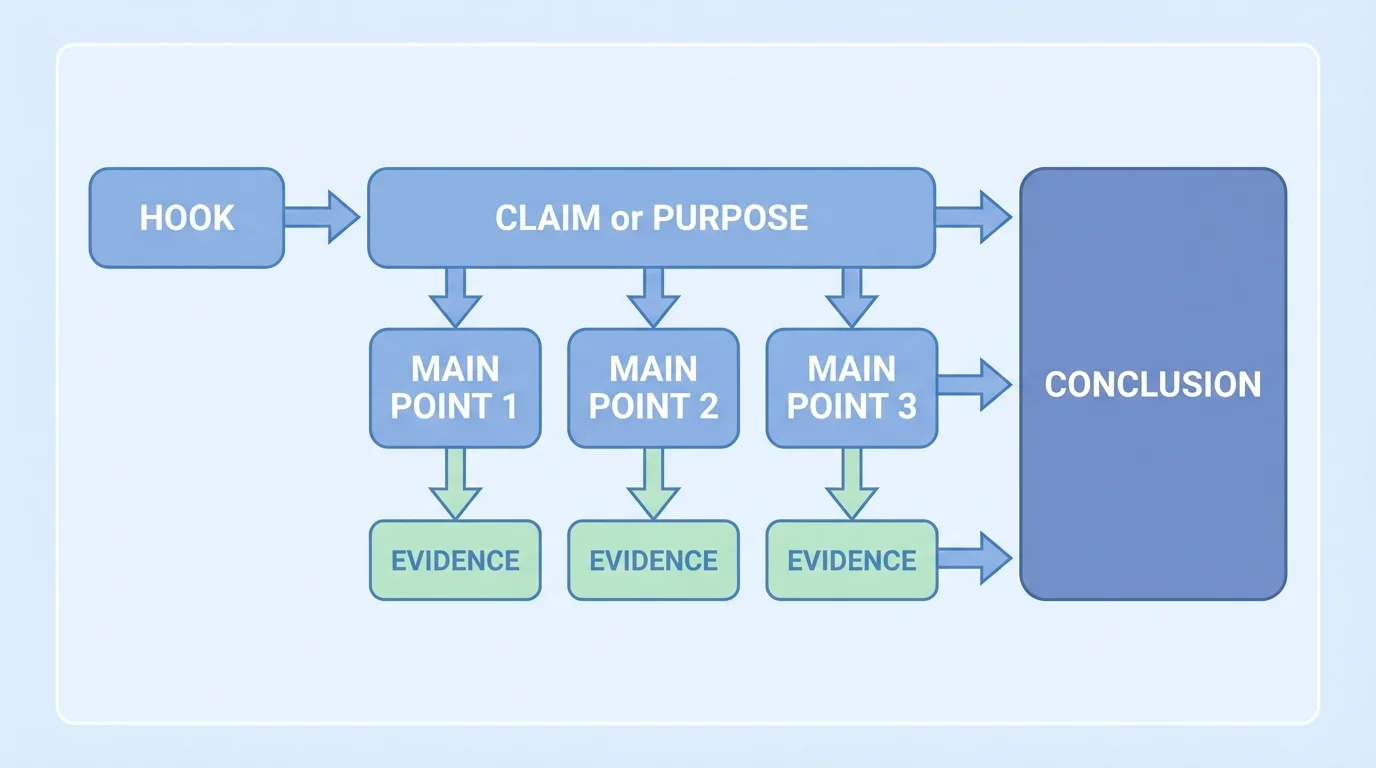
Transitions help listeners move from one idea to the next. Phrases such as "first," "in addition," "by contrast," and "as a result" signal organization. In formal English, transitions should sound natural rather than mechanical. They guide the audience without making the speech feel robotic.
The conclusion should do more than stop. It should reinforce the purpose, leave a strong final idea, and match the tone of the occasion. A persuasive speech may end with a call to action. An informative speech may end by emphasizing why the information matters. A ceremonial speech may end with appreciation or reflection.
Example: adjusting one topic for three different tasks
Topic: the importance of sleep for teenagers
Step 1: Class discussion
In a small class discussion, a speaker might say, "A lot of teens are not getting enough sleep, and that affects focus in school." The tone can be conversational and brief.
Step 2: Formal presentation
In a formal presentation, the speaker might say, "Teenagers need adequate sleep for concentration, memory, and physical health. Research shows that sleep loss can reduce academic performance." The diction becomes more precise and evidence-based.
Step 3: School board meeting
At a school board meeting, the speaker might say, "Adjusting school start times may improve attendance, alertness, and student well-being. Multiple studies suggest that later start times are associated with measurable academic and health benefits." The style becomes even more professional and policy-focused.
Notice that the core idea remains the same, but the phrasing, evidence, and tone shift with the task and audience. That is the heart of adaptation.
Students already move through many speaking contexts. In classrooms, you may explain ideas, collaborate in groups, ask questions, and present projects. Outside school, you may speak in community events, part-time jobs, sports teams, clubs, or interviews. Each setting has its own expectations.
In a group discussion, strong speaking includes listening, building on others' ideas, and staying respectful during disagreement. In a presentation, strong speaking includes structure, audience awareness, and polished delivery. In an interview, it includes concise answers, formal language, and a professional tone. In a debate, it includes reasoned claims, evidence, and calm rebuttal.
Digital speaking contexts matter too. If you are giving a presentation on video, your speech may need to be even clearer because audio delays and screen distance can affect understanding. You may need stronger verbal signposts such as "My second point is..." or "To clarify that idea..." In recorded presentations, there is often less room for casual wandering, so organization becomes especially important.
The structure from [Figure 2] remains useful across many of these settings, but the details change. A short update to a club may need only a brief introduction and one main point. A formal research presentation may need several carefully developed points and stronger source-based evidence.
Effective speaking is not a one-way performance. It is also a form of listening. A speaker can read audience reactions and adjust in real time. If listeners look confused, you may need to define a term, slow down, or give a clearer example. If they seem engaged and ready for more detail, you may be able to deepen the explanation.
As [Figure 3] shows, adapting in the moment requires awareness. You might notice that the audience is restless, that your explanation is too long, or that your vocabulary is too advanced for the setting. You may need to rephrase a point, shorten an answer, or shift your tone. In a formal context, these changes should still sound composed and respectful.
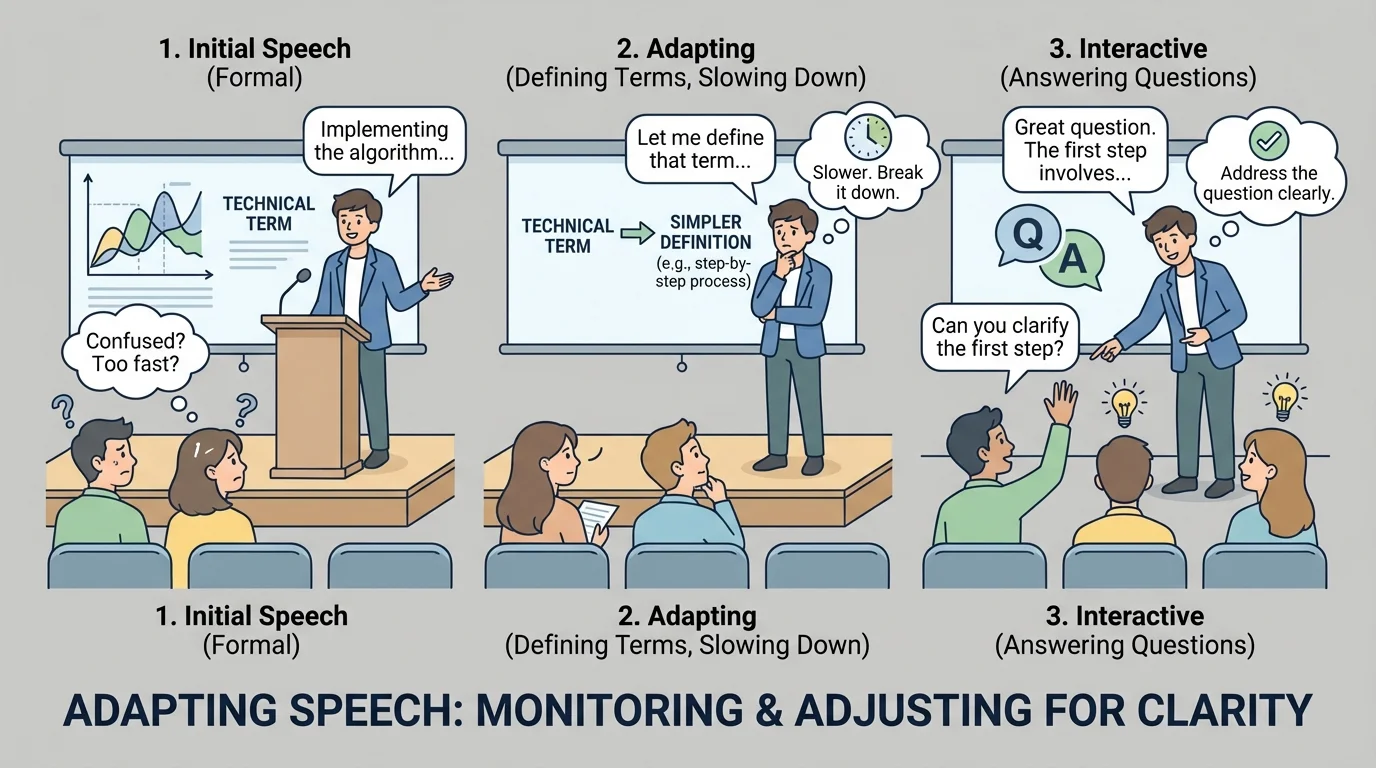
Questions from listeners are also part of adaptation. A strong response listens carefully, answers directly, and uses a tone that fits the moment. Even if a question sounds challenging, formal English helps you remain calm and credible. Saying "That's a fair question. Let me clarify the evidence behind that claim" is stronger than sounding defensive or dismissive.
Good speaking depends on good listening. Skills such as paying attention, noting key ideas, and responding to others respectfully are not separate from oral presentation; they are part of it.
Sometimes adaptation means simplifying. Sometimes it means becoming more precise. The goal is not always to say more. The goal is to say what the audience needs, in the clearest form for that situation.
Many speaking problems come from mismatch. A speaker may use language that is too casual for a formal task, too vague for an informative purpose, or too complicated for a general audience. Another common mistake is sounding memorized rather than meaningfully prepared. Adaptation helps prevent both extremes.
| Weak Choice | Why It Misses the Context | Stronger Revision |
|---|---|---|
| "This thing was super crazy and basically changed everything." | Too vague and informal for academic speaking | "This event had major effects on public opinion and policy." |
| "You guys probably don't care, but..." | Undermines audience connection and speaker confidence | "This issue matters because it affects daily student life." |
| "I'm not really sure, but maybe..." | Weakens authority when clearer wording is possible | "The evidence suggests that this explanation is most likely." |
| "Like, um, the main thing is..." | Too many fillers reduce clarity | "The main point is..." |
Table 1. Examples of mismatched speech choices and stronger revisions suited to more formal speaking tasks.
Notice that the stronger revisions are not always longer. They are simply more precise, respectful, and appropriate. That is a useful reminder: effective formal English is often cleaner, not more complicated.
Case study: revising a presentation opening
Original opening: "Hey guys, today I'm gonna talk about pollution and stuff, and yeah, it's a really big problem."
Step 1: Remove vague fillers
Words such as "stuff" and "yeah" do not add meaning and reduce credibility.
Step 2: Use precise diction
Replace "a really big problem" with a more exact phrase such as "a major environmental challenge."
Step 3: Match a formal audience
Revised opening: "Today I will discuss pollution as a major environmental challenge and explain how it affects ecosystems, health, and communities."
This revised version sounds more prepared because it states the topic clearly, names the focus, and fits a formal academic setting.
Credibility grows when your language shows control. Command of formal English includes grammar, sentence structure, pronunciation, pacing, and respectful expression. This does not mean erasing regional identity or natural voice. It means being able to shift into a standard, polished form when the situation requires it.
One way to build this skill is to notice patterns. Formal English usually avoids slang, uses complete thoughts, and relies on accurate vocabulary. It often includes verbal cues such as "According to," "The evidence indicates," "One important factor is," and "In conclusion." These phrases help speech sound organized and grounded.
Pronunciation and pacing matter as much as wording. Speaking too quickly can make even strong ideas difficult to follow. Speaking too softly can weaken authority. Speaking too dramatically in a serious context can sound unnatural. The most effective delivery fits the message. If the topic is important and evidence-based, the delivery should sound steady and clear.
The audience reactions in [Figure 3] remind us that command of formal English includes flexibility. It is not enough to sound polished at the start if you ignore signs that listeners are lost. Real command means staying clear, respectful, and effective from beginning to end.
"The right words at the right time can move minds, build trust, and open opportunities."
There is also an ethical side to speech adaptation. When you choose language responsibly, you show respect for your audience. You avoid talking down to people, excluding them with unnecessary jargon, or speaking so casually that serious topics seem trivial. Adapting well means balancing confidence with awareness.
Whether you are presenting research, asking a question in class, answering in an interview, or speaking at a public event, your goal is the same: make your message fit the moment. Strong speakers understand that communication is not just expression. It is audience-centered action. They know when to be conversational, when to be formal, and how to move between those modes with purpose.
