Have you ever noticed that some days feel long and bright, while other days get dark so early? That is a clue from the world around you. Scientists are careful observers. They look carefully, listen carefully, and collect information. Then they use that information to compare things and learn more.
An observation is something you notice by using your senses. You might see a bird building a nest, hear rain tapping the window, or feel warm sunshine on your skin. When we pay attention to what we notice, we can learn about the world.
Data is the information we collect. Data can be words, drawings, tallies, pictures, or numbers. If you look outside each afternoon and notice whether it is sunny or cloudy, you are collecting data. If you watch the sky for many days, your data can help you compare one day to another.
Observation means using your senses or tools to notice something carefully. Data means the information you collect from your observations. Compare means to look at how things are the same and different.
Good observations are careful observations. Instead of saying, "The plant looks nice," a careful observer might say, "The plant has 4 green leaves and one yellow leaf." That kind of detail makes comparing easier.
[Figure 1] We can make observations in more than one way. Sometimes we do firsthand observations with our own eyes, ears, and hands. We might watch ants on a sidewalk or look at clouds in the sky. Other times, we observe from media, such as photos, videos, sound recordings, or charts. Both ways can help us collect useful information.
A video of a tree in winter and summer can help us notice changes over time. A photo of a desert animal can help us look at its body parts. If a scientist far away records bird sounds, we can listen and compare them. Media helps us observe things we cannot always see in person.
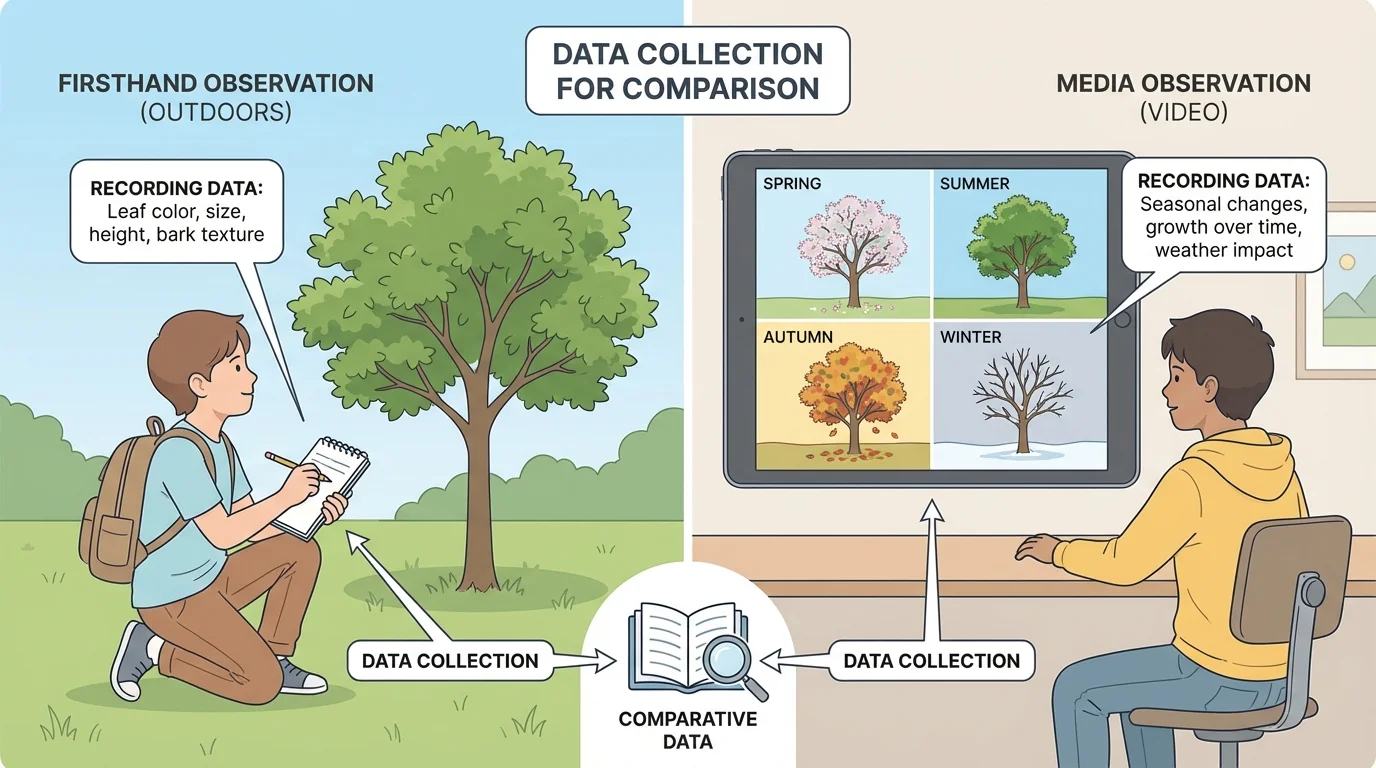
When we use media, we still need to be careful observers. We ask, "What do I notice?" "What is the same?" and "What is different?" Those questions help us collect data that makes sense.
Some scientists use cameras that take one picture every day in the same place. When the pictures are put together, people can observe changes across weeks or months very quickly.
Observing in different ways is helpful because nature changes. A flower opens over time. A caterpillar changes into a butterfly. The sky changes from morning to night. Watching, recording, and comparing help us understand those changes.
[Figure 2] One great thing to observe is daylight, the time when the Sun is up and the sky is light. During the year, the amount of daylight changes. At some times of year, the Sun seems to stay up longer. At other times, it gets dark earlier. We can observe this by noticing when it is light outside in the morning and when it starts to get dark in the evening.
If you compare winter and summer, you may notice that winter often has less daylight and summer often has more daylight. That means there are shorter periods of daylight in one part of the year and longer periods of daylight in another part of the year. These observations help us compare seasons.
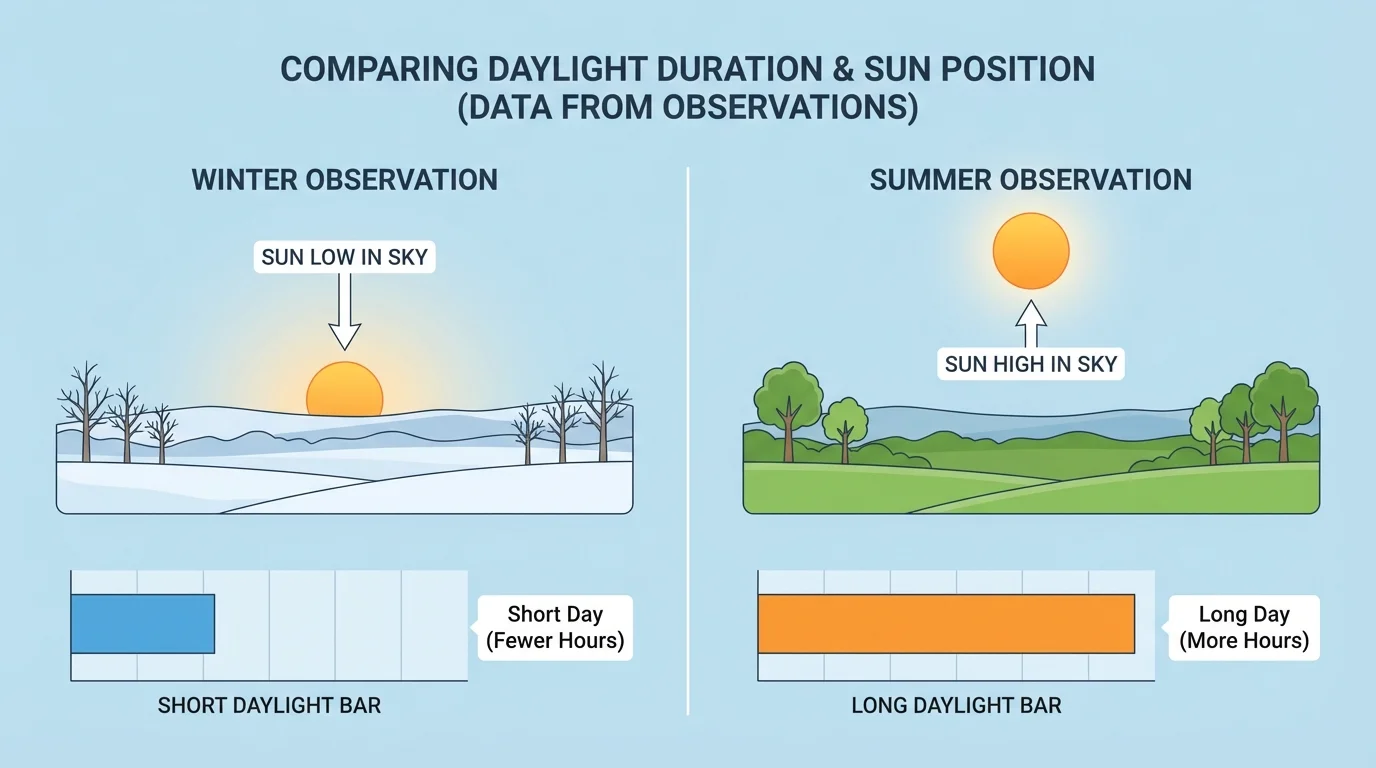
We can collect daylight data in simple ways. We might draw a sun when it is light after school and a moon when it is already dark. We might keep a class chart for different months. Over time, the chart helps us see patterns.
For example, if one month has light outside at both breakfast and dinner, but another month is dark by dinner, we can compare those times of year. We do not need hard math to notice the pattern. We simply gather the same kind of data again and again.
| Time of Year | What We Might Observe | Comparison Idea |
|---|---|---|
| Winter | Gets dark earlier | Less daylight |
| Spring | Days begin to get longer | More daylight than winter |
| Summer | Stays light later | More daylight |
| Autumn | Days begin to get shorter | Less daylight than summer |
Table 1. Seasonal observations that help students compare the amount of daylight during the year.
Patterns help us compare. When we collect the same kind of observation over many days, we can notice a pattern. A pattern is something that repeats or changes in a way we can recognize. Daylight patterns help us understand the seasons.
Later, when we think again about observing from media, the daylight bars in [Figure 2] help us see the same idea quickly: some seasons have longer bright parts of the day, and some have shorter ones.
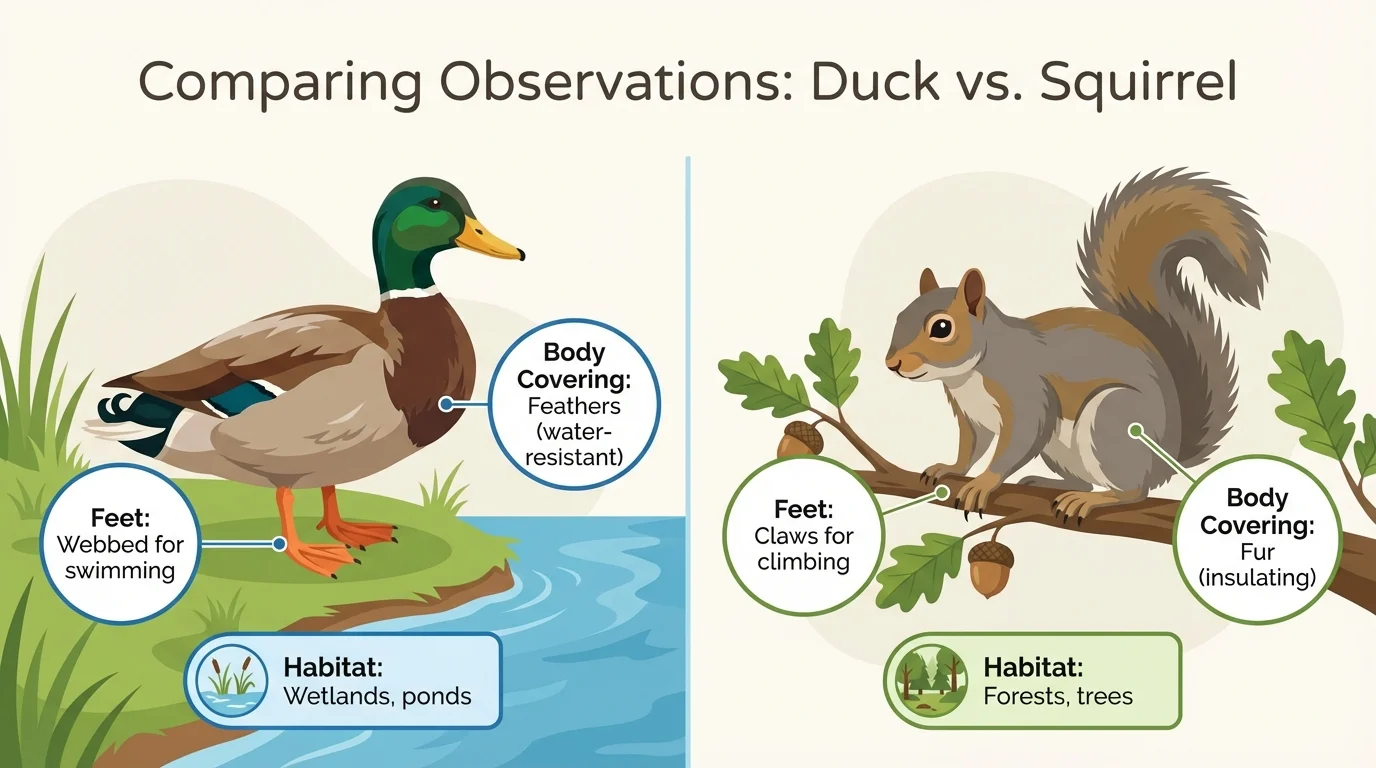
[Figure 3] Observations also help us compare plants and animals. A trait is a feature you can notice, like fur, feathers, leaf shape, or beak size. When we observe living things, we can compare their traits and think about how they live with two different animals as examples.
A duck and a squirrel are both animals, but they are not the same. A duck has feathers, a beak, and webbed feet. A squirrel has fur, teeth for gnawing, and feet made for climbing. Those observations help us compare how each animal moves and where it lives.
Plants can be compared too. One plant may have big, wide leaves. Another may have thin, spiky leaves. One may grow well in a wet place, and another may grow in a dry place. By observing parts of plants, we collect data that helps us compare them.
Real-world example: comparing two animals
Step 1: Observe body covering.
The duck has feathers. The squirrel has fur.
Step 2: Observe feet and movement.
The duck has webbed feet for swimming. The squirrel has claws for climbing.
Step 3: Compare habitats.
The duck often lives near water. The squirrel often lives in trees or parks.
These observations become data we can use to tell how the animals are alike and different.
When we compare living things, we should look at the same kinds of details for each one. If we compare only color for one animal but feet for another, the comparison is not very clear. Careful comparisons use matching kinds of observations.
The animal comparison in [Figure 3] reminds us that traits are clues. They can tell us how an animal survives, moves, eats, or stays safe.
A fair comparison means looking at things in a careful and organized way. If we want to compare two trees, we might look at leaf color, trunk size, and where each tree grows. If we want to compare two days, we might look at clouds, temperature, and how long it stays light outside.
It helps to record data in a chart, drawing, or list. Then we can look back at our information. We may see that one object is taller, one season is brighter, or one animal has different body parts. Organized data makes our thinking stronger.
You already know how to notice colors, shapes, sounds, and sizes. Those simple noticing skills are important science tools. Scientists use them every day.
If two people observe the same thing, they may notice some of the same details. That can help us check our work. Looking more than once is also helpful because we sometimes miss something the first time.
People use observations every day. Farmers observe weather and sunlight to help plants grow. Doctors observe changes in a patient. Meteorologists observe clouds, wind, and temperature. Animal scientists observe traits and habitats to learn about living things.
Families use observations too. You might notice that it is still bright when you eat dinner in summer, but already dark after dinner in winter. That is real data from your own life. You can compare those observations and learn about the seasons.
"The more carefully we look, the more we learn."
Media can help in real-world science. A nature video may show penguins in a cold place far away. A photo series may show a plant sprouting and growing. Just like the tree example in [Figure 1], media lets us compare changes that happen over time or far away from us.
Careful observers take their time. They look closely, listen carefully, and think about what they notice. They collect data that can be trusted because they try to be accurate and fair.
Sometimes we use simple tools to help us observe, such as a ruler, magnifier, calendar, or camera. Tools can help us notice details we might miss. But even with tools, the most important part is paying attention.
When we make observations, collect data, and compare what we find, we are doing science. We are learning from the world itself.
