Have you ever watched an ice cube turn into a puddle, then later seen water turn back into ice? That is a science clue. Scientists look closely at clues and use them to say, "I think this is true because I saw this happen." That is how we make an argument in science. It is not a fight. It is a smart way to share an idea and support it with evidence.
A claim is an idea or answer you think is true. Evidence is what you observe that helps show your idea makes sense. An argument in science is when you put your claim and your evidence together.
Claim means what you think is true.
Evidence means the observations that help show your claim is true.
Argument means telling your claim and your evidence together in a clear way.
If you say, "The sidewalk is warmer than the grass," that is a claim. If you touched both and the sidewalk felt warmer, that is evidence. If you say, "The sidewalk is warmer than the grass because I touched both places and the sidewalk felt hotter," you made a science argument.
Science begins with looking carefully. We use our senses and simple tools. We can see, touch carefully, listen, or measure. Then we ask, "What does this tell us?" Good evidence matches the claim.
Sometimes we watch what heating does. Sometimes we watch what cooling does. Heating means something gets warmer. Cooling means something gets colder. When matter changes, we ask an important question: can it change back?
Matter is the "stuff" things are made of. Water, ice, chocolate, cake batter, and rocks are all matter.
When we heat or cool matter, it may change. Some changes are easy to undo. Some changes make something new and do not go back the same way.
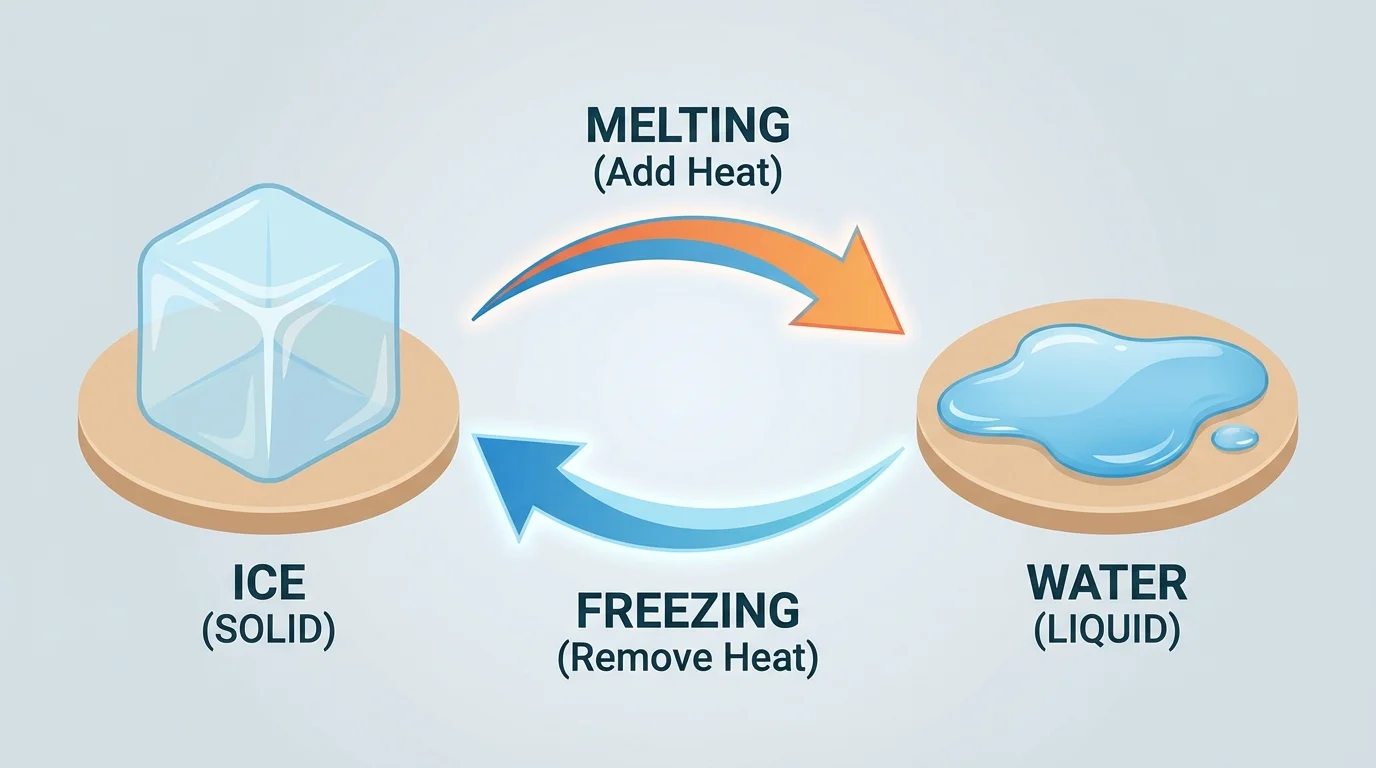
A reversible change is a change that can go back, as [Figure 1] shows with ice and water. When ice gets warmer, it melts into liquid water. When water gets cold enough, it freezes back into ice. The matter is still water, written as \(\textrm{H}_2\textrm{O}\).
We can make a claim: "Melting ice is a reversible change." Our evidence is that the ice melts when warmed and freezes again when cooled. The change goes back and forth.
Butter can soften when it gets warm and get harder again when it cools. Chocolate can melt and then become solid again. These are good examples of changes caused by heating or cooling that can be reversed.
Science argument example
Step 1: Make a claim.
"Melted ice can change back."
Step 2: Give evidence.
"The ice melted into water on the table. Later, the water was put in the freezer and became ice again."
Step 3: Explain the reason.
"This shows heating and cooling can change water back and forth."
Later, when we compare other changes, we can remember the back-and-forth pattern in [Figure 1]. If a material can return to the way it was before, that is strong evidence for a reversible change.
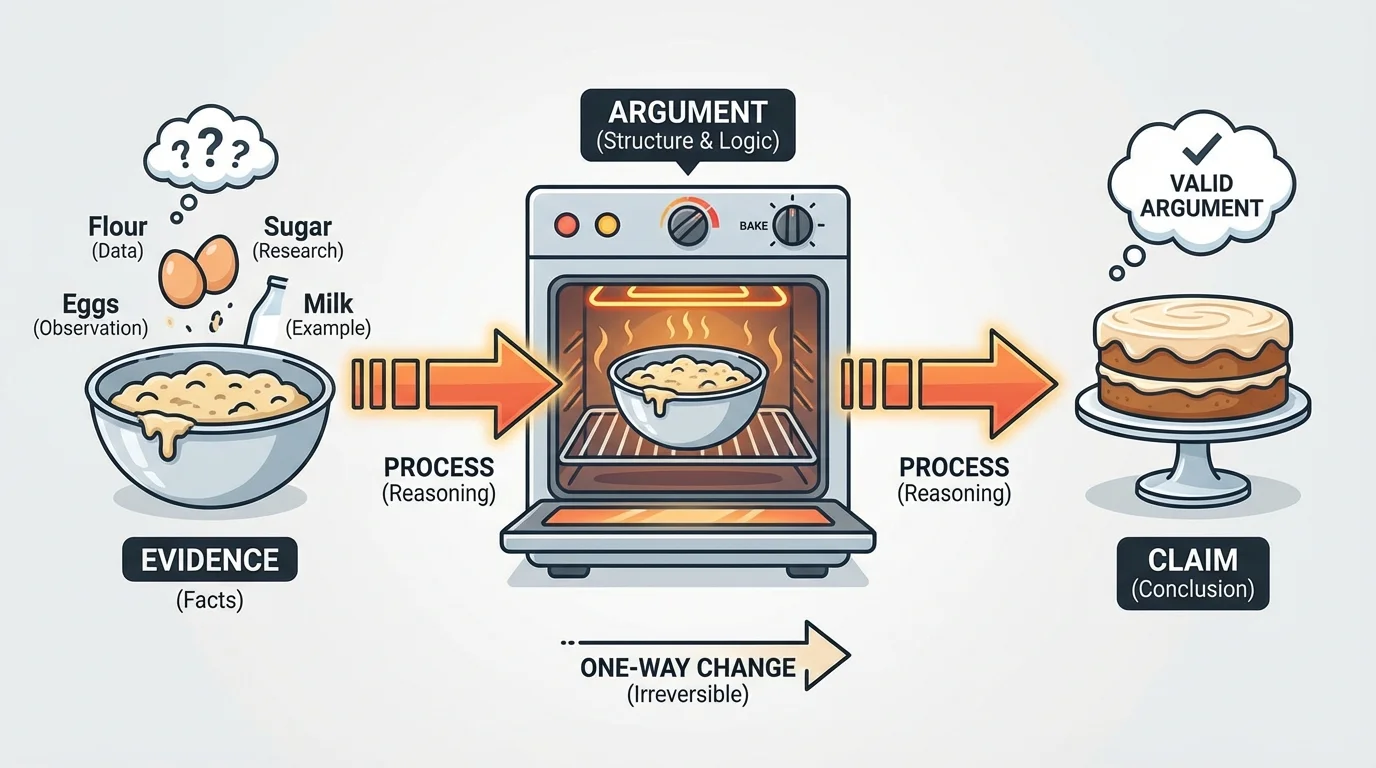
An irreversible change is a change that cannot go back the same way, as [Figure 2] shows with batter and cake. When cake batter is heated in an oven, it turns into cake. The cake does not turn back into batter.
We can make a claim: "Baking a cake is not a reversible change." The evidence is that the batter changes color, texture, smell, and shape after heating. Cooling the cake does not change it back into batter.
Cooking an egg is another example. A runny egg becomes firm when heated. Burning toast is also a one-way change. These changes make something different, and cooling does not undo them.
Some changes happen very fast, and some happen slowly. Toast can burn in minutes, but fruit left out for a long time can also change in ways that do not reverse.
Think about the one-way path in [Figure 2]. That picture helps us see a key idea: if heating changes something and it cannot return to what it was before, the evidence supports an irreversible change.
When you make a science argument, you can use three parts: claim, evidence, and reason. The reason tells how the evidence supports the claim.
You can say: "My claim is ____. My evidence is ____. This means ____." These sentence frames help organize your thinking.
| Part | What it means | Example |
|---|---|---|
| Claim | What you think is true | Ice melting is reversible. |
| Evidence | What you observed | Water froze and became ice again. |
| Reason | How the evidence fits the claim | The material changed back to the way it was before. |
Table 1. The three main parts of a simple science argument.
A strong argument uses true observations, not just a guess. If two people have different ideas, they can look for more evidence. They can watch carefully, compare results, and decide which claim has better support.
Why evidence matters
Evidence helps us choose between ideas. In science, we do not say something is true only because we want it to be true. We look for observations that match the claim.
This is how scientists learn about the world. They notice changes, collect clues, and explain what those clues mean.
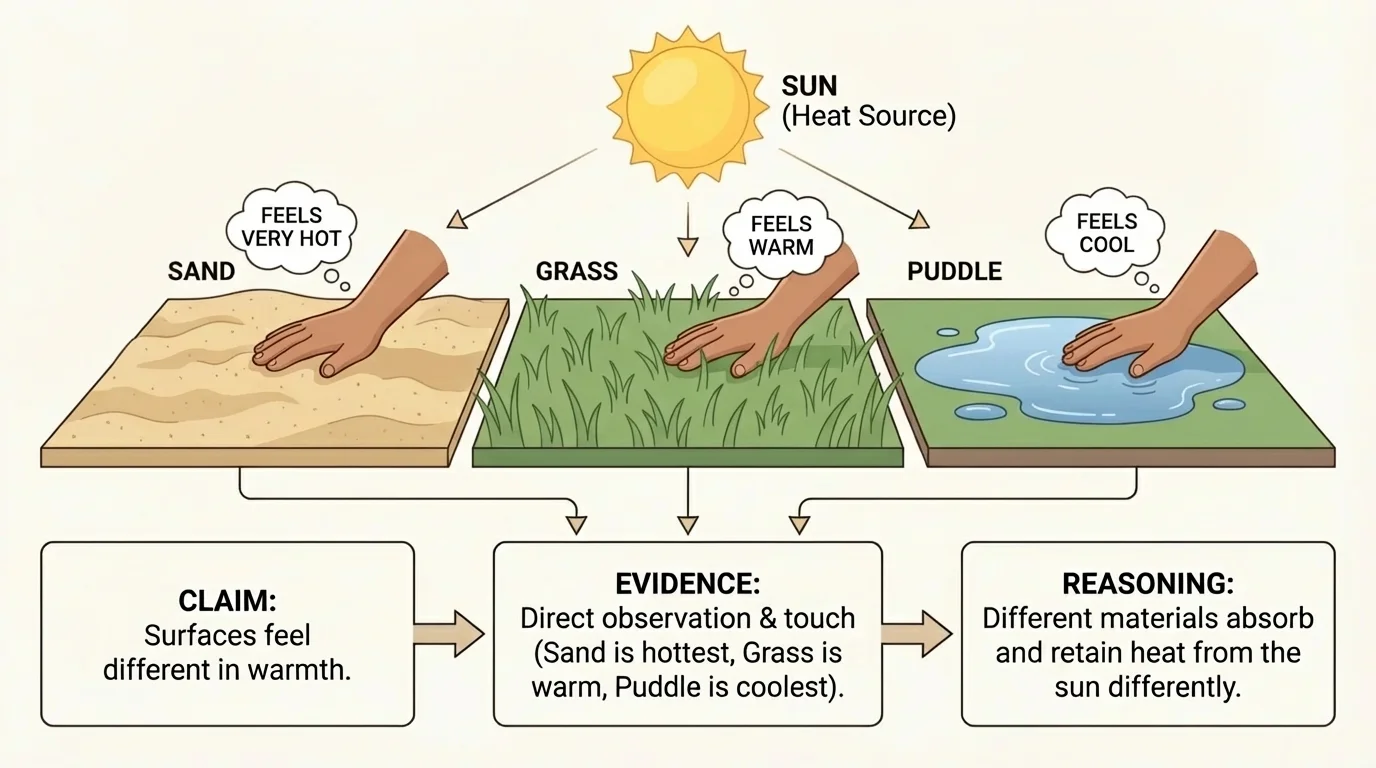
We can also use evidence to support claims about the world around us, as [Figure 3] illustrates with sunlight warming land and water. For example, you might claim, "The sun warms some places more than others." To support that claim, you can observe sand, grass, and a puddle at the same time.
If the sand feels warmer than the grass, that observation is evidence. If the puddle stays cooler than the sidewalk, that is evidence too. We use what we notice on Earth's surface to support our ideas about heating from the sun.
Another claim could be, "The sun helps dry a puddle." Evidence might be that a puddle becomes smaller after sunshine and warmth. We can compare it over time and use those observations to support the claim.
Earth science argument example
Step 1: Make a claim.
"The sun warms the sidewalk."
Step 2: Give evidence.
"In the afternoon, the sunny sidewalk felt warmer than the shaded ground."
Step 3: Explain the reason.
"This evidence supports the claim because the sunny place got more warming."
When we talk about warm sand, cool puddles, or sunny sidewalks, [Figure 3] reminds us that different surfaces can heat in different ways. Careful observations help us build better arguments.
Good science arguments use careful words like because, I observed, my evidence shows, and this supports. These words help explain thinking clearly.
Here are some strong sentence starters: "I claim that ____." "I know this because ____." "My evidence is ____." "This shows ____."
Sometimes a claim is not supported well. For example, saying "The cake will turn back into batter tomorrow" does not match what we know from heating and cooling evidence. A better claim would match observations from baking.
Scientists listen to evidence, even if it changes their minds. That is one of the most powerful parts of science.
"Good ideas in science are supported by good evidence."
When you see a change, ask yourself: What is my claim? What is my evidence? Can this change go back, or not? Those questions help you think like a scientist.
