Have you ever wondered where all the water on Earth is hiding? Some water is in oceans, some flows in rivers, and some sits quietly as ice. Scientists learn about these things by asking questions and then finding good information. Young scientists can do that too.
A scientific question is a question we can answer by observing, reading, watching, or investigating. A question like Where is water found on Earth? is a science question. Another one is Can water be solid and liquid?
When we ask a science question, we do not just guess. We look for facts. Facts can come from a nonfiction book, a photo with labels, a video, a chart, a website, or a teacher reading information aloud.
Information source means a place where we get facts. A source can be a book, a picture, a video, a map, a chart, or a screen.
Claim means an idea or answer that we say is true because we have facts to support it.
A good scientist tries to use more than one source. If one book says water is in oceans and a picture map shows oceans too, the two sources help support the same idea.
We can learn from many kinds of sources. Sometimes one source gives only part of the answer, so we put information from several sources together.
As [Figure 1] shows, a nonfiction book may tell us that much of Earth's water is in oceans. A labeled photo may show snow on a mountain. A short video may show ice melting into water. All of these help answer the same question about water.
Other media can help too. A weather report on TV may show rain, snow, or ice. A classroom poster may show a pond, river, and ocean. A digital story on a tablet may have buttons to press so we can hear words or see more pictures.
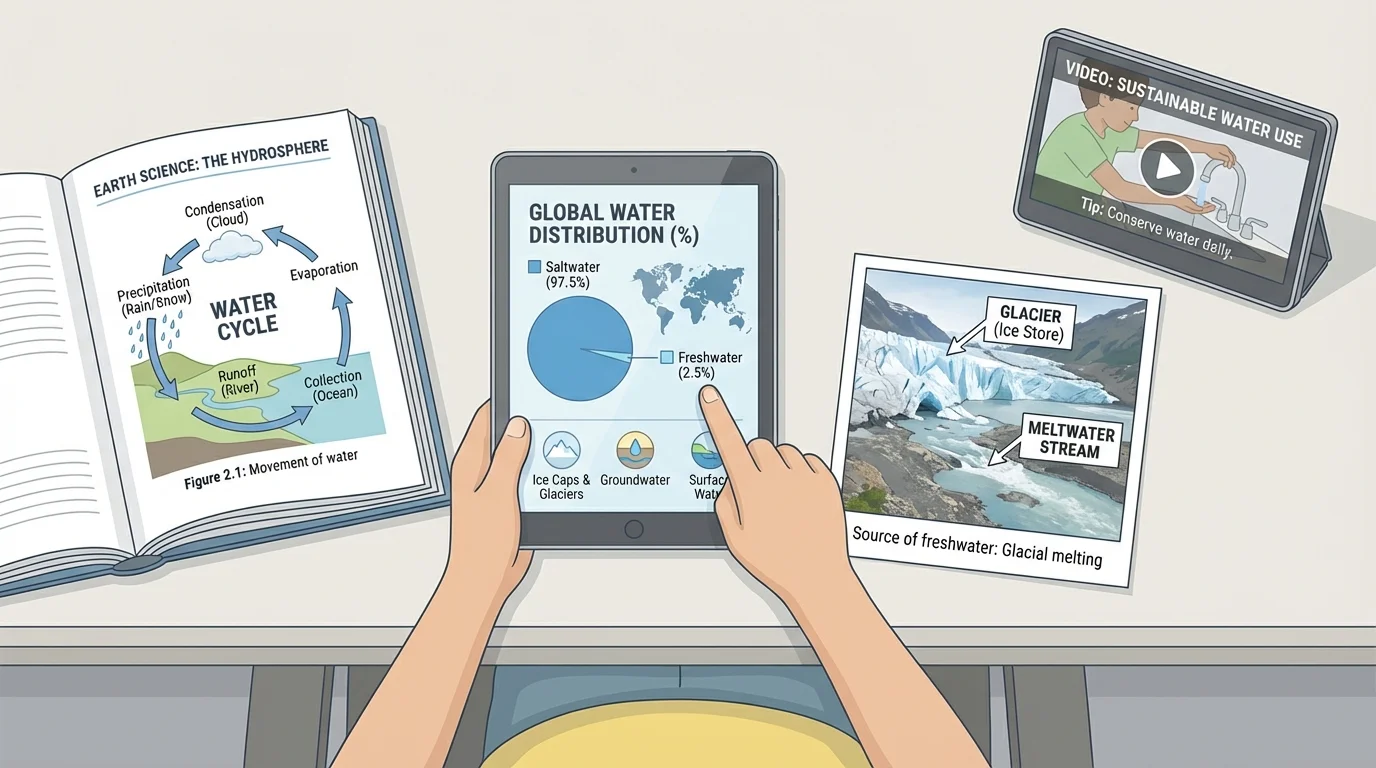
When we use different sources, we should ask, What fact did I learn here? For example, from a picture we might learn that ice is hard and solid. From a book we might learn that rivers and lakes hold liquid water. Together, the facts make our answer stronger.
Books and screens have special helpers called text features. These helpers guide readers to answers and point us to important facts.
As [Figure 2] shows, a heading tells what a section is about. If the heading says Water on Earth, we know that part will have useful information. A table of contents at the front of a book helps us find the right page fast.
A glossary at the back of a book explains special words. If we see the word liquid, the glossary may tell us it means water that can pour and flow. If we see the word solid, the glossary may explain that it keeps its shape, like ice.
On a screen, an icon is a small picture you can click or tap. An icon that looks like a magnifying glass may help us search. An electronic menu gives choices, like Oceans, Rivers, or Ice. Captions under pictures and labels on diagrams are also useful because they tell us exactly what we are looking at.
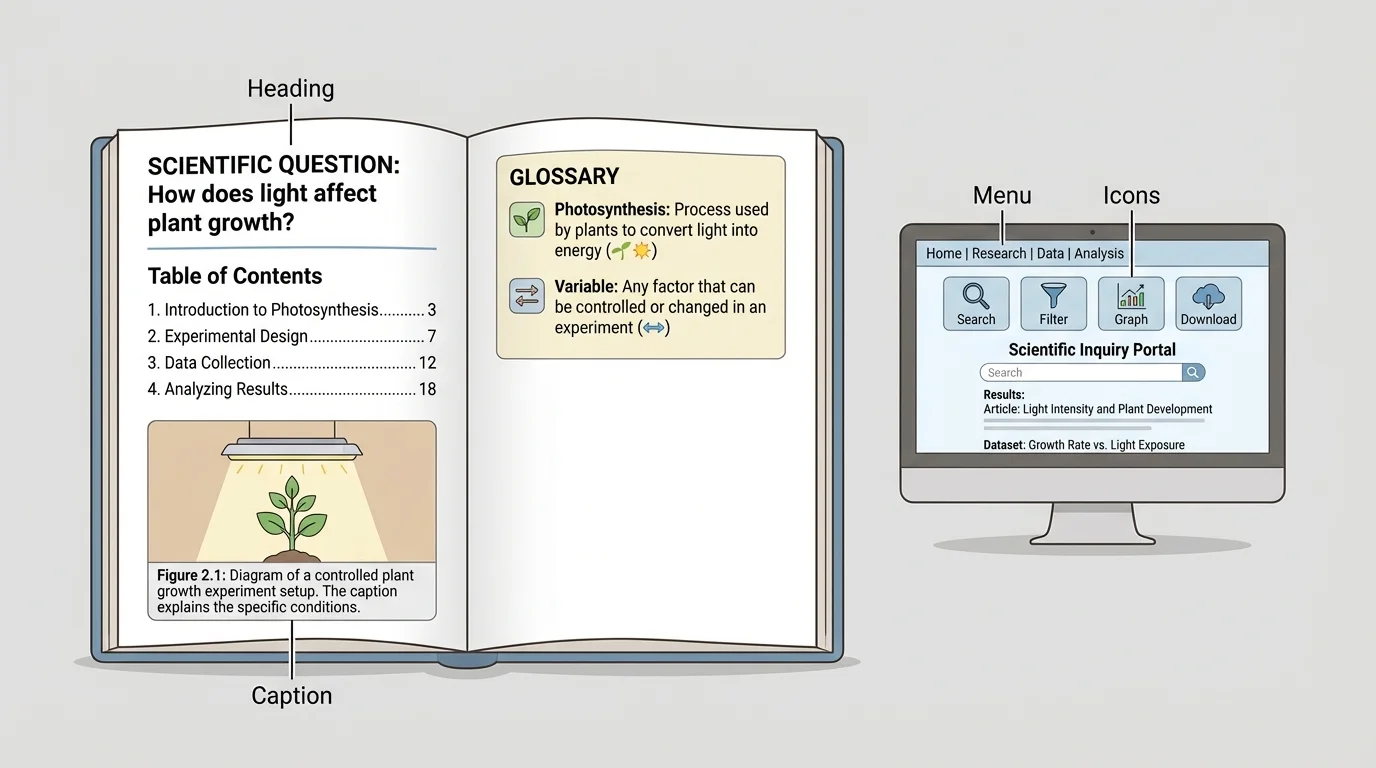
If we want to answer a question quickly, these features save time. Instead of reading every page, we can use the table of contents, heading, or search icon to jump right to the information we need.
Using text features to answer a question
Question: Where can we find water on Earth?
Step 1: Look at the table of contents.
Find a part called Water, Oceans, or Weather.
Step 2: Read the heading on that page.
The heading tells whether the page is about oceans, rivers, lakes, snow, or ice.
Step 3: Check picture labels and captions.
These may point to ocean water, lake water, river water, or ice on mountains.
Step 4: Use the glossary if a word is tricky.
Words like glacier or liquid can be explained there.
Now we can give an answer using facts from the source.
Later, when we use a website or digital book, the same idea still works. Menus, icons, labels, and headings help us locate facts without getting lost.
One big science idea is that water is found in many places on Earth. We can gather this information from books, maps, photos, and videos.
As [Figure 3] shows, water is in oceans, rivers, lakes, ponds, and puddles. Water is also underground and in the air as tiny drops in clouds. Some water is frozen in snow, ice, and glaciers.
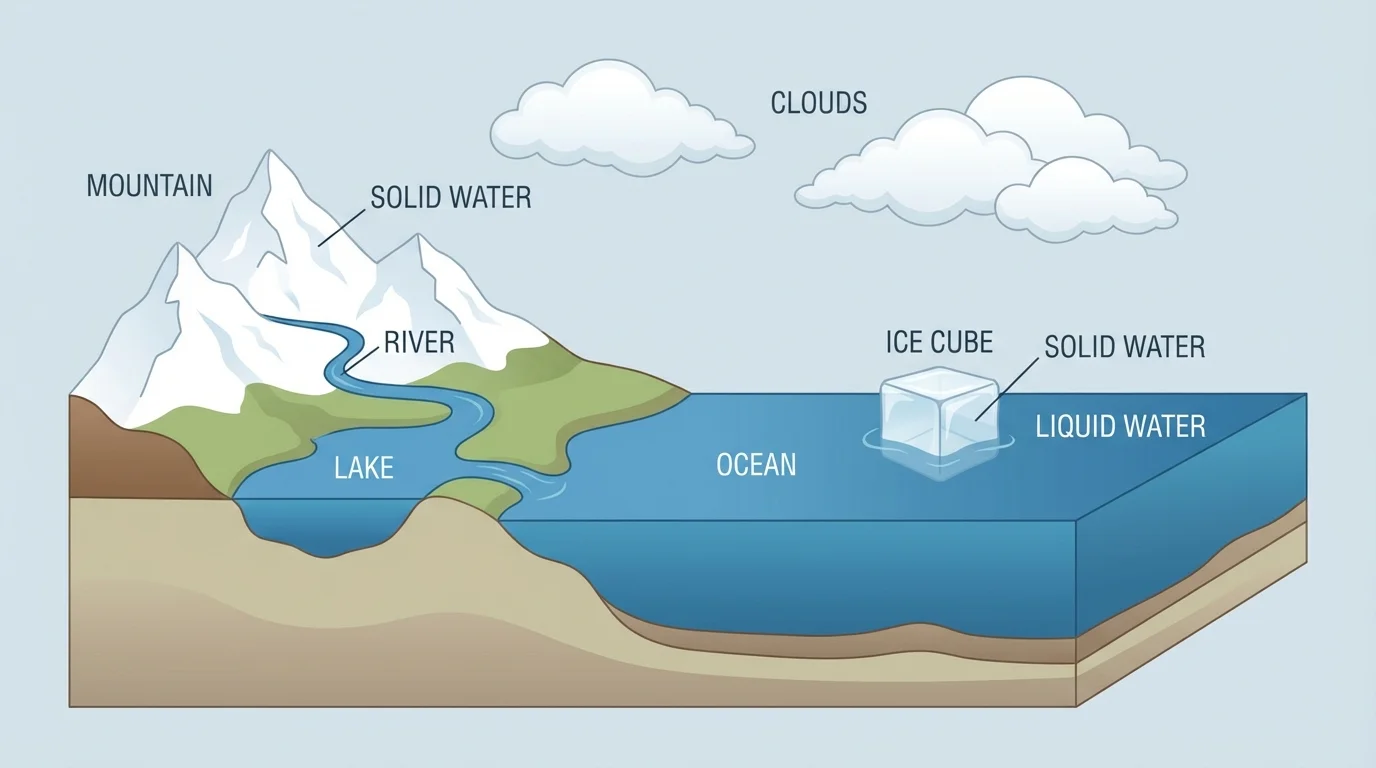
Water can be in different states. Liquid water flows and can be poured. Solid water is ice. Ice cubes in a freezer are solid water. Snow on the ground is also water in a solid form. The chemical formula for water is \(\textrm{H}_2\textrm{O}\).
How one question can have many helpful sources
If we ask, Is water only in oceans?, one photo may show a lake, a book may describe rivers, and a weather video may show snow. Each source adds a new fact. Putting the facts together helps us understand the whole idea.
We can use these facts to answer questions such as Where is water found? or Can water be solid? The answer is yes: water is found in many places, and it can be liquid or solid.
As we saw earlier in [Figure 2], labels and captions are especially helpful here because they tell us whether a picture shows ocean water, river water, snow, or ice.
Suppose someone says, Water is only a liquid. We can check sources to see whether that claim is true. A book page about ice, a photo of snow, and a video of frozen ponds all give evidence that the claim is not correct.
A better-supported claim would be: Water is found in many places on Earth, and it can be liquid or solid. We can support that claim with facts. Oceans, rivers, and lakes show liquid water. Snow and ice show solid water.
Supporting a science claim
Claim: Water can be liquid or solid.
Step 1: Find a source about liquid water.
A book says oceans and rivers hold water that flows.
Step 2: Find a source about solid water.
A labeled picture shows ice and snow.
Step 3: Put the facts together.
Since water is flowing in oceans and frozen in ice, water can be both liquid and solid.
Now the claim is supported with evidence from more than one source.
Looking back at [Figure 3], we can clearly compare flowing water with frozen water. That makes it easier to explain our claim using what we observed and read.
People use these skills every day. Meteorologists read weather maps and screens to learn about rain, snow, and ice. Park rangers read signs and guides about lakes, streams, and glaciers. Families may check a weather app with icons to see if it will rain or snow before going outside.
In school, you might use a library book, a classroom chart, and a safe website to answer one question. In nature, you might notice a puddle, frost on grass, or ice in a freezer and connect those observations to what you learned from text features and media.
Most of Earth's surface is covered by water, but not all of that water is easy for people to drink. Much of it is salty ocean water, and some of it is frozen as ice.
Good readers and good scientists pay attention to clues. Headings, glossaries, menus, icons, captions, and pictures help us find facts. Then we use those facts to answer questions and support claims about the world.
