Have you ever had a problem like carrying too many toys, keeping a paper dry in the rain, or making a block tower stay up? Here is something amazing: there is often more than one way to solve a problem. Smart thinkers do not stop at just one idea. They look for solutions, compare them, and choose the one that works best.
A problem is something that needs help or fixing. A solution is a way to help with that problem. If your crayons keep rolling off the table, that is a problem. You might put them in a box, use a cup, or place a small tray on the table. Those are all solutions.
Problem means something we want to fix, answer, or make better. Solution means a way to fix, answer, or help with the problem. Compare means to look at how things are the same and different.
Sometimes a solution works right away. Sometimes it works only a little. Sometimes it does not work at all. That is why it is helpful to think of more than one idea.
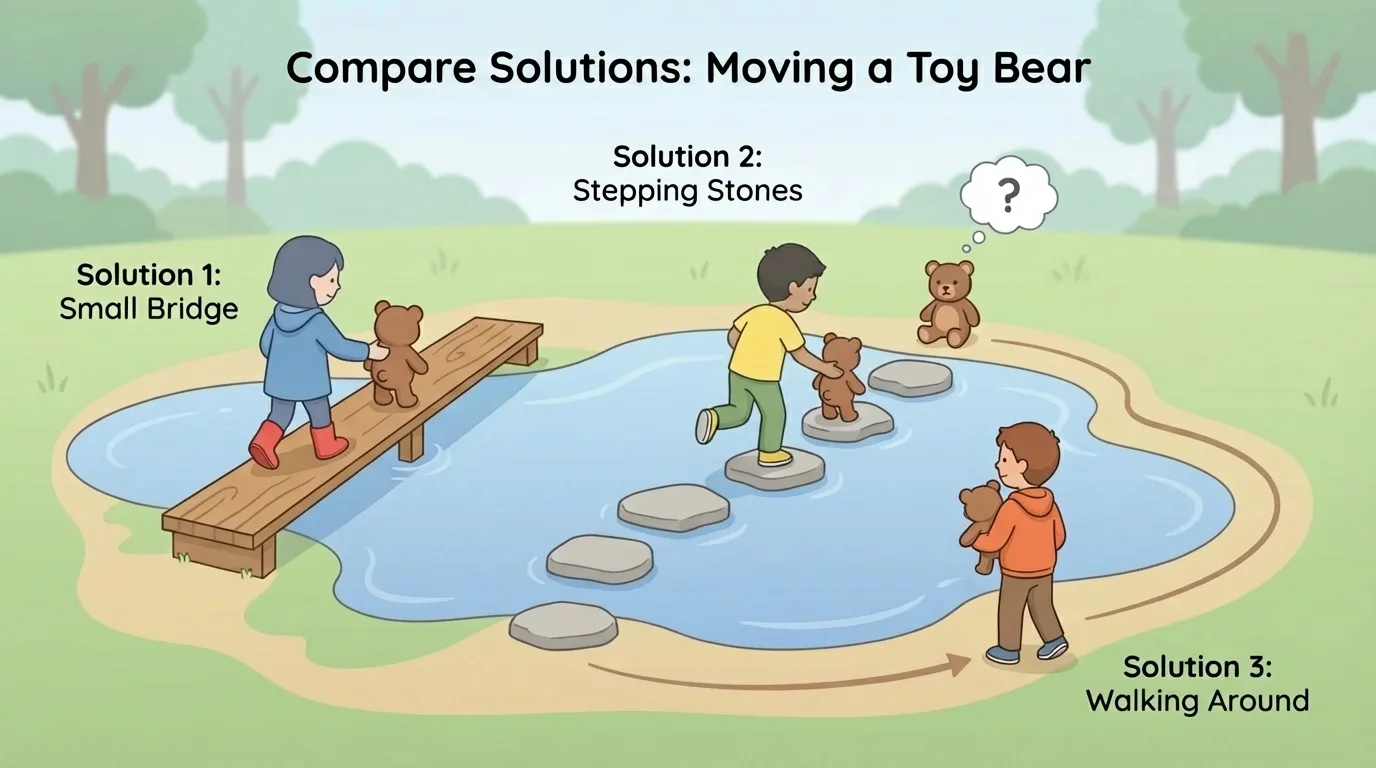
When people try to solve a problem, they can make a list of ideas. This is called brainstorming. For one problem, we may have many answers, as [Figure 1] shows with different ways to get across a puddle. One child may build a bridge. Another may hop on stones. Another may walk around the puddle.
All of those ideas try to solve the same problem. Some may be faster. Some may be easier. Some may keep shoes drier. Thinking of many ideas helps us notice more choices.
Good problem-solvers do not always say, "My first idea is the best." Instead, they ask, "What are other ways?" That helps them become careful thinkers.
Many inventors try lots of ideas before they find one that works well. A first idea can be good, but a later idea can be even better.
In science, children also think of more than one explanation for what they see. If a plant looks droopy, maybe it needs water, maybe it needs more sunlight, or maybe the pot is too small. Looking at different possible explanations helps us understand what is really happening.
When we compare solutions, we look at what each one does well. We can ask simple questions: Does it work? Is it safe? Is it easy to use? Is it strong? Is it fast? Does it use fewer things?
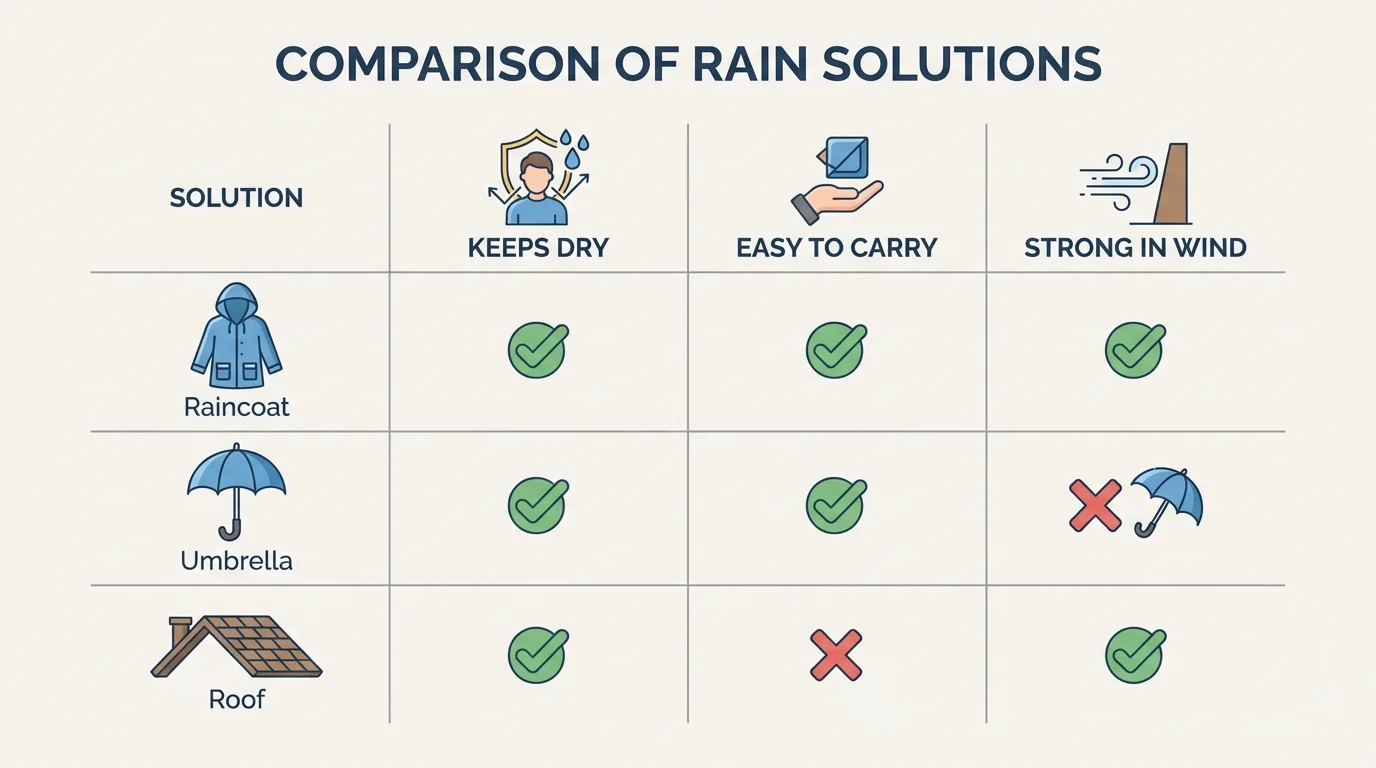
[Figure 2] If the problem is "stay dry in the rain," one solution might be a raincoat. Another might be an umbrella. Another might be standing under a roof. All three can help, but they are not the same.
| Solution | Keeps you dry? | Easy to carry? | Works in wind? |
|---|---|---|---|
| Raincoat | Yes | Yes | Yes |
| Umbrella | Yes | Sometimes | Not always |
| Roof | Yes | No | Yes |
Table 1. A simple comparison of three ways to stay dry.
Looking at a chart like this helps us make choices. The "best" answer depends on the job. If you are walking home, a raincoat may help more than a roof because you can wear it while moving.
We can also compare by using simple counts. If one bridge idea uses \(2\) blocks and another uses \(6\) blocks, the first uses fewer blocks. If one path takes \(3\) steps and another takes \(7\) steps, the first path is shorter.
Example: Choosing a way to carry books
Problem: A child wants to carry books from one table to another.
Step 1: Think of solutions.
Possible solutions: use two hands, use a bag, or use a small box.
Step 2: Compare them.
Two hands are simple, but the books may fall. A bag is easy to carry. A box can hold many books, but it may be big.
Step 3: Choose the best fit.
If there are only \(2\) books, two hands may be enough. If there are \(6\) books, a bag or box may work better.
The best solution depends on how many books must be carried.
Sometimes children think there is only one right answer. But in many real problems, more than one answer can be good. The best solution is the one that matches the goal.
If the goal is to build a toy house quickly, a simple design may be best. If the goal is to build a toy house that is very strong, a different design may be better. As we saw earlier in [Figure 2], comparing ideas helps us notice which one matches the need.
Best depends on criteria
A list of criteria is a set of things we care about when choosing. For young learners, criteria can be simple: safe, strong, easy, fast, or using fewer materials. A solution may be best for one criterion but not best for another.
That means good choosing is not guessing. It is thinking carefully about the job.
Scientists look at the world and ask, "Why did this happen?" They make explanations. Engineers ask, "How can we solve this problem?" They design solutions. Both kinds of thinking are important.
Suppose ice melts on a warm table. A scientist may explain that heat makes the ice melt. An engineer may design something to keep the ice cold longer, such as a thick cooler or a shaded box.
Remember that careful observing helps us think clearly. We look, listen, touch safely, and notice what changes. Then we can explain what happened or design a way to help.
Sometimes science and engineering work together. If we know why a paper airplane falls fast, we can make a better one. If we know why a plant bends toward light, we can place it where it will grow well.
Here are more ways to think about multiple solutions.
Example: Making a block tower stand
Problem: A tower keeps falling down.
Step 1: Think of more than one solution.
Make the bottom wider, use fewer blocks, or use larger blocks at the bottom.
Step 2: Compare the ideas.
A wider bottom may make the tower stronger. Fewer blocks may make it shorter but steadier. Large bottom blocks may help hold the top.
Step 3: Choose and try one.
Try the wider bottom first if the goal is to keep the tower tall and standing.
This solution is chosen because it helps with strength and balance.
Another problem could be moving a toy car across the floor without touching it. One child may blow on it. Another may pull it with string. Another may make a ramp. These are different solutions to the same problem.
We can compare them by asking: Which one moves the car the farthest? Which one is easiest? Which one is safest in the classroom? The scene in [Figure 1] reminds us that many paths can lead to success.
Example: Keeping a snack cold
Problem: A banana and yogurt need to stay cool.
Step 1: Think of solutions.
Put them in a lunch box, wrap them in a cloth, or use a lunch box with a cold pack.
Step 2: Compare the ideas.
A plain lunch box helps a little. A cloth helps a little. A cold pack helps more.
Step 3: Pick the strongest solution.
A lunch box with a cold pack is best if the goal is to keep the food cool longer.
Comparing helps us choose the solution that fits the need best.
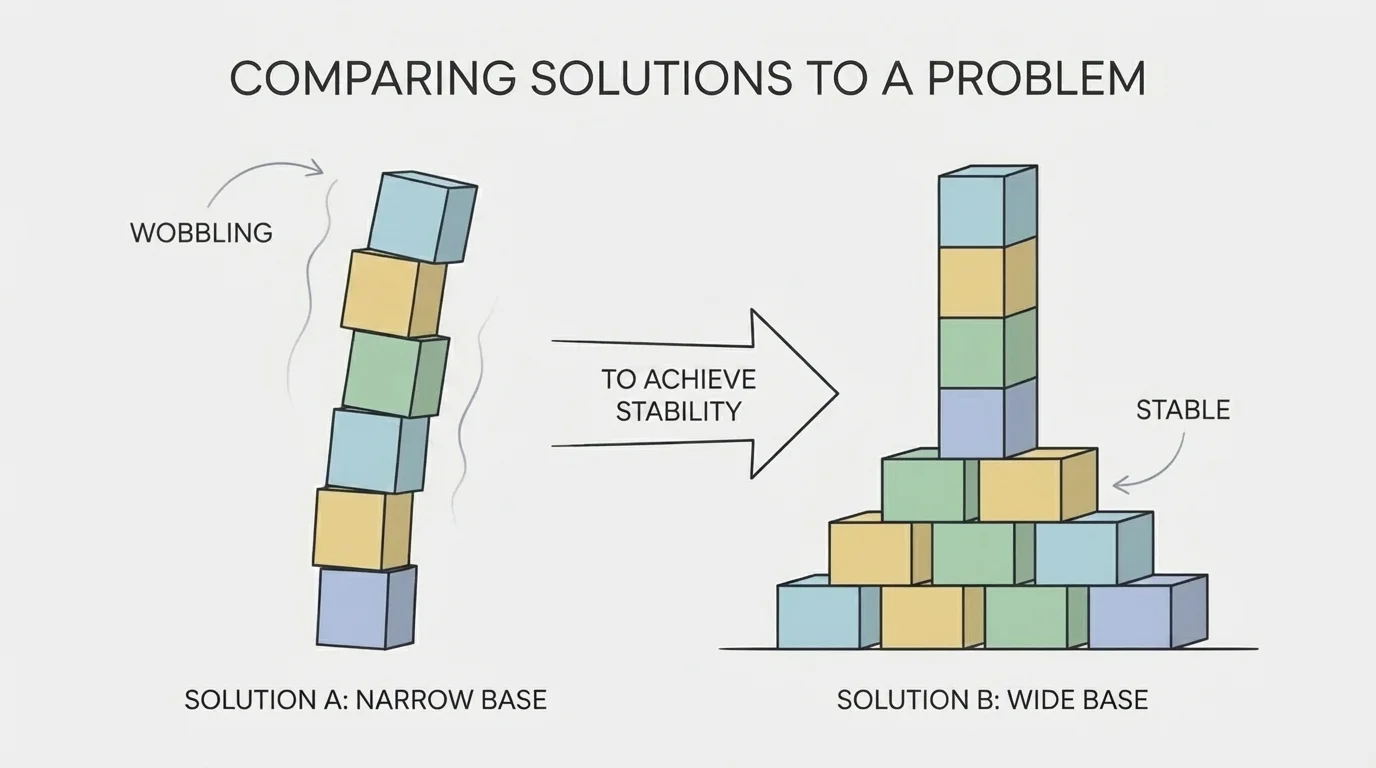
[Figure 3] Sometimes the first try does not work well. That is okay. Problem-solvers test, look closely, and change their ideas. Testing and improving are part of good design, as towers can change from shaky to stable.
If a paper bridge bends too much, we might fold the paper to make it stronger. If a toy boat tips over, we might make the bottom wider. Each new try teaches us something.
Improving does not mean the first idea was bad. It means we are learning. A small change can make a big difference.
Later, when we think again about strong designs, a wide base can support a tower better than a narrow one. This is why comparing and testing go together.
"There can be many good ideas, and testing helps us choose."
Good thinkers ask questions like these: What happened? What worked well? What should I change? Should I try another solution? These questions help us explain what we see and design better answers.
People use this kind of thinking every day. A family may choose whether to walk, ride a bike, or drive somewhere. A builder may choose which shape makes a bridge stronger. A teacher may choose different ways to store books and papers neatly.
Even young students can do this important work. When you think of more than one solution, compare them, and choose carefully, you are using powerful ideas from science and engineering.
