A mountain can contain evidence of an ancient ocean, and a quiet cliff can tell a story that took millions of years to build. That may sound surprising, but Earth leaves behind signs of its past in rocks, layers of sediment, and the remains of living things. Scientists do not simply guess what happened long ago. They look for clues and ask an important question: What evidence supports this idea?
When you explain how a landscape changed over time, each point in your explanation should be backed up by something you can observe. A landscape is the shape and features of the land in a place, such as hills, valleys, beaches, deserts, canyons, and plains. Wind, water, volcanoes, earthquakes, and slow changes deep inside Earth can all shape landscapes. Rocks and fossils help us understand these changes.
Earth is a little like a giant history book, except its pages are made of stone. Some pages are stacked in layers, some are cracked or bent, and some contain the remains of plants and animals that lived long ago. By studying these clues, scientists build explanations about what a place used to be like and how it became what it is today, as [Figure 1] shows.
For example, if a scientist says, "This dry area was once under water," that idea needs support. The support might come from shells trapped in rock, ripple marks in stone, or layers of sediment that form in water. These are not random details. They are pieces of evidence connected to a specific point.
Evidence is information that helps show whether an idea or explanation is likely to be true. In Earth science, evidence often comes from what scientists can observe in rocks, fossils, landforms, and patterns in nature.
Explanation is a statement that tells how or why something happened. A good explanation uses evidence, not just opinion.
Pattern is something that repeats or appears in a predictable way. Patterns in rocks and fossils help scientists notice connections.
When scientists study Earth, they often make a claim, which is a point they think is true, and then they search for evidence that supports it. If the claim is "A river carved this valley," then the evidence should connect to moving water, erosion, and the shape of the valley.
Not every fact is useful for every explanation. A rock's color might matter in one investigation but not in another. The important question is: Does this observation support the point I am trying to explain?
Suppose someone says, "This place used to have a forest." Tree fossils, leaf prints in rock, or buried wood would be helpful evidence. But the fact that the sky is cloudy today would not support that point at all. Good evidence is connected to the explanation.
The first time you look at a rock or fossil, you are making an observation. An observation is something you notice using your senses or simple tools. After that, you may make an inference, which is an idea based on evidence. For example, seeing fish fossils in rock is an observation. Saying, "This area was once covered by water," is an inference based on that evidence.
You already know that Earth changes over time. Mountains wear down, rivers move soil, beaches grow or shrink, and volcanoes can build new land. This lesson focuses on how we know those changes happened by using evidence left behind.
Strong explanations usually use more than one piece of evidence. One clue can be helpful, but several clues that fit together make an explanation much stronger.
Rock layers are one of the clearest records of Earth's past. In many places, layers are stacked with older rock below and younger rock above. This helps scientists put events in order, almost like arranging story pages from first to last.
If a lower layer has one kind of fossil and a higher layer has a different kind, scientists know the environment or living things changed over time. A sandy layer might show that a beach or desert once existed there. A muddy layer might show a lake bottom or a quiet sea floor. By reading the sequence of layers, scientists can explain changes in the landscape.
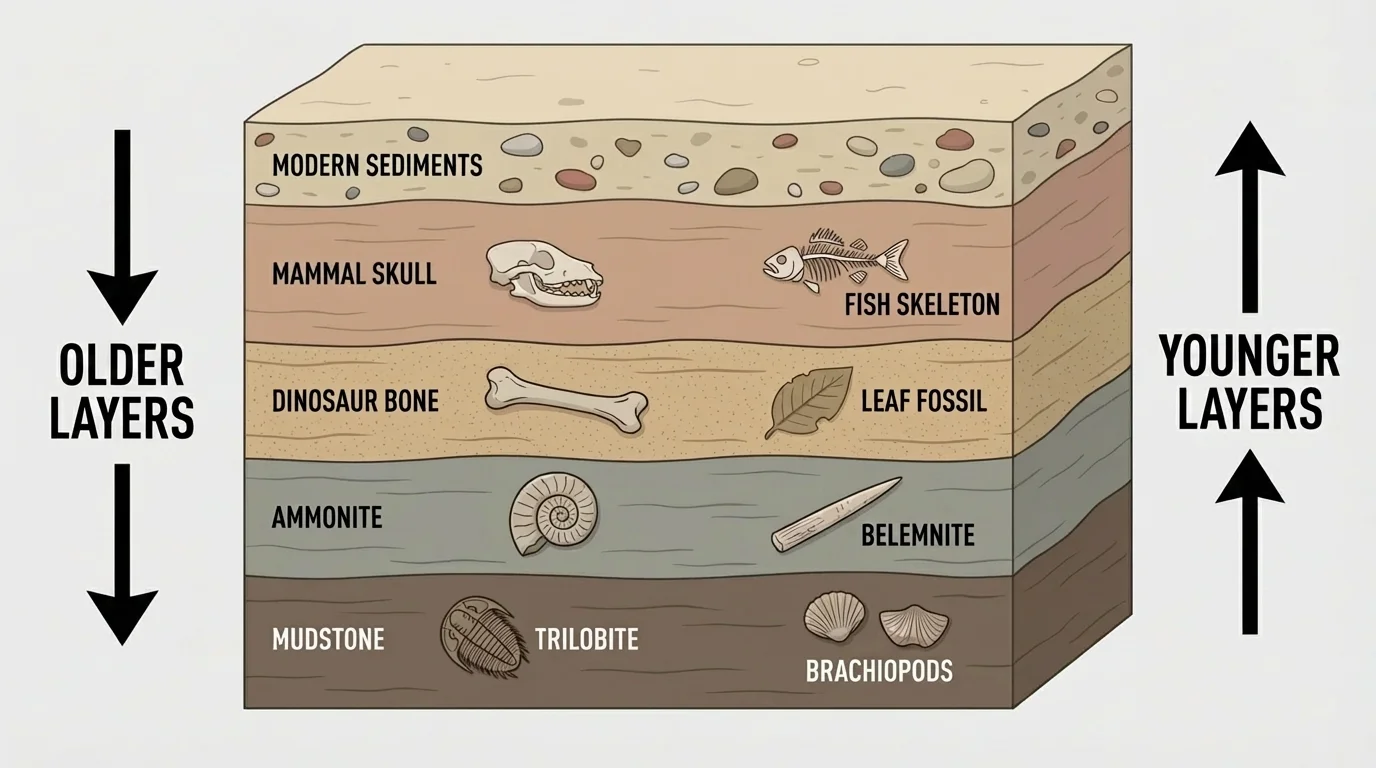
Imagine a cliff with four layers. The bottom layer has sea-shell fossils. Above that is a layer of dark mudstone with fish fossils. Above that is a sandy layer with no shells, and on top is soil with plant roots. These clues suggest that the place changed from an underwater environment to a different kind of land environment over a very long time.
Sometimes layers are not flat. They may be folded, tilted, or broken. That is also evidence. Bent layers may mean forces inside Earth pushed the rocks. A crack where rocks moved can be evidence of an earthquake or faulting. So scientists do not only look at what is in the rocks. They also look at how the rocks are arranged.
Later, when scientists compare several places, the pattern of older-below-younger layers seen in [Figure 1] helps them decide which changes happened first and which happened later.
A fossil is the preserved remains or trace of a living thing from long ago, as [Figure 2] shows. Fossils are powerful clues because different plants and animals live in different environments. Seashell fossils on dry land support the idea that the area was once under water.
If you find a fossil of a fern in rock, that may suggest the place once had conditions where that plant could grow. If you find coral fossils, that can point to warm, shallow water. If you find tracks, such as footprints, they can show that animals once moved across soft ground there.
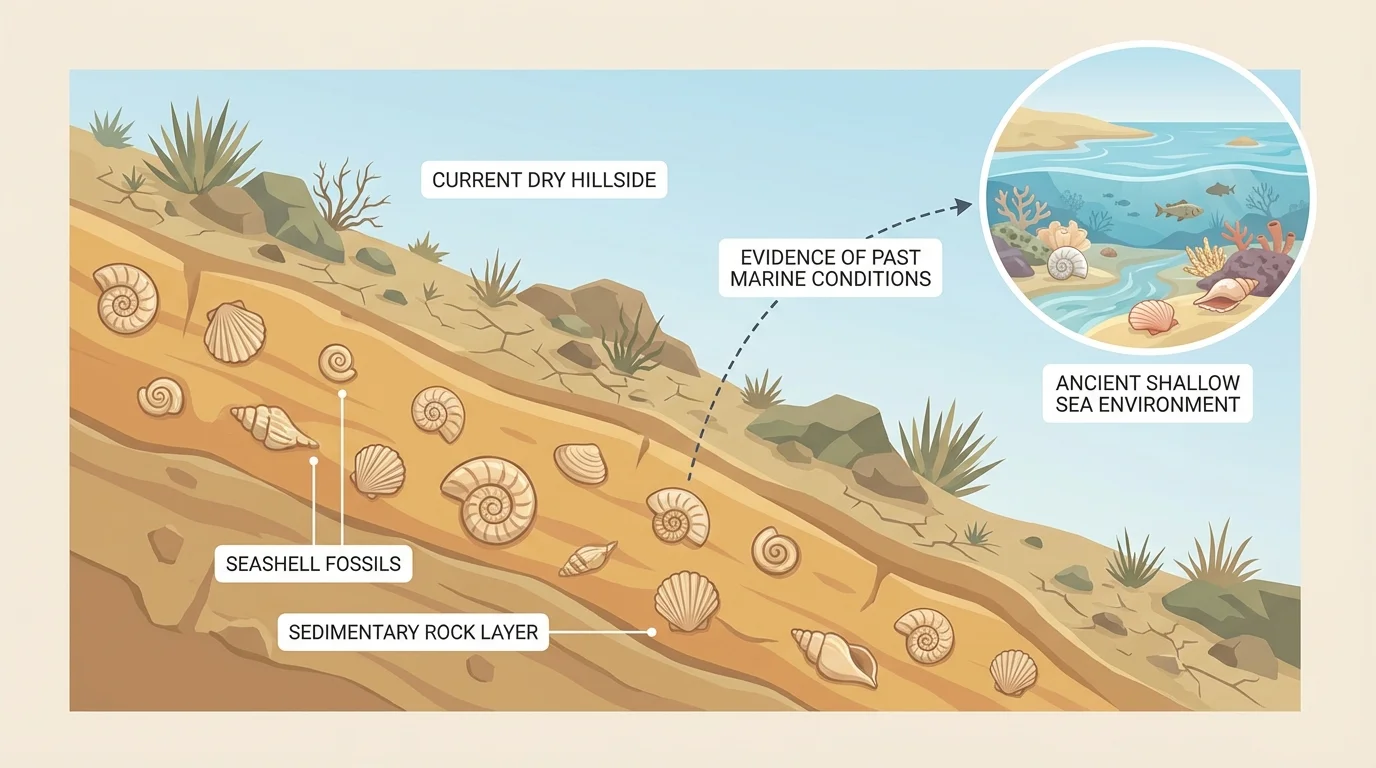
Fossils do not tell us everything by themselves. A shell fossil in one rock layer is useful, but it becomes even more helpful when scientists also study nearby rock types, the order of the layers, and patterns across a wider area. Good explanations often come from matching several pieces of evidence together.
Why fossils matter
Living things can only survive in certain conditions. Fish need water. Many desert plants need dry places. Coral grows in specific ocean environments. When fossils are found in rock, they help scientists infer what the environment was like when that rock formed. This is why fossils are evidence for landscape change over time.
Long after seeing the hillside example in [Figure 2], a scientist might compare it with another inland place that also contains shell fossils. If both places have similar evidence, the explanation that those areas were once underwater becomes stronger.
Patterns are important because they help scientists see more than a single clue. If many rock layers in a region contain signs of water, that repeated pattern supports the idea that water shaped the area. If fossils in lower layers are different from fossils in upper layers, that repeated change supports the idea that life and environments changed over time.
Patterns can include the order of layers, the kinds of fossils found in each layer, the shape of valleys, or the way rocks are worn away. When the same pattern appears again and again, scientists become more confident in their explanations.
For example, if several cliffs along a coast all show shell fossils low in the rock and land-soil layers above, that pattern suggests a large environmental change happened over time. One cliff might be a special case, but many cliffs showing the same thing create stronger evidence.
Some fossils are not preserved body remains at all. A fossil can be a footprint, a burrow, or even a leaf print. These are called trace fossils because they show what a living thing did, not just what it looked like.
Scientists often ask, "Is this clue part of a pattern, or is it only one isolated observation?" The more a clue fits with other clues, the more useful it becomes.
This skill is about more than spotting interesting clues. It is about deciding which clues support which parts of an explanation. A single explanation may have several points, and each point needs matching evidence.
Suppose the explanation is: "A river slowly cut through rock and made a valley. Later, the area became drier." That explanation has at least two points. One point is that a river shaped the valley. Another point is that the climate later became drier. Each point needs evidence that fits it.
| Point in the explanation | Evidence that supports it | Why it fits |
|---|---|---|
| A river cut the valley | A winding valley shape, smooth rounded stones, and signs of erosion | Moving water wears away rock and carries stones |
| The area was once underwater | Shell fossils in rock layers | Shell animals usually live in water |
| The environment changed over time | Different fossils in lower and upper layers | Different layers formed during different times and conditions |
| Earth forces changed the rocks | Folded or tilted layers | Pushing inside Earth can bend rock layers |
Table 1. Examples of matching evidence to specific points in an explanation about landscape change.
Notice that evidence must be linked to the correct point. Shell fossils do not directly prove that a river carved a valley. They support a different point: that water once covered the area. Good scientific thinking means choosing the evidence that actually matches the statement.
Case study: choosing the best evidence
A student says, "This hill was once at the bottom of a sea, and later the land was lifted upward." Which observations best support the two parts of that explanation?
Step 1: Separate the explanation into points.
Point one: the hill area was once underwater. Point two: the land later moved upward.
Step 2: Match evidence to point one.
Sea-shell fossils and ripple marks in rock support the idea of shallow water.
Step 3: Match evidence to point two.
Those same shells are now high above sea level, so the land must have changed position over time.
This is stronger than simply saying, "The hill looks old," because "looks old" is not a clear piece of evidence.
Sometimes students choose evidence that is true but not helpful. A rock may be gray, heavy, and rough, but those facts do not always support the explanation you are trying to make. Always ask: How does this clue connect to the point?
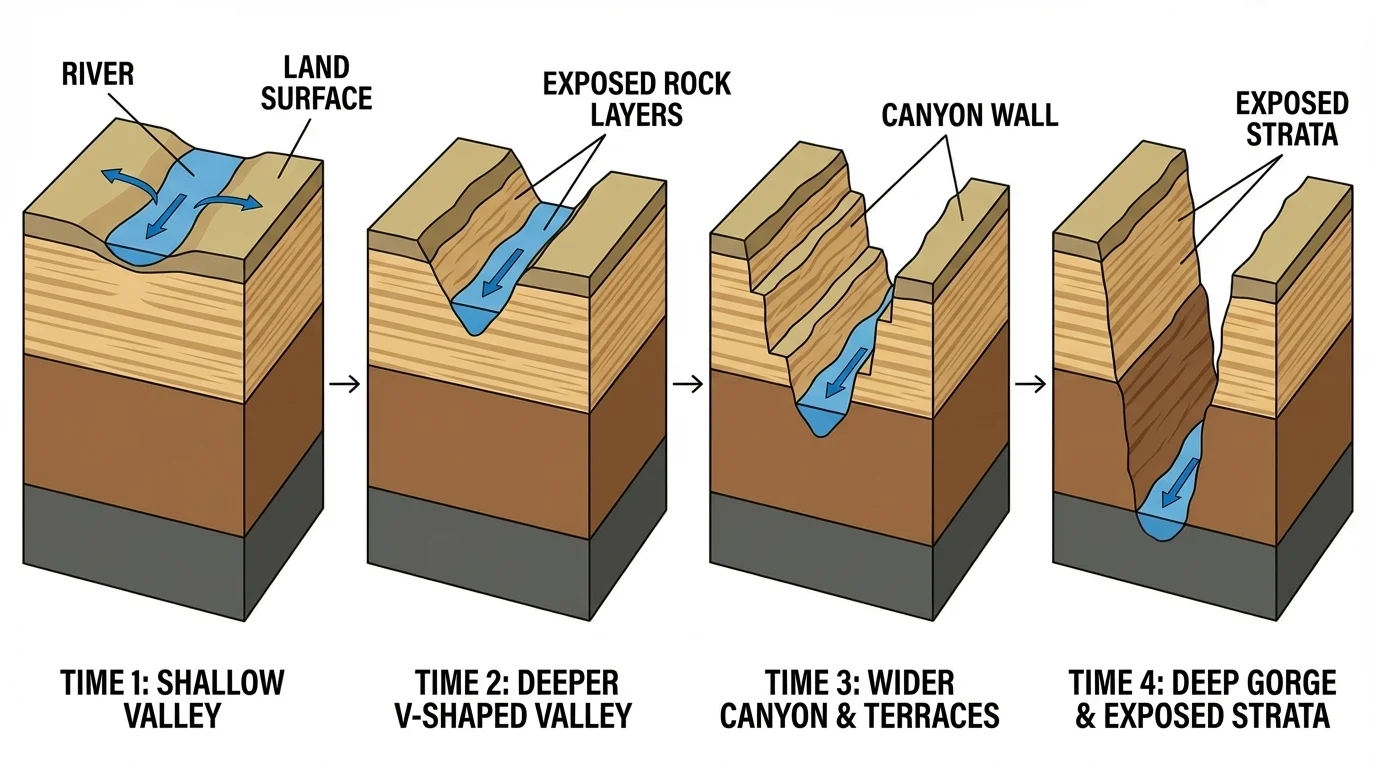
One powerful example comes from rivers, as [Figure 3] illustrates. Over long periods, moving water can wear away rock and soil. A river may cut a small channel that becomes deeper and wider over time. This process is called erosion, which means the wearing away and moving of Earth materials.
If scientists see a deep valley with a river at the bottom, smooth stones, and rock worn by flowing water, those observations support the point that water shaped the land. If the exposed walls of the valley also show layers, those layers reveal older and younger rocks and may contain fossils too.
Another example is a place where marine fossils are found far from the ocean. Marine means related to the sea. If shell or coral fossils are found high on land, scientists may explain that the area was once underwater and later changed because of uplift, which is land moving upward over time.
Volcanoes can also change landscapes. Layers of cooled lava and ash can build land upward. If a place has volcanic rock above older sedimentary rock, that order supports the explanation that volcanic activity happened after the older layers formed.
Even a beach can change in ways that leave evidence. Sand can build up in one season and wash away in another. Over much longer times, repeated changes can create new layers. Scientists study those layers to understand what happened.
When students look back at the river example in [Figure 3], they can connect the shape of the valley to the process of erosion and the exposed layers to the story of the land before the valley was cut.
Strong evidence is clear, connected, and often supported by more than one clue. Weak evidence may be unclear, unrelated, or based mostly on guessing. Scientists prefer direct observations and patterns over opinions.
Compare these two statements:
Statement A: "This place was once underwater because shell fossils are trapped in the rock, and the rock layer matches other water-formed layers nearby."
Statement B: "This place was once underwater because the hill has a nice shape."
Statement A uses strong evidence. Statement B does not. A hill's shape alone is not enough to support that explanation.
"Claims need evidence."
— A key rule in science
Another sign of strong evidence is when different clues agree. If fossils, rock type, and layer order all point to the same explanation, the explanation becomes more convincing.
Scientists usually follow a careful process. First, they observe rocks, fossils, and landforms. Next, they compare patterns. Then they infer what may have happened. Finally, they build an explanation and check whether the evidence really supports each point.
They may revise their explanation when they discover new evidence. Science is not about sticking to the first idea forever. It is about improving explanations as more clues are found.
This is why fieldwork matters. Geologists and paleontologists study cliffs, canyons, road cuts, riverbanks, and other places where layers are visible. Museums also help because collected fossils and rocks can be compared with samples from many regions.
Real-world application: protecting places and learning from them
Scientists use evidence from rocks and fossils to understand hazards and protect special places.
Step 1: They study the layers in an area.
These layers may reveal old floods, volcanic eruptions, or times when the sea covered the land.
Step 2: They compare patterns with nearby places.
Matching patterns help them know whether a change happened in one small place or across a large region.
Step 3: They use the explanation to make decisions.
Communities can learn where flooding, erosion, or landslides may happen, and parks can protect important fossil sites.
This shows that evidence from the past can help people in the present.
Understanding evidence also helps people care for Earth. When scientists explain how a canyon formed or why fossils appear in certain rocks, they are helping us understand the long history of our planet.
One common mistake is confusing a guess with evidence. Saying "I think this happened" is not enough. You must point to the clues that support the idea.
Another mistake is using evidence that does not match the point. If your point is about water, look for clues connected to water. If your point is about land rising or folding, look for clues about rock position and structure.
A third mistake is relying on only one clue when several clues are available. One fossil may help, but a fossil plus the rock layer plus the shape of the land creates a much stronger explanation.
It is also important not to jump too quickly from observation to conclusion. A shape in a rock may appear to be a fossil, but scientists examine it carefully and compare it with other evidence before deciding.
This skill is not only for Earth science. People use evidence every day. If the ground is wet, clouds are dark, and there is water dripping from leaves, you may explain that it recently rained. Those clues support your explanation.
Science uses the same kind of thinking, but more carefully. Instead of just saying "maybe," scientists connect each point in an explanation to observations they can describe and compare. In Earth science, those observations often come from rocks, layers, fossils, and landforms.
Learning to identify evidence helps you become a stronger thinker. It teaches you to ask not only what happened, but also how do we know?
