A huge storm can turn a quiet playground into a puddle-filled lake in just a few minutes. When that happens, people do not just say, "That is a problem." They also start thinking like designers: How can we fix it? But here is the important part: a good idea is not enough by itself. To decide whether a solution is really good, we need to make a claim and back it up with evidence.
A problem is something that needs to be solved. A weather hazard can cause a problem for people. Heavy rain can flood roads. Strong winds can break windows. Heat waves can make outdoor spaces unsafe. Snow and ice can make sidewalks slippery.
A solution is a way to help fix the problem. People build, plant, move, or change things to reduce danger. For example, a town may place sandbags near a river, build stronger roofs, plant trees for shade, or clear storm drains before a storm.
When we decide whether a solution is good, we make a claim. A claim is a statement that says what we think is true. For example, we might say, "Planting shade trees is an effective solution for reducing heat on the playground." That is a claim. But to make it strong, we must show why we think it is true.
Claim means a statement or answer that you say is true.
Evidence means facts, observations, measurements, or test results that help prove a claim.
Design solution means a planned way to solve a problem.
A weak claim sounds like an opinion only: "I like this idea best." A strong claim uses evidence: "I claim this idea is best because it kept out more water, cost less, and was quick to set up."
Every good solution must be judged in a fair way. Designers use criteria and constraints to do that, and the project goals and limits are organized clearly, as shown in [Figure 1]. If we do not know the criteria and constraints, we cannot tell whether a solution really fits the problem.
Criteria are the things the solution should do. They are the goals. If the problem is flooding at a school door, the criteria might be: stop water from entering, keep students safe, and be easy to use.
Constraints are the limits. A solution cannot be huge, super expensive, or too hard to build. It may need to fit in a small space, use safe materials, or be ready in less than \(10\) minutes.
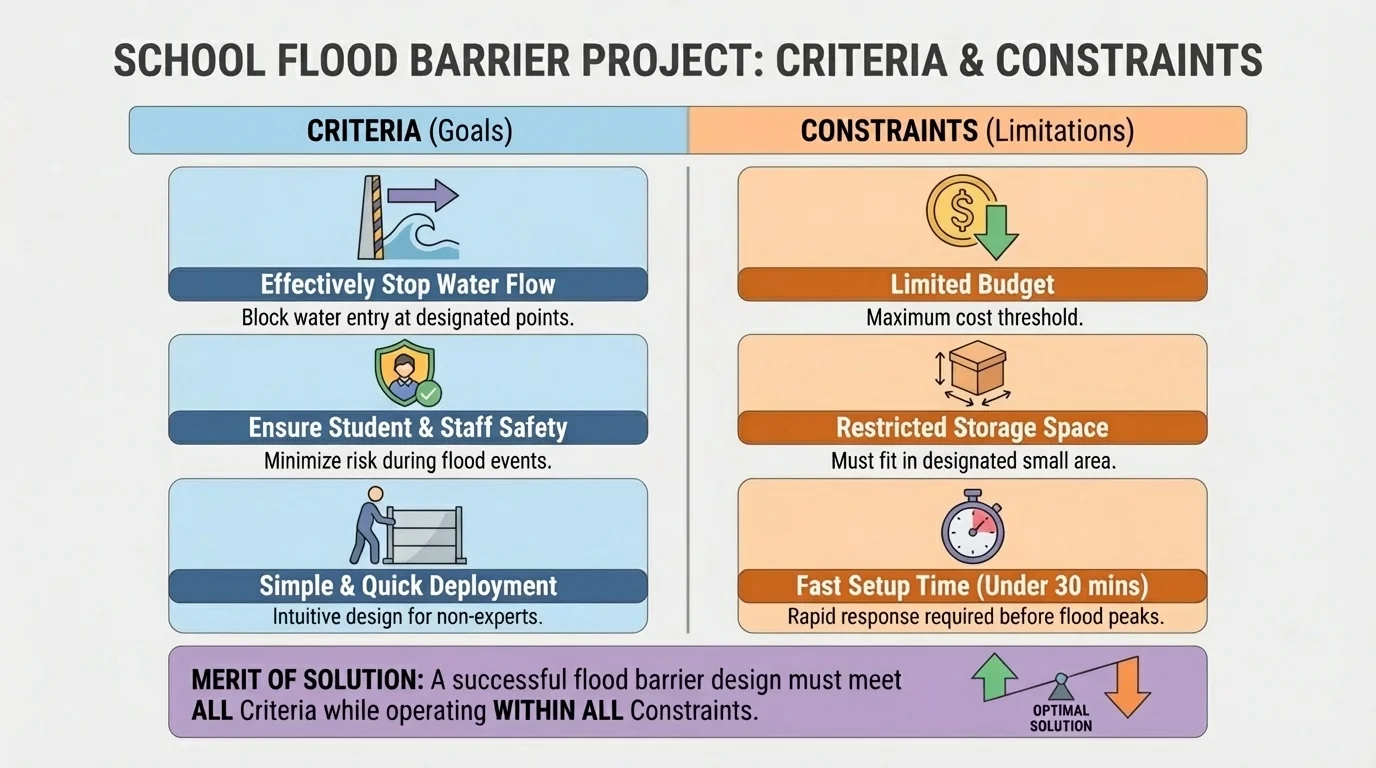
Think of it this way: criteria answer, "What should this solution do?" Constraints answer, "What limits must we stay within?" A solution that works very well but costs too much may not be the best choice. A solution that is cheap but does not solve the problem also is not the best choice.
Suppose a class tests a rain cover for a garden. Their criteria might include keeping plants from being damaged by hail and letting sunlight through. Their constraints might include using only classroom materials and spending less than $20. Even if one design is strong, it may not be chosen if it blocks too much sunlight or costs too much.
Why criteria and constraints matter
A design is effective only when it meets the goals of the problem and stays within the limits. Engineers, scientists, and communities use both ideas together. That is why a claim about a solution should mention not only what worked, but also whether the design fit the rules and limits of the situation.
Later, when students compare solutions, they often return to the same chart of criteria and constraints, just as we saw in [Figure 1], because the chart helps them judge each idea by the same standards.
Different weather hazards need different kinds of help, as [Figure 2] illustrates with several real-world examples. A weather hazard is a weather event that can cause harm. Hazards include floods, hurricanes, tornadoes, blizzards, droughts, hailstorms, and heat waves.
People create design solutions to reduce the effects of these hazards. To reduce flood damage, they may use sandbags, drainage ditches, raised buildings, or rain gardens. To protect buildings from strong wind, they may install storm shutters, stronger roof straps, or windows made to handle pressure.
To reduce heat, schools might add shade structures, plant trees, or paint roofs with lighter colors that reflect sunlight. To handle snow and ice, communities may store salt, build covered walkways, or design roofs that let snow slide off more safely.
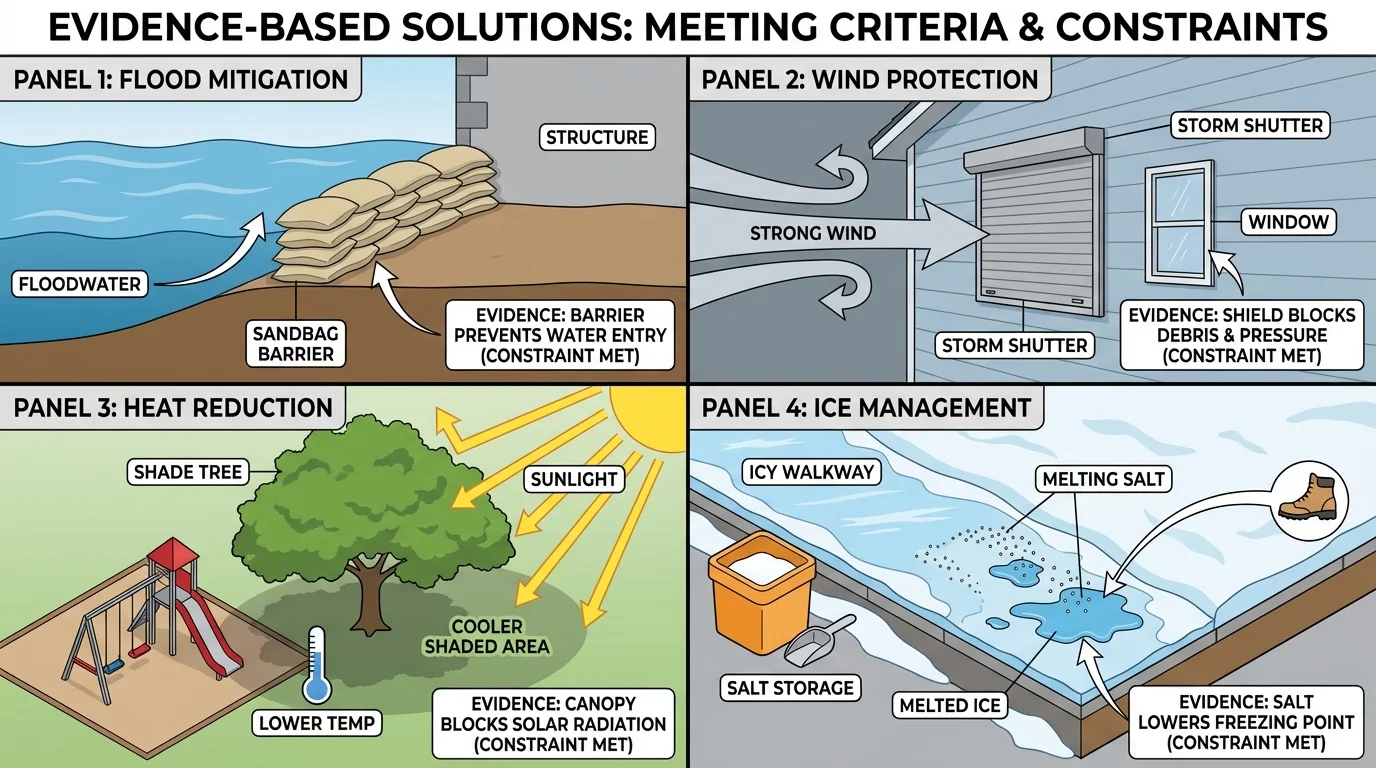
Notice that one problem can have more than one solution. For flooding, a town could build a wall, place sandbags, or improve drains. Each solution should be tested against the criteria and constraints. One may be stronger, one cheaper, and one easier to move.
Some solutions are built by people, and some use nature. Planting trees, restoring wetlands, and planting grasses along a shoreline can reduce harm from weather. These natural solutions can slow water, hold soil in place, and cool hot areas. When people use nature in a smart way, they are still designing a solution.
Wetlands act like giant sponges. They can soak up extra rainwater and slow down flooding, which helps protect nearby homes and habitats.
When you compare solutions for different hazards, the scenes in [Figure 2] remind you that the best design depends on the kind of weather danger, the place, and the people or living things that need protection.
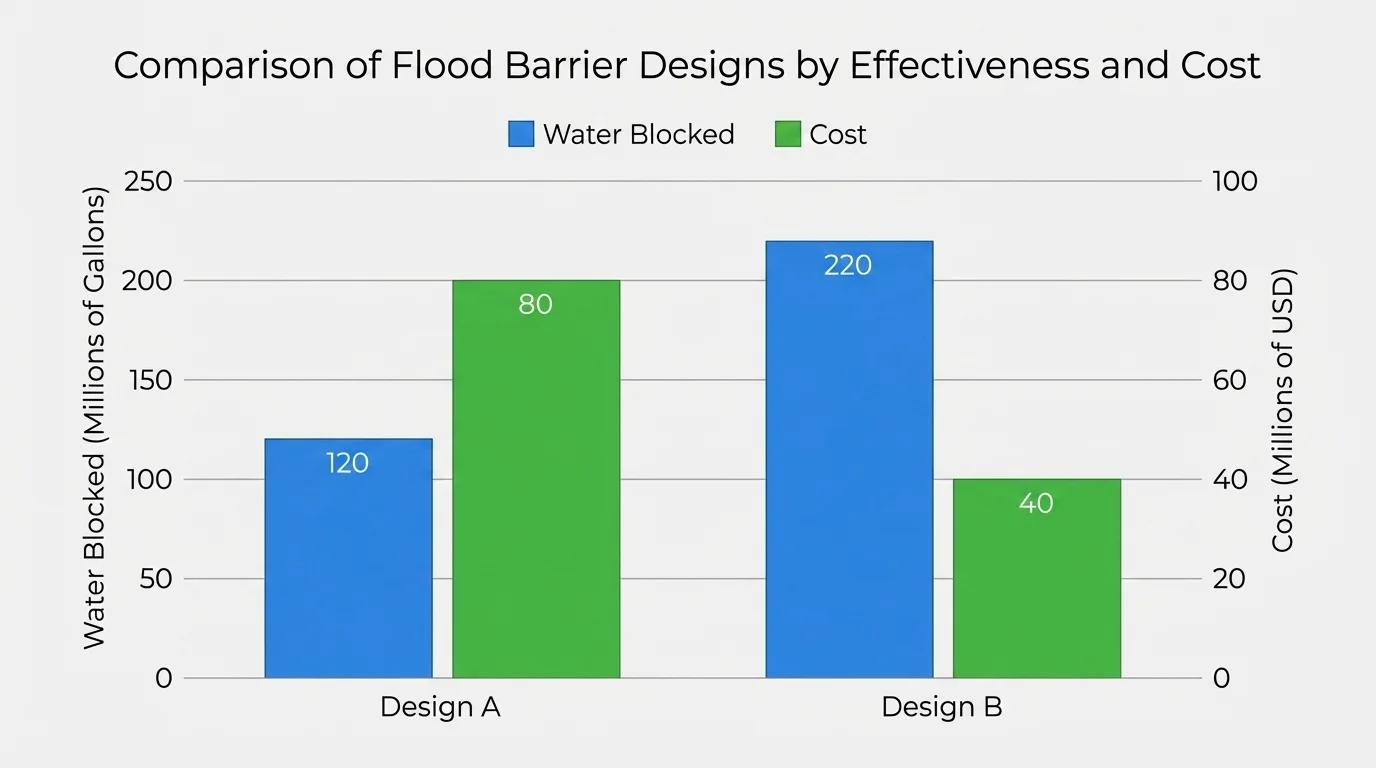
To make a strong decision, we need more than a guess. We need evidence. Test results like those in [Figure 3] help us judge solutions fairly because measurements and comparisons are stronger than opinions alone.
Evidence can come from many places: watching what happens in a test, measuring how much water gets through, timing how long setup takes, checking cost, or seeing whether people can use the design safely.
Suppose two barriers are tested in a tray of water. Barrier A lets in \(1\) cup of water and takes \(3\) minutes to set up. Barrier B lets in \(4\) cups of water and takes \(2\) minutes to set up. If the main goal is to stop water, Barrier A gives better evidence for success. If quick setup matters most, Barrier B has an advantage. This is why we must look at all the criteria and constraints together.
Evidence should be relevant. That means it should match the problem. If the problem is a roof blowing off in strong wind, then evidence about paint color is not very helpful. But evidence about roof strength, wind tests, and safety is helpful.
Evidence should also be accurate. If students test one design many times and get similar results, they can trust the data more. If they only try it once, the result may not be enough. Repeating tests helps us know whether the design works again and again.
Using evidence from a test
A class tests two shade designs for a playground on a hot day.
Step 1: Identify the criteria and constraints.
The criteria are lowering temperature and giving enough shade. The constraints are using safe materials and keeping the cost low.
Step 2: Examine the evidence.
Design A lowers the temperature by \(6\) degrees and covers a large area. Design B lowers the temperature by \(3\) degrees and covers a smaller area. Design A costs a little more, but both designs stay under the budget.
Step 3: Make a claim.
A strong claim is: "Design A is more effective because it lowers the temperature more and gives more shade while still meeting the cost limit."
Later, when someone asks why the class chose Design A, they can point back to the kind of comparison displayed in [Figure 3] and explain that the decision was based on measurable results.
Sometimes two solutions both work, but one works better for the exact problem. Comparing solutions means looking at each one side by side. A table can make this easier.
| Solution | Meets the main goal? | Safe? | Low cost? | Easy to use? |
|---|---|---|---|---|
| Sandbags | Yes, for small floods | Usually | Often | Can be heavy |
| Concrete wall | Yes, for bigger floods | Yes | No | Not movable |
| Rain garden | Helps soak water | Yes | Medium | Needs planning |
Table 1. A comparison of three flood-related solutions using common criteria and constraints.
From this chart, we can see that each solution has strengths and weaknesses. Sandbags are flexible and often cheaper, but they can be heavy to move. A concrete wall may stop more water, but it costs much more and cannot be moved. A rain garden helps absorb water, but it may not protect a doorway during a sudden storm.
This is why claims should be specific. Instead of saying, "Concrete walls are best," it is stronger to say, "For a place with frequent large floods and enough money to build, a concrete wall may be the most effective solution." The best answer depends on the criteria and constraints.
When scientists compare ideas, they look for patterns in observations and data. The same habit helps when comparing design solutions: gather information, compare it carefully, and base your answer on evidence.
A solution can be effective in one place but not in another. Trees that provide shade in a hot schoolyard may be excellent there, but they would not solve the problem of icy roads in winter.
A clear claim is not just one sentence pulled from a feeling. It has three parts: the answer, the evidence, and the reason the evidence matters.
You can use a sentence frame like this: "I claim that ______ is the most effective solution because ______. This evidence shows it meets the criteria of ______ and stays within the constraints of ______."
Here is another example: "I claim that storm shutters are an effective solution for strong winds because they protect windows from flying debris, can be closed quickly before a storm, and help keep people safer inside the house."
"Good claims are built on good evidence."
— A key rule in science and engineering
Notice that the claim names the solution and then gives evidence. It does not simply say the shutters are "cool" or "better." It explains why the shutters match the problem.
A stronger claim may also include a comparison: "Storm shutters are more effective than taping windows because they provide stronger protection during high winds." Comparing helps make the reasoning clearer.
A school entrance floods during heavy rain, and the layout of the problem is shown in [Figure 4]. Water runs down a sidewalk and collects near the front doors. The school wants a solution that keeps water out, is safe for students, costs little, and can be used quickly before storms.
The school considers two ideas: a low curb wall and movable sandbag barriers. The curb wall is always in place, but it costs more to build. The sandbags cost less at first, but they must be carried and stacked each time a storm is coming.
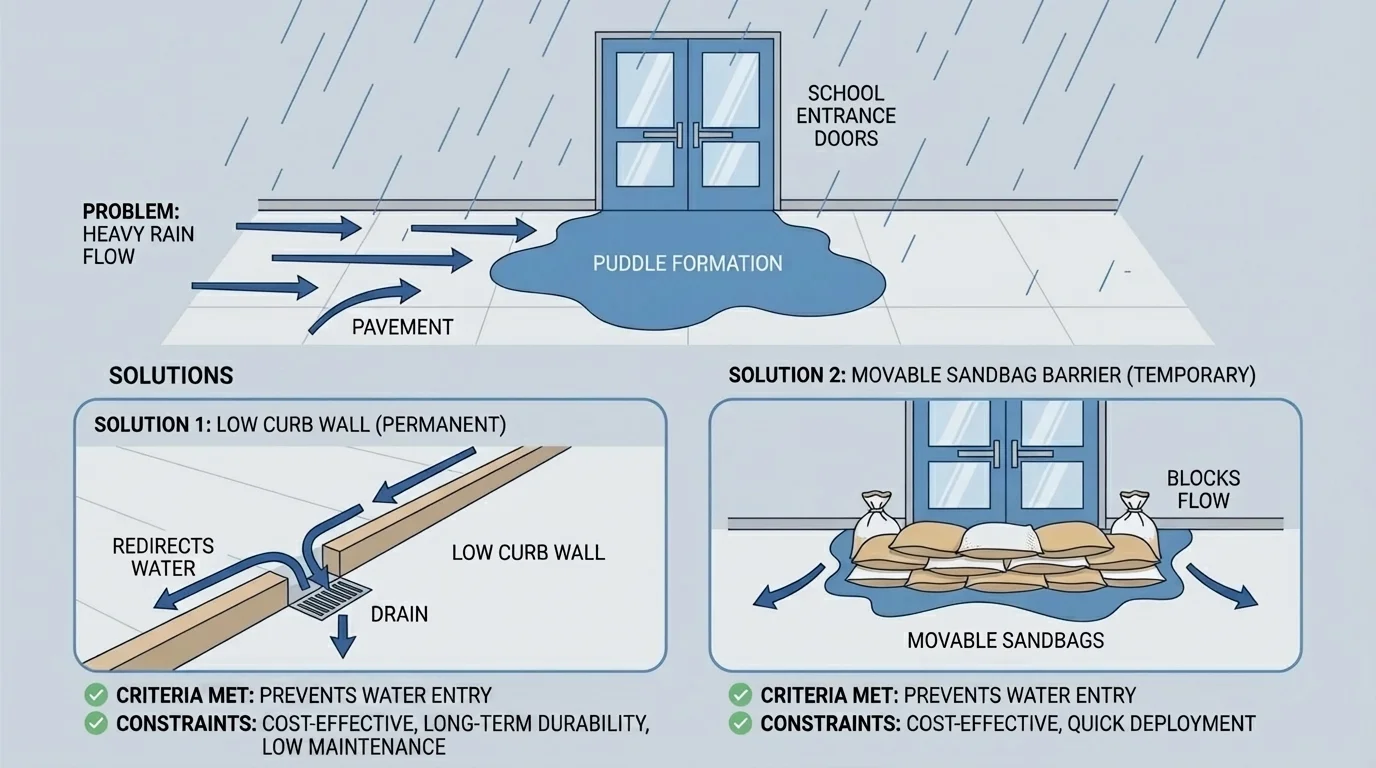
Now the school gathers evidence. In a water-flow test, the curb wall stops more water. It also stays in place all year. But it may create a tripping problem if it is too high. The sandbags work fairly well, but older students or adults must move them into place, and that takes time.
Case study claim
After testing, the school team decides which solution is more effective.
Step 1: Review the criteria.
The design must stop water, be safe, and be easy to use before storms.
Step 2: Review the constraints.
The school has limited money and limited setup time.
Step 3: Use the evidence.
The curb wall stops more water and does not require emergency setup. The sandbags are cheaper at first but take longer to place and may not block as much water.
Step 4: Make the claim.
A strong claim is: "The low curb wall is the more effective solution because it blocks more water and is always ready, which means it better meets the main criteria. However, it must be designed carefully so it stays safe and fits the school's budget."
This example shows that a claim can include both strengths and concerns. The team is not saying the curb wall is perfect. They are saying it is more effective based on the evidence and the needs of the school. Looking again at [Figure 4], it becomes clear why location and water flow matter when judging a flood solution.
When people solve problems caused by weather, they should also think about living things. A wall that protects one area might push water toward a habitat where animals live. Cutting down trees to build something quickly might remove shade and make heat worse later.
A habitat is the place where a plant or animal lives and gets what it needs. Good design solutions try to protect people without causing unnecessary harm to habitats. For example, planting native grasses to hold soil can reduce erosion and also support insects and birds.
This means that evidence can include effects on nature too. If one solution protects a neighborhood and also keeps a wetland healthy, that may make it a stronger choice than another solution that damages the wetland.
People and the environment are connected
Earth systems and living things affect one another. A design that changes water flow, shade, soil, or shelter can also change where organisms can survive. Strong claims about solutions should consider those effects when they matter to the problem.
In many places, the best solutions are not only strong and affordable. They also fit the environment. A rain garden, for example, can reduce flooding, support pollinators, and make a schoolyard more beautiful at the same time.
One common mistake is making a claim without evidence. Saying "I just know this one is best" is not enough. Another mistake is using evidence that does not match the problem. If the problem is heat, then evidence about flood protection does not answer the question.
A third mistake is forgetting the constraints. A solution might work very well but be too expensive, too large, or too slow to use. In that case, it may not be the best solution for that situation.
A final mistake is ignoring other living things and the environment. Since people share Earth with plants and animals, strong design choices often consider both human safety and natural systems.
When you make a claim, ask yourself: What is the problem? What are the criteria? What are the constraints? What evidence do I have? How does the evidence show the solution fits the problem? If you can answer those questions, your claim will be much stronger.
