A drop of pond water can hold tiny living things too small to see with your eyes, while the night sky stretches far beyond what you could travel in a lifetime. Nature is full of objects and events that exist on many different scales. Some are so small that we need special tools to observe them. Others are so large that we can only understand them by studying maps, photographs, and telescopes. Some changes happen in less than a second, while others take thousands or millions of years.
When scientists study nature, they think carefully about scale. Scale means the size of something, the length of time it takes, or sometimes the amount of energy involved. A ladybug, a tree, a mountain, and a planet are all real parts of nature, but they are not important in the same way when we study a question. If you want to know why a leaf has tiny holes, you look closely at insects. If you want to know why seasons change, you think about Earth and the Sun.
Scientists also think about proportion and quantity. Proportion is how one part compares to another part. Quantity is how much of something there is. A small amount of rain and a huge amount of rain can lead to very different results. A tiny seed and a giant tree are both plants, but their size changes what they can do and what they need.
Scale is the size of something, the time it takes, or the amount of energy involved in a process.
Proportion is the way one part compares in size or amount to another part.
Quantity is how much of something there is, such as the number of objects, the amount of water, or the length of time.
Thinking about scale helps us decide what is relevant. A single ant matters when we study an anthill. One ant does not matter much when we study a whole forest. In the same way, one raindrop matters when it lands on a spider web, but it does not explain a flood. The right scale helps us notice the right causes and effects.
Natural objects can be arranged almost like a size ladder, as [Figure 1] shows. Near the small end are grains of dust, cells, and tiny insects. Farther up are flowers, children, dogs, and trees. Beyond that are hills, rivers, oceans, Earth, and stars. Each step on this ladder helps us understand how greatly sizes can differ in nature.
Even objects that seem small to us can be huge compared with something else. An ant may seem tiny beside your shoe, but to a bacterium, an ant is enormous. A tree may seem big in a park, but compared with a mountain, it is small. This is why size is often about comparison, not just one number.
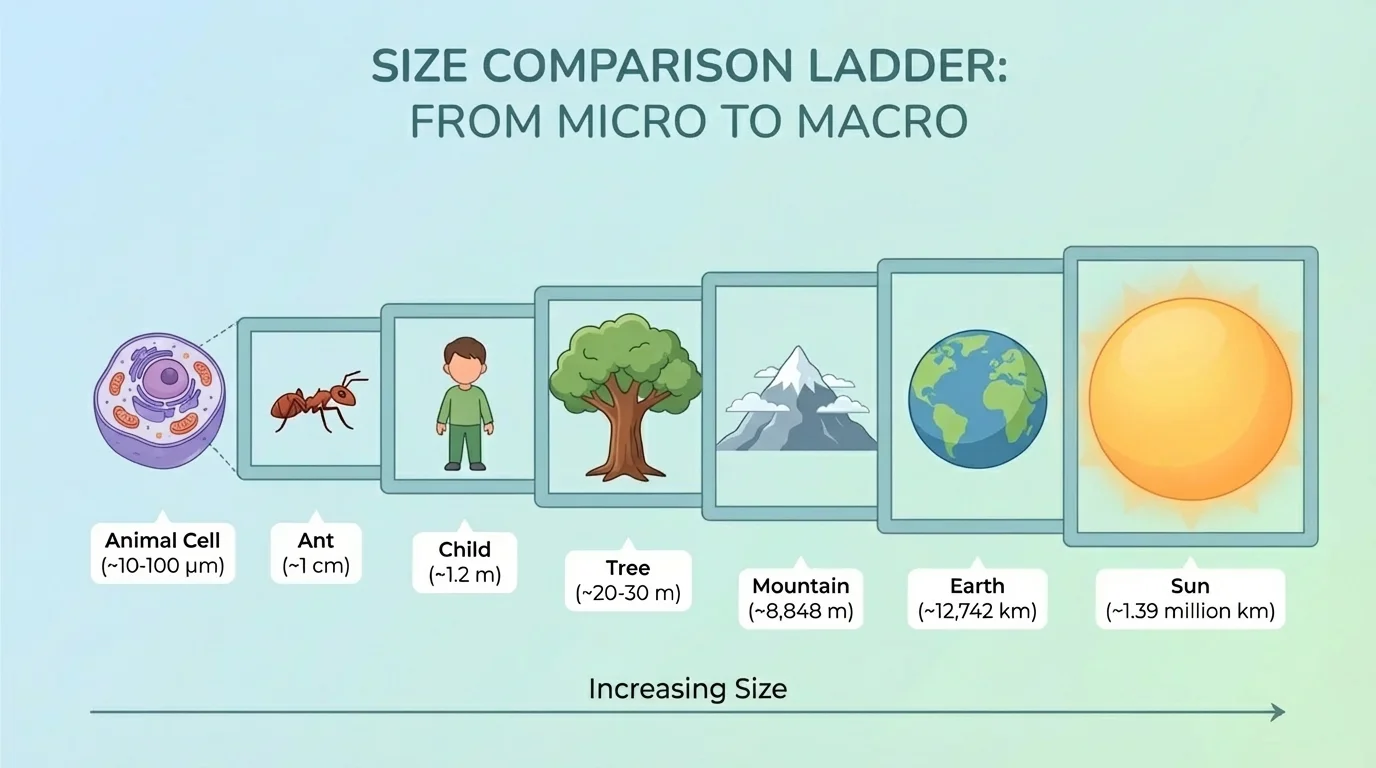
Scientists use measurements to compare sizes. A paper clip might be a few centimeters long. A classroom might be several meters long. A road trip might cover many kilometers. Tiny things may be measured in millimeters or even smaller units. Very large distances in space are so great that standard everyday units are not practical.
When we change scale, what we notice changes too. If you look at a sandy beach from far away, it seems smooth. If you kneel down and look closely, you see separate grains, shell pieces, and tiny tracks. The beach is the same place, but a closer scale reveals different details. This idea matters in science because different questions require different views.
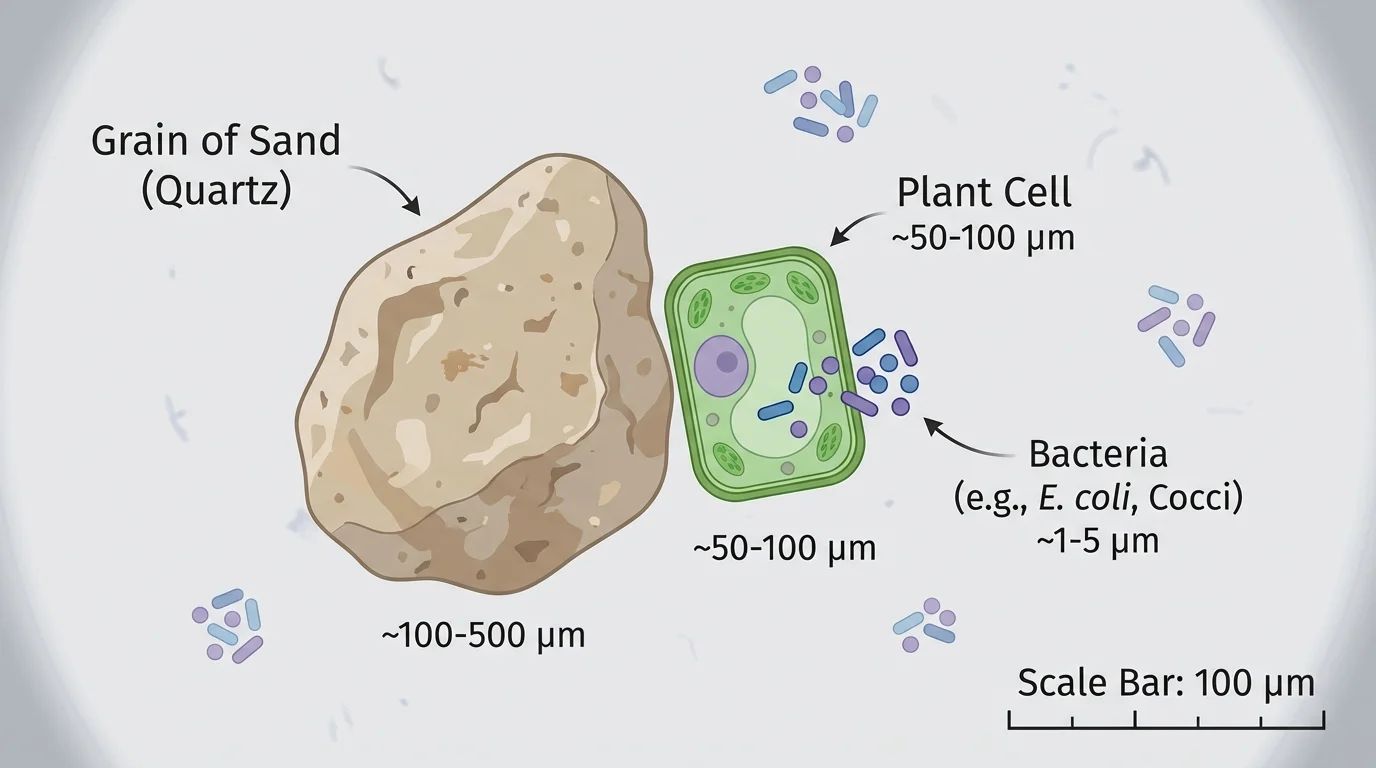
Many important parts of nature are too small to see clearly without help, as [Figure 2] explains. Your body is made of cells, which are tiny building blocks of living things. Some living things, such as certain bacteria, are made of just one cell. Even though cells are tiny, they do important jobs like taking in nutrients, making energy, and helping organisms grow.
A microscope helps scientists observe very small objects. Through a microscope, a drop of pond water may look crowded with movement. Tiny organisms that seem invisible in everyday life suddenly become part of an amazing hidden world. Without using the right tool for the right scale, we would miss important information.
Small size can change how something behaves. A dust speck can float in the air much longer than a rock because it is so light. A tiny insect can walk across a leaf without bending it much, but a heavier animal would tear or crush it. At small scales, lightness, surface contact, and shape can matter a lot.
This also means that tiny things can add up to something large. One cell is microscopic, but trillions of cells make up a human body. One grain of sand is easy to ignore, but countless grains can build a beach or a desert. Quantity matters because many small parts together can form a system that is large and powerful.
Your skin is made of many layers of cells, and your body replaces old skin cells all the time. Something tiny and hard to notice is happening on your body every day.
Later, when we think about large systems, it helps to remember what [Figure 2] shows: small parts can be hidden from view but still be essential to how a whole system works.
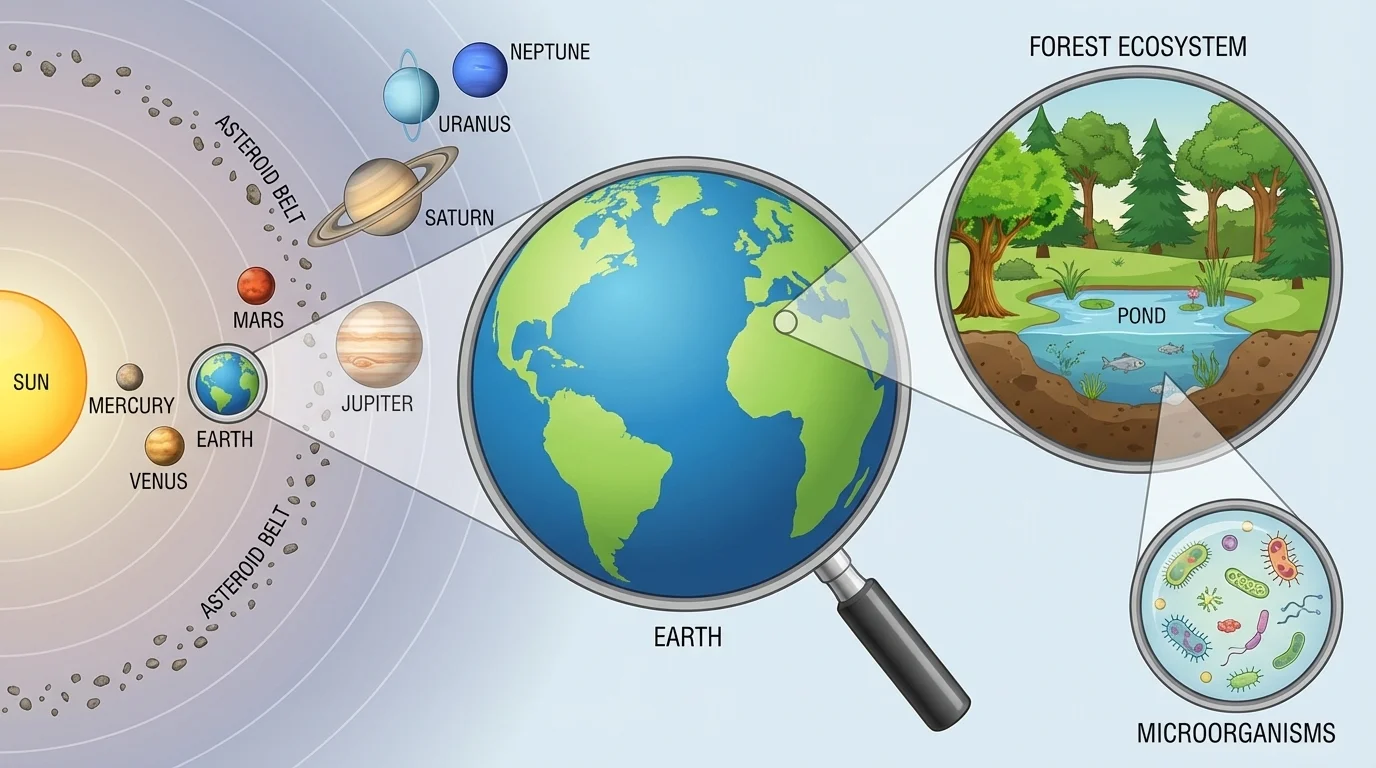
Nature also includes very large systems, as [Figure 3] illustrates. A pond contains water, plants, fish, insects, and tiny organisms. A forest contains many ponds, trees, animals, soil, and streams. Earth contains forests, deserts, oceans, and ice. Beyond Earth is the solar system, which includes the Sun and the objects that move around it.
A system is a group of parts that work together or affect one another. This idea is important because large systems are often made of smaller systems. A forest is not just "one thing." It is made of living and nonliving parts connected in many ways. If rainfall changes, plant growth may change. If plant growth changes, animals may also be affected.
Very large scales often require us to step back and look at patterns instead of tiny details. When meteorologists study weather across a region, they do not track every single air molecule. They look at clouds, wind patterns, temperature, and pressure over large areas. That larger view helps them understand storms.
At the scale of Earth, the movement of land, water, and air shapes climate and habitats. At the scale of the solar system, gravity helps keep planets in orbit around the Sun. At even larger scales, stars gather into galaxies. These huge scales remind us that the universe is far larger than our everyday surroundings.
Big systems are built from smaller parts. A natural system can be understood at more than one scale. A plant has cells. A garden has many plants. A park has many gardens, trees, insects, birds, and soil. The larger the system, the more important it becomes to notice patterns and connections instead of focusing on just one tiny part.
The nested idea in [Figure 3] helps explain why scientists sometimes switch scales. They may zoom in to study a leaf and zoom out to study a whole forest, depending on the question they want to answer.
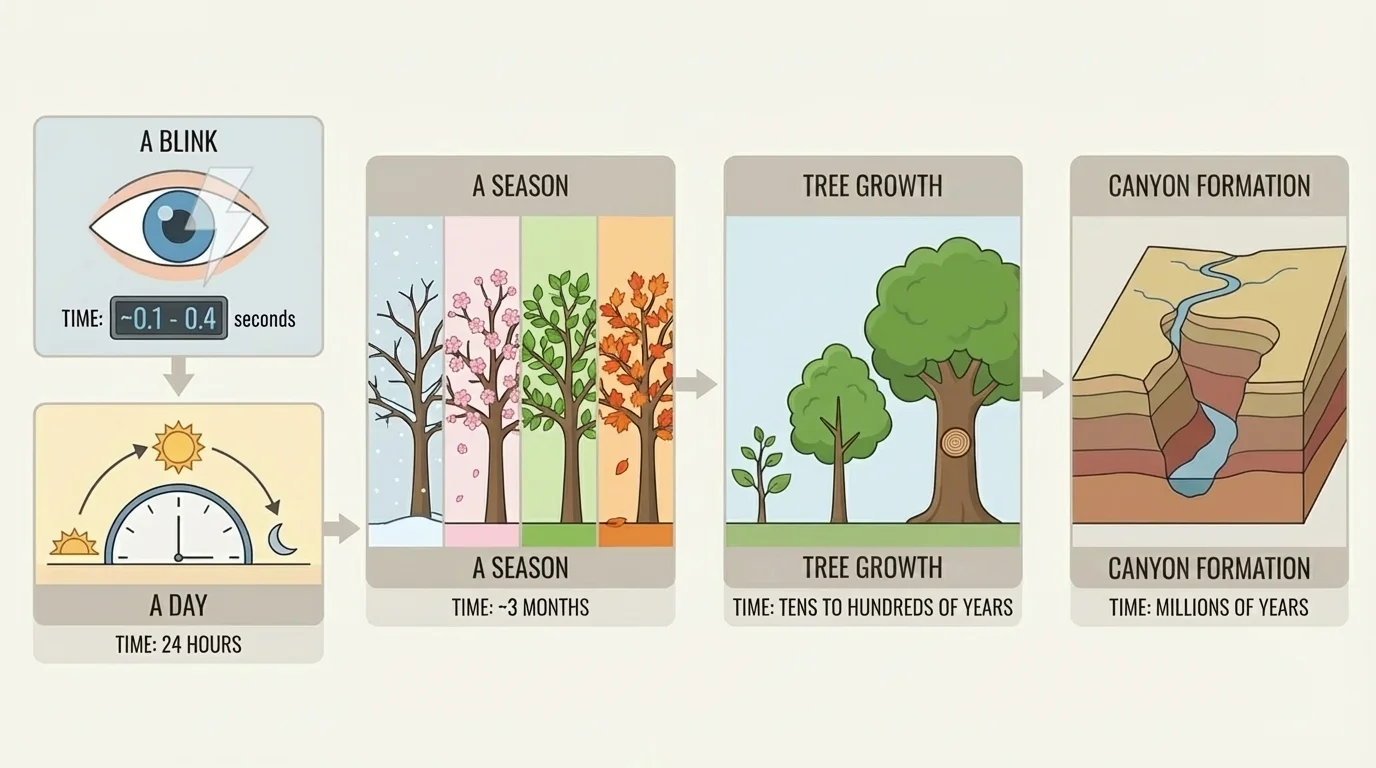
Scale is not only about size. It is also about time, as [Figure 4] shows. Some natural events happen very quickly. A blink may take less than one second. A clap of thunder follows lightning in just moments. A seed may burst open after the right conditions are met. Other events take much longer.
Many everyday cycles happen over hours, days, or seasons. The Sun appears to move across the sky during the day because Earth rotates. The Moon changes appearance over about a month. Trees may lose leaves in autumn and grow new ones in spring. Birds may migrate during certain seasons each year.
Some changes are so slow that people hardly notice them from day to day. A child growing taller happens over years. A tree growing from a seedling to a giant oak takes many years. A canyon shaped by flowing water may take an extremely long time. Mountains can rise and wear down over millions of years.
When time is measured, scientists use units such as seconds, minutes, hours, days, years, and much longer spans. We can compare them mathematically. For example, one minute equals \(60\) seconds, and one hour equals \(60\) minutes. So one hour equals \(60 \times 60 = 3,600\) seconds.
Long time scales are important in Earth science and astronomy. Rocks, fossils, and landforms can tell stories from long before humans were alive. Short time scales are important too. A fast change, such as a lightning strike, can still have a big effect.
Time comparison example
A caterpillar may crawl across a leaf in minutes, but changing into a butterfly takes much longer.
Step 1: Compare the short event.
Crawling might take about \(5\) minutes.
Step 2: Compare the long event.
Metamorphosis may take many days.
Step 3: Decide what matters at each time scale.
To study crawling, you watch movement right away. To study metamorphosis, you observe changes over a much longer period.
The same animal can be studied on very different time scales depending on the question.
The timeline in [Figure 4] makes this clear: some processes are almost immediate, while others need patience, records, and careful long-term observation.
Changing size does not always mean keeping the same behavior, as [Figure 5] helps us see. Two objects may have the same shape but different sizes. A toy boat and a real boat both float, yet the larger one needs much stronger materials and careful design. When size changes, weight, support, and movement can change too.
Proportion tells us how parts compare. If an animal has very large ears compared with its body, those ears may help it release heat or hear better. If a plant has roots that spread far compared with its stem size, it may be good at collecting water. The relationship between parts often affects how well a system works.
Quantity matters too. A few snowflakes do not stop traffic, but a huge quantity of snow can close roads. A small number of bees may pollinate only a few flowers, but a large number can help a whole orchard. The amount of something often changes the outcome.
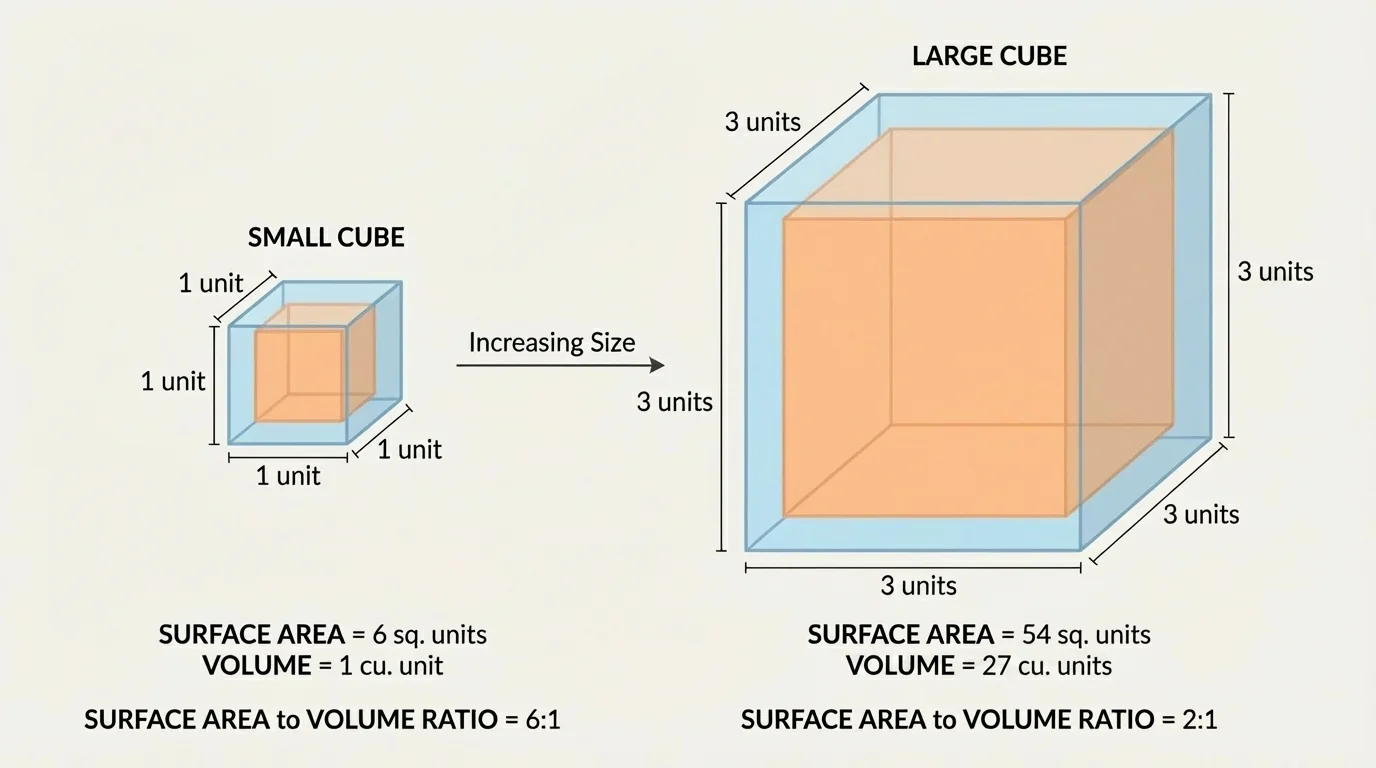
One useful way to think about this is to compare surface area and volume. A small object may have less volume, while a larger object has much greater volume. This matters for things like body heat, storage, and structure. Animals, plants, and buildings all face challenges that change with size.
For a simple example, compare cubes. If each edge of a small cube is \(1\) unit long and each edge of a larger cube is \(2\) units long, the larger cube is not just "twice as much cube" in every way. Its volume increases much more. This is why changing scale can change performance.
| Situation | Small Quantity or Size | Large Quantity or Size | Possible Effect |
|---|---|---|---|
| Rainfall | Light drizzle | Heavy rainstorm | Wet ground versus flooding |
| Plant growth | Short roots | Deep roots | Less water reached versus more water reached |
| Animal body | Small body | Large body | Different needs for food, heat, and movement |
| Sand | One grain | Millions of grains | Hard to notice versus forming a dune |
Table 1. Examples of how changing quantity or size can change the results in natural systems.
The size comparison in [Figure 5] reminds us that bigger and smaller versions of a shape may have different strengths and needs, even when they look similar.
Natural phenomena also involve different amounts of energy. Energy is what allows things to move, change, or cause effects. A rolling pebble uses less energy than a landslide. A gentle breeze has less energy than a hurricane. A hand warmer gives off less heat than molten lava.
The amount of energy often helps explain why some events are powerful and why others are mild. A tiny spark can light a candle, but it cannot power a city. The Sun provides enormous energy to Earth, helping drive weather, plant growth, and the water cycle.
Energy is the ability to cause change or do work, such as moving objects, heating matter, or producing light.
Energy also connects with time and size. Large storms may release much more energy than small storms. Tiny moving particles can have effects too, especially when there are huge numbers of them. In a pot of boiling water, each bubble is small, but many bubbles show that heat energy is changing the water rapidly.
Scientists choose what to measure based on the scale of the event. For a campfire, they may look at temperature nearby. For a heat wave across a country, they study weather patterns over a huge area. The question determines the useful scale.
To compare scales clearly, scientists measure. Length may be measured in millimeters, centimeters, meters, or kilometers. Time may be measured in seconds, minutes, hours, or years. Mass and temperature can also be measured when they matter to a question.
Suppose a seedling grows \(3\) centimeters one month and then another \(2\) centimeters the next month. Its total growth is \(3 + 2 = 5\) centimeters. That number tells us about change over time. If a stream rises \(1\) meter after heavy rain, that quantity helps describe the event.
You already use scale in everyday life when you choose tools. You use a ruler for a notebook, a measuring cup for ingredients, and a clock for time. Science uses the same idea more carefully: the right tool and unit depend on what is being measured.
Measurements let scientists share ideas clearly. Saying a tree is "tall" is useful, but saying it is \(12\) meters tall gives much more exact information. Saying a storm lasted "a long time" is less exact than saying it lasted \(6\) hours. Good measurement makes comparisons possible.
Understanding scale helps people solve real problems. Doctors think about tiny germs and cells, but they also think about the whole body. Engineers design tiny parts inside phones and huge bridges across rivers. Farmers watch small seeds, local soil, and large weather patterns. Meteorologists study water droplets in clouds and giant storm systems.
At home, scale matters in cooking. A pinch of salt and a tablespoon of salt do not produce the same result. Baking time changes with the size of what you cook. A small muffin bakes much faster than a large loaf because heat moves through them differently.
In space science, telescopes help us observe objects that are very far away. In biology, microscopes help us study objects that are very small. These tools work in opposite directions, but both solve the same problem: our eyes alone cannot observe every scale in nature.
Real-world example: weather and scale
A puddle after rain and a hurricane over the ocean both involve water, air, and energy, but they happen on very different scales.
Step 1: Identify the small-scale event.
A puddle forms in one location and can change in hours.
Step 2: Identify the large-scale event.
A hurricane covers a huge area and may develop over days.
Step 3: Compare what matters.
For the puddle, local ground shape matters. For the hurricane, ocean temperature, wind patterns, and large amounts of energy matter.
The correct scale helps scientists understand both events, even though they are very different in size and power.
Once you start looking for scale, you notice it everywhere: in ant colonies and rainstorms, in leaves and forests, in seconds and centuries, and in the tiny cells that help make giant living organisms possible.
