A skateboard rolling fast down a sidewalk, a lamp lighting a room, and a spoon getting warm in a bowl of soup may seem like very different things. But they are all connected by one big science idea: energy can move, or transfer, from one place to another and from one object to another. Energy is involved whenever something moves, warms up, lights up, or makes sound. Once you start looking for energy, you can find it almost everywhere.
Energy is what makes things happen. It can make objects move, change temperature, produce light, or create sound. You cannot usually see energy by itself, but you can see what it does. A spinning fan, a glowing flashlight, and a bouncing basketball all give evidence that energy is present.
Scientists often describe energy by looking at its effects. If an object starts moving, speeds up, slows down, gets warmer, or makes a sound, energy is being transferred or changed. For example, when you push a swing, energy transfers from your body to the swing. When the swing moves, that motion is evidence of energy.
Energy transfer happens when energy moves from one object, place, or system to another.
Motion is a change in position over time.
Speed tells how fast something moves.
Energy comes in many forms. For this topic, it is especially helpful to think about energy of motion, heat, light, and sound. These forms often work together. A toaster uses electrical energy to make heat. A drum uses motion to create sound. The Sun gives off light energy that can warm the ground.
When something moves, it has kinetic energy, or energy of motion. A moving bicycle, a rolling marble, and a running dog all have kinetic energy. As [Figure 1] shows, two objects that are alike except for speed can have different amounts of kinetic energy. If one ball rolls slowly and another rolls quickly, the faster one can push or knock things farther because it has more energy of motion.
This leads to an important idea: when the same kind of object moves faster, it usually has more kinetic energy. You can gather evidence for this by observing what happens in real life. A slowly rolled toy car might barely bump over a block, but a faster toy car can send the block sliding. The stronger effect is evidence that the faster-moving object had more energy to transfer.
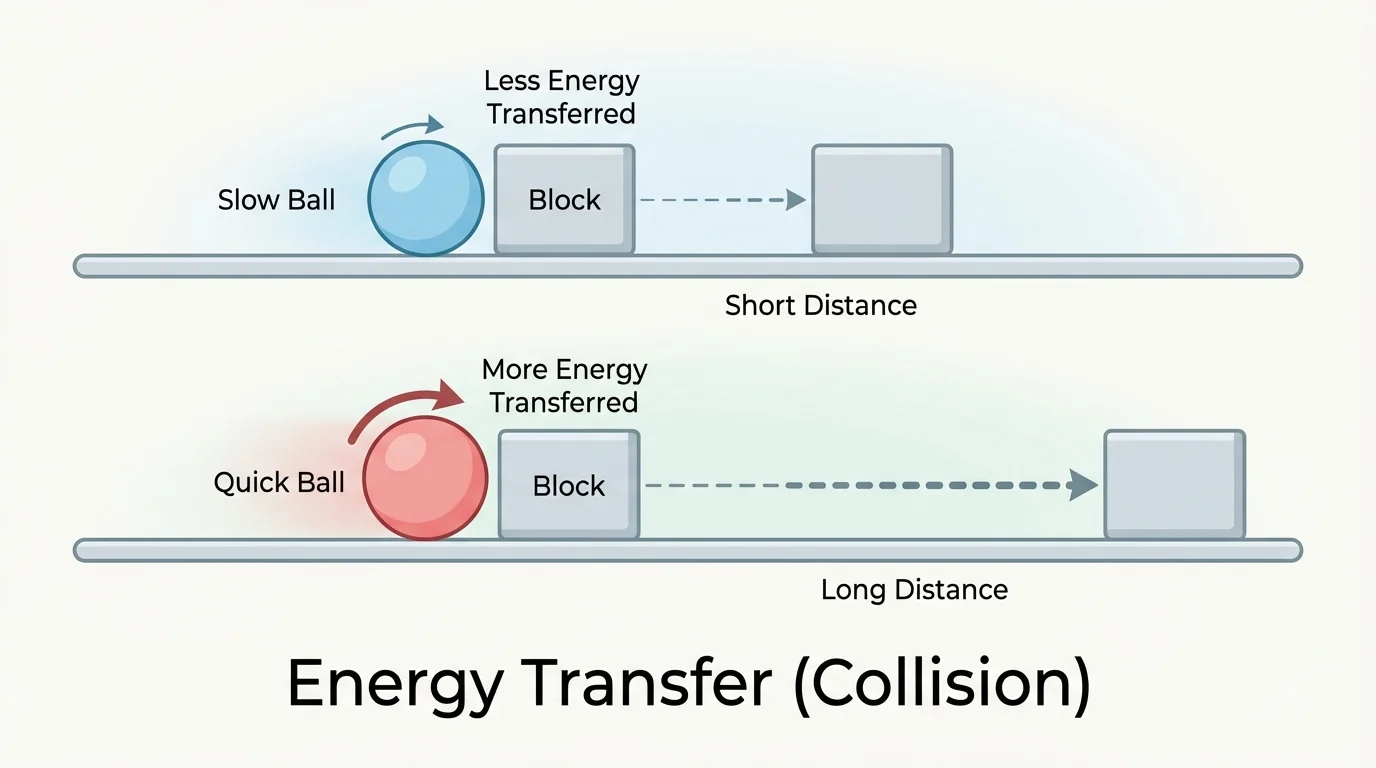
Scientists can measure speed, but you do not always need a number to notice this pattern. You can compare what objects do. A gently tossed ball might lightly tap a set of cups. The same ball thrown faster can knock the cups over. The ball is the same object, but its faster speed means more energy of motion.
Sometimes we use a simple relationship to help describe this idea. If speed increases, energy of motion increases too. For example, if a toy car moves at about \(5\ \textrm{cm/s}\), it may only nudge a block, but if it moves at \(15\ \textrm{cm/s}\), it may push the block much farther. The exact amount of kinetic energy is not the main focus here. The important evidence is what the moving object can do.
Using evidence from a playground ball
A student rolls the same ball two times toward plastic pins. The first time, the ball rolls slowly and knocks down \(1\) pin. The second time, the ball rolls faster and knocks down \(4\) pins.
Step 1: Look at what stays the same.
The same ball is used both times, so the main difference is speed.
Step 2: Look at the evidence.
The faster roll causes a bigger effect because it knocks down more pins.
Step 3: Build an explanation.
The faster-moving ball has more kinetic energy, so it transfers more energy to the pins.
The evidence supports the idea that greater speed means greater energy of motion.
That does not mean every fast thing is always more energetic than every slow thing. A huge truck moving slowly may still have a lot of energy. But when you compare the same object moving at different speeds, the faster motion is evidence of more energy.
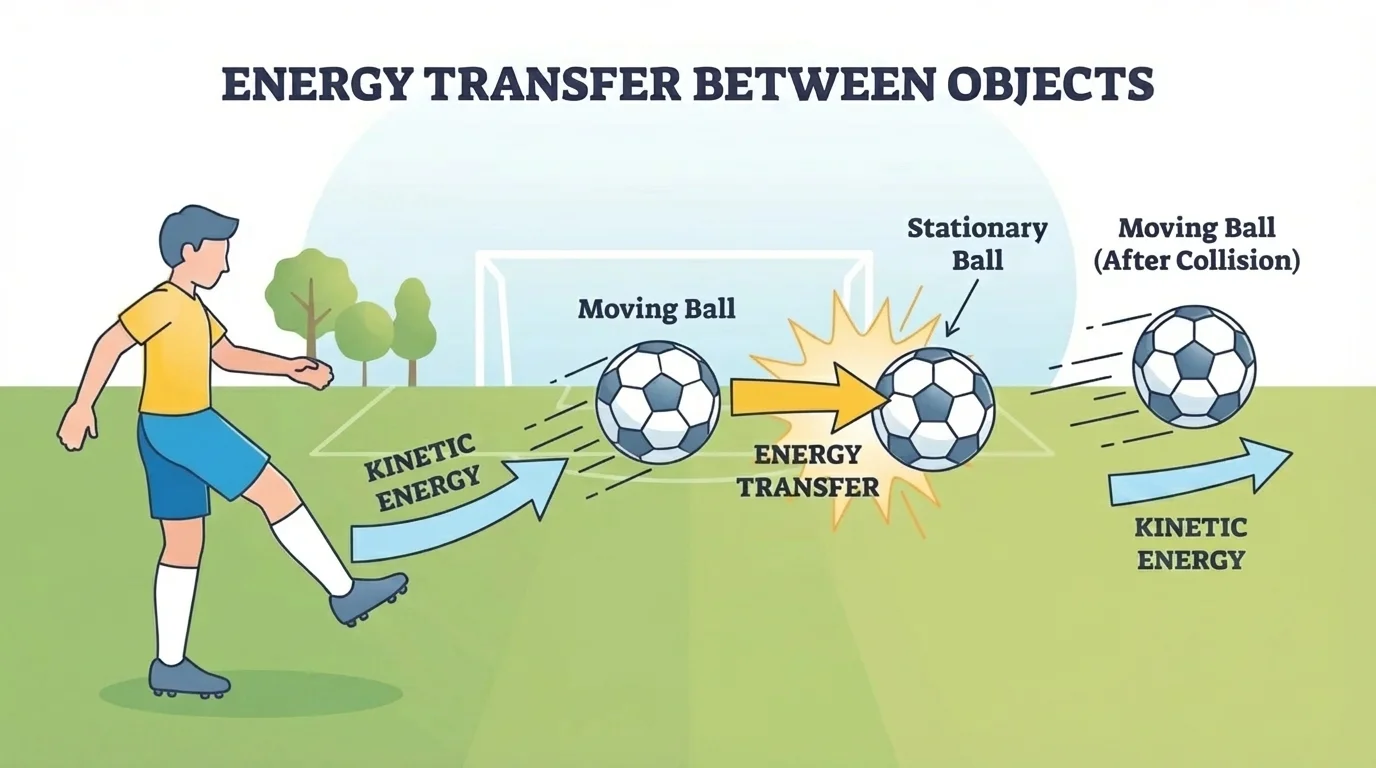
Energy can move from one object to another by contact. As [Figure 2] illustrates, when one moving object hits another object, some of its energy can transfer during the collision. This is easy to notice in games and sports. A kicked soccer ball can hit a still ball and make the second ball move. The second ball starts moving because energy transferred into it.
Pushing and pulling also transfer energy. When you push a wagon, energy from your muscles transfers to the wagon and makes it move. When you pull back a slingshot, you transfer energy into the stretched band. That energy is stored and can later move into a small object when the band is released.
Collisions are a clear kind of transfer because you can often see the before and after. One object is moving, another may be still, and then after contact the motion changes. A moving bowling ball can send pins flying. A bat can transfer energy to a baseball. In each case, the motion of one object helps cause motion in another.
Energy can also transfer through moving air or moving water. Wind can turn the blades of a windmill. Flowing water can spin a waterwheel. In both cases, moving matter transfers energy to another object and makes it move.
You can even feel energy transfer in your hands. If you clap, the motion of your hands transfers energy into the air as sound and a little heat. If you rub your hands together quickly, motion transfers energy and your hands get warmer.
A meteor moving through Earth's atmosphere can get extremely hot because its motion leads to strong energy transfers with the air around it.
The idea of transfer helps explain chain reactions of motion. In a row of dominoes, one falling domino transfers energy to the next. Then that domino transfers energy again. The energy keeps moving through the line, even though each domino only touches the one next to it.
Energy does not only transfer by visible motion. It can also transfer as thermal energy, light, and sound. [Figure 3] shows two common examples: sunlight warming a surface and sound traveling through air. If you sit in sunshine, your skin may feel warmer because light from the Sun transfers energy to you. If someone beats a drum, energy moves through the air as sound to your ears.
Thermal energy is related to how warm something is. When a hot object touches a cooler object, energy usually transfers from the warmer one to the cooler one. That is why an ice cube melts faster in a warm hand than on a cold table. Energy moves into the ice cube, making its temperature rise.
Light can transfer energy over long distances. The Sun is very far away, yet plants, sidewalks, lakes, and buildings all receive energy from sunlight. A blacktop playground may get hotter than the grass nearby because it absorbs more of the Sun's energy.
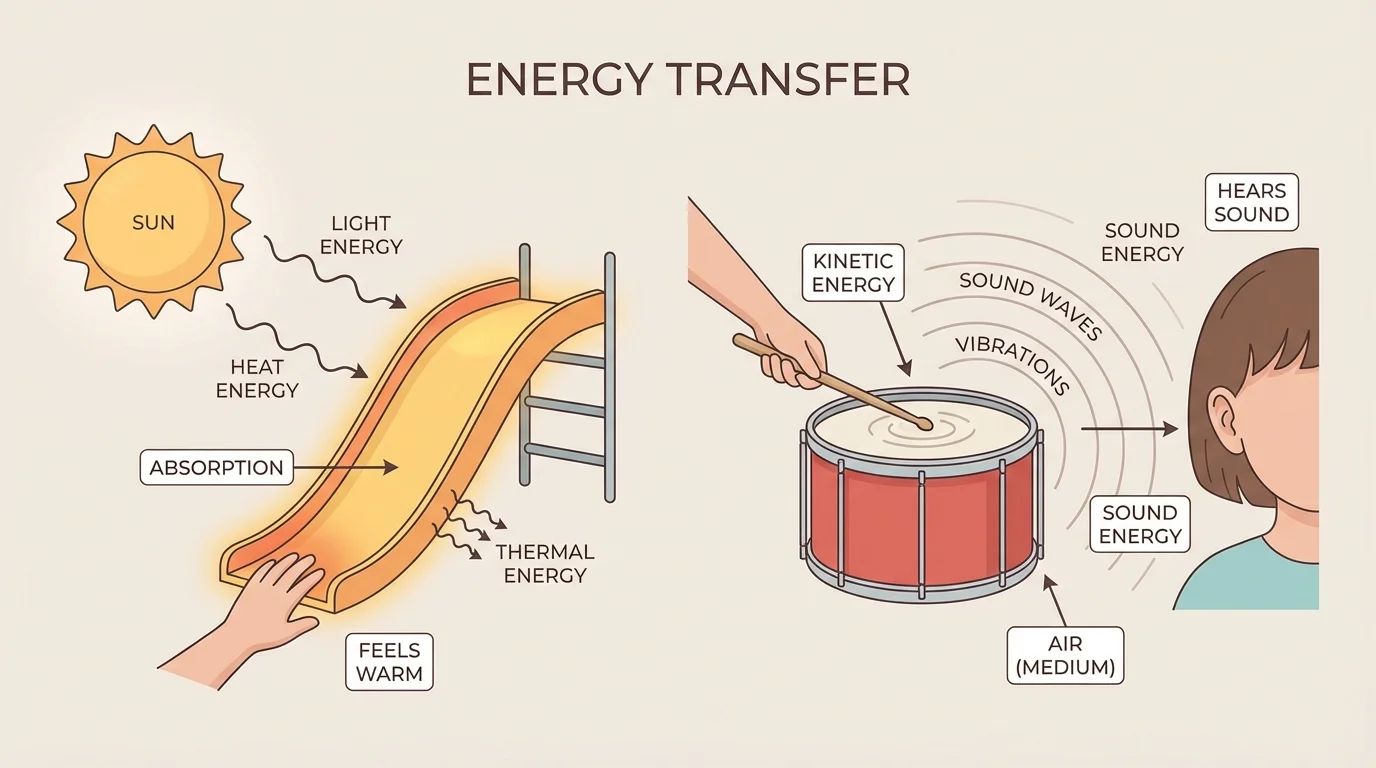
Sound is another kind of energy transfer. Sound begins when something vibrates. A guitar string vibrates. A speaker vibrates. A drumhead vibrates. Those vibrations transfer energy to nearby air particles, and the movement travels to your ears. Without that transfer, you would not hear anything.
Heat, light, and sound often happen together. Think about a campfire. Wood stores energy. As the wood burns, energy is released as heat and light. Crackling sounds are also produced. A single event can involve several forms of energy moving at once.
| Type of energy transfer | What you notice | Example |
|---|---|---|
| Motion | An object starts moving or changes speed | A bat hits a ball |
| Thermal energy | An object gets warmer or cooler | Hot soup warms a metal spoon |
| Light | A surface is lit or warmed | Sunlight warms a rock |
| Sound | You hear vibrations | A bell rings across a room |
Table 1. Common ways energy is transferred and what changes you can observe.
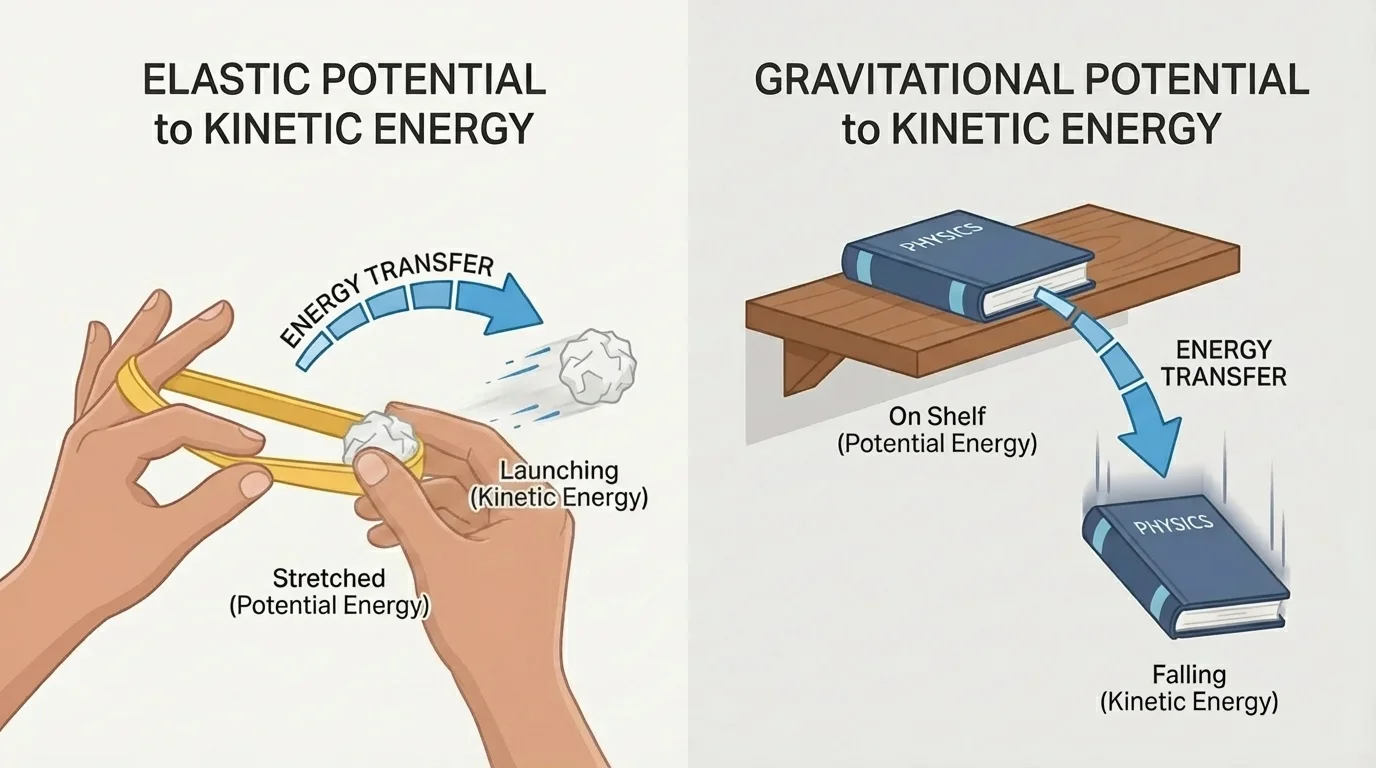
Sometimes energy is stored before it is transferred. A stretched rubber band, a raised object, a battery, and food all store energy in different ways. As [Figure 4] shows, stored energy can change into motion. A stretched rubber band can launch a paper ball. A book resting on a shelf has energy because of its position above the ground, and if it falls, that stored energy changes into motion.
This is important because energy is often transferred after it changes form. Food gives your body stored energy. Your muscles use that energy to move your legs when you run. Then your moving legs can kick a ball, and the ball can roll across a field. Energy has moved through several objects and changed forms along the way.
Batteries are another everyday example. A battery stores energy. In a flashlight, that stored energy changes into light and a little heat. In a toy car, energy from the battery can become motion. In a speaker, energy can become sound.
Even plants are part of energy transfers. Plants get energy from sunlight. Animals eat plants or eat other animals that ate plants. That stored energy in food helps living things move, grow, and stay warm.
Energy can change form while still being tracked by its effects. A transfer does not always look the same from start to finish. Energy may begin as stored energy, become motion, and then become sound or heat. What matters is that we can follow the evidence: movement, warming, lighting, or vibrating.
When students learn about energy, it helps to ask, Where did the energy come from, where did it go, and what evidence shows it moved? Those questions work for many situations, from toy cars to thunderstorms.
Science explanations are stronger when they use evidence. If you want to explain why a faster object has more energy, look at what happens when objects move at different speeds. We saw earlier in [Figure 1] that a faster rolling ball moves a block farther than a slower rolling ball. That result is evidence of greater energy transfer.
Here are some kinds of evidence students can observe:
Suppose two identical toy cars roll down the same ramp from different starting points. The car released from the higher point usually reaches a faster speed before it hits a stack of cups. If it knocks the cups farther, that stronger effect is evidence that the faster car had more energy of motion when it arrived.
Using measurements as evidence
A student tests the same toy car on two ramps. On Ramp A, the car reaches a speed of about \(2\ \textrm{m/s}\) and pushes a block \(10\ \textrm{cm}\). On Ramp B, the car reaches about \(4\ \textrm{m/s}\) and pushes the same block \(30\ \textrm{cm}\).
Step 1: Compare the speeds.
The speed on Ramp B is greater than the speed on Ramp A.
Step 2: Compare the effects.
The block moves farther when hit by the faster car.
Step 3: Explain the result.
The faster car has more kinetic energy, so it transfers more energy to the block.
The car on Ramp B gives stronger evidence of greater energy of motion.
Evidence is also useful when thinking about sound and heat. If rubbing your hands slowly makes only a little warmth, but rubbing them faster makes more warmth, that is evidence that faster motion can transfer more energy. If you tap a drum softly and then hit it harder, the louder sound is evidence that more energy was transferred.
The same thinking applies to safety. A slowly rolling bike is easier to stop than a very fast bike because the faster bike has more energy of motion. Helmets, pads, and seat belts help protect people by reducing harmful effects when energy is transferred during sudden stops or collisions.
Energy transfer is part of nearly everything people do. When you cook food, thermal energy moves from the stove to the pan and then to the food. When you turn on a lamp, energy changes into light. When you play basketball, energy moves from your muscles to the ball, then from the ball to the floor and back again as it bounces.
Engineers think about energy transfer when they design buildings, machines, toys, and vehicles. Good winter coats slow down thermal energy transfer so people stay warm. Solar panels collect light energy from the Sun. Ramps, brakes, and padding are designed with motion and energy in mind.
Music is another great example. A musician uses body movement to pluck, strike, or blow into an instrument. That movement transfers energy to the instrument, which vibrates and transfers sound energy through the air. The audience hears the result across the room.
Nature is full of these ideas too. Waves transfer energy across water. Wind transfers energy to tree branches and kites. Sunlight transfers energy to land and water, helping drive weather patterns. Life on Earth depends on energy coming from the Sun and moving through ecosystems.
You already know that pushes and pulls can change an object's motion. Energy helps explain why those changes happen: pushes and pulls often transfer energy from one object to another.
When you understand energy transfer, many everyday events make more sense. You can explain why a fast pitch is harder to catch than a slow toss, why metal spoons warm up in hot soup, and why sunlight can heat a parked car. These are all examples of energy moving and changing in the world around you.
