A shout across a playground, music from a speaker, and a message sent to a phone may seem very different, but they all depend on waves. Waves can carry energy and information from one place to another. Scientists often cannot hold a sound wave in their hands or watch radio waves with their eyes, so they use models to help explain what is happening.
A model is a way to show, explain, or think about something. A model can be a drawing, a physical object, an analogy, or even a simple pattern. For example, a globe is a model of Earth. It is not the real planet, but it helps us understand Earth's shape and where places are located.
In science, models are useful when something is too big, too small, too fast, too slow, or invisible. Waves are perfect examples. You can see some waves, like water waves in a pond, but other waves, such as sound and light, need to be understood through evidence and models.
Model means a simplified representation used to explain how something works.
Analogy means a comparison that helps us understand something new by linking it to something familiar.
Wave means a repeating disturbance that carries energy from one place to another.
Good models help us notice important patterns. They do not need to include every tiny detail. In fact, most useful models leave some things out so we can focus on the main idea. A drawing of a wave, for example, helps us focus on shape, height, and spacing.
A wave is a repeating pattern that moves energy. When you toss a pebble into water, rings spread outward. The water goes up and down, and the energy moves across the pond. When someone speaks, the air vibrates and sound waves travel through it. When a lamp shines, light waves travel from the bulb to your eyes.
One important idea is that waves transfer energy more than they transfer matter. Matter is the "stuff" things are made of. In a water wave, the water does not usually travel all the way across the pond in a straight line with the wave. Instead, the water mostly moves up and down or in small circles while the wave pattern moves forward.
This is why a floating leaf may bob on the surface instead of sailing all the way to shore with each wave. The wave carries energy through the water, and that energy can make the leaf move.
Waves transfer energy through a pattern. The pattern moves from place to place, even when the material making the wave only moves a little. This idea helps explain water waves, sound waves, and many kinds of technology that send information.
Scientists use different kinds of models for different waves. A sketch of a curved line can model a wave's pattern. A slinky can model motion through a spring. A jump rope can model how a wave travels. Each model highlights certain features clearly.
To describe waves clearly, scientists give names to the parts of the pattern. As [Figure 1] shows, the high points and low points help us talk about the shape in a precise way. This is important because two waves can look different even if they are both waves.
The highest part of a wave is called the crest. The lowest part is called the trough. These labels help us point to places on the wave and compare one wave to another.
The amplitude of a wave tells how tall the wave is from its middle position to a crest or to a trough. A bigger amplitude means a taller wave. For sound, a bigger amplitude often means a louder sound. For water, a bigger amplitude means a taller wave.
The wavelength tells the distance from one repeating part of the wave to the next matching part, such as from crest to crest. If the crests are far apart, the wavelength is longer. If the crests are close together, the wavelength is shorter.
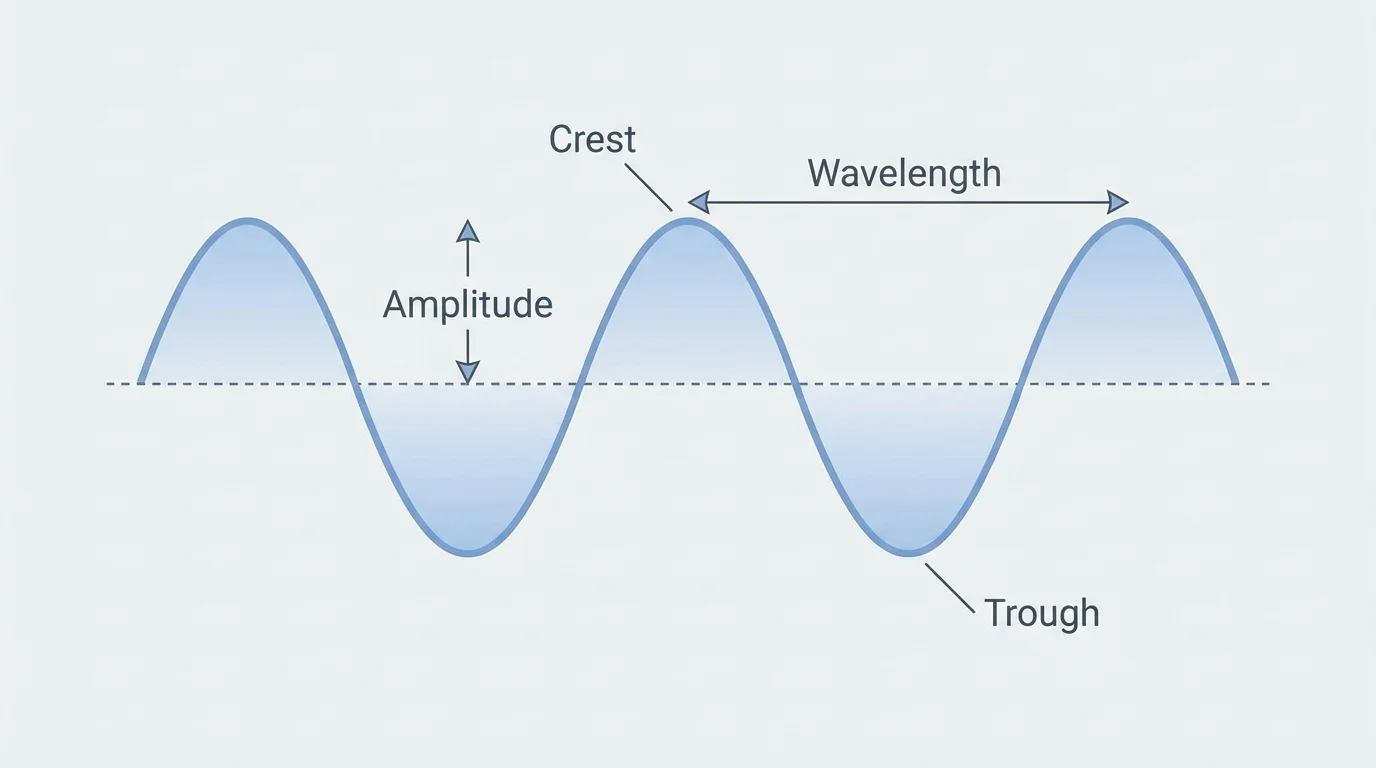
You can think of amplitude as the wave's height and wavelength as the wave's spacing. These two ideas are often enough for students to describe a wave model clearly.
If one wave has amplitude of about \(2\) units and another has amplitude of about \(4\) units, the second wave is taller. Since \(4 > 2\), the second wave has the greater amplitude. If one wavelength is about \(8\) units and another is about \(4\) units, the first wave has the longer wavelength because \(8 > 4\).
Looking back at [Figure 1], notice that amplitude is measured up or down from the middle line, while wavelength is measured across the wave from one matching point to the next. Students sometimes confuse these because both involve measuring, but they describe different features.
Describing two waves
Suppose Wave A is tall and spread out, while Wave B is short and squeezed together.
Step 1: Compare amplitude.
If Wave A rises about \(5\) units above the middle and Wave B rises about \(2\) units, then Wave A has the greater amplitude because \(5 > 2\).
Step 2: Compare wavelength.
If the distance from crest to crest in Wave A is \(10\) units and in Wave B is \(4\) units, then Wave A has the longer wavelength because \(10 > 4\).
Wave A is taller and has greater spacing. Wave B is shorter and has smaller spacing.
These words are useful in many science situations. When you describe a wave model, saying "This wave has a large amplitude and short wavelength" is much more exact than saying "This wave looks big."
Waves do not just make patterns. They can also make objects move. When a water wave reaches a floating toy, the toy may bob up and down. When sound waves reach your eardrum, they make it vibrate. Those vibrations help you hear.
Even though the wave may not carry the object all the way across a space, it can still cause motion. Energy in the wave is what does the pushing, shaking, or vibrating. This is why loud sound can rattle a window and why ocean waves can rock a boat.
A useful way to think about this is to ask, "What is the wave doing to the material it travels through?" In water, the wave can lift and lower the surface. In air, the wave can squeeze and spread the air. In each case, the moving pattern can affect nearby objects.
A very strong sound wave can make grains of rice jump on a drum or a speaker. The rice moves because the surface vibrates as wave energy reaches it.
This idea matters for technology too. Microphones and speakers work because waves can cause tiny parts to move. In a microphone, sound waves make a part vibrate, and that vibration is changed into an electrical signal. In a speaker, the process happens in reverse, and the signal causes a part to vibrate and make sound waves.
[Figure 2] A strong way to explain a scientific principle is to use an analogy. A jump rope is a great analogy for wave motion. If one person holds one end and flicks it, a wave travels down the rope. You can easily see the height of the wave and the spacing between waves.
With a jump rope model, a bigger hand motion makes a wave with greater amplitude. Faster repeated motions can make the wave patterns closer together. Students can see that the rope itself moves up and down while the wave pattern travels along the rope.
This analogy is helpful because it makes an invisible idea visible. You may not be able to see sound waves moving through air, but you can see a rope wave and use it as a model for repeating motion and energy transfer.
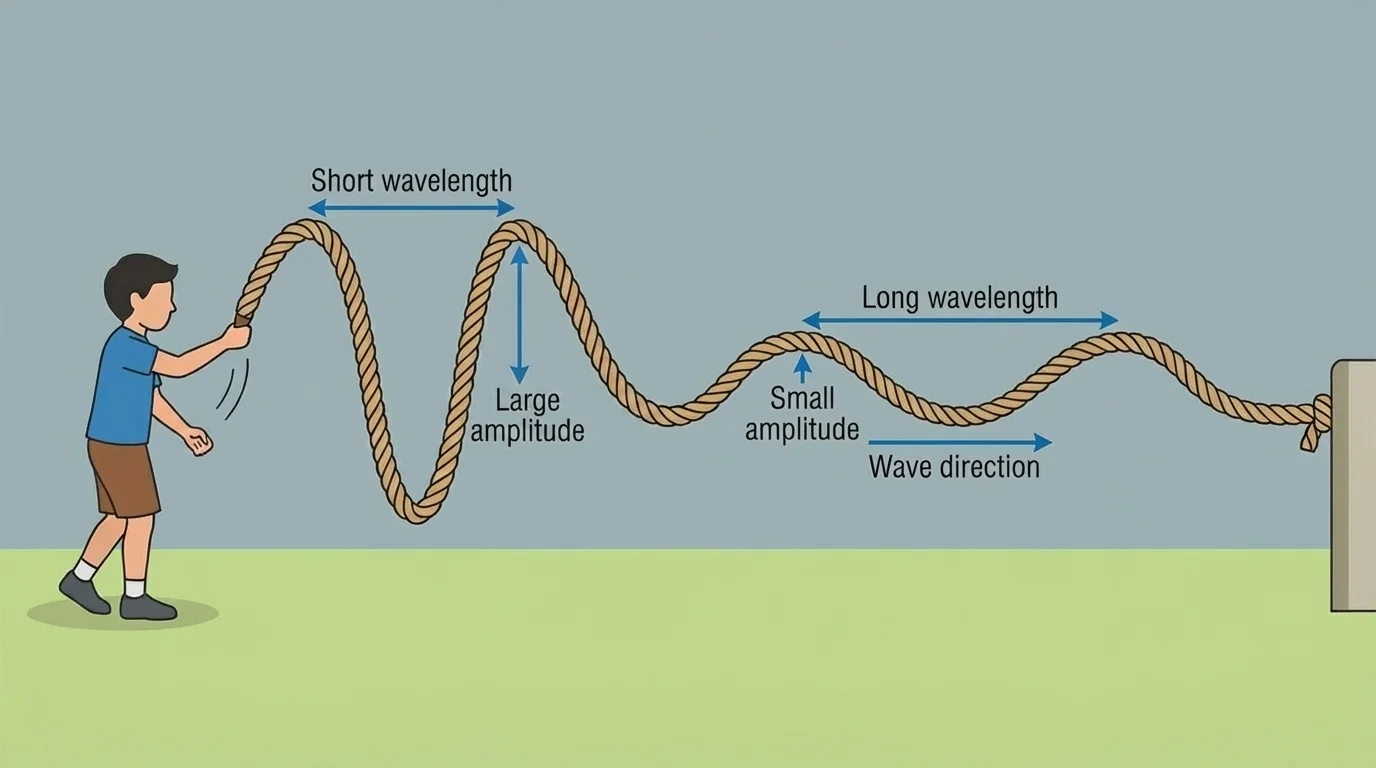
Still, an analogy is not perfect. A jump rope wave is something you can see moving on a rope, while sound waves move through air in a different way. The model helps with pattern, motion, and energy transfer, but it does not match every detail. Good scientists know what a model explains well and what it leaves out.
Another analogy is the "stadium wave" at a sports game. One group stands up, then the next, then the next. The wave pattern moves around the stadium, but each person mostly stays in the same seat. That is similar to how a wave pattern can move even when the material itself does not travel far.
Just as in the jump rope model, the important idea is that a pattern travels across the system while each part only moves a little. This helps students understand why a wave can carry energy without carrying all the matter with it.
Example model statement
A student might say: "I use a jump rope as a model for a wave. The tall rope crests represent large amplitude. The distance from one crest to the next represents wavelength. The rope moves, and the wave pattern travels along it. This model helps show how waves carry energy and can make objects move."
That kind of statement is a clear scientific model because it names the parts, explains the comparison, and connects the model to the real idea.
[Figure 3] Waves are not only found in nature. Engineers use wave ideas to design tools that send information. Communication technology depends on waves carrying patterns from one place to another. When you talk on a phone, your voice becomes signals that travel and are turned back into sound.
Radio, television, wireless internet, and cell phones all depend on waves. Some use sound waves at one stage, and many use electromagnetic waves, such as radio waves, to carry information over long distances. Students do not need every detail yet, but it is important to know that wave models help people invent and improve these systems.
Design solutions often begin with a model. If engineers want a speaker to sound louder, they think about amplitude. If they want to send clearer signals, they study patterns in waves carefully. Models let them test ideas before building expensive devices.
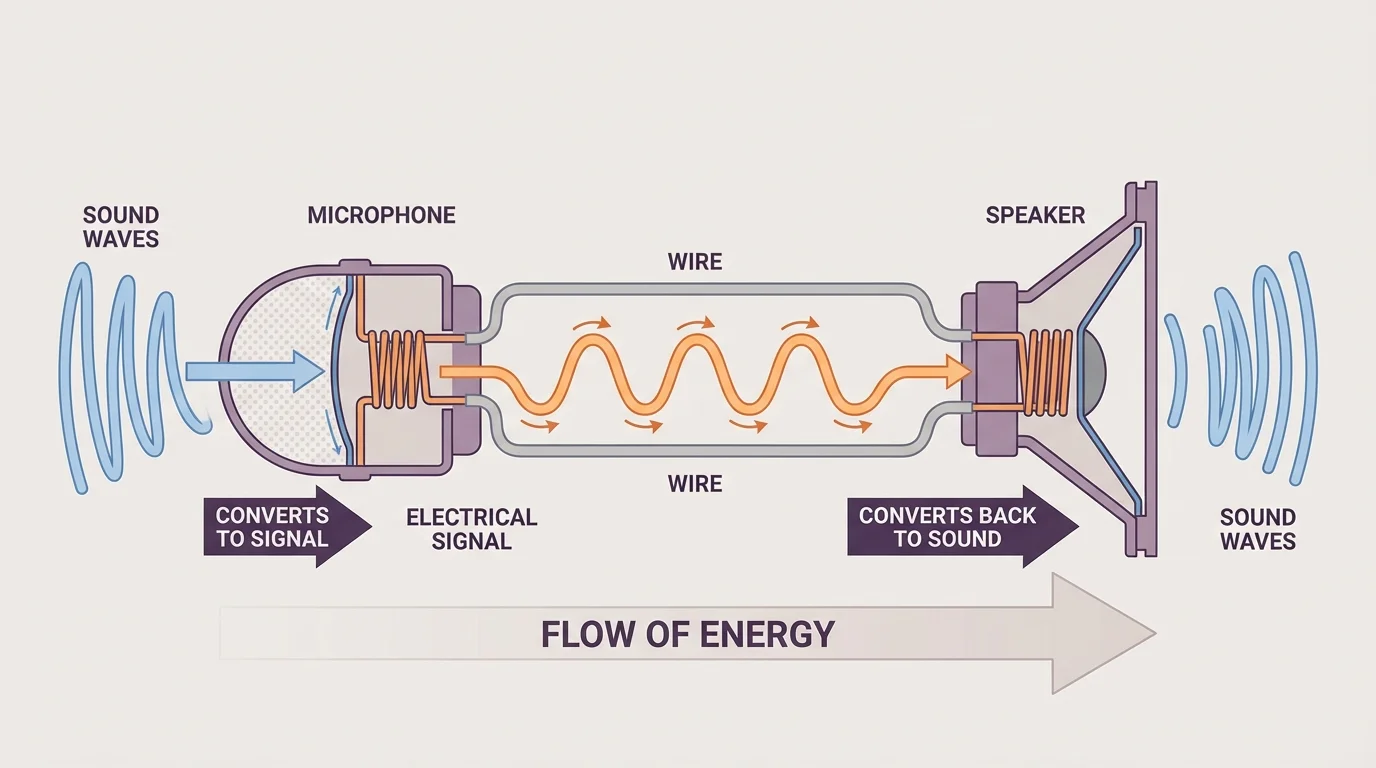
Consider a classroom microphone system. If a teacher's voice is too quiet in the back of the room, a sound system can help. The microphone detects sound waves, the system transfers the information, and the speaker creates sound waves that students can hear better. The design solution uses wave behavior to solve a real problem.
Light is also important for information transfer. Flashlights, remote controls, and fiber-optic cables rely on waves. In fiber-optic cables, light carries information very quickly. Even though the lesson focus is on describing wave models with amplitude and wavelength, these real examples show why the models matter.
Models help solve problems. A scientific model is not only for explanation. It can also help people design a device, predict what will happen, and improve a solution when something does not work well.
When you look again at [Figure 3], notice the path from sound to signal to sound again. The model simplifies a complex technology so we can focus on the key idea: information is transferred using wave-based systems.
Scientists do not treat models as perfect copies of reality. A model is useful when it helps answer a question or explain a pattern. If it stops being useful, scientists change it or build a better one.
For example, a drawing of a smooth wave line is helpful for learning amplitude and wavelength. But actual water in the ocean is much messier than a perfect classroom sketch. The simple wave model still helps because it shows the main pattern clearly.
When you develop your own model, ask three questions: What does my model show well? What does it leave out? How does it connect to the real science idea? These questions make your explanation stronger.
You already know that forces can push or pull objects and cause movement. Waves connect to that earlier idea because a wave carries energy that can push, pull, shake, or vibrate matter.
This is one reason scientists like models so much. A model can connect new learning to something students already understand, such as ropes, water, sound, or motion.
Suppose you are asked to develop a model to describe how waves can cause objects to move. One strong answer would use a drawing of water waves and a floating cork. The drawing would show crests and troughs, label amplitude and wavelength, and show the cork bobbing as the wave passes.
You could explain it like this: "My model uses water waves to show a repeating pattern. The higher the wave rises, the greater the amplitude. The distance from one crest to the next is the wavelength. As the wave travels, the cork moves up and down because the wave transfers energy to it."
This model works because it uses labeled parts of a wave and connects them to motion. It also matches something students can observe in real life at a beach, pond, or pool.
| Model type | What it helps show | One limit |
|---|---|---|
| Wave drawing | Crest, trough, amplitude, wavelength | Does not show all real-world messiness |
| Jump rope analogy | Pattern moving and energy transfer | Not the same kind of wave as sound in air |
| Stadium wave analogy | Pattern moves while people stay mostly in place | Does not show wave height clearly |
| Microphone-speaker system | Information transfer using waves | Technology is simplified |
Table 1. Different models of waves, what each model explains well, and one limit of each model.
The best scientific explanations are clear, specific, and based on evidence or observation. Instead of saying only "A wave moves," it is better to say, "A wave transfers energy, has measurable features like amplitude and wavelength, and can cause objects to move."
"Science is a way of thinking much more than it is a body of knowledge."
— Carl Sagan
Thinking like a scientist means choosing the right model for the job. Sometimes a rope is the best analogy. Sometimes a diagram is better. Sometimes a real device, such as a speaker, becomes the model that helps explain the science.
