Have you ever seen stripes in a canyon wall or a shell fossil in a rock far from the ocean? Those are not just interesting sights. They are clues. Earth leaves behind patterns, and scientists use those patterns as evidence to explain what happened long ago. A landscape that looks dry and rocky today may once have been under water. A mountain may have risen slowly over millions of years. By studying what repeats, what changes, and what is found in different places, we can learn Earth's story.
A pattern is something that repeats or happens in a way we can notice. In science, patterns are important because they help us make explanations based on evidence instead of guesses. If one rock layer contains tiny shells and another layer above it contains plant marks, that pattern tells us something changed in the environment over time.
Scientists look for clues that match each other. One clue alone may not be enough. But when several clues form a pattern, the explanation becomes stronger. For example, if many rocks in the same layer contain sea fossils, that pattern is better evidence that the area was once covered by water than finding just one shell-shaped mark in one rock.
Evidence is information that helps support an explanation. Pattern means something that repeats or can be observed in an organized way. In Earth science, patterns in rocks and fossils help scientists explain how a place changed over time.
Patterns are useful in everyday life too. If you notice dark clouds, strong wind, and cooler air, those repeated signs help you predict rain. Earth scientists do something similar, but their clues are often much older. They study rock layers, fossils, and land shapes to explain changes that happened over very long times.
Earth gives us many kinds of patterns. Some patterns are in the colors and layers of rocks. Some are in the kinds of fossils found in certain places. Some are in the shapes of land, such as winding river valleys, sandy deltas, steep cliffs, or worn-down canyons. When these features repeat in ways scientists understand, they become evidence.
One important clue is a rock layer. Sediment, such as sand, mud, or tiny bits of shells, can settle over time. Later, more sediment settles on top. After a very long time, pressure can turn those layers into rock. The order and appearance of the layers can help show what happened first and what happened later.
Another clue is a fossil, which is the preserved remains or trace of a once-living thing. Fossils are often found in sedimentary rocks because those rocks form from layers of sediment where plants and animals may be buried. A pattern of fish fossils in one set of layers and land-plant fossils in another set can tell us that the environment changed.
Weathering breaks rock into smaller pieces. Erosion moves those pieces from one place to another. Deposition drops the pieces in a new place. These processes help create the layers and landforms scientists study.
Scientists also notice patterns in the size of sediments. Bigger rocks and pebbles may be left where water was fast and strong, while tiny mud particles often settle in calmer water. That means the materials in a rock layer can give evidence about the energy of water or wind in the past.
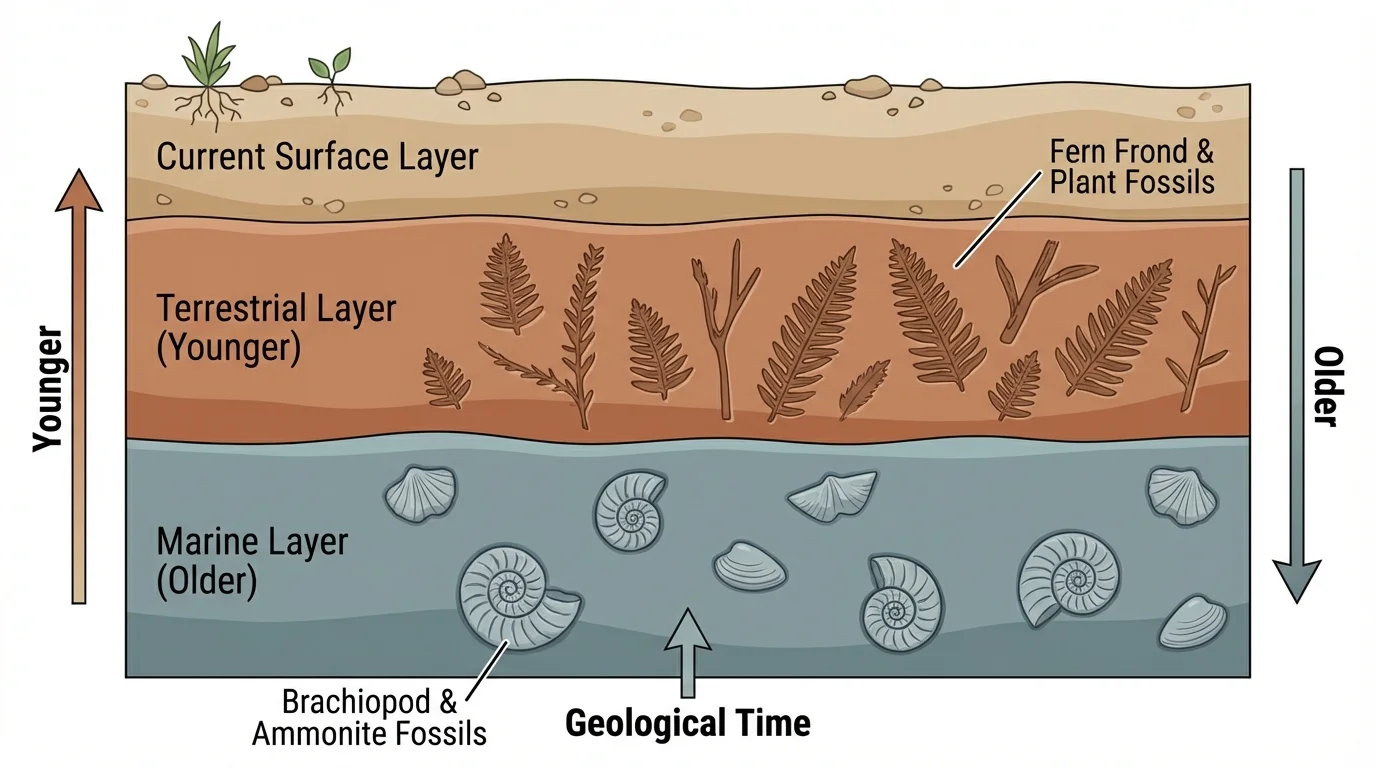
In many places, the order of layers helps scientists read Earth history, as [Figure 1] illustrates. In a simple stack of sedimentary rock layers, the lower layers are usually older and the upper layers are usually younger. This pattern matters because it helps scientists place events in order.
If a lower layer contains shell fossils and an upper layer contains tree leaf fossils, scientists can explain that the older environment may have been underwater and the later environment may have been on land or near land. The pattern in the layers supports the explanation that the landscape changed over time.
Different layers can also show different conditions. A dark muddy layer may suggest calm water, while a layer with larger pebbles may suggest faster-moving water. A layer of volcanic ash can show that a volcanic eruption happened. When scientists compare these patterns across many layers, they build a timeline of change.
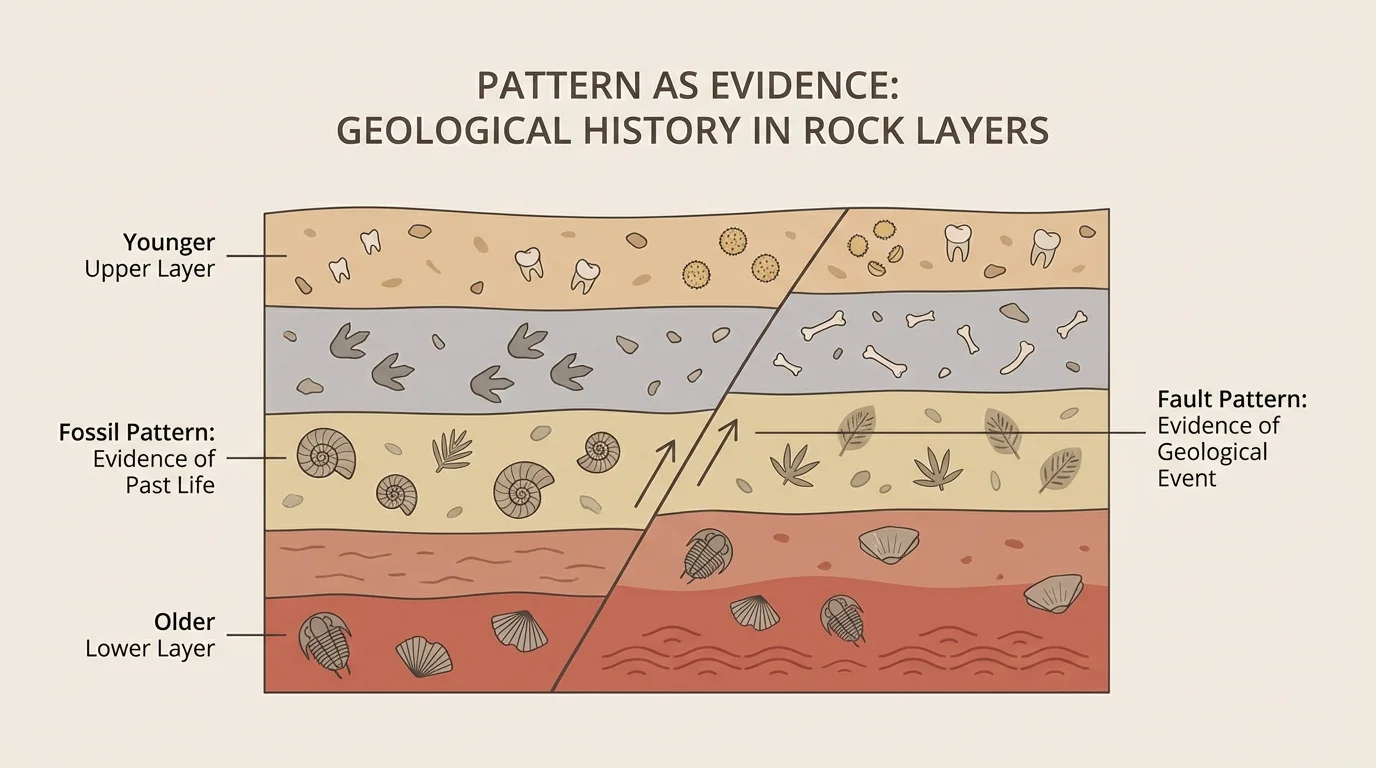
Sometimes rock layers are flat and easy to read. Sometimes they are bent, broken, or tilted because Earth's crust moved. Even then, the pattern still gives evidence. If layers that were once flat are now tilted, scientists can explain that forces inside Earth changed the shape of the land after the layers formed.
Rock formations can also show repeating shapes made by water and wind. Ripple marks in stone may have formed when waves or currents moved over wet sediment. Cracks in dried mud can be preserved in rock and show that wet ground dried out. These patterns are like snapshots from long ago.
How layer patterns support explanations
Scientists do not simply look at a rock and make a wild guess. They compare the position of layers, the materials in each layer, and the fossils inside them. When several clues point to the same idea, the explanation becomes much stronger. A set of clues is more dependable than a single clue by itself.
For example, if several lower layers contain fine mud, shell fossils, and ripple marks, scientists may explain that the area was once a shallow sea. If layers above them contain soil-like materials, plant fossils, and stream deposits, the explanation may be that the sea moved away and land conditions took over.
Patterns in fossils help identify past environments. Fossils are powerful evidence because living things need certain conditions to survive. Fish usually live in water. Tree roots grow on land. Coral grows in warm, shallow seas. When scientists find patterns in where these fossils appear, they can explain what the area was like long ago.
If a rock layer contains many shell fossils, that suggests the area may once have been under water. If another layer contains fossils of swamp plants, that suggests wet land conditions. When these layers are stacked one above another, they show change through time.
Fossils can be body fossils, such as bones, teeth, or shells. They can also be trace fossils, such as footprints, burrows, or leaf prints. Both kinds are useful. A pattern of footprints in one layer may show that animals walked across soft ground there. Burrows may show that small animals lived in wet sediment.
Not every rock contains fossils. Rocks formed from melted material, such as many igneous rocks, usually do not preserve organisms because the heat destroys remains. That is why many fossils are found in sedimentary rocks instead. This pattern also helps scientists understand how the rock formed.
Later, when scientists compare fossil patterns from different places, they may notice that the same kinds of fossils appear in similar layers. That can help them explain that those places may once have had similar environments. As we saw in [Figure 2], fossils are not just objects in stone; they are evidence of past life and past landscapes.
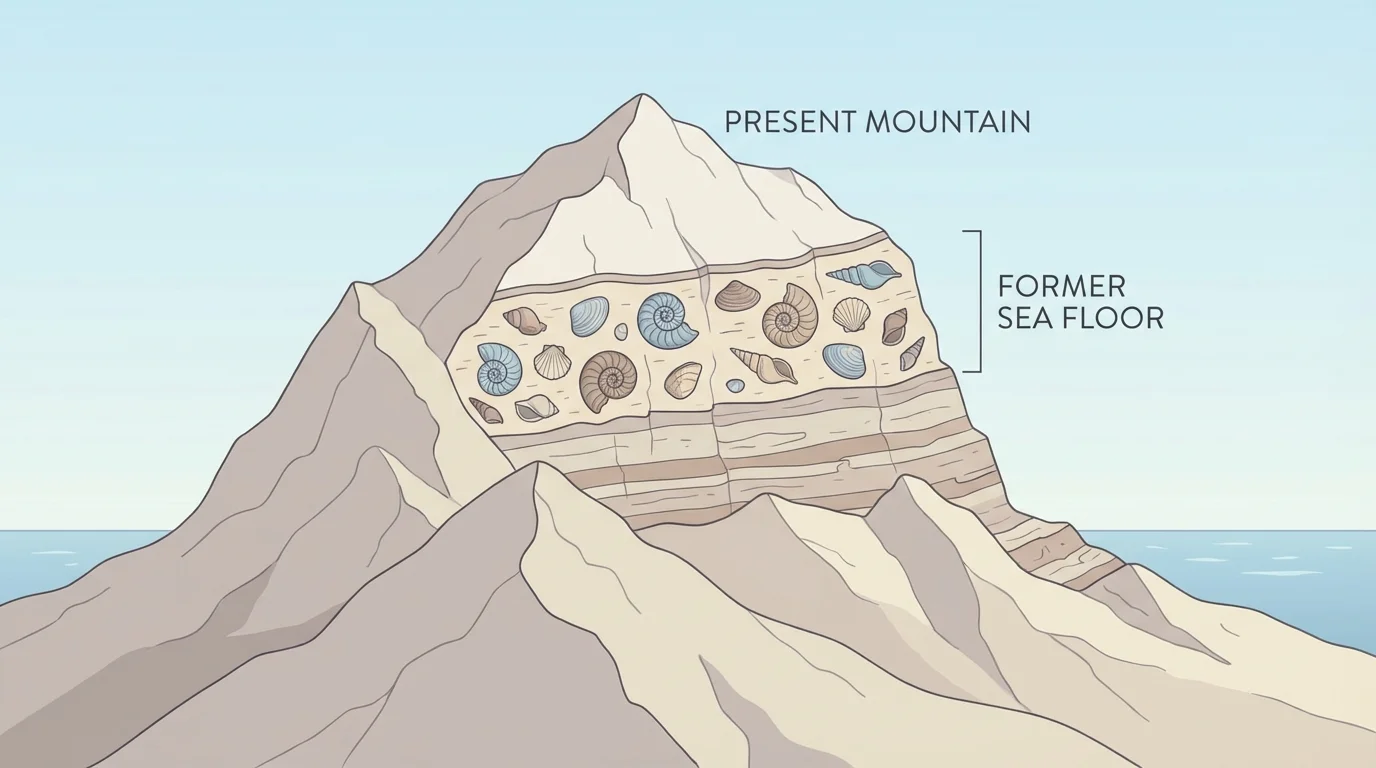
Some fossils are found on mountaintops. When scientists find sea fossils high above sea level, that is strong evidence that the land has changed greatly since the fossils were formed.
Scientists must be careful, though. One fossil alone does not tell the whole story. It is the pattern of many fossils, along with rock layers and land shapes, that gives the best evidence.
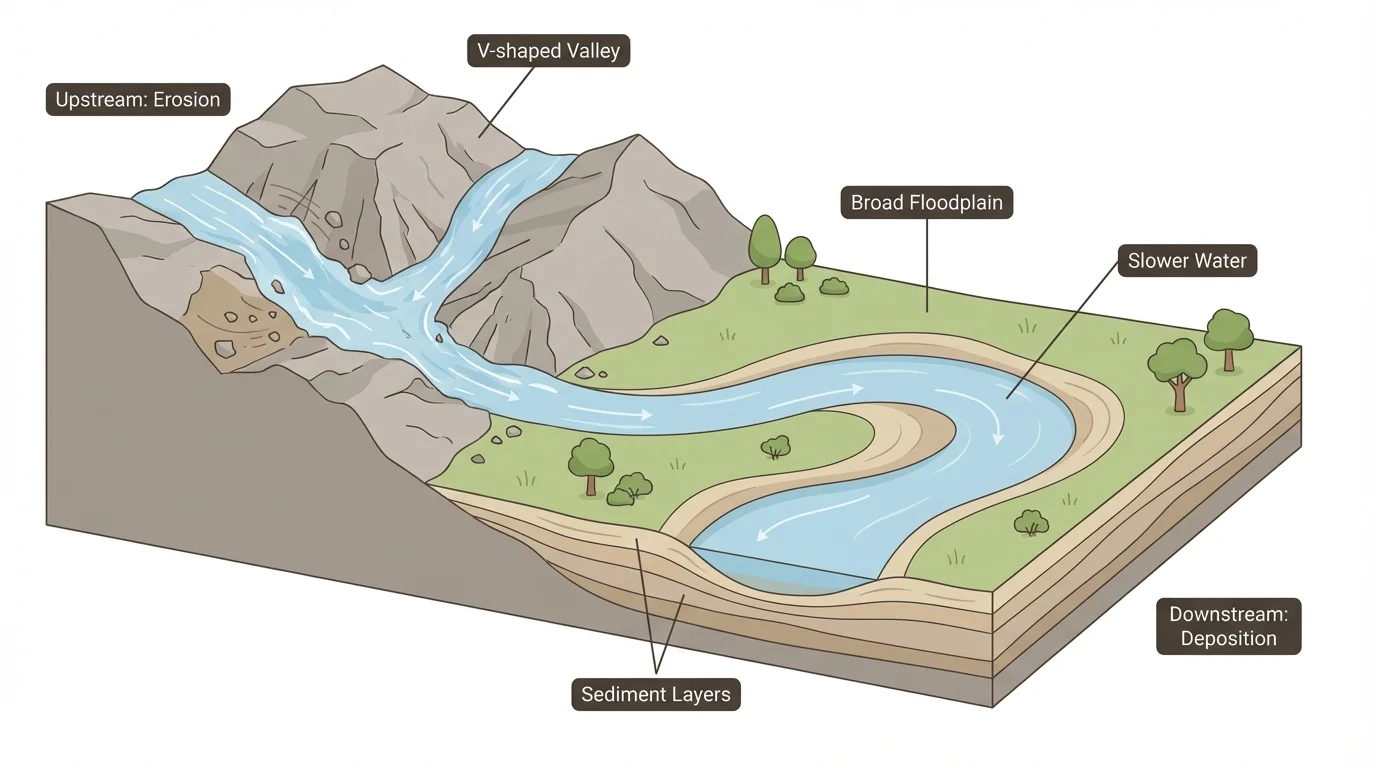
Repeated land patterns often point to moving water, as [Figure 3] illustrates with erosion and deposition. A landscape is the visible shape of an area, including features such as hills, valleys, rivers, beaches, plains, and mountains. Landscapes change when water, wind, ice, gravity, and movements inside Earth act on the land over long periods.
Erosion wears away and moves sediment. A river can cut into rock and form a valley or canyon. Wind can carry sand and shape dunes. Waves can break down cliffs along a coast. These changes may happen slowly, but the patterns they leave behind can last a long time.
Deposition happens when sediment is dropped in a new place. Rivers often drop sediment where water slows down. This can form sandbars, floodplains, and deltas. Over time, new layers may build up. If those layers later turn into rock, they become evidence of how the landscape once worked.
Weather can also shape the land. Rain and freezing water can crack rock apart. Plant roots can push into cracks. Gravity can pull loosened rocks downhill. These processes may work together for many years, changing mountains into smaller hills and carrying sediment to lower places.
The same place can look very different after enough time. A valley may become deeper. A coastline may move. A muddy pond may fill with sediment and become dry land. The patterns left in rock and fossils help scientists explain these changes even when no one was there to watch them happen.
Case study: reading a changing shoreline
A scientist studies three rock layers in one cliff.
Step 1: Observe the lowest layer
The bottom layer has shell fossils and fine mud. This suggests calm water, likely a shallow sea or bay.
Step 2: Observe the middle layer
The middle layer has ripple marks and sand. This suggests moving water near a shore.
Step 3: Observe the top layer
The top layer has plant fossils and soil-like material. This suggests land conditions.
Step 4: Build an explanation
The pattern supports the explanation that the shoreline changed and the area went from underwater to land over time.
This kind of reasoning is common in Earth science. The explanation is not based on a single clue. It is supported by a pattern across several layers.
Scientists often ask questions such as: What was this place like in the past? What changed? What evidence supports that idea? Then they compare many clues. They may look at rock color, grain size, fossils, layer order, and the shape of the land.
A strong explanation matches the evidence. Suppose scientists find rounded pebbles in one rock layer. Rounded pebbles often form when water tumbles rocks and smooths their edges. If they also find channel-shaped rock patterns and layers of sand nearby, these clues together support an explanation that a river once flowed there.
Scientists also test whether another explanation fits better. Could the pebbles have been moved by waves instead of a river? Could the area have been a beach? They compare all the patterns before deciding which explanation is best supported.
Patterns are not proof by themselves
Patterns are strong evidence, but scientists still compare different possible explanations. They ask whether the same pattern might happen in more than one way. Then they look for more evidence to narrow down the answer.
This is an important part of science. Explanations are based on evidence and can improve when new evidence is found. That does not make science weak. It makes science careful and honest.
Shell fossils on mountains are one of the clearest examples of landscape change. If scientists find sea fossils high above today's sea level, they can explain that the rocks formed underwater long ago and that the land later moved upward. The pattern does not fit a landscape that has always been a high mountain.
Another example comes from canyon walls. In a canyon, many layers are exposed where a river has cut downward. Scientists can study the colors, thicknesses, and fossils of the layers. These visible patterns help them explain how sediment built up over long times and how the river later carved the canyon.
River deltas also give evidence. A delta forms where a river slows and drops sediment near a lake or ocean. Over time, the pattern of branching channels and layered sediment shows repeated deposition. If these sediments later harden into rock, future scientists can use them to explain that a river once entered standing water there.
Desert rocks can contain another set of clues. Wind-blown sand may form layers with slanted patterns. If those patterns are preserved in stone, scientists can explain that wind shaped the sediments. This is different from the patterns made by rivers or ocean waves.
Later, the same mountain example remains useful. As shown earlier in [Figure 4], fossils found high above sea level are evidence that landscapes can change in very large ways, not only in small surface changes like a stream cutting a bank.
| Pattern observed | Possible evidence | Supported explanation |
|---|---|---|
| Shell fossils in rock | Organisms that lived in water | Area was once underwater |
| Plant fossils above shell fossils | Different fossils in newer layer | Environment changed from water to land |
| Rounded pebbles in layers | Rocks moved and worn smooth by water | A river or shoreline may have been present |
| Ripple marks in stone | Moving water or wind shaped soft sediment | Waves, currents, or wind affected the area |
| Tilted rock layers | Layers changed after forming | Land was pushed or moved |
Table 1. Examples of patterns in rocks and fossils and the explanations they can support.
Sometimes scientists first make one explanation and later change it. For example, they may think an area was once a lake because they found fine mud layers. Later they may discover fish fossils, shoreline features, and river deposits nearby. The new pattern gives a fuller explanation.
This happens because Earth is complex. One location may have been a sea, then a beach, then a forest, and much later a mountain slope. A single place can have a long history. Each layer and fossil adds another piece to the puzzle.
As we saw with rock layers in [Figure 1] and changing landscapes in [Figure 3], patterns help scientists organize events in order and explain what processes shaped the land. The more matching evidence they have, the more confident they can be in their explanation.
"The Earth has a history, and the rocks remember it."
When you look at a cliff, canyon, hillside, or rocky beach, you are not just seeing stone. You are seeing evidence. The colors, layers, shapes, and fossils are patterns that help explain how that place changed over time. Earth science is a little like detective work, but the clues are written in the land itself.
