A small flashlight, a toaster, and a speaker may seem like very different objects, but they all do something amazing: they change energy from one form into another. That is one of the biggest ideas in science and engineering. People use what they know about energy to build helpful things, from toys and tools to solar panels and wind turbines. When a device does not work as well as we want, we can study it, test it, and improve it.
Energy is the ability to make things happen. Energy can make objects move, produce light, create sound, or warm something up. We may not always see energy itself, but we can see what it does. A lamp lights a room. A fan spins its blades. A microwave heats food. A guitar string vibrates and makes sound.
Scientists observe how energy behaves in the world. Engineers use those scientific ideas to solve problems. If people need light in a dark place, they design a device that changes stored energy into light. If people want to hear music, they design a device that changes electrical energy into sound. Science helps us understand what is possible, and engineering helps us turn that understanding into something useful.
You already know that pushes and pulls can change motion, and that moving objects can transfer energy. This lesson builds on that idea by showing how people design devices to control and use energy changes in helpful ways.
When we say a device converts energy, we mean it changes energy from one form into another. A battery-powered toy car changes energy stored in a battery into electrical energy, and then into motion, sound, and a little heat. A device may change energy in one step or in several steps.
A design problem is a challenge that can be solved by making or improving something. The problem might be, "How can we make a reading light that works without plugging into a wall?" or "How can we build a toy car that travels farther?" To solve a design problem, engineers ask questions, plan, build, test, and improve.
Engineers do not just guess. They use evidence. They think about what is already known in science. They ask what materials to use, what energy source is available, and what the device must do. They also think about safety, cost, size, and how easy the device is to use.
Criteria are the things a solution must do to be successful. Constraints are the limits a designer must work within, such as time, materials, size, or safety. Refine means to improve a design after testing it.
If a class is designing a small oven to warm food using sunlight, the criteria might include "must warm the food" and "must be safe to use." The constraints might include "must use classroom materials" and "must be built in one class period." These limits do not stop creativity. They help focus it.
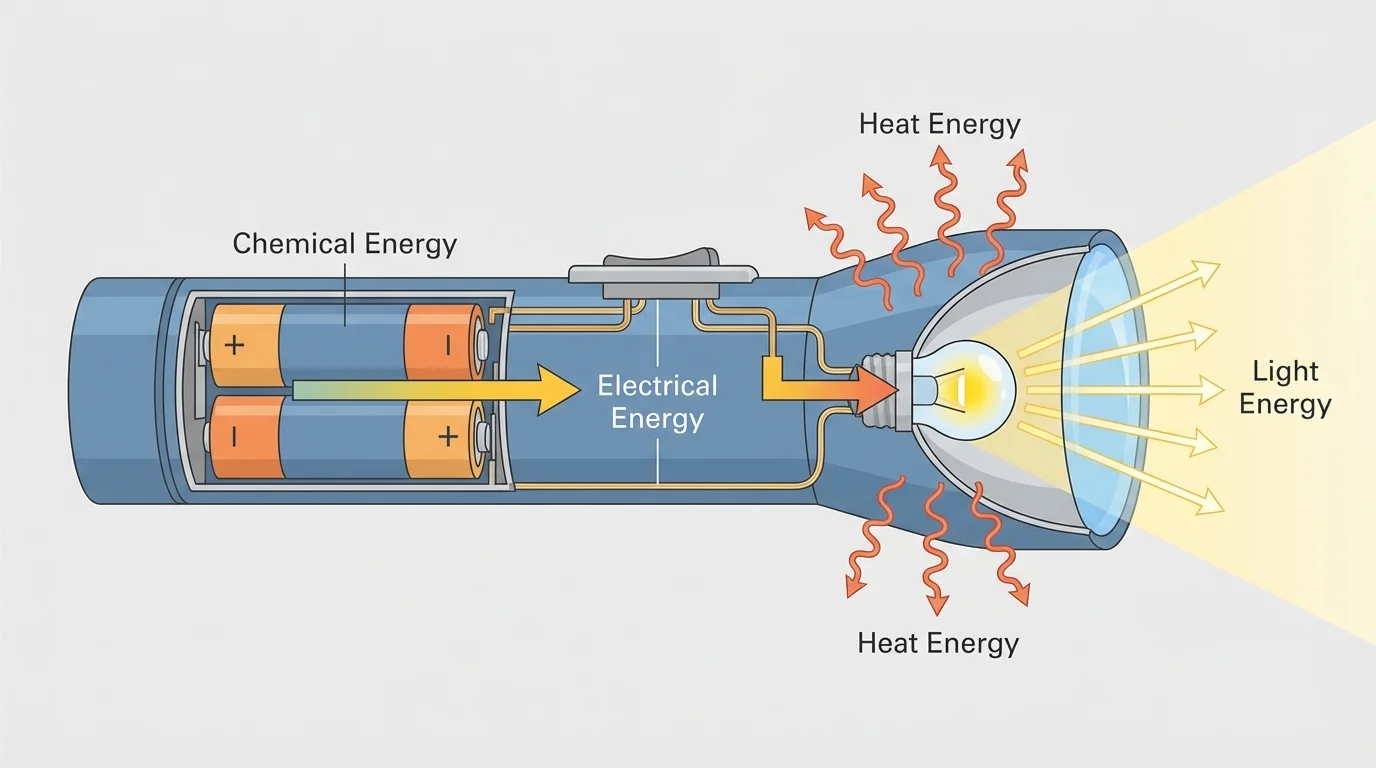
Devices that solve problems often work because they change one kind of energy into another, as [Figure 1] shows with a flashlight. Common energy forms for this grade level include stored energy in batteries or stretched bands, electrical energy, light energy, sound energy, heat energy, and motion energy.
Think about a flashlight. The battery stores energy. When the switch is turned on, that energy moves through the circuit as electricity. The bulb or light-emitting part changes that electrical energy into light. Some of the energy also becomes heat. That means not all the energy becomes the useful form we want.
A speaker changes electrical energy into sound energy. A toaster changes electrical energy into heat. A solar-powered calculator changes light energy from the Sun into electrical energy. A hand-crank flashlight changes motion energy from your hand into electrical energy and then into light.
Sometimes energy changes in a chain. In a wind turbine, moving air has motion energy. The spinning blades turn that motion into mechanical motion in the machine, and then a generator changes that into electrical energy. In a home, that electrical energy might later be changed into light, sound, motion, or heat by different devices.
No energy conversion is perfectly useful
When a device changes energy, some energy often spreads out as heat or sound that is not the main goal. For example, a lamp gives light, but it may also feel warm. Engineers try to design devices so that more of the energy becomes the useful output and less is wasted.
This is why a good design matters. If two flashlights use the same kind of battery, but one gives brighter light for a longer time, the better design is converting energy in a more useful way. The idea first seen in [Figure 1] helps us compare many other devices too.
One way to understand a device is to ask two questions: What energy goes in? and What energy comes out? The energy that goes in is called the input. The energy or effect that comes out is called the output.
For a desk lamp, the input is electrical energy, and the useful output is light. For a blender, the input is electrical energy, and the useful output is motion of the blades. For a drum, the input is motion from your hand, and the output is sound. By studying inputs and outputs, we can understand what job the device is doing.
| Device | Energy Input | Main Useful Output | Other Outputs |
|---|---|---|---|
| Flashlight | Stored energy in battery | Light | Heat |
| Toaster | Electrical energy | Heat | Light from glowing wires |
| Speaker | Electrical energy | Sound | Small amount of heat |
| Hand-crank light | Motion energy | Light | Heat, sound |
| Solar calculator | Light energy | Electrical energy for operation | Small amount of heat |
Table 1. Examples of devices, their energy inputs, and their outputs.
Scientists and engineers also look for patterns. If a motor gets hotter than expected, that may mean too much energy is turning into heat instead of motion. If a toy car moves slowly, the wheels might rub too much, or the battery might not provide enough energy to the motor. Careful observation helps explain what is happening.
Some animals solve energy problems in amazing ways. Fireflies change stored chemical energy in their bodies into light with very little heat, which is one reason scientists study them when thinking about efficient lighting.
Nature often inspires design. Birds helped inspire flying machines. Seed shapes inspire ways to move through air. By studying the world carefully, people get ideas for better devices.
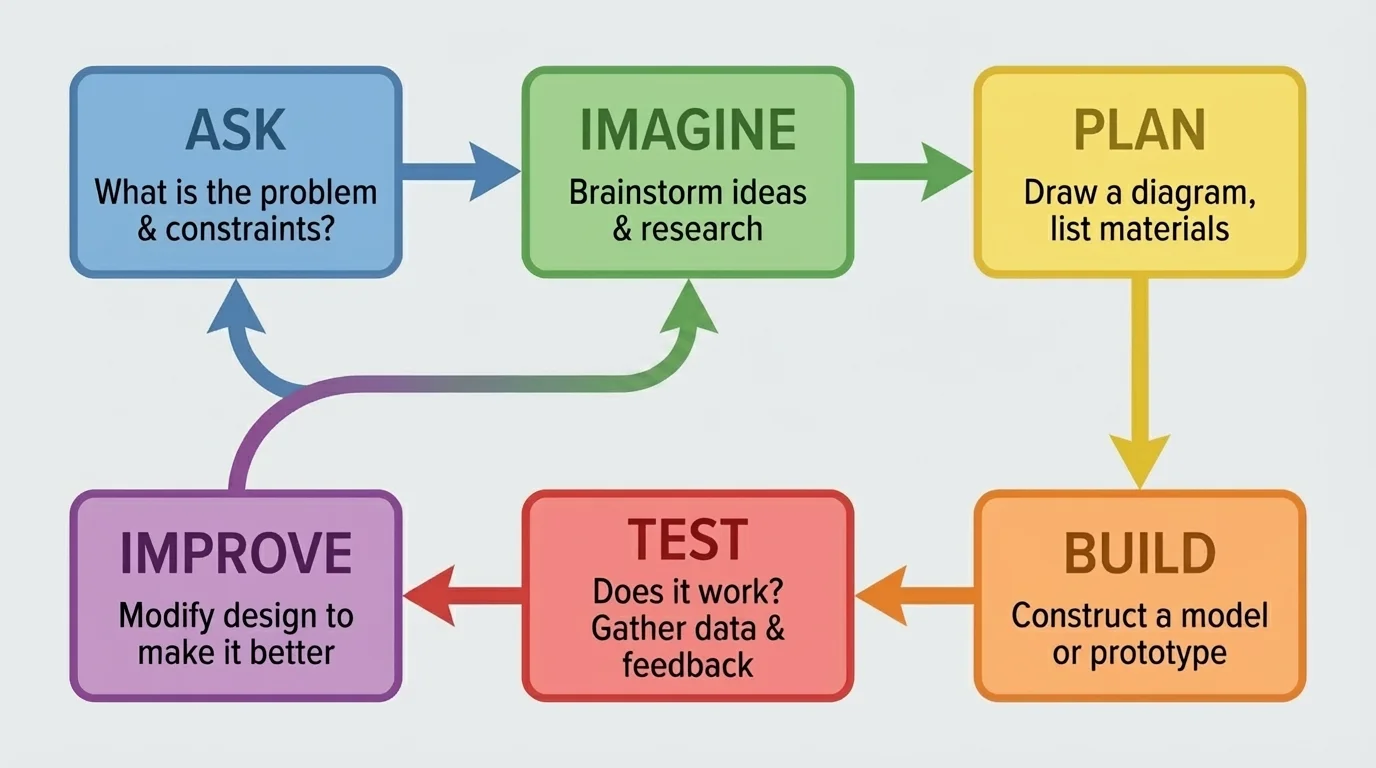
When engineers plan a device, they follow a process, and [Figure 2] lays out the main steps clearly. They ask what problem needs solving, imagine possible solutions, make a plan, build a model or prototype, test it, and improve it.
A prototype is a first model of a design. It may not be perfect. Its job is to help us learn. A prototype lets us see what works, what does not work, and what should be changed.
Suppose students want to design a device that changes wind energy into motion to lift a small paper flag. They might test blade shapes, blade sizes, and how many blades to use. Their criteria could include "the flag must rise" and "the device must stand on its own." Their constraints could include "only classroom materials" and "must be safe near a fan."
To make a fair test, it helps to change just one thing at a time. If students change blade shape and blade size and tower height all at once, they will not know which change made the difference. Fair tests give better evidence.
Good designers also write down observations. They might count how many times blades spin in a set amount of time, or measure how high the flag rises. Measuring gives stronger evidence than saying only "it worked better."
Example: Comparing two fan designs
Two teams build paper fans for a wind-powered device.
Step 1: Team A uses wide blades, and Team B uses narrow blades. Both use the same straw axle, the same fan, and the same distance from the wind source.
Step 2: Each team tests how many seconds it takes to lift a paper clip one time.
Step 3: Team A lifts the paper clip in \(6 \textrm{ s}\), and Team B lifts it in \(9 \textrm{ s}\).
Step 4: The class concludes that, in this test, the wide blades work better for the goal because they lift the paper clip faster.
The result does not mean wide blades are always best in every machine. It means they worked better under these conditions.
That careful way of thinking is part of applying scientific ideas. We use observations and tests to support claims about which design works better.
Testing is not the end of design. It is the beginning of improvement. A first design may wobble, stop early, or convert energy less effectively. Engineers learn from those problems. They ask why the problem happened and what change might help.
For example, if a rubber band-powered car does not travel far, the wheels might be too heavy, the axle might have too much friction, or the body might be too large and hard to move. If the students change one feature and test again, they can see whether that change helps.
Evidence leads to better redesigns
A redesign is strongest when it is based on evidence from testing. If a car goes farther after using lighter wheels, that result supports the idea that less energy is being lost to friction or extra mass. Engineers use this kind of evidence to choose their next improvement.
Sometimes simple measurements help. If Car A travels \(120 \textrm{ cm}\) and Car B travels \(150 \textrm{ cm}\), then the difference is \(150 - 120 = 30 \textrm{ cm}\). That tells us Car B went farther by \(30 \textrm{ cm}\). Numbers help us compare designs clearly.
Testing should be repeated. A single trial can be affected by chance. Maybe one car hit a bump on the floor. If students test three times and look for a pattern, they can trust the evidence more.
Many devices in everyday life were improved over time because people kept applying scientific ideas. Light bulbs became more efficient. Wind turbines were designed with better blade shapes. Solar panels improved at turning light energy into electrical energy. Headphones became better at turning electrical energy into sound.
Consider a solar oven. It uses light from the Sun as the energy input. Dark surfaces absorb more light energy and turn more of it into heat, so engineers and students often choose dark paper inside the oven. Shiny foil reflects light toward the food. Clear plastic wrap helps trap warm air. Each material is chosen for a scientific reason.
Example: Improving a solar oven
A class tests two solar ovens.
Step 1: Oven A has a dark inside surface. Oven B has a light inside surface.
Step 2: Both ovens sit in the same sunlight for the same amount of time.
Step 3: Oven A reaches \(38 \textrm{ °C}\) and Oven B reaches \(31 \textrm{ °C}\).
Step 4: The class infers that the dark surface helped convert more light energy into heat energy.
This is a scientific idea used to improve a design.
Another useful example is a hand-crank radio. When a person turns the crank, motion energy is converted into electrical energy. That electricity can power the radio, which then changes electrical energy into sound. Devices like this are helpful in emergencies because they do not depend on wall power.
We can also think about safety and caring for Earth. Some designs save energy by reducing wasted heat. Some use renewable sources such as sunlight or wind. A strong design solves a problem while also being safe and thoughtful about resources.
One of the clearest ways to see design in action is to test a small model vehicle, as [Figure 3] illustrates. In one version, a stretched rubber band stores energy. In another version, air rushing out of a balloon pushes the car forward. In both cases, stored energy changes into motion.
Students can choose one question to test: Which wheel size helps the car travel farther? Which body shape helps it move straighter? Which amount of balloon air helps it go the longest distance? A good investigation changes one variable at a time and measures the result.
Suppose two balloon-powered cars are built with the same body and same balloon size, but one has large wheels and one has small wheels. Students release each car from the same start line and measure how far it travels with a tape measure.
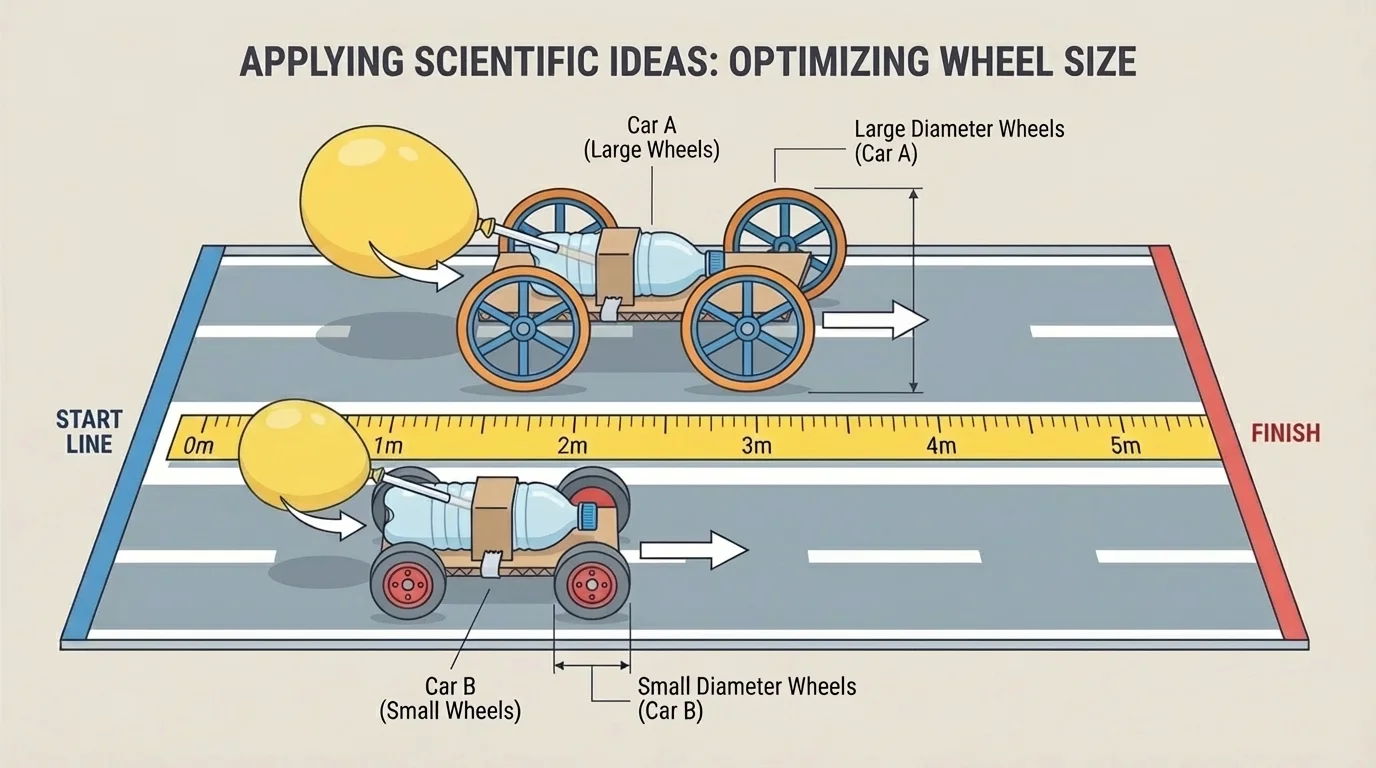
If the large-wheel car travels \(210 \textrm{ cm}\) and the small-wheel car travels \(180 \textrm{ cm}\), then the large-wheel car goes farther by \(210 - 180 = 30 \textrm{ cm}\). Students may infer that, for this design, the larger wheels helped the car roll more effectively.
But one test is not enough. Students should try several trials and look for a pattern. If the large-wheel car wins most of the time, that is stronger evidence. If the results are mixed, then other features may matter more.
Later, when students redesign the car, they can return to the setup in [Figure 3] and compare new versions fairly. The picture of the test setup helps remind us that careful measuring and equal starting conditions are important parts of science.
Applying scientific ideas means more than building something once. It means using what we know about energy, motion, materials, light, and heat to make smarter choices. If a device needs to stay cool, we think about how heat moves. If a device needs to spin, we think about friction and balance. If a device must run without batteries, we may think about sunlight, wind, or hand power.
Science helps explain why a design works. Engineering uses that explanation to make the design better. That teamwork between science and engineering is how people create useful tools, safer machines, and more efficient devices.
"The best designs grow from good questions, careful tests, and smart improvements."
Whenever you flip a switch, charge a tablet, hear a song from a speaker, or watch a wind turbine spin, you are seeing the results of people applying scientific ideas to solve design problems. They study energy, build devices, test them, and refine them so the devices do useful work in the world.
