Your body is doing something amazing right now. Your eyes may be reading words, your ears may be hearing sounds nearby, and your brain is sorting all that information at the same time. Then your body responds. You might turn your head, blink, smile, or reach for something. Scientists study these kinds of actions by looking for cause and effect. They also use models to test what happens in a system when one part changes.
A model is something that helps us understand another thing. A model might be a drawing, a diagram, a small object, a set of arrows, or even a simple plan written in words. Scientists use models to study natural systems, such as animals, plants, weather, and landforms. Engineers use models to study designed systems, such as machines, bridges, alarms, and doors.
Models are useful because some real systems are too fast, too tiny, too dangerous, or too complicated to test directly. A model can help us notice which part causes a change and what effect follows. If a student draws a picture showing how light enters the eye and leads to a person closing their eyes, that picture is a model of a real body system.
Cause and effect means that one thing happens and makes another thing happen. The cause is what starts the change. The effect is what happens because of that cause.
Interaction means two or more parts affect one another while working in a system.
When people test ideas with models, they ask questions like these: What happens if the light gets brighter? What happens if the sound gets louder? What happens if the sensor stops working? These questions help us learn how systems function.
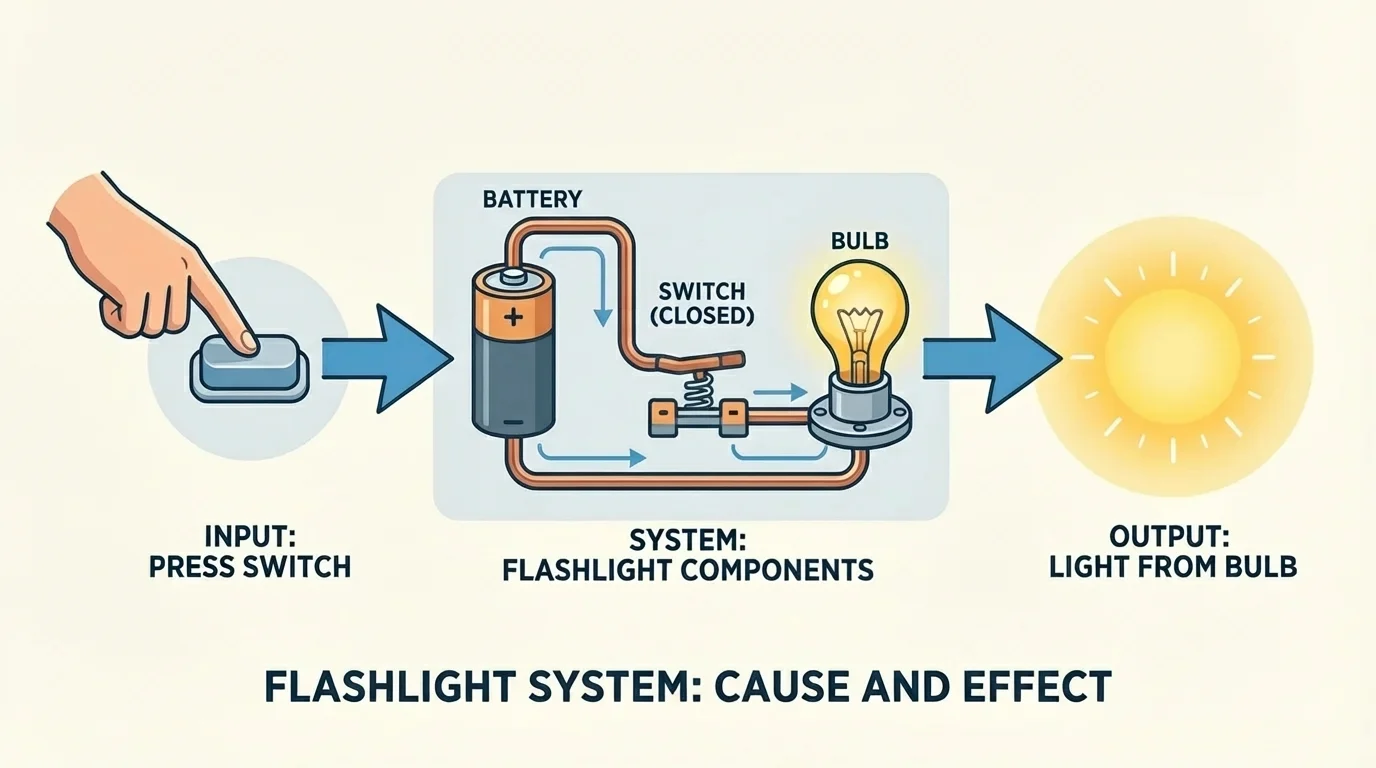
A system is a group of parts that work together. In many systems, something goes in, the parts interact, and something comes out. This pattern of input, process, and output is shown clearly in [Figure 1], which presents a simple system with connected parts working together.
A natural system exists in nature. An animal using its senses is a natural system. A plant bending toward light is another natural system. A designed system is made by people. A flashlight, a bicycle brake, and an automatic door are designed systems.
For example, think about a flashlight. The input is pressing the switch. Inside, the battery and wires allow electricity to move. The output is light. If the battery is dead, the flashlight will not work. In this system, the battery is one cause of whether the bulb lights up.
Systems can be simple or complex. A simple system may have only a few parts. A complex system may have many parts and many interactions. Your body is a very complex system because many organs and signals work together at once.
Later, when we compare body systems with machines, [Figure 1] remains helpful because both kinds of systems have parts, actions, and results.
A cause is not just any event. It is something that leads to a change. An effect is the result of that change. If the sun warms a sidewalk, the heat is a cause and the warmer sidewalk is the effect. If you touch something cold and pull your hand away, touching the cold object is a cause and moving your hand is the effect.
Sometimes one cause has one effect. Sometimes one cause has many effects. A loud thunderclap may make a dog bark, a baby cry, and birds fly away. The same cause leads to different effects in different living things.
Sometimes many causes work together. Suppose a rabbit hears a sound, sees movement, and smells a predator. The rabbit's response depends on several pieces of information, not just one. This is why scientists often make models. A model helps them look at the parts one by one and then see how the parts connect.
Testing cause and effect with a model means using a simplified version of a system to see how one change can lead to another change. A good model helps us predict what might happen and explain why it happens.
When we test a model, we try to be fair. We change one important thing and watch what happens. If too many things change at once, it becomes hard to tell which change caused the effect.
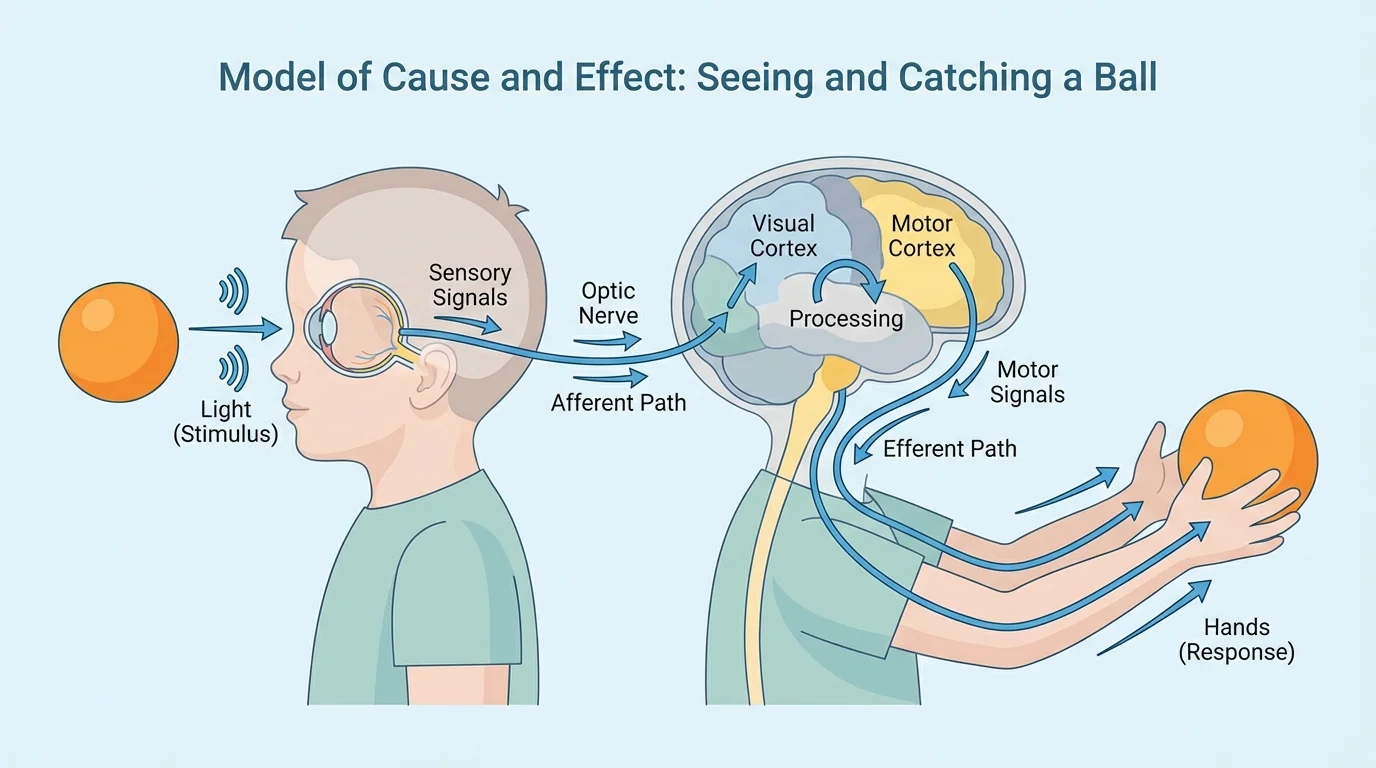
[Figure 2] Animals receive information from the world through their senses. This information moves through a system from the sense organs to the brain and then to the body in a clear sense-to-response pathway. This is a natural system with many interacting parts.
The main senses include sight, hearing, smell, taste, and touch. Sense organs collect information. Eyes detect light. Ears detect sound. Noses detect smells. Skin detects pressure, temperature, and pain. These signals travel to the brain. The brain processes the information, which means it sorts, compares, and interprets the signals. Then the brain sends messages that help the body respond.
Suppose a child sees a ball flying toward them. The eyes collect visual information. The brain notices the ball's direction and speed. The brain then sends messages to the muscles in the arms and hands. The child may lift both hands to catch the ball, duck, or step aside. The same input does not always lead to the same response because the brain makes choices based on the situation.
Now think about a different example. If a person touches a hot pan, the skin detects heat and danger. Very quickly, the body responds by pulling the hand away. The cause is the heat touching the skin. The effect is the fast movement away from danger. This quick response helps protect the body.
Animals can respond in different ways to the same kind of information. A deer hearing rustling leaves may freeze and listen. A bird hearing the same kind of sound may fly away. A cat may turn its ears toward the sound and creep forward. These different responses show that natural systems are not one-size-fits-all.
The model in [Figure 2] also helps explain why a problem in one part can affect the whole system. If the eyes do not detect the ball clearly, or if the messages to the muscles are delayed, the catch may fail.
Case study: testing a simple sense-response model
A class wants to model how light affects a person's response.
Step 1: Identify the cause.
The cause is a bright light shining toward a person's eyes.
Step 2: Predict the effect.
The class predicts that the person will blink, squint, turn away, or cover their eyes.
Step 3: Build a model.
The class makes a flowchart: bright light → eyes detect light → brain processes signal → body responds.
Step 4: Test one change.
If the light becomes dim instead of bright, the response may be much smaller.
The model helps students see the relationship between the cause, the body system, and the effect.
This kind of model does not show every cell or nerve, but it shows the main pathway clearly enough to test ideas.
Many natural systems have chain reactions. A chain reaction is a series of connected cause-and-effect events. For example, when the air gets colder, some animals grow thicker fur. Thicker fur helps keep them warm. Staying warm helps them survive the winter. One change can lead to several effects over time.
Plants also respond to information from their surroundings. A plant may bend toward a window because it detects light. The cause is light coming more strongly from one direction. The effect is the plant growing or bending toward that light source. Scientists can use a model with arrows to show this relationship.
Sometimes natural systems are affected by changes inside the body. If a person has a stuffy nose, smells may be harder to notice. That may also change how food tastes. One problem in one part of the system can influence another part. This is called an interaction among parts.
Some animals sense things humans cannot easily detect. Bats use sound echoes to help them move and find food, and some snakes can detect heat from other animals.
These examples remind us that living things gather many types of information. Their bodies must process that information correctly so they can survive, find food, avoid danger, and care for their young.
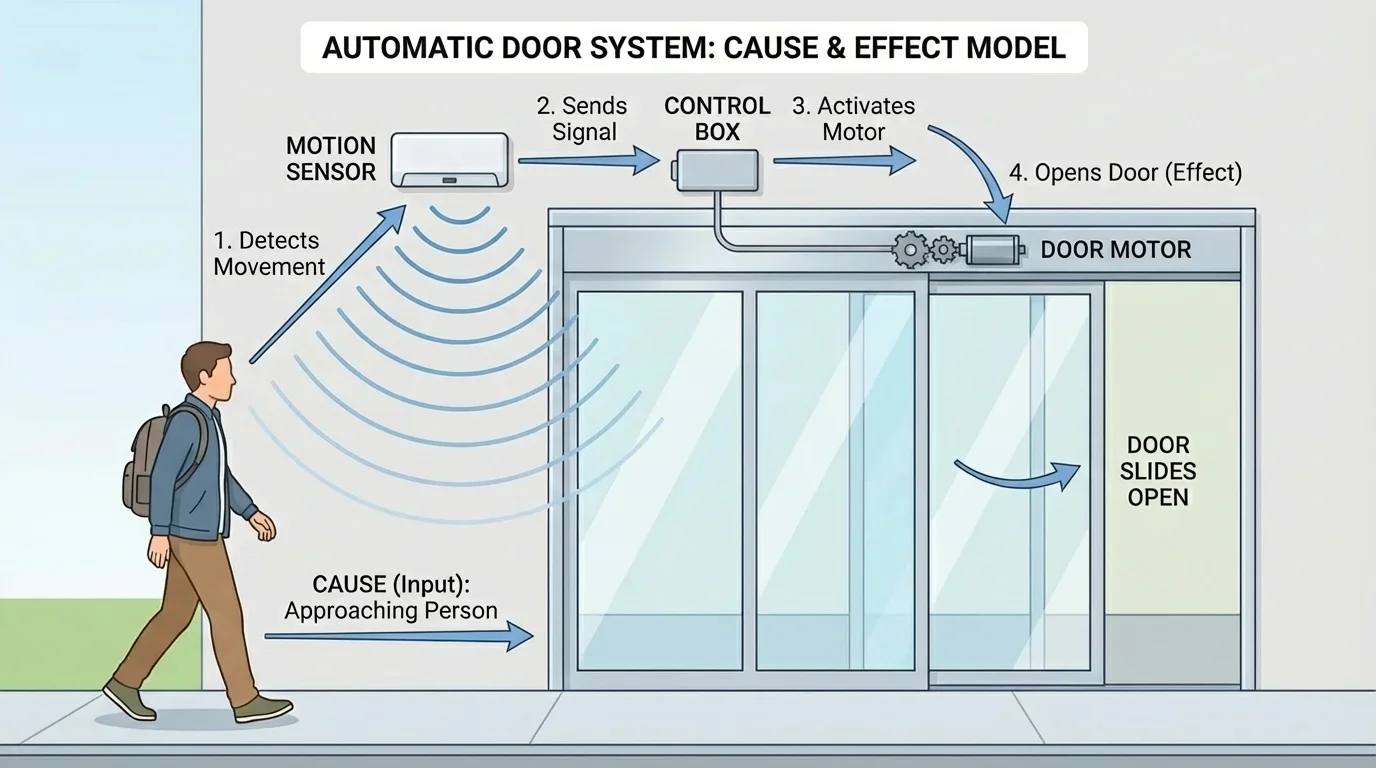
[Figure 3] Designed systems are built by people, but they often work in ways that are similar to natural systems. An automatic door uses a sensor, a control unit, and a moving door panel. In a way, the sensor acts a little like a sense organ because it detects information from the surroundings.
When a person walks toward the door, the sensor detects motion or closeness. The control system processes that information. Then the motor opens the door. The cause is the detected movement. The effect is the door opening. If the sensor is blocked or broken, the door may stay shut.
A smoke alarm is another designed system. Smoke enters the alarm. A sensing part detects the smoke. The device processes the signal and makes a loud sound. This sound warns people of possible danger. Engineers test models of these systems so they can improve safety.
The comparison with [Figure 3] helps us notice an important idea: both living systems and designed systems gather information, process it, and respond. The parts are different, but the pattern is similar.
| Type of system | Input | Processing part | Response or output |
|---|---|---|---|
| Human catching a ball | Seeing the ball | Brain | Hands move to catch |
| Automatic door | Detecting motion | Control unit | Door opens |
| Smoke alarm | Detecting smoke | Alarm circuit | Sound warning |
Table 1. Examples of natural and designed systems with inputs, processing parts, and outputs.
When scientists or engineers test an idea, they often begin with a simple model. They decide what part they want to study. Then they think about what might happen if that part changes.
For example, if we use a model of an automatic door, we might ask: what happens if the sensor is placed too high? The model may predict that small children or pets will not be detected as easily. That would affect how well the system works.
If we use a model of a person reacting to sound, we might ask: what happens if the sound is very soft instead of loud? The model may predict that the person will respond more slowly or may not notice the sound at all. The changed cause leads to a different effect.
To make a fair test, it helps to change only one important factor at a time while keeping other parts the same. That way, the effect is easier to connect to the cause.
Scientists also look for repeated patterns. If the same cause often leads to the same effect, the model becomes more trustworthy. But if the result changes a lot, the model may need more detail.
A model is useful, but it is not the real thing. A drawing of a dog hearing a whistle cannot show every nerve and muscle. A model of an automatic door may not show every wire and computer chip. Models are simplified on purpose so we can focus on the most important parts.
Because models are simplified, they have limits. A model may help explain one cause-and-effect relationship but leave out other factors. For example, a model of catching a ball may show eyes, brain, and hands, but it may not include wind, distractions, or tired muscles.
Good thinkers ask two questions: What does this model help me understand? What does this model leave out? Those questions help us use models wisely.
A strong model shows the key parts of a system, how those parts interact, and what effects happen when a cause is introduced or changed. It should be simple enough to understand but detailed enough to explain the main idea.
Even when models are not perfect, they are powerful tools for learning, designing, and solving problems.
Doctors and health scientists use models to understand how the body reacts to signals. They study how eyes respond to light, how ears detect sound, and how the brain helps people move safely. This work can help people who have trouble seeing, hearing, or reacting to danger.
Animal scientists also use models. They may study how pets respond to sounds, smells, or touch. Knowing these responses helps people care for animals better and build safer homes, shelters, and zoos.
Engineers use models to build safer schools, cars, playgrounds, and buildings. If a sensor in a machine does not detect danger quickly enough, the machine may not respond in time. By testing models first, engineers can improve the design before people use it.
"The important thing is to never stop questioning."
— Albert Einstein
Questioning is at the heart of testing cause and effect. We ask what happens, why it happens, and how one change affects the rest of the system. That is true whether we are studying a human brain, a rabbit listening for danger, or a door opening at a store.
