A city can run out of clean water, a playground can fill with litter, and a creek can become dirty even when no one dumps trash directly into it. That may sound surprising, but communities often face environmental problems caused by many small actions added together. To understand what is happening and what to do about it, scientists, engineers, and community members do not rely on a single guess. They collect information from books, articles, maps, photos, data tables, expert interviews, and other trustworthy sources. Then they put the pieces together like a puzzle.
When you study Earth and human activity, you learn that people use natural resources such as water, soil, forests, air, and energy every day. These resources are important, but they can be damaged or used too quickly. Communities need smart solutions to protect them. A good solution starts with a good explanation, and a good explanation starts with careful research.
A phenomenon is something that happens in the natural world or in the world people have changed. For example, fish disappearing from a pond is a phenomenon. Too much trash blowing around a neighborhood is also a phenomenon. A design problem is a problem people can try to solve by planning and creating something, such as a better recycling system or a rain garden that helps soak up stormwater.
To explain a phenomenon or solve a design problem, you need evidence. Evidence is information that helps support an idea. If a community wants to know why a creek is muddy after rain, it might gather evidence from a science book about erosion, a weather report, photos of bare soil near the creek, and local water-quality data. One piece of information alone may not tell the whole story. Several pieces together can make the explanation much stronger.
Reliable source means a source of information that is trustworthy, accurate, and based on evidence.
Community means a group of people living in the same place and sharing resources such as water systems, roads, parks, and schools.
Natural resource means something from Earth that people use, such as water, soil, forests, sunlight, wind, or minerals.
Communities make better decisions when they use strong information. If people choose a solution without enough evidence, they may spend time and money on something that does not work well. For example, if a school wants to reduce plastic bottle waste, it should first find out where the waste comes from, how much there is, and which solution is realistic for students and families.
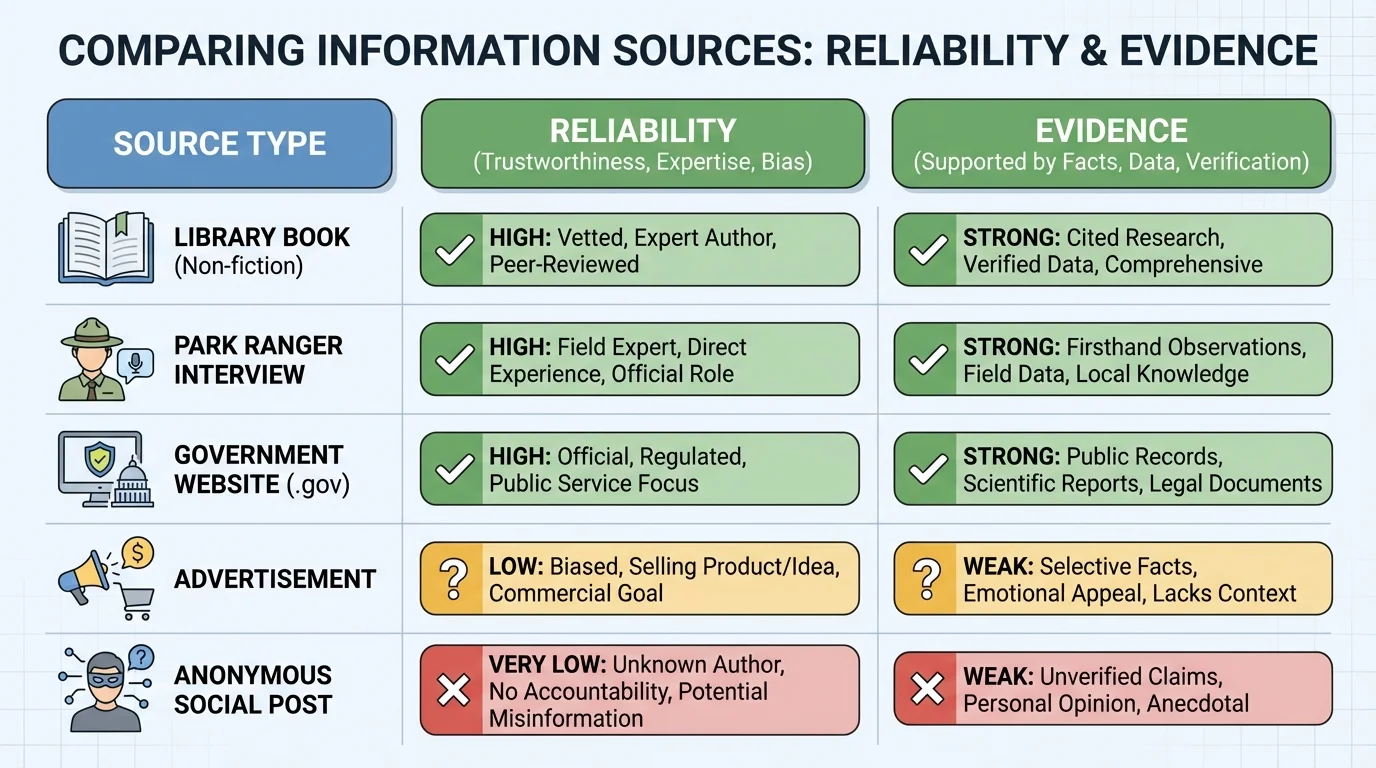
Some sources are much stronger than others, as [Figure 1] shows in a comparison of different kinds of media. A library book about ecosystems, a government water report, or an interview with a park ranger usually gives more trustworthy information than an advertisement or a random online post with no evidence.
Reliable sources often have a few important features. They name the author or organization. They explain where the information came from. They are updated when needed. They match what other trustworthy sources say. They also try to inform, not just persuade people to buy or support something.
Books are useful because they often give organized background information. A book about weather, for example, can explain runoff, erosion, and watersheds. Other media can add current details. A recent local news report may show that a town had heavy rain last week. A map from the town website may show where storm drains lead. Together, these sources can help explain why flooding happened in a certain area.
It is also important to ask, "Who made this?" and "Why was it made?" A city environmental department may publish information to help keep water clean. A company selling a product may focus only on reasons to buy that product. That does not always make the company wrong, but it means you should check other sources too.
Scientists often use more than one source even when they already know a lot about a topic. Checking multiple sources helps them catch mistakes and notice patterns they might miss in just one place.
Later, when you compare ideas from several sources, the source chart in [Figure 1] still matters because not all information should count equally. Strong evidence from a science text or local data should have more weight than a rumor.
Research usually begins with an observation. You might notice that grass near a stream is gone, that trash bins overflow after lunch, or that school lights stay on in empty rooms. Observations help you ask a focused question.
A clear question is specific. Instead of asking, "How do we help Earth?" you might ask, "Why does the playground have so much litter after windy days?" or "Which solution would help our school waste less water in the bathroom sinks?" Specific questions make it easier to find useful information.
From noticing to investigating
Good investigators move from what they see to what they want to know. First, they notice a pattern or a problem. Next, they ask a question that can be answered with evidence. Then they gather information that directly connects to that question. This keeps research focused and useful.
Sometimes the question is about a cause. Why is the pond level lower than usual? Sometimes it is about a solution. Which type of shade tree should be planted in a hot schoolyard to help cool the area and save water? In both cases, the question guides what sources you need.
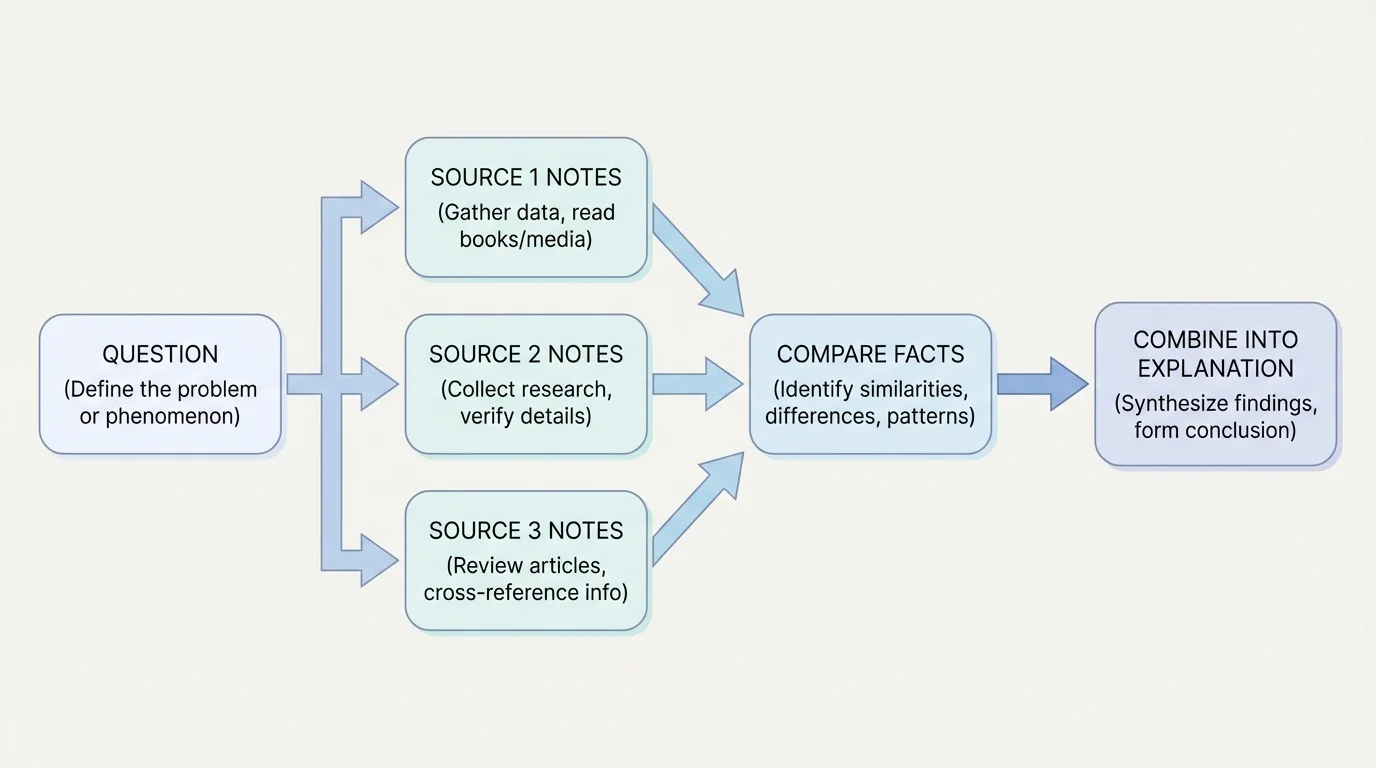
Research works best when it follows a clear sequence, as [Figure 2] illustrates. You begin with a question, collect notes from several sources, compare what those sources say, and then combine the ideas into one explanation or plan.
When gathering information, look for the main idea and the important details. The main idea tells what a source is mostly about. Details support that idea. If you read a book page about erosion, the main idea may be that moving water can carry soil away. Important details may include that bare soil erodes faster than soil protected by plants.
Taking notes helps you keep track of facts. A simple note might say, "Book: roots hold soil in place." Another note might say, "Town photo: hill near creek has little grass." A third note from a weather report might say, "Heavy rain fell for two days." None of these notes alone fully explains the muddy creek, but together they begin to connect.
You should also compare sources. Do two sources agree? Does one add an important detail? If one source says the town has enough recycling bins but another shows photos of crowded trash cans and no nearby bins, you may need more evidence to understand the full situation.
Sometimes information comes in different forms. A book gives background ideas, a chart gives numbers, a map shows location, and an interview gives expert knowledge. Combining different kinds of media is helpful because each one shows something a little different.
| Source type | What it helps you learn | Example |
|---|---|---|
| Book | Background science ideas | How erosion or pollution happens |
| Map | Where things are located | Where a creek, road, or storm drain is |
| Chart or data table | Measured information | How much rain fell or how much water was used |
| Photo or video | What a place looks like | Bare soil, litter, flooding, dead plants |
| Expert interview | Knowledge from experience | A park ranger explains local wildlife changes |
Table 1. Different source types provide different kinds of useful information for environmental questions and design problems.
The research flow in [Figure 2] reminds us that information gathering is not just collecting facts. The important part is what happens after collecting: comparing, connecting, and building an explanation.
To synthesize information means to put ideas from different sources together into a new understanding. This is more than copying facts. It means seeing how facts connect.
Suppose three sources give you these facts: a science book says plants help stop soil from washing away, a local photo shows a riverbank with few plants, and a rainfall chart shows recent storms. When you combine those facts, you can explain that rain likely washed loose soil into the river because the bank was not protected by many plants.
Case study: Why is the school garden drying out?
A class wants to explain why a small school garden looks dry and unhealthy.
Step 1: Gather information from different sources.
A gardening book explains that many vegetables need regular watering and healthy soil. A weather report shows very little rain in the last two weeks. A student observation note says the soil feels hard and dry.
Step 2: Look for connections.
The book gives background knowledge, the weather report gives recent evidence, and the observation gives local details.
Step 3: Build one explanation.
The garden is drying out because it has not received enough water recently, and the hard soil may not be holding moisture well.
The final explanation is stronger because it combines information instead of relying on one clue.
When you synthesize information, you should use your own words. You can say what several sources together suggest. For example: "Based on the map, rainfall data, and photos, water likely flowed quickly off the parking lot and carried litter into the storm drain." That sentence combines ideas from multiple sources into one clear explanation.
Many environmental problems happen because natural systems and human actions interact. People build roads, homes, farms, and schools. Rain falls, wind blows, water flows, and plants grow. When these parts work together in harmful ways, a problem can appear.
One common phenomenon is erosion. Erosion happens when water, wind, or ice moves soil or rock from one place to another. A book may explain the process, while local photos show where it is happening. If a hill has been cleared of plants, rain may carry soil downhill into a stream.
Another phenomenon is pollution. Pollution can enter water when litter, oil, or chemicals wash into storm drains. It can enter air when too much smoke or exhaust is released. To explain pollution, a community may need information about land use, weather, waste systems, and where pollutants travel.
Earth has connected systems. Water, land, air, plants, animals, and people affect one another. When you study an environmental problem, look for these connections instead of thinking about just one part.
A third phenomenon is resource waste. This happens when people use more water, paper, or electricity than needed. If lights stay on in empty rooms, energy is wasted. If a leaking faucet drips all day, water is wasted. A community can study these problems by gathering observations, usage records, and information about conservation methods.
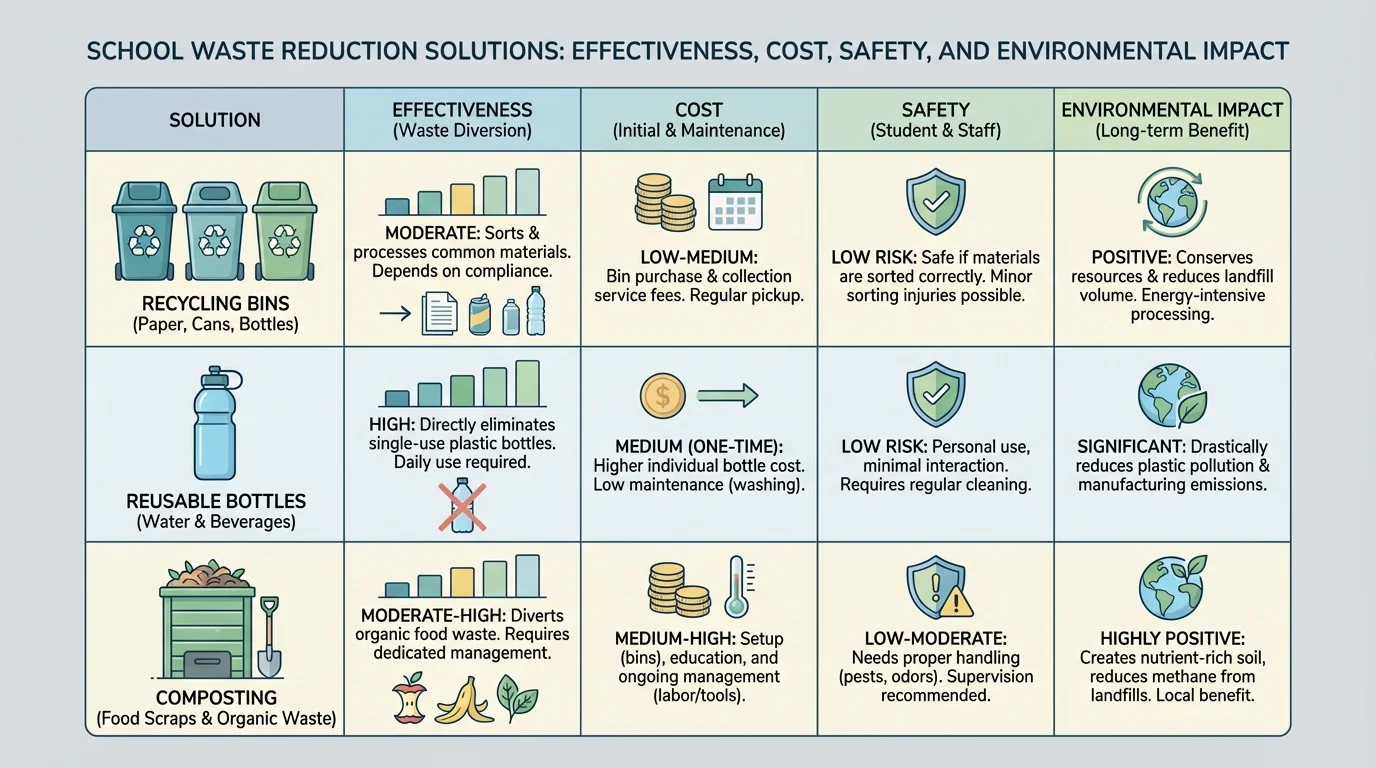
When a community understands a problem, it can begin to evaluate solutions. Communities compare choices using clear criteria, as [Figure 3] shows. A solution should be effective, safe, realistic, and helpful for the environment. Sometimes cost and time matter too.
Suppose a school wants to reduce lunch waste. Possible solutions might include adding recycling bins, starting a compost bucket for food scraps, or encouraging reusable water bottles and containers. Each solution has strengths and limits. Recycling bins are helpful only if students use them correctly. Composting helps with food waste but needs care and space. Reusable containers reduce waste but require family support and cleaning.
To evaluate solutions, compare them fairly. Ask: Which solution removes the most waste? Which is easiest to start? Which protects resources over time? Which fits our community's needs? The best solution is not always the fanciest one. It is the one that works well under real conditions.
Sometimes communities use more than one solution together. A town trying to protect a lake may plant grasses near shorelines, add trash cans in parks, and teach people not to dump waste into drains. A combination can be stronger than a single action.
Comparing solutions for saving water at school
A school wants to lower water waste in bathroom sinks.
Step 1: List possible solutions.
Options include fixing leaks, putting up reminder signs, and installing automatic faucets.
Step 2: Gather evidence.
A custodian reports that two sinks drip after use. A book about water conservation explains that leak repair saves water right away. A district website says automatic faucets can be expensive to install.
Step 3: Evaluate.
Fixing leaks may be the fastest and most direct first step. Reminder signs may help some students. Automatic faucets may help too, but cost more.
The evidence suggests starting with leak repair and then adding reminder signs if needed.
The decision chart in [Figure 3] helps show why evidence matters in design. You are not just picking your favorite idea. You are choosing based on criteria and information.
Actions in one part of a neighborhood can affect another part, as [Figure 4] illustrates with streets, drains, and a nearby creek. When rain falls on roofs and parking lots, water moves quickly across hard surfaces. It can pick up litter and carry it into storm drains that lead to streams.
A community that notices dirty water in a creek might gather information from a watershed map, local rainfall records, cleanup photos, and a park worker interview. The combined information may show that stormwater runoff carries trash and soil into the creek after heavy rain.
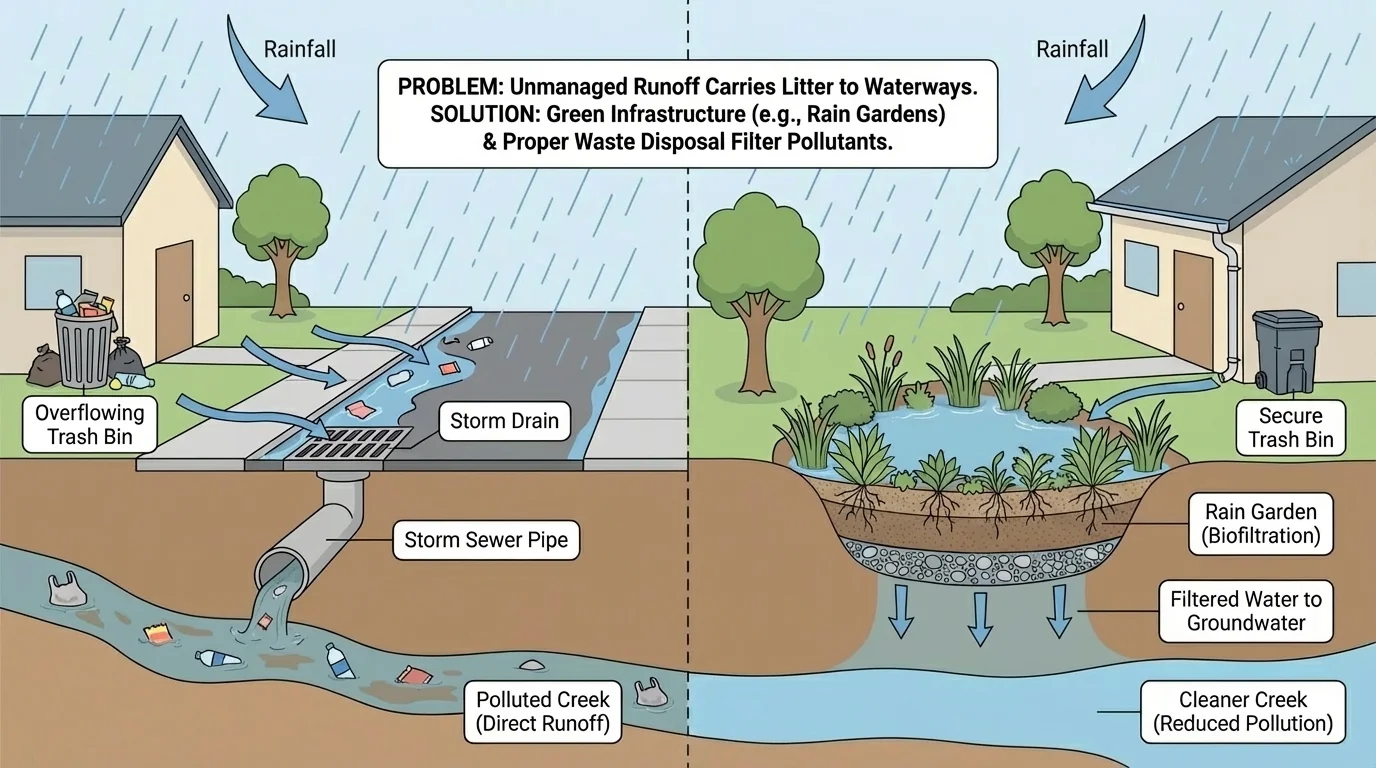
From there, the community can evaluate solutions. It might place more trash bins in busy areas, plant vegetation to hold soil, and build a rain garden that slows runoff. A rain garden is a planted area designed to catch and soak up rainwater. This helps less water rush directly into drains.
Another example is tree planting. If a schoolyard becomes very hot in summer, students can use books and weather information to learn how shade affects temperature and how trees help hold soil and support wildlife. They may compare native trees that need less water with trees that need more care. Then they can choose a tree-planting plan that best fits the place.
One mature tree can help in several ways at once. It can provide shade, slow rainwater, hold soil with roots, and offer habitat for living things such as birds and insects.
Plastic waste is another community problem. A town may use reports from waste services, photos of littered parks, and surveys of what people throw away. If much of the waste is single-use plastic bottles, a useful solution might include refill stations and reusable bottles instead of only adding more trash cans.
The neighborhood example in [Figure 4] shows an important idea: environmental problems are often connected. Water flow, land surfaces, trash, plants, and human choices all interact.
After choosing a solution, communities need to check whether it works. This means collecting evidence again. If a school adds recycling bins, it can observe whether less recyclable material ends up in the trash. If a town plants grass on a bare slope, it can watch whether muddy runoff decreases after rain.
Evidence can come from counting, measuring, observing, and comparing before and after. For example, a class may count the number of plastic bottles thrown away in one week before a refill station is installed and count again later. If the number drops, that is evidence the solution is helping.
Sometimes a solution works partly but not fully. Then people revise it. Maybe bins need clearer labels. Maybe signs should be placed closer to sinks. Maybe a rain garden needs a better location. Good problem solvers improve solutions over time.
Science and engineering work together
Science helps explain why a phenomenon happens. Engineering uses that understanding to design and improve solutions. When a community studies erosion, pollution, or waste, it often uses both science and engineering thinking.
This is why combining information is so powerful. Books can explain how a system works, local media can show what is happening now, and observations can reveal what the community still needs. When those parts are combined carefully, people can protect Earth's resources in smarter ways.
As you learn to use sources, keep asking yourself a few strong questions: What problem am I trying to explain or solve? Which sources are most reliable? What facts agree across several sources? What new understanding do I get when I combine these facts? Which solution best protects resources and the environment?
These questions help you move from simply finding information to truly using it. That is an important skill in science, engineering, and everyday life. Communities need people who can look carefully, think clearly, and choose solutions based on evidence.
