Have you ever struggled to carry too many books, open a hard lunch container, or keep your pencils from rolling off your desk? Those small struggles are not just annoying moments. They are clues. They can help us notice a problem that might be solved by making a new object or improving one we already have. Engineers often begin with ordinary problems from everyday life.
Engineering is about solving problems for people. Sometimes the solution is a machine, but often it is something much simpler: a handle that is easier to grip, a box that keeps food cold longer, or a tool that helps clean up faster. Before anyone builds a solution, they must first understand the problem clearly.
Problem means something that is difficult or does not work as well as it should.
Tool means an object used to help people do a job more easily.
Engineering is the work of designing and improving things to solve problems.
In science, people often ask questions to learn how the natural world works. In engineering, people also ask questions, but they ask them to define problems and create solutions. That means asking, "What is wrong?", "Who needs help?", and "What should a better object or tool do?"
A problem does not have to be huge to matter. A zipper that gets stuck is a problem. A backpack strap that hurts your shoulder is a problem. A watering can that spills too much water on a tiny plant is a problem. These are examples of everyday needs that could lead to better tools or objects.
When you notice a problem, do not jump too fast into making something. First, look carefully. What exactly is happening? When does it happen? Who is affected? A careful observer can see details that help create a smarter solution.
For example, suppose crayons keep breaking in a classroom. The problem may not be "we need a fancy crayon machine." The real problem might be that students press too hard, or that the crayon box does not protect them well. The best solution depends on the true cause of the problem.
Many inventions started with very ordinary problems. Even simple things like bandages, bottle caps, and paper clips were designed because someone noticed a small problem that needed a better solution.
That is why engineers pay attention to daily life. A simple problem can lead to a useful invention.
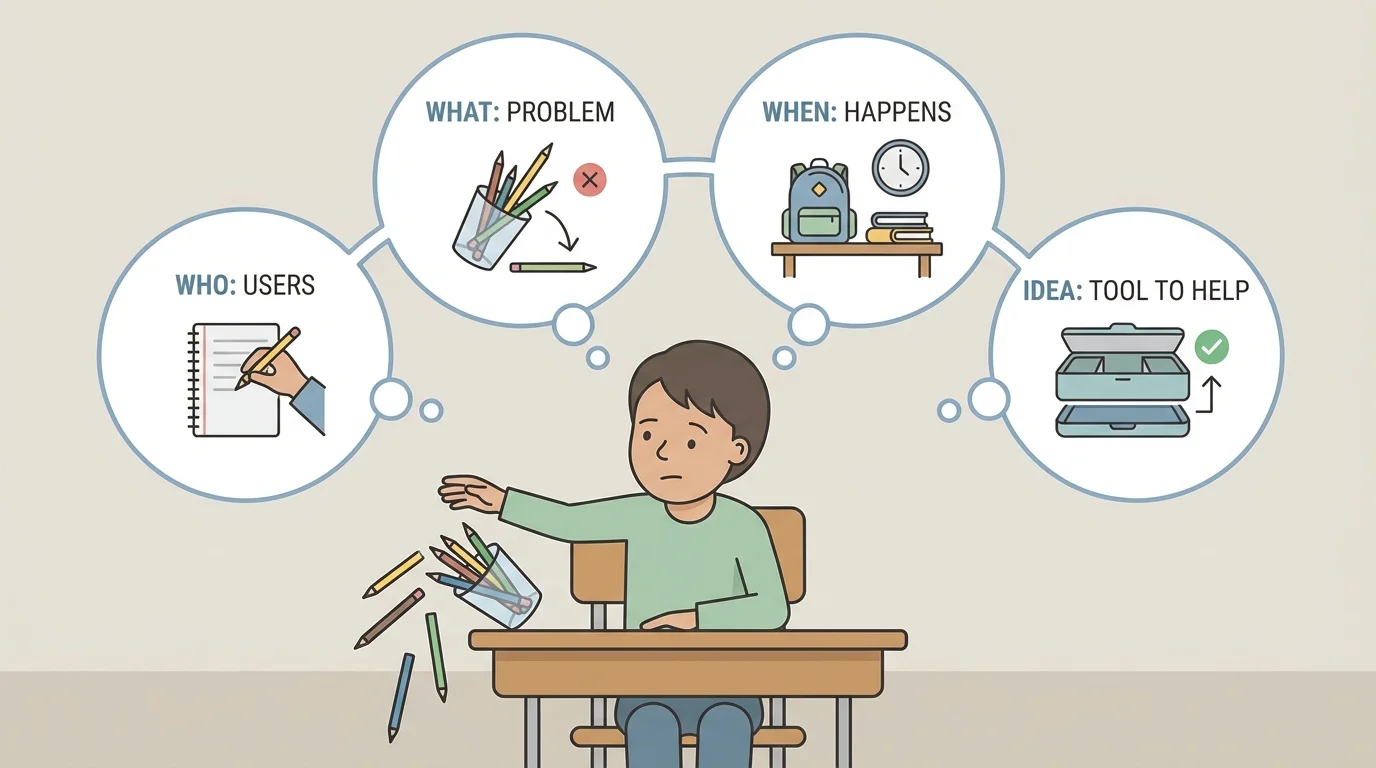
Engineers begin by observing and asking questions, as [Figure 1] shows with a common classroom problem. They do not start with glue, cardboard, or tools in their hands. They start with curiosity. Good questions help them understand the problem before they try to solve it.
Here are some important kinds of questions engineers ask:
Who has the problem? Is it a student, a teacher, a gardener, or a pet owner?
What is difficult? Is something too heavy, too slippery, too small, too messy, or too slow?
When does the problem happen? Does it happen every day, only outside, only at lunchtime, or only when it rains?
Where does it happen? In a classroom, on a playground, at home, or in a garden?
Why is it a problem? Does it waste time, cause a mess, make work harder, or create danger?
How might an object or tool help? Could it hold, lift, protect, organize, move, or measure something better?
Asking questions helps us gather information. This information is sometimes called criteria and constraints when we get more specific. Criteria tell what a solution should do well. Constraints tell what limits the solution must stay within.
Suppose a student says, "My water bottle keeps tipping over." An engineer might ask: Is the bottle too narrow? Is the desk crowded? Does it spill often? Does the student need a holder, a wider base, or a clip? The questions help define the problem clearly.
Later, when a person starts designing a solution, the early questions in [Figure 1] still matter. If the questions were weak, the solution may not fit the real need.
A simple problem is a problem that is clear, focused, and not too big to understand. It usually has one main need and can often be helped by one object or one improvement.
"Kids need better schools everywhere" is not a simple problem. It is too big and has many parts. But "students need a way to keep worksheets from blowing away when they work outside" is a simple problem. It is specific. We know who has the problem, what is happening, and what kind of help might work.
Simple problems are easier to solve because they are easier to define. They often have a clear user, a clear need, and a clear setting. That does not mean the solution is always easy, but it means the problem is understandable.
How engineers narrow a problem
When a problem feels too large, engineers make it smaller by focusing on one person, one place, or one need. Instead of solving every problem with backpacks, they might focus only on straps that slip off small shoulders. Narrowing the problem makes designing possible.
One useful way to check if a problem is simple is to ask, "Can I say the problem in one clear sentence?" If the answer is yes, you may have a simple problem that is ready for a tool or object solution.
Sometimes people get excited about making something before they know what need it will meet. They may say, "I want to build a robot," or "I want to invent a giant pencil case." But in engineering, the object is not the starting point. The need is.
Think about this difference:
Object-first thinking: "I want to make a new kind of chair."
Problem-first thinking: "Some students cannot reach the sink easily, so they need a safe step stool with a non-slip top."
The second idea is stronger because it begins with a real need. Once the need is clear, a person can decide whether the answer should be a stool, a platform, or some other helpful object.
This is why engineers talk about the need. A need is the help people require to solve a problem. The best designs match the need closely.
When scientists ask questions, they often want to explain something in nature. When engineers ask questions, they often want to solve a human problem. Both begin with careful observation.
If we focus only on making a cool-looking object, we may end up with something that does not help anyone very much. A good tool is useful, not just interesting.
A strong problem statement has clear parts. It explains who has the problem, what the problem is, and what kind of help is needed.
Here is a simple pattern for a problem statement, as [Figure 2] shows:
Someone needs a way to do something because something is difficult.
For example: "Students need a way to carry library books safely because the books can slip from their arms."
This sentence tells us the user, the need, and the problem. It does not yet tell us the exact solution. That is good. A problem statement should describe the problem clearly without locking us into only one answer.
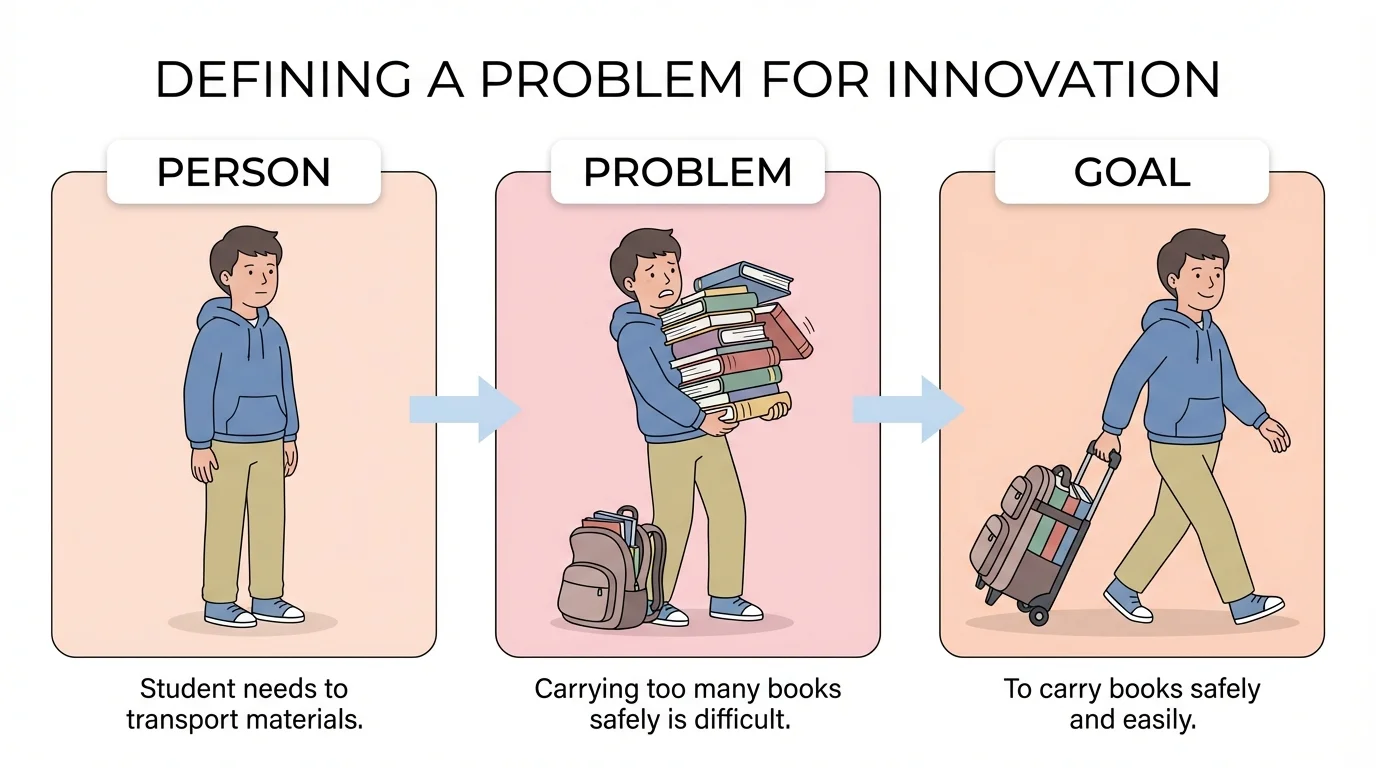
Here are the main parts again:
User: Who needs help?
Need or goal: What should the object or tool help the person do?
Problem: What is going wrong now?
You can also add the place or situation. For example: "Gardeners need a way to water tiny seedlings gently outdoors because large watering cans pour too much water at once."
When students define a problem, the clear structure helps them avoid vague ideas such as "make something better." Better for whom? Better in what way? Good problem statements answer those questions.
Some solutions involve a brand-new object. Other solutions improve something that already exists. Both kinds of engineering are important.
A solution may be a new tool or an improved one, and [Figure 3] compares these two ideas clearly. A new tool is created when there is no good object already doing the job. An improved tool changes an existing object so it works better.
New tool example: A plant-watering spike that slowly drips water into the soil while a family is away.
Improved tool example: A lunchbox with a lid that is easier for small hands to open and closes tightly so it does not leak.
New tool example: A reading finger guide that helps a student keep track of lines while reading.
Improved tool example: Scissors with softer grips for hands that get tired quickly.
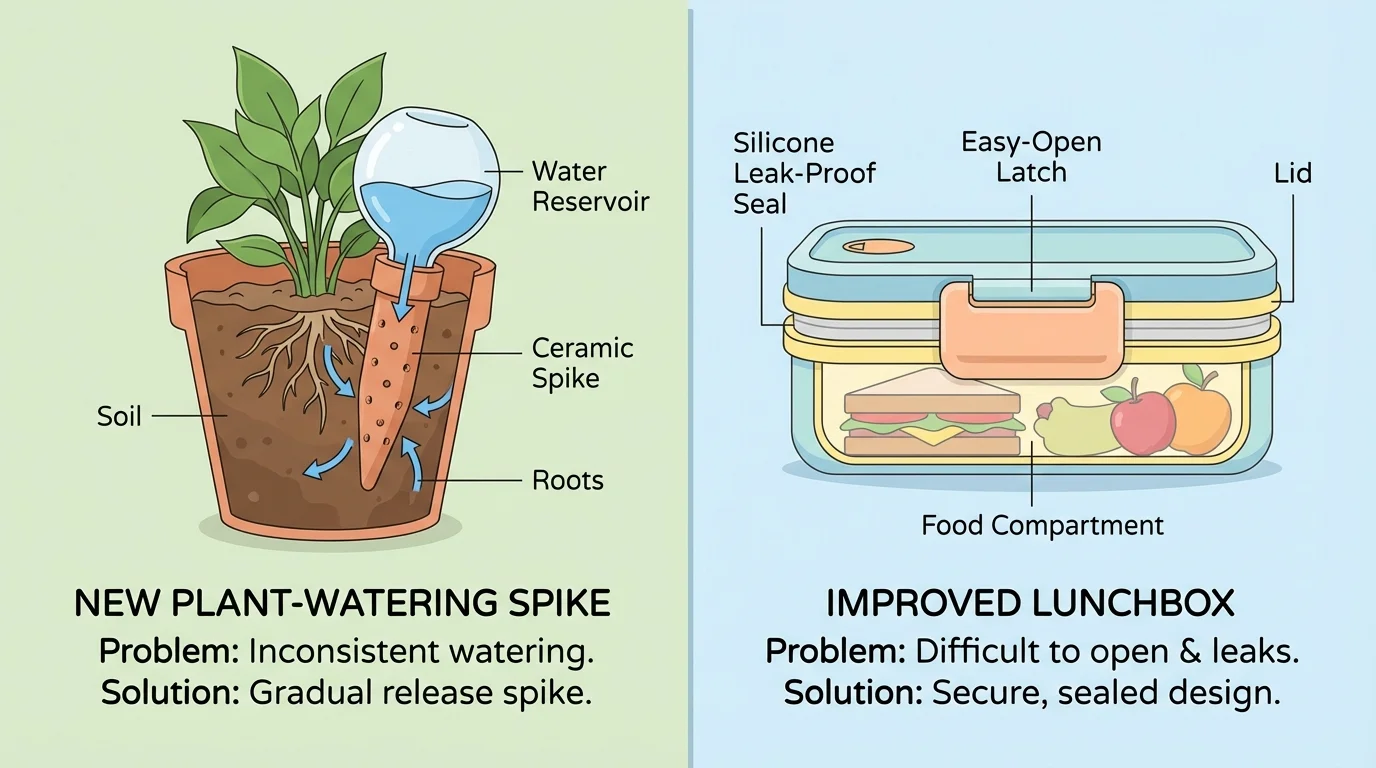
Notice that in each case, the design connects to a problem. Engineers do not improve things at random. They improve them for a reason.
When deciding whether a tool should be new or improved, ask these questions: Is there already something that almost works? If yes, improvement may be best. If nothing works well enough, a new object may be needed. That comparison helps show that both paths begin with the same first step: defining the problem.
Every good problem definition includes what the solution must do and what limits it must fit within. Engineers think about these before building.
Requirements are the jobs the object or tool must do. For example, a paper holder for outdoor classwork must keep pages from blowing away. A lunch container must hold food. A pencil organizer must stop pencils from rolling.
Limits are the boundaries. The object may need to be small enough for a desk, safe for children, easy to carry, or made from only certain materials. A design also might need to cost only a little money, such as less than $5, or be built in less than one class period.
These ideas are often organized like this:
| Type | What it tells us | Example |
|---|---|---|
| Requirement | What the tool must do | Hold papers in place |
| Requirement | What the tool must do | Be easy to open |
| Limit | What the design must stay within | Use only recycled materials |
| Limit | What the design must stay within | Fit inside a backpack pocket |
Table 1. Examples of requirements and limits for simple engineering problems.
If we do not know the requirements and limits, we may build something that works in one way but fails in another. A giant paper holder may stop pages from blowing away, but if it is too heavy for students to carry, it does not fully solve the problem.
Some of the best inventions come from working within limits. When materials, money, or space are limited, people often think more creatively and design smarter tools.
That is why engineers define the problem carefully before they design. They want the solution to work in the real world, not just in an idea.
Let us look at how observations and questions can turn into clear engineering problems.
Example 1: Rolling pencils
Observation: Pencils roll off desks during class.
Step 1: Ask questions.
Who has the problem? Students.
What happens? Pencils roll away and fall.
Why is it a problem? It wastes time and distracts students.
Step 2: Think about the need.
Students need a way to keep pencils from rolling off their desks.
Step 3: Write the problem statement.
Students need a way to keep pencils on their desks because round pencils roll away during class.
This problem might lead to a desk clip, a shallow tray, or a grooved pencil holder. Notice that the problem statement does not force only one answer.
Example 2: Hard-to-open snack bags
Observation: Some children cannot open snack bags by themselves.
Step 1: Ask questions.
Who has the problem? Children with small hands.
What is difficult? Gripping and tearing the bag.
Why is it a problem? It causes frustration and spills.
Step 2: Think about the need.
Children need a way to open snack packages more easily.
Step 3: Write the problem statement.
Children need a way to open snack bags easily because the packages are hard to grip and tear.
A solution might be a package opener, a new tab shape, or an improved bag design.
Example 3: Overwatering plants
Observation: Young plants get damaged when too much water is poured on them.
Step 1: Ask questions.
Who has the problem? Gardeners or students caring for class plants.
What is difficult? Pouring a small amount of water gently.
Why is it a problem? Strong water flow bends or harms tiny plants.
Step 2: Think about the need.
Gardeners need a way to water small plants gently.
Step 3: Write the problem statement.
Gardeners need a way to water tiny plants gently because large pours can damage them.
In each example, the process is similar: observe, ask questions, identify the need, and write a clear statement. This is how engineers define problems before making tools.
It can be tempting to race ahead and build the first idea that comes to mind. But if the problem is not clear, the design may miss the real need. A fast solution to the wrong problem is not very helpful.
For example, if books are hard to carry, someone might design a bigger bag. But what if the real issue is that the bag straps cut into the shoulders? Then the better solution may be padded straps, not a bigger bag. Careful problem definition saves time and leads to better designs.
Defining a problem also helps people work together. When everyone understands the same need, they can compare ideas fairly. They can ask, "Which design solves the problem best?" instead of just, "Which design looks coolest?"
This habit is useful far beyond school. People who invent sports equipment, kitchen tools, classroom supplies, and medical devices all begin by understanding a need clearly. Even a very small improvement can make daily life easier for many people.
"A good solution starts with a clear problem."
When you define a simple problem well, you are already doing an important part of engineering. You are noticing needs, asking strong questions, and preparing for a thoughtful solution.
