Why can one place be rainy almost every day while another stays dry for months? Why do some animals have thick fur, while others have smooth skin or feathers? Nature may seem full of surprises, but it also has many repeating patterns. When scientists notice what is alike and what is different, they can sort and classify the world around them. This helps people understand weather, climates, landforms, plants, and animals.
A pattern is something that repeats or happens in a way we can notice. A pattern might happen every day, every season, or over many years. The Sun rises in the east each morning. Winter is colder than summer in many places. Some birds migrate when the seasons change. These are all patterns in nature.
Patterns help us make sense of big amounts of information. If a place is usually hot and rainy, we start to expect certain plants there, such as tall trees and many green leaves. If a place is usually cold, we expect different plants and animals. Scientists look for patterns because patterns help them organize what they observe.
Pattern means something that repeats or can be described in a regular way. Classify means to sort things into groups based on shared features. Climate is the usual pattern of weather in a place over a long time.
Weather and climate are related, but they are not the same. Weather is what the air is like right now or over a short time. It can be sunny today and rainy tomorrow. Climate is the bigger pattern over many years. If a place is often rainy year after year, that is part of its climate.
People in different parts of the world live in very different climates, and those climates can be grouped by similarities, as [Figure 1] shows. Some regions are warm all year. Some have four seasons. Some are very dry. Some are very cold for most of the year. By comparing these long-term weather patterns, scientists can classify places into climate regions.
One important climate region is the tropical climate. Tropical regions are usually near the equator. They are warm all year and often get a lot of rain. Rain forests are found in many tropical regions. The Amazon in South America is one example. In places like this, plants grow thick and tall because warmth and rain are common.
Another climate region is the desert. Deserts are very dry and get little rain. Some deserts are hot, like the Sahara in Africa. Others can be cold. Cactus plants in hot deserts have special ways to store water. Since dry conditions are a pattern there, living things in deserts often have traits that help them survive with less water.
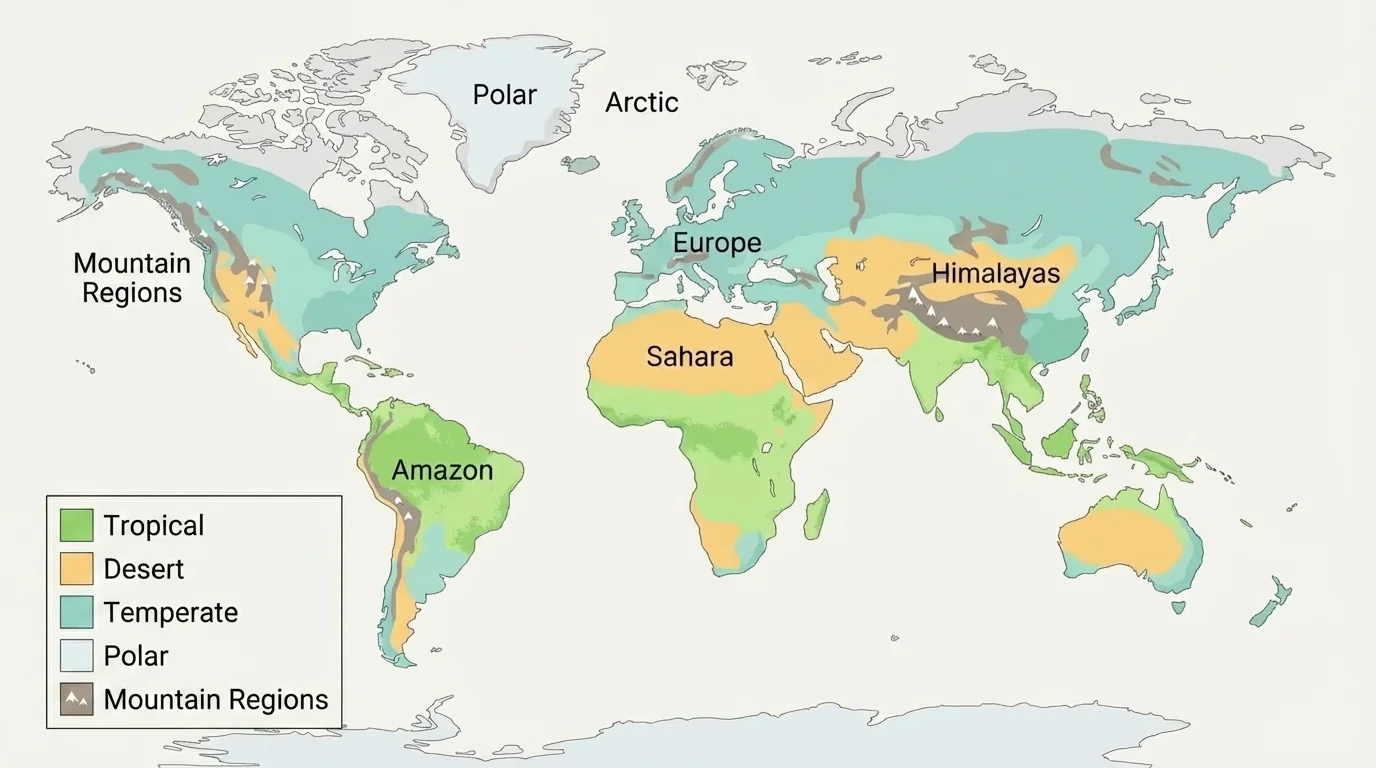
A temperate climate often has seasons such as spring, summer, autumn, and winter. Many parts of North America, Europe, and Asia have temperate climates. These places are not extremely hot or extremely cold for the whole year. Instead, the weather changes with the seasons in a regular pattern.
A polar climate is very cold for most of the year. Polar regions are near the North Pole and South Pole. They get less direct sunlight, so temperatures stay low. Ice and snow are common. Animals there, such as polar bears in the Arctic, have body features that help them stay warm.
Mountain regions are also special. As you go higher up a mountain, the air usually gets cooler. This means a mountain can have different climate patterns from bottom to top. At the base, trees may grow well. Higher up, fewer plants grow, and snow may stay longer.
Scientists do not sort climate regions randomly. They look at patterns in temperature, rainfall, wind, and seasons. They compare which places are similar and which are different. That is how regions can be classified. Looking again at [Figure 1], we can see that places far apart on Earth may still belong to the same kind of climate region if their long-term weather patterns are alike.
Some deserts can be very cold at night even after a hot day. Dry air does not hold heat as well, so temperatures can change a lot.
These patterns matter in everyday life. People wear different clothes in different climates. Houses are built differently too. In very cold places, homes may have thick walls and strong heating. In hot, rainy places, buildings may have roofs designed to let water run off quickly.
Sorting means putting things into groups. Classifying means grouping things using rules based on important features. We do this all the time. We sort laundry by color. We classify books by topic. Scientists do something similar with nature.
For example, if we observe several places and write down whether they are hot or cold, wet or dry, and whether they have strong seasons, we can group them into climate categories. A place that is hot and rainy most months may fit into one group. A place that is cold and icy most of the year may fit into another. The groups are based on patterns, not guesses.
Natural phenomena are things that happen in nature. Rainstorms, droughts, snow, seasons, ocean waves, plant growth, and animal traits are all natural phenomena. Some natural phenomena happen quickly, like a thunderstorm. Others happen over a long time, like the climate of a region.
Classifying three places by climate patterns
Suppose we observe three regions over many years.
Step 1: Region A is warm most of the year and gets lots of rain.
Step 2: Region B gets very little rain and is dry most of the time.
Step 3: Region C has cold winters, warm summers, and clear seasonal changes.
We can classify Region A as tropical, Region B as desert, and Region C as temperate because each one matches a different long-term weather pattern.
Classification helps us compare. It also helps us notice exceptions. If one desert gets more rain than expected one year, scientists know that year is different from the usual pattern. They can then ask why.
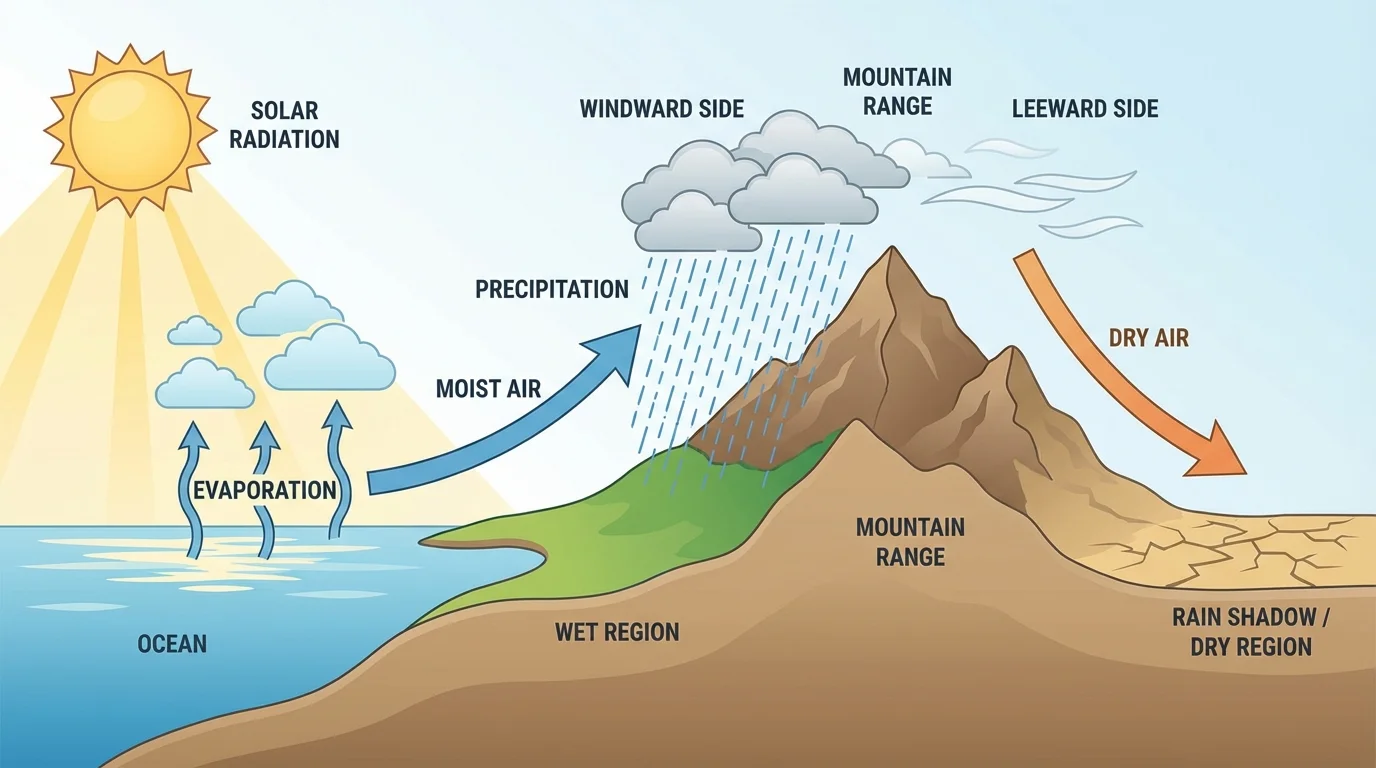
Climate is not caused by just one thing. It comes from connected parts of Earth's systems, as [Figure 2] illustrates. Earth's systems include the air, water, land, and living things. Sunlight powers many of the changes in these systems.
The amount of sunlight a place gets affects its climate. Regions near the equator receive more direct sunlight, so they are often warmer. Regions closer to the poles get less direct sunlight, so they are colder. This is one major reason why climate patterns differ across the world.
Water also affects climate. Large oceans and lakes can make nearby land less extreme in temperature. Water heats and cools more slowly than land. That means a coastal place may have milder temperatures than a place far inland. Water in the air also matters because it can form clouds and rain.
Mountains can change climate patterns too. On one side of a mountain, air may rise, cool, and drop rain. On the other side, the air may be drier. This can lead to very different conditions over short distances. A mountain region can create wet forests on one side and dry land on the other.
Wind is another part of the pattern. Moving air carries heat and moisture from one place to another. Over oceans, winds can help move warm or cool air. This affects where rain falls and how temperatures feel.
Because Earth's systems work together, climate patterns are connected. Land, water, air, and sunlight do not act alone. Scientists combine information from many observations to describe a region's climate clearly.
How connected systems create climate patterns
Sunlight warms Earth unevenly. Air and water move that heat around. Land shapes where air rises or sinks. Mountains can block moist air, and oceans can add moisture. When these effects repeat over long periods, a region develops a climate pattern.
People use this knowledge in real life. Farmers choose crops that match local climate patterns. Builders choose materials that work well in local weather. Travelers pack differently for polar, desert, or tropical regions because climate patterns help predict what conditions are likely.
Patterns are not only found in weather and climate. They are also found in living things. Scientists sort plants and animals by shared traits, as [Figure 3] shows. A trait is a feature of a living thing, such as fur color, leaf shape, or beak size.
Some traits are inherited, which means they are passed from parents to offspring. A puppy may have fur color similar to its parents. A sunflower plant may produce seeds that grow into sunflowers like the parent plant. Shared inherited traits can help scientists classify living things into groups.
At the same time, there are differences within a group. Not all dogs look the same. Not all oak leaves are exactly alike. Similarities help us see that organisms belong to a group, while differences help us notice variety inside the group.
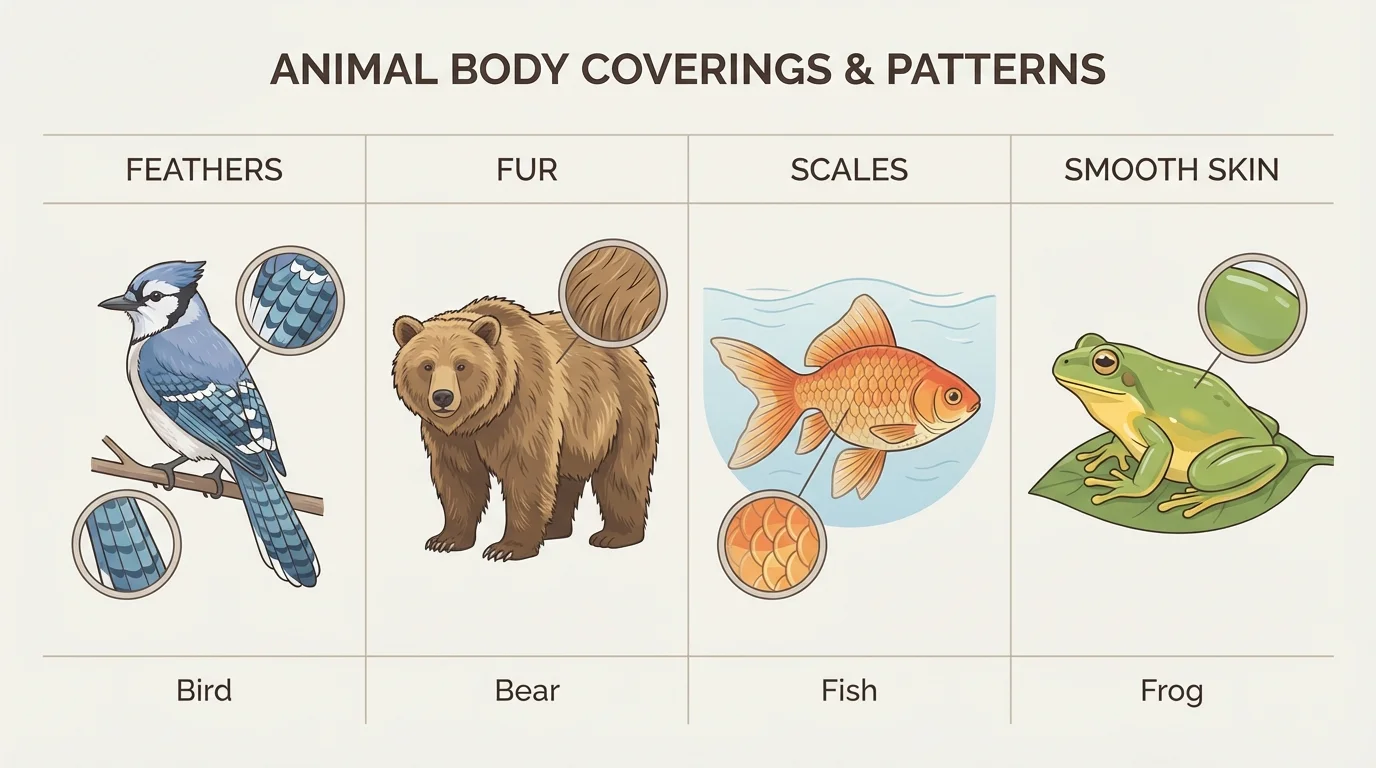
Animals can be sorted by body covering, number of legs, how they move, or where they live. Plants can be sorted by flower type, seed type, leaf shape, or stem type. Looking at [Figure 3], we can see that one useful pattern is body covering. Feathers, fur, scales, and smooth skin are differences that help classify animals.
Living things need food, water, air, and a place to live. They also have life cycles and traits. Those ideas help us understand why certain plants and animals are found in certain climates.
Climate patterns and living things are connected. In cold climates, animals may have thick fur or layers of fat. In dry climates, plants may have waxy surfaces or deep roots. These traits do not appear by accident in our sorting system. They are clues that help us understand how living things fit into their environments.
When scientists compare natural phenomena, they ask useful questions. Does it happen often or rarely? Is it hot or cold, wet or dry, fast or slow? Does it repeat in a cycle? These questions help reveal patterns.
Seasons are a good example. In many temperate regions, spring brings new growth, summer is warmer, autumn brings leaf color changes, and winter is colder. This repeating yearly cycle is a pattern. Because the pattern repeats, scientists can classify temperate regions by their clear seasons.
Rainfall is another example. If one place gets heavy rain in many months each year, while another place stays dry most of the time, those places belong in different climate groups. The difference is not just one rainy day or one dry week. It is the repeated pattern over time.
| Natural phenomenon | Pattern to observe | How it helps classify |
|---|---|---|
| Climate | Temperature and rainfall over many years | Groups places as tropical, desert, temperate, polar, or mountain |
| Seasons | Yearly changes in temperature and daylight | Shows whether a region has strong seasonal cycles |
| Animals | Body covering, body parts, and traits | Groups animals by shared features |
| Plants | Leaf shape, flowers, seeds, and stems | Groups plants by shared structures |
Table 1. Examples of natural phenomena, the patterns scientists observe, and how those patterns help with classification.
Scientists must be careful when they classify. One feature alone may not be enough. For example, a place can be hot but still not be tropical if it is very dry. That is why scientists combine information from many observations before deciding how to group something.
Classification is useful because it helps people make predictions. If you know a region has a desert climate, you can predict that water may be limited. If you know a region has cold winters, you can predict the need for warm clothing and heating.
Classification also helps scientists share information clearly. If one scientist says a place has a polar climate, other scientists already understand many of its usual weather patterns. If a biologist says an animal has feathers, that trait helps place it in a certain group.
Real-world example: choosing crops
A farmer wants to plant crops in two different places.
Step 1: The farmer studies climate patterns in each place.
Step 2: One place is warm and rainy for much of the year, while the other is dry.
Step 3: The farmer chooses crops that grow well in each climate instead of planting the same crop everywhere.
Using climate classification helps the farmer make better decisions and protect crops.
Safety depends on pattern recognition too. Communities that know they have rainy seasons or snowy winters can prepare roads, clothing, and supplies. People who understand climate patterns can plan ahead instead of being surprised by conditions that happen again and again.
"The more clearly we notice patterns, the better we understand the natural world."
Nature is full of variety, but it is not random. Similarities and differences give us clues. Those clues help us sort, compare, and classify the world. From climates across the globe to traits in living things, patterns are one of the most important tools scientists use to understand Earth.
